

Otoguro, Susaki avoid carnage to secure tickets to Belgrade
Sunday, June 18, 2023 - 16:31 By Ken Marantz

TOKYO (June 18) -- Japanese stars Takuto OTOGURO and Yui SUSAKI managed to avoid the carnage that all but knocked their fellow Tokyo Olympic champions out of the running for a repeat in Paris.
Otoguro overcame a severe right foot injury to take the freestyle 65kg title, and Susaki withstood a late flurry to triumph at women's 50kg at the Meiji Cup All-Japan Invitational Championships on Sunday, the final day of the four-day tournament at Tokyo Metropolitan Gym.
With their victories, both Otoguro and Susaki clinched places on Japan's team to this year's World Championships in Belgrade, where they will have their first chance to secure a place at the 2024 Paris Olympics by winning a medal.
"I knew that leading up to the Olympics the matches would be tough, so I'm happy that I was able to win them one by one," said Otoguro, who defeated Ryoma ANRAKU 9-0 in a match that was far closer than the score indicates.
The Meiji Cup was the second of Japan's domestic qualifiers for the Belgrade worlds, combined with the Emperor's Cup All-Japan Championships held last December. A victory at both in an Olympic weight class assures a ticket to Belgrade; if the champions are different, the two will face each other in a playoff on July 1.
Both Otoguro and Susaki repeated victories in the Emperor's Cup finals against the same opponents on Sunday.
 Takuto OTOGURO defeated Ryoma ANRAKU 9-0 in the 65kg final. (Photo: Japan Wrestling Federation / Takeo Yabuki)
Otoguro, who had been unable to walk off the mat under his own power after his semifinal win on Saturday, had considered defaulting to Anraku and letting the world team spot come down to a playoff but opted to go for it upon consultation with his coaches.
"Talking it over with my coaches, they said it would be a good experience to win amid such adversity, and instead of a playoff, we should get it done now," said Otoguro, who would not reveal details of the injury, only to say it was "serious."
Otoguro, seemingly hesitant to attack, scored the bulk of his points with defensive counter moves in the final minute of the match, in which he had been given a 2-0 lead with a pair of activity points.
Otoguro was himself on the clock when Anraku got in deep on a single leg, but Otoguro perfectly timed a counter-lift for 2, then went back the other way for 2 more. An unsuccessful challenge added a point, then Otoguro got a takedown in the final seconds off a desperation shot by Anraku.
"There wasn't anything particularly bad, but I'm not really satisfied," Otoguro said of his performance. "The good things were few."
Since winning the gold at Makuhari Messe in 2021, Otoguro's lone competition was at the Emperor's Cup, which he won with a 4-0 victory over Anraku.
A 2022 world U23 bronze medalist, Anraku won a bronze at this year's Asian Championships in Astana that Otoguro had planned to enter, but pulled out after suffering his foot injury at a training camp in January.
Otoguro's main focus over the next three months is to prepare for Belgrade, where he will aim to secure his ticket to Paris by regaining the title he won in 2018, which made him at 19 years 10 months Japan's youngest-ever male world champion.
The Japan Wrestling Federation has decreed that any wrestler winning a medal in an Olympic weight class in Belgrade will automatically fill the spot themselves at the Paris Olympics, without going through any further qualifying process.
"First of all, I have to get healthy, then at the World Championships gain the Olympic spot, then aim for the gold in Paris," said the 26-year-old Otoguro.
 Yui SUSAKI managed to roll over Remina YOSHIMOTO from here to score the winning points in the 50kg final. (Photo: Japan Wrestling Federation / Takeo Yabuki)
Susaki secured her ticket back to Belgrade, where she won a third career world title last year, with a 4-3 victory over rival Remina YOSHIMOTO that wasn't decided until a challenge sorted out the points from a flurry in the final seconds.
"This was a tournament for contending for [places at] the World Championships and subsequently Paris, and I came into it determined to win," Susaki said. "The final did not go very well, but I was able to win and get to the World Championships, so it was good that I cleared that task."
Like Otoguro, Susaki had received an activity point in each period before being put on the activity clock, although the time ran out on her, leaving her with a 2-1 lead.
With 20 seconds left, Yoshimoto got in on a single leg, which Susaki defended by slipping the side and reaching over for the far leg, attempting a counter lift. Yoshimoto went with the lift and charged over the top, putting Susaki onto her back with :06 on the clock. But in the final one second, Susaki managed to finish off the roll.
The original call was 2 for Susaki; the challenge awarded 2 to each wrestler, still leaving Yoshimoto on the short end and giving Susaki her sixth win in six career meetings between the two.
"I knew she would do her homework on me," Susaki said of Yoshimoto, who won the 2021 world gold while Susaki was on a post-Olympic hiatus. "In the final, she got in on a tackle and my response was not enough and made things difficult for me.
"I have to practice to be able to take advantage of opportunities that come my way."
Like Otoguro, Susaki had a health issue on Saturday, when she suddenly cut short her post-match press conference after one question without disclosing the reason. "I'm sorry, I wasn't feeling well," she said, adding that it had no effect on her performance on Sunday.
The Japanese women in particular realize the importance of getting to this year's World Championships, as there is a high likelihood that those who go to Belgrade in the Olympic weights will win a medal, meaning there will be no future chances for others.
At the 2019 World Championships, Japan's women medaled in four of the six Olympic divisions, and Susaki knows personally the anxiety of leaving one's fate in other hands.
Susaki ended up at the Tokyo Olympics only because Yuki IRIE shockingly failed to medal at 50kg in Nur-Sultan, and Susaki took full advantage of the second chance. She doesn't plan to let her chance slip away in Belgrade.
"I didn't get to the Tokyo Olympics solely on my own power," Susaki said. "For Paris, I want to control my own fate and get there and win the gold."
Waiting in the wings for another chance -- however slim -- will be Tokyo Olympic gold medalists Mayu SHIDOCHI (formerly MUKAIDA), Risako KINJO (formerly KAWAI) and Yukako KAWAI.
All three suffered losses over the four-day tournament to eliminate them from contention for places on the world team, meaning their only hopes for Paris lie in the representative in Belgrade failing to make the podium.
And even after that, they would have to earn a place on Japan's team for the Asian or world Olympic qualifiers in 2024, most likely with victories at this year's Emperor's Cup, no small task in itself.
 Tsugumi SAKURAI scores a takedown against Sae NANJO in the 57kg final. (Photo: Japan Wrestling Federation / Takeo Yabuki)
Sakurai upends Nanjo
For the third time in four matches between the two, world champion Tsugumi SAKURAI pulled off a last-second victory over world U23 champion Sae NANJO, giving her the women's 57kg title and setting up another clash in the July 1 playoff.
"The result was a victory, but I was nervous and I wasn't able to put into practice what I've done in training," said Sakurai, who ousted Kinjo in the semifinals on Saturday. "If I go on like this, two weeks from now, I will lose again. First, I have to reflect on today's match."
Sakurai was awarded a takedown with less than a second left on the clock, and the call was upheld on a challenge for a 5-2 victory over the Emperor's Cup champion.
Sakurai had opened the match with a go-behind takedown, to which Nanjo responded with a single-leg takedown to lead 2-2 on criteria going into the second period.
With a half-minute left, Sakurai got in on a single leg, and fought to get behind as Nanjo kept a firm clamp on Sakurai's right arm as the seconds ticked off. With the clock at 0.48, the referee was finally convinced and gave Sakurai the 2, and the challenge confirmed the points.
"I was running out of steam," Sakurai said. "There was a time when I was injured and couldn't train. But I knew that if I didn't do something, I would lose. I knew if I lost here, I wouldn't go to the Olympics. It would be a loss that I would always regret."
At the Emperor's Cup, Nanjo had finally gotten the best of Sakurai by taking a five-point lead and holding on for a 5-4 win in the semifinals. That had avenged last-second losses to Sakurai at both the 2021 Emperor’s Cup and last year's Meiji Cup.
 Maito KAWANA scored thrilling 5-4 win to win the Grec-Roman 60kg gold medal at the Meiji Cup. (Photo: Japan Wrestling Federation / Takeo Yabuki)
In the other Olympic weight class up for grabs, Asian bronze medalist Maito KAWANA won a 5-4 thriller in the Greco 60kg final over Kaito INABA, earning him a place in a playoff against Tokyo Olympic silver medalist Kenichiro FUMITA.
Kawana, who was trailing 4-4 on criteria, forced a stepout with :36 left to secure the victory and set up a rematch of his 6-0 loss to Fumita in the Emperor's Cup final.
Fumita, the 2017 and 2019 world champion, withdrew from the tournament due to a torn hamstring suffered in practice. He wrote on Twitter that he would do his utmost to recover in time for the playoff.
At freestyle 61kg, Rin SAKAMOTO of Tokyo's Jiyugaoka Gakuen High School defeated collegian Hayato FUJITA 6-2 in the final, making him just the second high schooler in the history of the Meiji Cup to win a freestyle title since the tournament was started in 1997.
Day 3 Results
Freestyle
61kg (14 entries)
GOLD - Rin SAKAMOTO df. Hayato FUJITA, 6-2
BRONZE - Kaito MORITA df. Takumi YOSHIMURA, 7-2
BRONZE - Kosei IDE df. Fuga SASAKI, 5-2
Semifinal - Rin SAKAMOTO df. Kaito MORITA, 9-4
Semifinal - Hayato FUJITA df. Fuga SASAKI by TF, 14-4, 3:19
65kg (9 entries)
GOLD - Takuto OTOGURO df. Ryoma ANRAKU, 9-0
BRONZE - Kaiki YAMAGUCHI df. Kaiji OGINO, 6-0
BRONZE - Kaito MORIKAWA df. Makoto HOSOKAWA, 10-2
Greco-Roman
60kg (11 entries)
GOLD - Maito KAWANA df. Kaito INABA, 5-4
BRONZE - Yu SHIOTANI df. Ayata SUZUKI by Def.
BRONZE - Kosei TAKESHITA df. Koto GOMI by TF, 9-0, 2:12
72kg (11 entries)
GOLD - Shingo HARADA df. Yuga KASUGAI by TF, 10-0, 2:00
BRONZE - Hajime KIKUTA df. Seiya TERADA by TF, 11-0, :55
BRONZE - Tomohiro INOUE df. Takahiro YAMAMOTO, 5-1
Semifinal - Yuga KASUGAI df. Hajime KIKUTA, 10-6
Semifinal - Shingo HARADA df. Tomohiro INOUE, 5-3
Women
50kg (13 entries)
GOLD - Yui SUSAKI df. Remina YOSHIMOTO, 4-3
BRONZE - Umi ITO df. Riko KASAI by TF, 10-0, 4:53
BRONZE - Miyu NAKAMURA df. Miu OBATA, 8-3
57kg (13 entries)
GOLD - Tsugumi SAKURAI df. Sae NANJO, 5-2
BRONZE - Umi IMAI df. Hana KIKUTA by TF, 11-0, 3:57
BRONZE - Sara NATAMI df. Risako KINJO by Def.

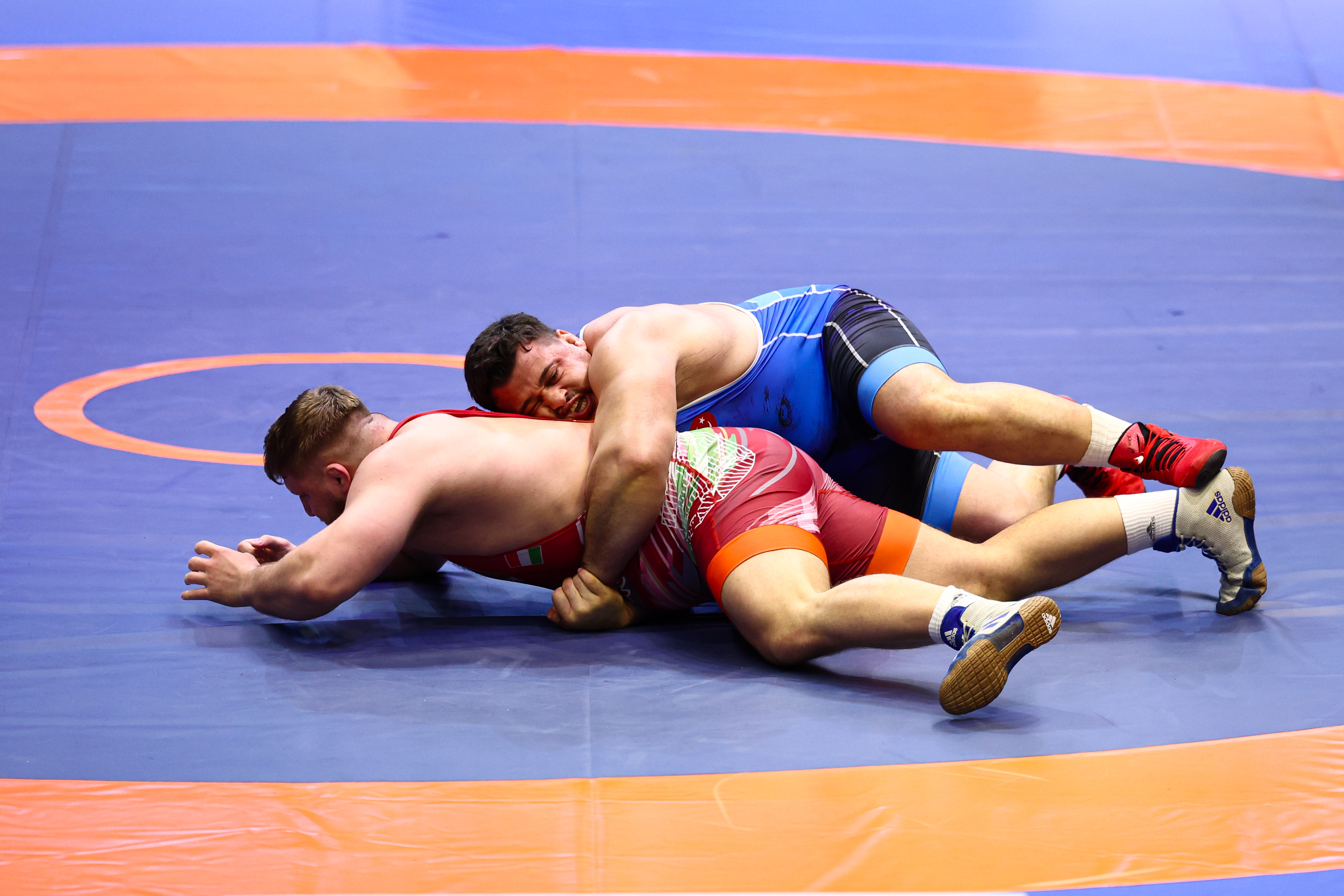 Riza KAYAALP (TUR) turns Darius VITEK (HUN) in the 130kg final. (Photo: United World Wrestling / Kadir Caliskan)
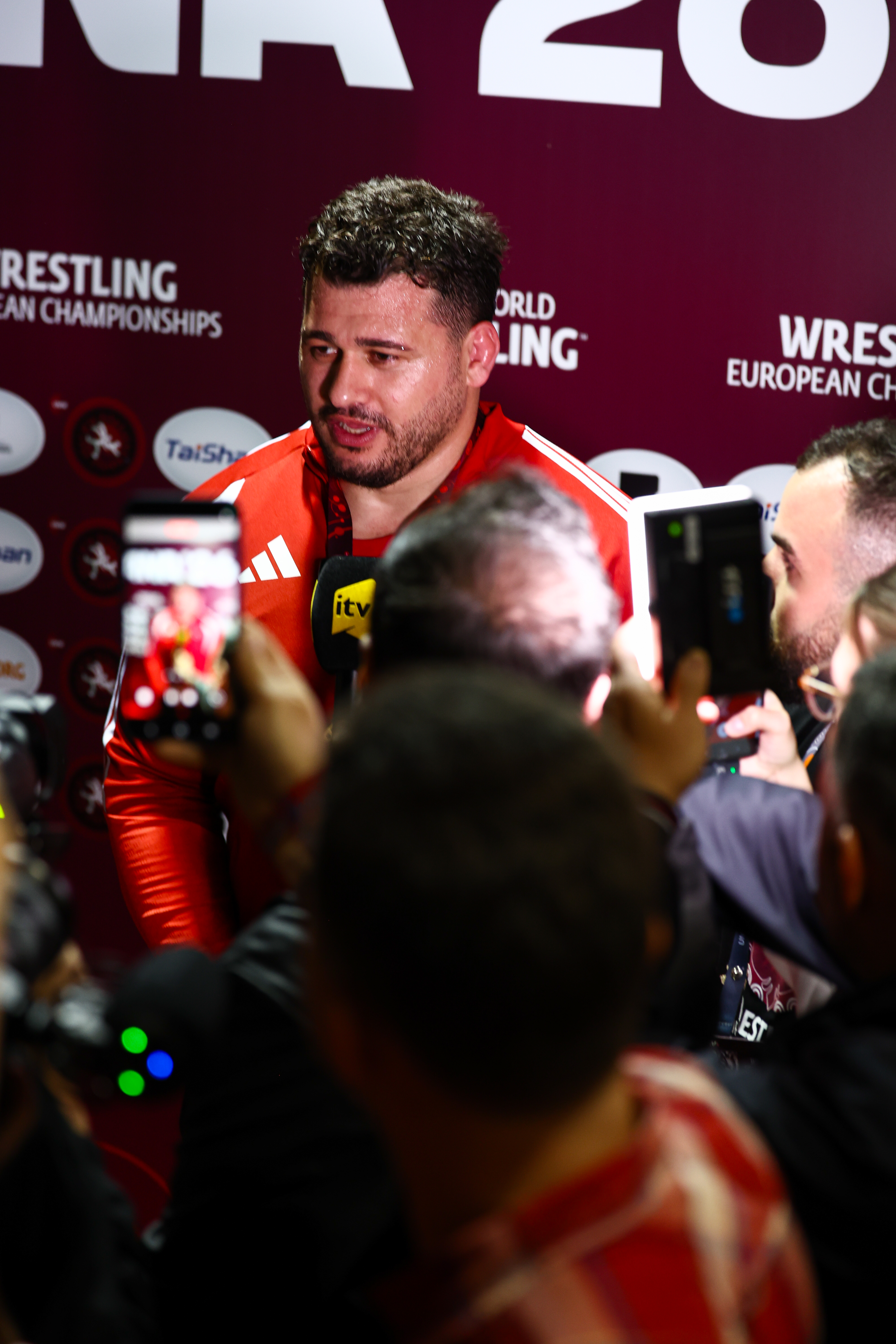 Riza KAYAALP (TUR) speaks to the media after winning the gold medal at the European Championships. (United World Wrestling / Jake Kirkman)
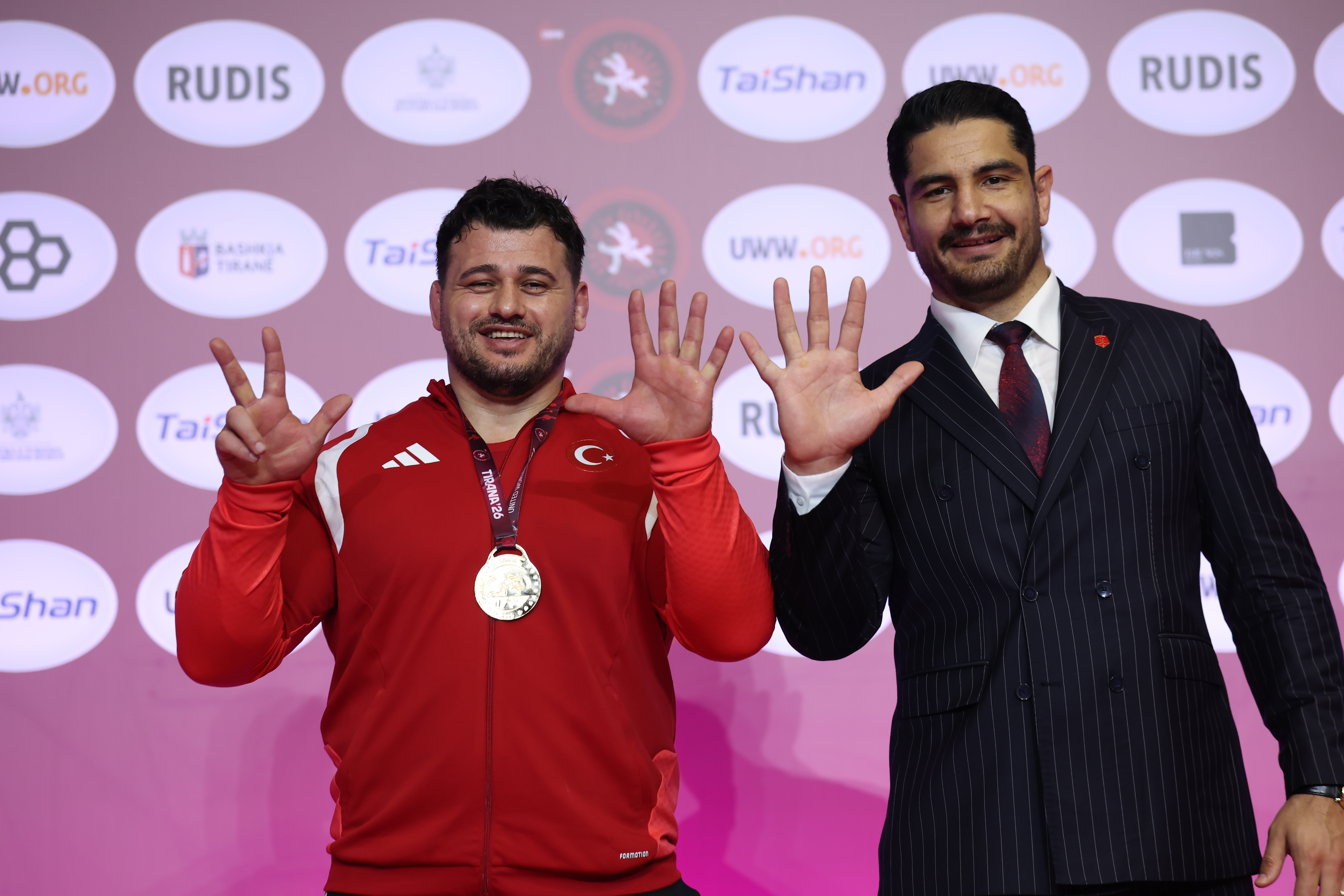 Riza KAYAALP (TUR) with Taha AKGUL (TUR) at the medal ceremony in Tirana. (Photo: United World Wrestling / Kadir Caliskan)
Share your thoughts.
Comments