BISHKEK, Kyrgyzstan (April 8) -- Yui SUSAKI (JPN) may have been away from the mat for over 20 months but she showed no signs of rust as she reached the Asian Championships final at 50kg in Bishkek on Wednesday.
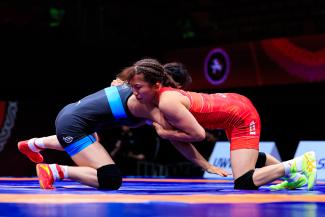
With two falls and a technical superiority win, it was vintage Susaki as she did not give up a single point in the three bouts. First up was Ziqi FENG (CHN), a fellow bronze medalist from 2024 Paris Olympics, and Susaki blocked an arm-spin attempt from Feng to score two points. As Feng landed on her back, Susaki kept her in the same position to secure the first fall.
NEELAM (IND) tried to challenge Susaki a few times in the quarterfinals but her attempted front headlock counters did not work and Susaki scored an 11-0 technical superiority win in 2:51. The semifinal was a similar story as Susaki pinned Maral TANGIRBERGENOVA (KAZ) in just two minutes.
Susaki scored a go-behind to open the scoring before a gut-wrench turn gave her a 4-0 lead. A sweep-single to takedown made it 6-0, and Susaki continued the sequence into an arm-bar to secure the fall.
"This is my first official UWW tournament in one year and eight months and I'm really happy to be back on this stage, and I'm filled with gratitude," Susaki said. "In my three matches, I was able to put out what I did in practice. Looking ahead to tomorrow's final, I think they were good matches."
The theme of the final will also be vintage as Susaki faces an opponent she last wrestled nine years ago. She will take on Son Hyang KIM (PRK) for the gold medal bout, a wrestler Susaki defeated 10-0 to win her first Asian gold aged 18 in 2017.
While she is focused on winning the gold medal on Thursday, Susaki is treating the Asian Championships as the launch pad for a newer version of herself.
"I'm here to start toward winning this year's World Championships and Asian Games, and then the Los Angeles Olympics. To face the DPR Korean and firmly win would establish my presence to the world," she said.
The new Susaki also includes a improved weight management, an issue she struggled with in the past. After the Paris Olympics, Susaki gave considerable thought to moving up to 53kg but as the 2025 Emperor's Cup approached in December, she decided to remain at 50kg, a weight in which she won Olympic gold in Tokyo.
"It's my first time to get down to 50kg overseas since the Paris Olympics," she said. "Since then, I've made some changes to my diet, and it was really smooth this time and I was able to maintain my strength. I could keep eating while dropping weight, so my condition is very good."
Susaki will have a chance to win her third Asian title on Thursday when she takes on Kim.
A former world bronze medalist, Kim wrestled Aktenge KEUNIMJAEVA (UZB) in the other semifinal and scored an early takedown to open the scoring. She used a lace lock and twisted the Uzbekistan wrestler over three times for an 8-0 lead before the match hit the minute mark.
But Keunimjaeva, a three-time Asian bronze medalist, did not go down meekly, as she used a whizzer for a 4-point takedown at the edge to cut the lead in half before the break. Kim opened the second period with a duck under to a double-leg takedown to make it 10-4.
Two years ago in the Asian Olympic qualifying tournament in Bishkek, Keunimjaeva pulled off a miracle late comeback to beat Kim, and she nearly did it again. Locking Kim's arms, Keunimjaeva muscled Kim directly to her back for a 4-pointer in the last 20 seconds. But she failed to get the fall, and Kim got a late exposure for a 12-8 win.
In other semifinals, local stars Aiperi MEDET KYZY (KGZ) and Meerim ZHUMANAZAROVA (KGZ) both made it to gold medal bouts at 76kg and 68kg respectively.
After her close call in the quarterfinals, Medet Kyzy leaves no margin for error in storming to an 11-0 win over Hui Tsz CHANG (TPE) in pursuit of her third straight Asian gold and fourth overall. Medet Kyzy spins behind for the opening takedown, then hits two gut wrenches, then adds a 2-point exposure. When Chang tries to escape by going over the top, Medet Kyzy somersaults her over onto her back for the winning points that end the match in 1:04. An unsuccessful challenge of who-knows-what adds a final point.
Two-time Asian bronze medalist Davaanasan ENKH AMAR (MGL) enters her first-ever Asian Championships final after a 7-2 win over Gulmaral YERKEBAYEVA (KAZ). She got the first point for Yerkebayeva's passivity before a double-leg takedown to lead 3-0. As the clock ticked, Yerkebayeva tried a few fake attacks but missed them and Enkh Amar scored two counter takedowns to extend her lead to 7-0. Yerkebayeva scored a late takedown to cut the lead.
68kg semifinals - Miwa MORIKAWA (JPN), wrestling her first Asian Championships at 68kg, into the finals after 7-0 victory over former world silver medalist Delgermaa ENKHSAIKHAN (MGL) in the semifinals. She started off with a point for Enkhsaikhan's passivity, then got a takedown when she was put on the activity clock. As the match progressed, Morikawa kept her pressure and scored two different takedowns on the edge to enter the final
Two-time Olympic medalist Meerim ZHUMANAZAROVA (KGZ) ends the reign of defending champion Zelu LI (CHN) with a 1-1 victory, much to the delight of the home crowd despite the lack of technical points scored — Zhumanazarova came out on top by virtue of receiving the second of the two activity points. LI gets her activity point in the first period as neither wrestler can find an opening. In the second period, Zhumanazarova gets in on a single-leg takedown, but Li forces the situation to a stalemate. Li is then put on the activity clock, which puts Zhumanazarova up on criteria. In the final minute, Li twice launches an attack, but Zhumanazarova sprawls to safety to make the final for the first time since 2022.
59kg semifinals - Sena NAGAMOTO (JPN) becomes the third Japan wrestler to reach the final after a 10-0 blanking of Ulmeken ESENBAEVA (UZB) in the 59kg semifinals. She built a 6-0 lead in the first period before another takedown to start the second period to make it 8-0. A sweep-single takedown was her last move to complete a technical superiority victory.
Mengyu XIE (CHN), a former Asian champion looking to improve on her bronze medal from 2025, shrugs NEHA (IND) by and gets behind for an early takedown, to which she adds a gut-wrench. Neha comes back with counter roll for 2 from a front body lock, which the Chinese side unsuccessfully challenges, cutting Xie's lead to 4-3 at the break. A deep single-leg takedown and gut wrench by Xie makes it 8-3. When Xie shoots for a double, Neha locks her up again, this time spinning behind for a takedown, making it 8-5 with a minute to go. Neha twice tries to force Xie over with a front headlock roll, but each time, the Chinese resists and holds the Indian's back toward the mat for a pair of 2-point exposures and a 12-5 win.
55kg semifinals - World bronze medalist Sowaka UCHIDA (JPN) continues to dominate in her senior Asian debut, advancing to the final with a one-side 10-0 victory over Ariunzaya ODONCHIMEG (MGL). Uchida, who won world U17 and U20 titles in recent years but had never competed in a continental tournament, finishes off the match after a second takedown, locking Odonchimeg's arm and levering her over three times to end the bout in 1:33.
Uchida will face returning silver medalist Yuxuan LI (CHN) for the gold medal after the China wrestler completed a dominant 11-1 victory over Hansika LAMBA (IND). Li got on the scoreboard when Lamba was called passive in the first period. Li then tripped Lamba for a takedown and used two gut-wrenches to lead 7-0. Lamba tried getting a takedown but Li was quick to counter and scored a takedown before giving up a reversal for a 9-1 lead. She finished the match with a takedown 6 seconds before the clock expired.
Qualification Session Higlights
12:42: Gulmaral YERKEBAYEVA (KAZ) with an excellent fake attack to get a takedown against KAJAL (IND) to secure the win int the 76kg quarterfinals. Kajal led 3-1 when Yerkebayeva scored a stepout with 25 seconds left. Yerkebayeva managed a leg attack soon but let it go when Kajal fell forward to defend it. The Kazakhstan wrestler just jumped behind to get a takedown which stunned Kajal. Yerkebayev with a 5-3 win, as India challenged at the end and lost it.
12:37: Former world silver medalist Davaanasan ENKH AMAR (MGL) secures her spot in the 76kg semifinals with an 8-2 victory over Eunju HWANG (KOR). Leading 4-0, Enkh Amar gains two takedowns in the second period before Hwang gets on the scoreboard with a late takedown
12:35: Aiperi MEDET KYZY (KGZ), one of the host nation's top stars, avoided what would have arguably been the biggest upset of the tournament so far when she snatched a victory from the jaws of defeat in her 76kg quarterfinal with Wenji LI (CHN). Li, the 2023 Asian U23 champion at 72kg, was the dominant wrestler, using her double-leg takedown to build up a 6-2 lead deep into the second period. But there is a reason that Medet Kyzy is a three-time Asian champion and three-time world medalist. Just when it looked like all was lost, she shot in on a double, rose up to secure a bear hug, and tripped Li directly to her back in the final minute. That four points would have given her the win, but Li wasn't going anywhere and Medet Kyzy secured the fall with :29 left.
12:25: Two-time Olympic medalist Meerim ZHUMANAZAROVA (KGZ), looking for her first Asian gold to go with two bronzes and a silver, gets her campaign at 68kg started with an 11-0 win over Thi Linh DANG (VIE). Zhumanazarova is limited to two takedowns in the first period by the gutsy Dang, but after a second-period takedown, she ends the match with a 4-point takedown.
12:24: After a slow first period in which Yelena SHALYGINA (KAZ) got a point for Miwa MORIKAWA (JPN) passivity in their 68kg bout, Morikawa managed to score 10 points in the second to complete a victory over the Kazakhstan wrestler. A takedown and gut-wrenches is what Morikawa used to score her points.
12:16: Yui SUSAKI (JPN) uses her low single to deadly effectiveness in an 11-0 victory over NEELAM (IND) at 50kg that she completes eight seconds inside the first-period buzzer. Neelam did her best to counter Susaki's singles, but the Japanese star kept piling up the points in a four-takedown effort.
12:10: Son Hyang KIM (PRK) continues to impress at 50kg, hitting three gut wrenches after her second takedown to defeat Munkhnar BYAMBASUREN (MGL) 10-0 in 1:10 and advance to the semifinals
12:07: Sena NAGAMOTO (JPN), winner at the Zagreb Ranking Series who is making her senior Asian debut, gets off to a roaring start at 59kg with an 10-0 victory over Sezim ZHUMANAZAROVA (KGZ)
12:02: Former Asian champion and world bronze medalist Mengyu XIE (CHN) overwhelms two-time Asian medalist Bolortuya KHURELKHUU (MGL), scoring seven points in the first period and then ending the match in the second for an 11-0 win to advance to the 59kg semifinals
11:59: Rising star Sowaka UCHIDA (JPN), a 2025 world bronze medalist a year after winning the world U20 gold, storms to a 10-0 victory over Jeongbin OH (KOR) to secure her spot in the 55kg semifinals
11:58: Ulmeken ESENBAEVA (UZB), a multiple-time medalist at age-group Asian Championships, begins with a fall over Hyebin AHN (KOR) at 59kg.
11:56: Wenji LI (CHN) proves too powerful for Yasuha MATSUYUKI (JPN) in their qualifying round bout at 76kg, handing the Japanese squad its first loss by topping off two of her three takedowns with 2-point rolls in a 12-2 technical superiority win in 5:31
11:55: NEHA (IND), a former U20 world bronze medalist, starts with a fall over Viktoriia KHUSAINOVA (KAZ) at 59kg. She built a 6-0 lead before scoring a takedown and then used a cradle to secure the fall
11:53: An impressive start for last year's runner-up at 55kg, Yuxuan LI (CHN). After a stepout to get started against Aruuke KADYRBEK KYZY (KGZ), Li gains a takedown, then reels off four gut wrenches in succession for an 11-0 victory in just over a minute.
11:52: Five-time Asian medalist and 2023 world silver medalist Delgermaa ENKHSAIKHAN (MGL) scores two stepouts in the first period, the second with Svetlana OKNAZAROVA (UZB) on the activity clock, and adds two takedowns in the second before finishing the match with a 4-point takedown in the last seconds for an 11-0 victory at 68kg.
11:41: Yi Hui LIN (TPE) stuns Ngoc Linh DO (VIE) with a 4-point takedown with :16 left, then holds on for a 5-4 victory at 50kg in the opening match on Mat B.
11:35: Son Hyang KIM (PRK), a world bronze medalist and Asian silver medalist way back in 2017, storms into the quarterfinals at 50kg with a 10-0 thrashing of Nipuni HEWA PEDIGE (SRI). Kim's most recent accomplishment was a silver at the 2023 Asian Games.
11:34: 53-second fall for Yui SUSAKI (JPN) in her first international match since the 2024 Paris Olympics! Susaki got Ziqi FENG (CHN) in her opening bout at 50kg, a rematch of the final from the 2024 Asian Championships final. Susaki tried two leg attacks but failed to covert them into points. Out of nowhere, Feng tried an arm-spin which was blocked by Susaki. Feng fell back first on the mat and Susaki kept the pressure to secure the fall!
11:30: After two days of exciting Greco-Roman in the morning, the Asian Championships will see Women's Wrestling on the mats. Local stars Meerim ZHUMANAZAROVA (KGZ) and Aiperi MEDET KYZY (KGZ) will be the favorites at 68kg and 76kg



Share your thoughts.
Comments