ZRENJANIN, Serbia (March 15) -- Since 2024, Yehor YAKUSHENKO (UKR) has suffered only one loss -- to Darius KIEFER (GER) in the final of 2025 U20 European Championships.
On either side of that loss, Yakushenko had won two age-group European and three world titles. He has also avenged that loss to Kiefer and now heads the head-to-head, 4-1, with his latest victory over the German coming on Saturday at the U23 European Championships.
A day later on Sunday, Yakushenko added his second U23 European title after he defeated former U20 world champion and Paris Olympian Abubakr KHASLAKHANAU (BLR), 3-1, in perhaps his toughest match of the tournament.
"This [U23] European Championships was really tough for me," Yakushenko said. "Not as easy as I imagined. I thought it would be easier, but overall I think the hardest fights are still ahead."
In the final, Yakushenko was awarded the first passivity point and the par terre position from wihch he lifted Khaslakhanau and brought him towards the edge of the mat but failed to land the Belarussian wrestler in danger. He was awarded a point for the stepout which gave him a 2-0 lead.
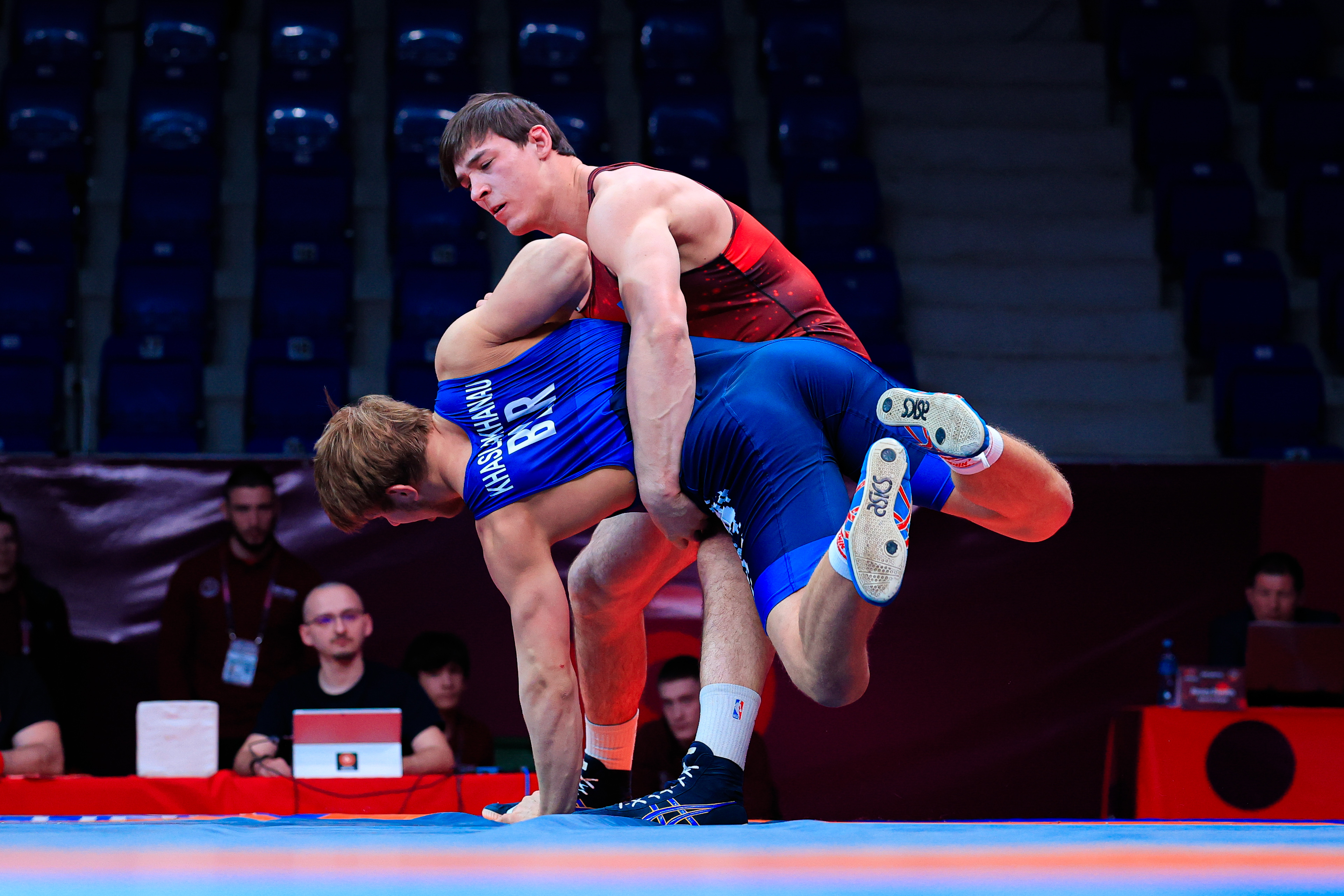 Yehor YAKUSHENKO (UKR) tries to throw Abubakar KHASLAKHANAU (BLR) during the 97kg final. (Photo: United World Wrestling / Kostadin Andonov)
Khaslakhanau got his chance in the second period when Yakushenko was put in par terre but failed to score any points. With a 2-1 lead, Yakushenko needed some good defense with two minutes left in the match.
While he had a couple of slip-ups during that time, Yakushenko did not give up any points. He was later warned for fleeing but managed to remain in contact after that. Belarus challenged for fleeing in the last 10 seconds but it was ruled out, adding one more point to Yakushenko's score.
"I had the same plan for all my opponents. It was tough," he said.
This was Yakushenko's third straight win over Khaslakhanau, a senior European bronze medalist and now a two-time U23 world silver medalist to go with his bronze as well.
Yakushenko defeated the Belarus wrestler twice last year -- a 7-3 victory at the U23 European Championships and then a 3-3 win at the U23 World Championships in Novi Sad.
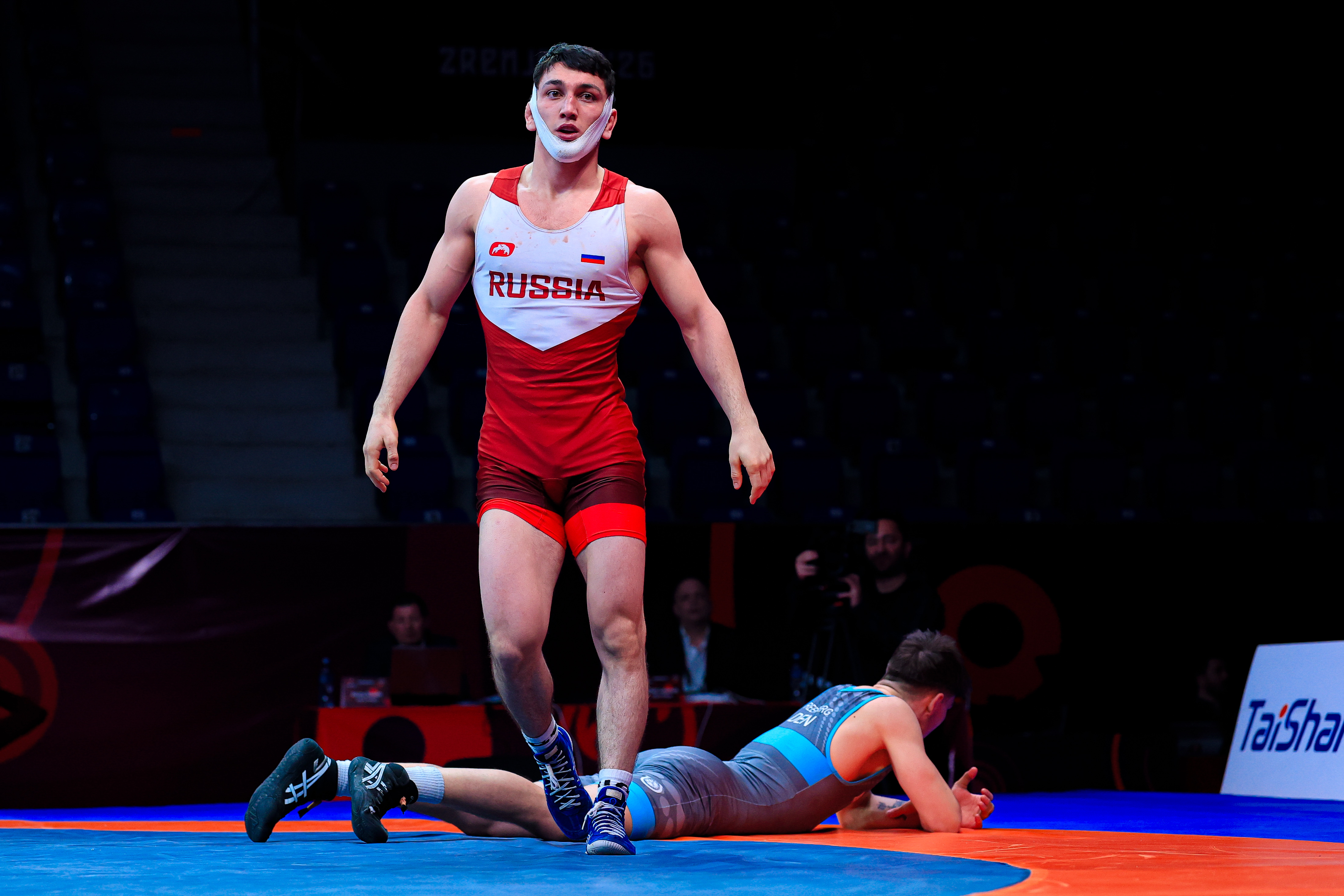 Daniial AGAEV (RUS) completed an 8-0 victory over William REENBERG (DEN) in just 37 seconds. (Photo: United World Wrestling / Kostadin Andonov)
Agaev Leads Russia to Team Title
In other finals, Russia won two gold medals while Azerbiajan and Armenia won one gold each.
World bronze medalist Daniial AGAEV (RUS) led an inspired performance from Russia as it won the Greco-Roman team title. Russia won the Freestyle team title as well in Zrenjanin.
With 190 points, Russia was the best team. Armenia managed 113 points to finish second and Georgia finished third with 106 points.
Agaev need only 37 seconds to win his 67kg final against William REENBERG (DEN). He scored a takedown and transitioned into a gut-wrench, winning 8-0.
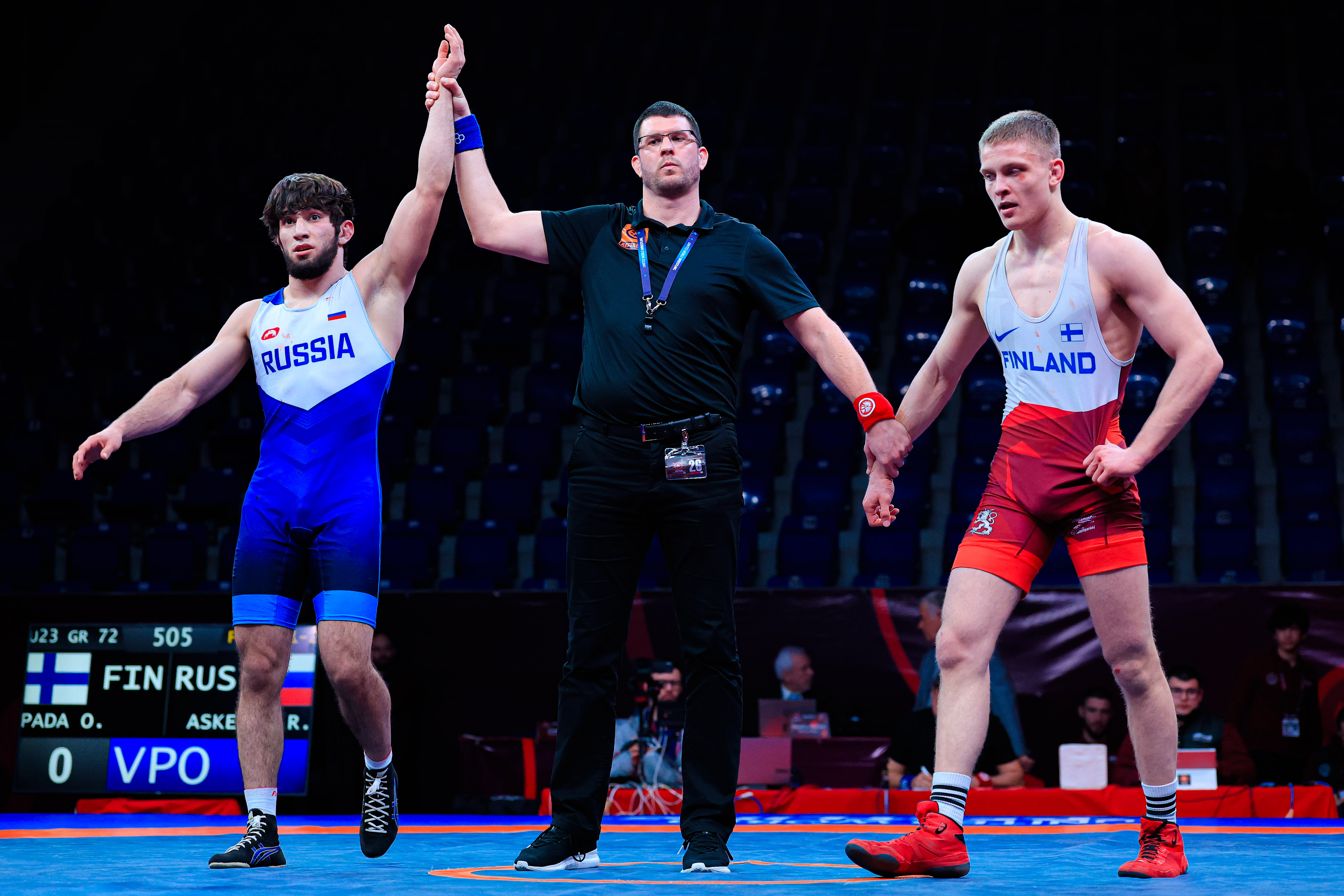 Rabil ASKEROV (RUS) defeated Oliver PADA (FIN), 6-0, in the 72kg final. (Photo: United World Wrestling / Kostadin Andonov)
Russia's second gold medal came at 72kg Rabil ASKEROV (RUS) blanked Oliver PADA (FIN), 6-0, in the final. Wrestling in only his third international tournament, Askerov began the final with a stepout before getting the par terre position. He did not score any points from the position but led 2-0.
An arm-drag to takedown doubled the lead to 4-0 before the break. In the second period, Askerov got another takedown to extend his lead to 6-0. The takedown also ended any hopes for Pada to get the par terre position.
Askerov would defend his 6-0 and win gold, his first major medal.
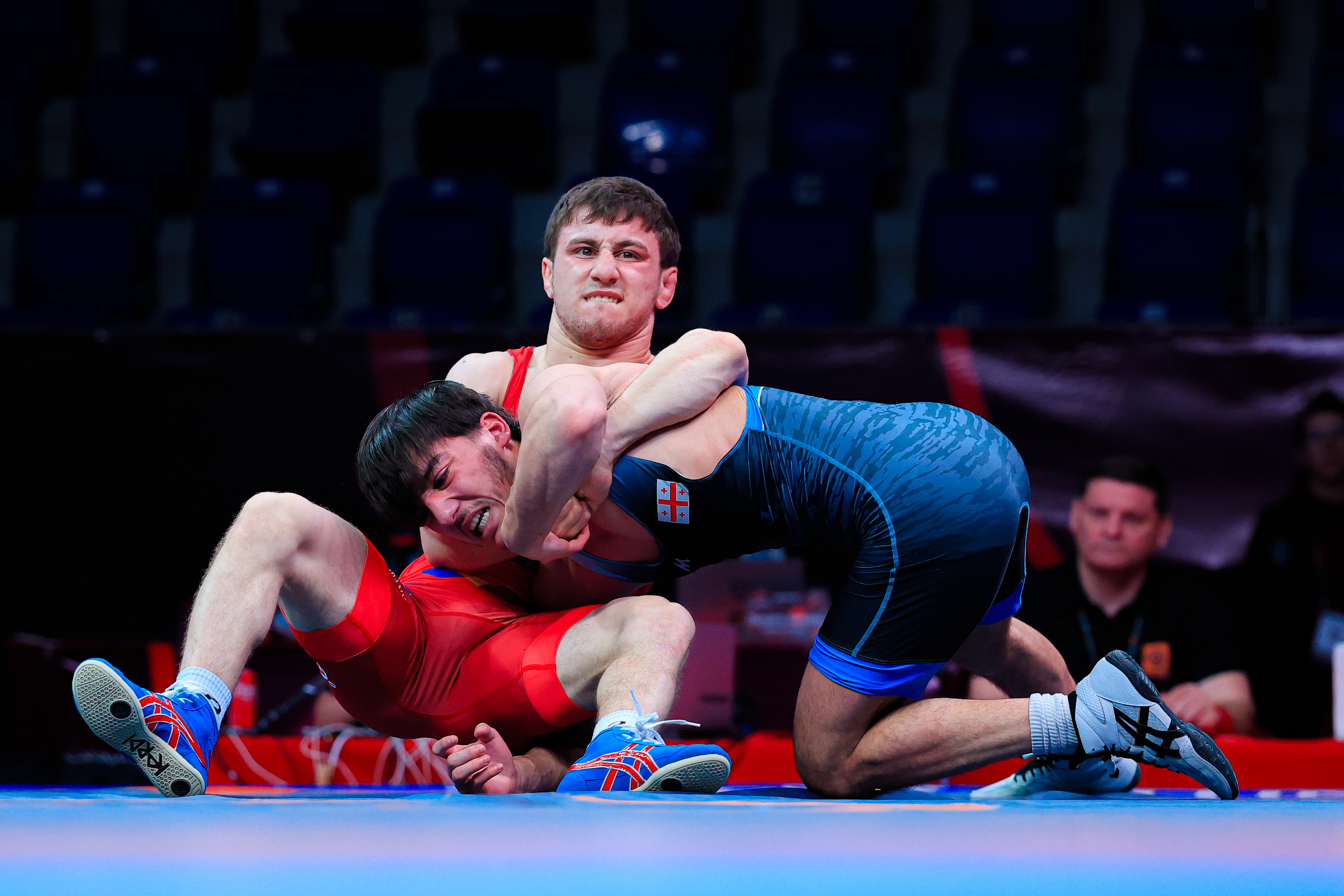 Suren AGHAJANYAN (ARM) uses the seatbelt grip to throw Giorgi KOCHALIDZE (GEO) during the 60kg final. (Photo: United World Wrestling / Kostadin Andonov)
Suren AGHAJANYAN (ARM) captured his first U23 European title after a series of suplex to beat Giorgi KOCHALIDZE (GEO), 9-0, in the 60kg final.
The former U20 champion was awarded the par terre in the first period which gave him a 1-0 lead. Kochalidze did well to defend the position but just as the referee was about to call neutral, Aghajanyan changed to a seatbelt grip and tossed Kochalidze in the opposite direction for two points.
He continued the same move with the seatbelt grip and was awarded four points for the second throw, giving him a 7-0 lead. The third throw was also scored four points, confirming an 11-0 victory for Aghajanyan.
Georgia challenged the decision, hoping that the throws will be scored two points each. But upon review the first throw was scored four points instead of original two points. With the second throw also being a four-pointer, the final was over, 9-0, a technical superiority win for the 2025 U23 world bronze medalist.
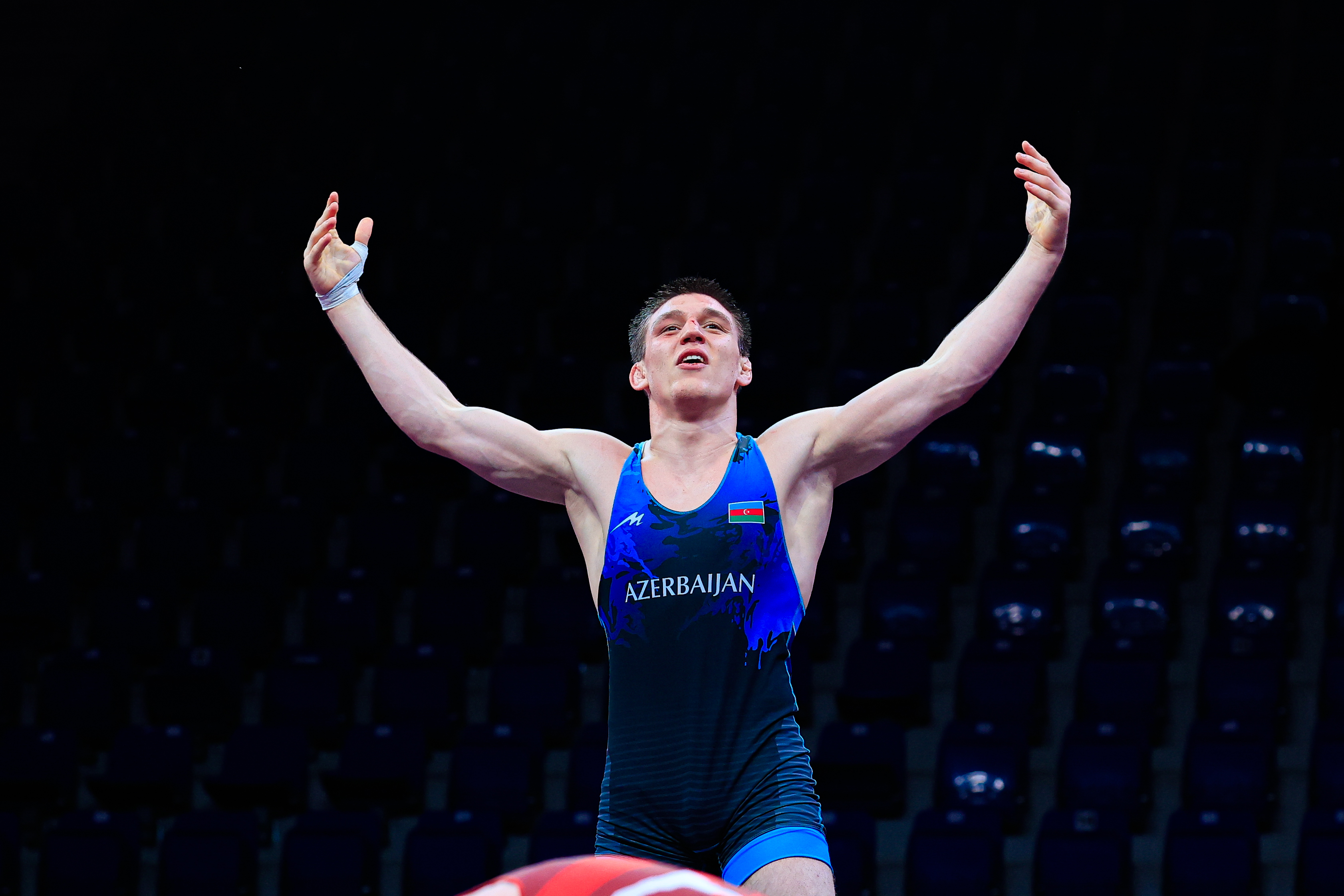 Elmin ALIYEV (AZE) celebrates after winning the 82kg final. (Photo: United World Wrestling / Kostadin Andonov)
Georgia suffered its second loss in the final at 82kg after Tornike MIKELADZE's (GEO) heartbreak against Elmin ALIYEV (AZE), 3-2.
Aliyev was down 2-0 at the break after giving up a stepout and passivity point in the first period. However, he managed to score a stepout at the start of the second period that later proved to be a crucial moment in the final.
Down 2-1, Aliyev was awarded the par terre position, giving him a 2-2 criteria lead. He failed to score any points from par terre but the criteria of scoring the last points remained with him and that enabled him to win the final.
Georgia threw a late challenge, asking for fleeing from Aliyev. But there was no evident fleeing and Georgia lost the challenge, giving one more point to Aliyev, who won 3-2.

RESULTS
60kg
GOLD: Suren AGHAJANYAN (ARM) df. Giorgi KOCHALIDZE (GEO), 9-0
BRONZE: Yevhen POKOVBA (UKR) df. Aykhan JAVADOV (AZE), 3-1
BRONZE: Ilian AINAOUI (FRA) df. Brian SANTIAGO (DEN), 1-1
67kg
GOLD: Daniial AGAEV (RUS) df. William REENBERG (DEN), 8-0
BRONZE: Azat SARIYAR (TUR) df. Arslanbek SALIMOV (POL), 4-1
BRONZE: Farid KHALILOV (AZE) df. Petro ZHYTOVOZ (HUN), 6-3
72kg
GOLD: Rabil ASKEROV (RUS) df. Oliver PADA (FIN), 6-0
BRONZE Faraim MUSTAFAYEV (AZE) df. Leonard IURASCU (ROU), 5-4
BRONZE: Arionas KOLITSOPOULOS (GRE) df. Ashot KHACHATRYAN (ARM), 4-1
82kg
GOLD: Elmin ALIYEV (AZE) df. Tornike MIKELADZE (GEO), 3-2
BRONZE: Illia VALEUSKI (BLR) df. Szabolcs SZINAY (HUN), 10-1
BRONZE: Gamzat GADZHIEV (RUS) df. Alexander AEMAES (NOR), 9-0
97kg
GOLD: Yehor YAKUSHENKO (UKR) df. Abubakar KHASLAKHANAU (BLR), 3-1
BRONZE: Saipula GADZHIMAGOMEDOV (RUS) df. Robin USPENSKI (EST), 6-4
BRONZE: Darius KIEFER (GER) df. Luka GABISONIA (GEO), 9-3



 Aline FOCKEN (GER) with the Olympic torch on Wednesday. (Photo: Lewis Joly)
Share your thoughts.
Comments