

Granma y Cerro Pelado

Olympic Champion Borrero Wows Home Crowd To Make Granma Cup Finals

By

HAVANA, Cuba – The heavy hitters emerged as day one of the Granma Cup Greco-Roman scrap came to a close on Saturday evening in Cuba’s illustrious capitol city.

Havana raved the return of its Olympic champion, Ismael BORRERO MOLINA (CUB), who competed in front of his home-country crowd for the first time since the Rio Games.

Competing eight kilograms above the weight class in which he won his Olympic gold medal, Borrero Molina navigated his way through three bouts to qualify for tomorrow afternoon’s final at 67kg.

He tackled a pair of countrymen to kick off his day, downing Damian CRISTIAN (CUB), 5-1, and Miquel MARTINEZ (CUB), 3-2. Hitting his stride in round three, Borrero Molina executed a sweeping five-point arm throw to pin Alejandro SANCHO (USA) in just over one minute.  

Borrero Molina, also a 2015 world champion, will rematch against Martinez for the gold medal.

Three additional finals feature two competitors from the host nation of Cuba. None are larger than the 130kg final pitting 2016 Olympic silver medalist Yasmany LUGO CABRERA (CUB) opposite 2017 world bronze medalist Oscar PINO HANDS (CUB).

Both heavyweight combatants went unscored upon throughout the day, with each grabbing two individual victories. Pino Hinds earned the tougher win of the two by edging 2017 European silver medalist Balint LAM (HUN) in the semifinals, 3-0.

The past two years Lugo Cabrera and Pino Hinds have been Cuban teammates at the Pan American Championships. Both earned gold on each occasion. In fact, Lugo Cabrera has amassed a whopping seven Pan American titles dating back to 2009.

The remaining Cuba-on-Cuba finals come at 60kg between Luis ORTA (CUB) and two-time Pan American champion Javier DUMENIGO (CUB), and at 63kg with Joy MAREN (CUB) and Janier ALMENARES (CUB) earning the nod.

The 87kg final will be a rematch of the Grand Prix of Zagreb final held two weeks ago in Croatia. Two-time world bronze medalist and reigning European champion Viktor LORINCZ (HUN) and U23 world champion Erik SZILVASSY (HUN) are slated to meet in an all-Hungarian final tussle once more. Lorincz won the latest battle between the two top-tier talents.
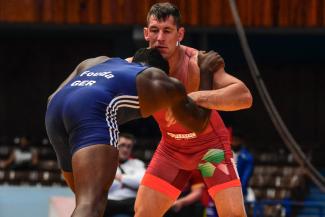
A highly-anticipated Hungary-Cuba showdown will take place at 72kg, with 2016 world champion Balint KORPASI (HUN) meeting two-time defending Granma Cup champion Yosvani PENA (CUB) for the gold.

The electric junior world champion from the United States, Kamal BEY (USA), downed two of last year’s Pan American medalists to secure a berth in the 77kg finals against Ariel FIZ (CUB).

Two-time Pan American bronze medalist Luigi PEREZ (VENEZUELA) will be challenged by Gabriel ROSILLO (CUB) in the 97kg final contest.

The 82kg weight class featured a four-man round-robin, therefore will not have a designated gold-medal match. The last bout scheduled to be wrestled in this bracket comes with 2016 world bronze medalist Lazlo SZABO (HUN) facing Antonio DURAN (CUB). Should Szabo take this bout, he will be named champion.

Of note, Szabo won a tight, 2-0 bout over 2014 world champion Peter BACSI (HUN) in the opening round of the day. Bacsi is positioned to win the silver medal if Szabo holds serve tomorrow.

The Greco-Roman medal matches at the Granma Cup will take place at 2 p.m. (ET) on Sunday. Complete results and a live stream of the event can be found at unitedworldwrestling.org.

RESULTS: http://uww.io/NQ6AU

MEDAL MATCHES

60kg

Gold – Luis ORTA (CUB) vs. Javier DUMENIGO (CUB)

Bronze – Andrej GINC (GER) vs. Dalton ROBERTS (USA

67kg

Gold – Ismael BORRERO MOLINA (Cuba) vs. Miquel MARTINEZ (Cuba)

Bronze – Alejandro SANCHO (United States) vs. Wilexys RIVAS (Venezuela)

72kg

Gold – Balint KORPASI (Hungary) vs. Yosvani PENA (Cuba)

Bronze – Anthony SANDER (Germany) vs. Logan KASS (United States)

77kg

Gold – Ariel FIZ (Cuba) vs. Kamal BEY (United States)

Bronze – Juan ESCOBAR (Mexico) vs. Luis AVENDANO (Venezuela)

87kg

Gold – Erik SZILVASSY (Hungary) vs. Viktor LORINCZ (Hungary)

Bronze – Friedrich FOUDA (Germany) vs. Geovanis CARRERAS (Cuba)

Bronze – Kevin RADFORD (United States) vs. Daniel GREGORYCH (Cuba)

97kg

Gold – Luigi PEREZ (Venezuela) vs. Gabriel ROSILLO (Cuba)

Bronze – Monteaqudo REINIER (Cuba) vs. Hayden ZILLMER (United States)

Bronze – Kevin MEJIA (Honduras) vs. Pablo REINIER (Cuba)

130kg

Gold – Yasmany LUGO CABRERA (Cuba) vs. Oscar PINO HINDS (Cuba)

Bronze – Diego ALMENDRA (Chile) vs. Balint LAM (Hungary)

Bronze – Eduardo MORRELL (Puerto Rico) vs. Franz RICHTER (Germany)
Development

DNSS Program in Cambodia: Building Foundations for Wrestling Growth

By United World Wrestling Press

PHNOM PENH, Cambodia (December 2) --- From July 18 to November 30, 2024, the Development of the National Sports System (DNSS) program in Cambodia marked a significant milestone for the growth of wrestling in the country. Led by UWW Educator Martin Hauck (USA), this program provided a comprehensive approach to enhancing coaching, athlete development, and refereeing in Cambodia. Through a mix of workshops, camps, and tournaments, the initiative sought to foster collaboration, education, and enthusiasm for wrestling at all levels.

During the program, more educational opportunities were created for coaches, athletes, and referees. A key highlight was a youth national tournament held during the second visit, which connected athletes and coaches from several provinces, promoting competition and collaboration. Plans were made to make this event an annual tradition, further strengthening the sport’s foundation in Cambodia.

The program objectives included observing and assessing the national team during a high-performance camp in July, educating coaches on long-term athlete development, and organizing a one-day seminar in a neighboring province to introduce wrestling games to youth. Meetings with the Cambodia Wrestling Federation leadership helped establish a roadmap for future development and in-person training sessions.

Key deliverables included:

  • Running camps and seminars for coaches and athletes, focusing on practical and theoretical education.
  • Creating a Cambodian Coaches Course Curriculum and teaching topics such as emergency action planning, practice structuring, periodization, talent identification, and connecting traditional Cambodian wrestling with Olympic styles.
  • Organizing a youth national tournament and camp, which saw participation from almost all provinces, showcasing significant growth on and off the mat.
  • Promoting communication, education, and resource-sharing platforms for ongoing development.

The DNSS program not only strengthened technical skills but also built excitement and unity within the Cambodia Wrestling Federation. With a focus on collaboration among referees, coaches, athletes, and stakeholders, this initiative laid the groundwork for sustained development and opportunities in wrestling throughout Cambodia.

The Development of National Sports System (DNSS) program, conducted in Cambodia from July 18 to November 30, 2024, marked a significant step toward developing wrestling in the country. Led by UWW Educator Martin Hauck (USA), the program aimed to address critical gaps in coaching, athlete development, and organizational structure while fostering growth and enthusiasm for the sport nationwide.

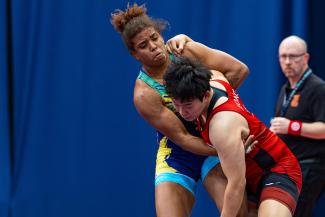
CAMOver 100 participants competed in the national youth tournament during the Development of the National Sports System (DNSS) program in Cambodia.

Program Activities and Achievements

The DNSS program implemented a range of initiatives to address these challenges and lay the groundwork for wrestling’s growth:

  1. Youth Development and Competitions:
    The program introduced a national youth tournament, drawing over 100 athletes from nearly all provinces. This event not only provided a platform for competition but also fostered excitement and collaboration among athletes, coaches, referees, parents, and stakeholders.
  2. Coaching Education and Communication:
    Coaches participated in comprehensive seminars covering emergency action planning, athlete development, periodization, video analysis, coaching females, and practice structuring. A centralized communication platform on the Cambodia Wrestling Federation website improved collaboration among coaches and clubs, helping connect rural and urban areas.
  3. Structured Athlete Development:
    New frameworks for athlete progression were introduced, enabling coaches and athletes to engage in long-term development cycles. Practical sessions during national team camps allowed coaches to apply their learning while working with athletes from across the country.
  4. Safety and Inclusivity:
    Emphasis on mental health, recovery practices, and safety protocols improved understanding and implementation of safe wrestling environments.
  5. Stakeholder Engagement:
    Meetings with the Cambodia Wrestling Federation leadership resulted in a shared vision for growth, including plans to strengthen partnerships, increase opportunities, and enhance stakeholder representation.

Key Outcomes

The program’s efforts led to several important outcomes:

  • Improved communication and collaboration within the wrestling community.
  • Significant growth in coaches’ theoretical and practical knowledge.
  • Increased participation and retention among athletes and coaches.
  • The successful execution of Cambodia’s first youth national tournament.
  • The identification of Coach Sotheara as a future leader for the sport.

Path to Success

The success of wrestling in Cambodia will depend on sustained education, participation, and collaboration. With improved communication, increased opportunities, and the emergence of local leaders like Coach Sotheara, the sport is well-positioned for growth. The DNSS program has laid a strong foundation, and with continued effort, wrestling in Cambodia has the potential to thrive at both national and international levels.

By fostering education, inclusivity, and passion, this program has not only addressed immediate needs but also set a vision for wrestling’s bright future in Cambodia.