

Olympic Champ Vlasov, Silver Medalist Kaayalp Punch Ticket to Euro Finals
Monday, April 30, 2018 - 20:18 By Tim Foley

KASPIYSK, Russia (April 30) – As youngsters looked to emerge on day one of wrestling in Dagestan, it was the Old Guard, led by Rio Olympic champion Roman VLASOV (RUS) and silver medalist Riza KAYAALP (TUR), showing fans they were still to be considered among the continent's best.
Vlasov had one of the day’s tougher semifinal matchups, facing 2015 European Games champion Elvin MURSALIYEV (AZE) at 77kg. The two-time Olympic champion used plenty of veteran savvy to earn the one-point passivity early and then immediately tack on two more points for a successful lift at the edge of the mat.
The Russian earned a pushout late in the first to make it 4-0 heading into the second period, which proved to be the last points scored. The win avenged a 20176 loss Vlasov suffered to Mursaliyev, 2-2. Vlasov will face defending world champion Viktor NEMES (SRB) who beat Alex Michel BJURBERG KESSIDIS (SWE), 2-0 in the night's other 77kg semifinal.
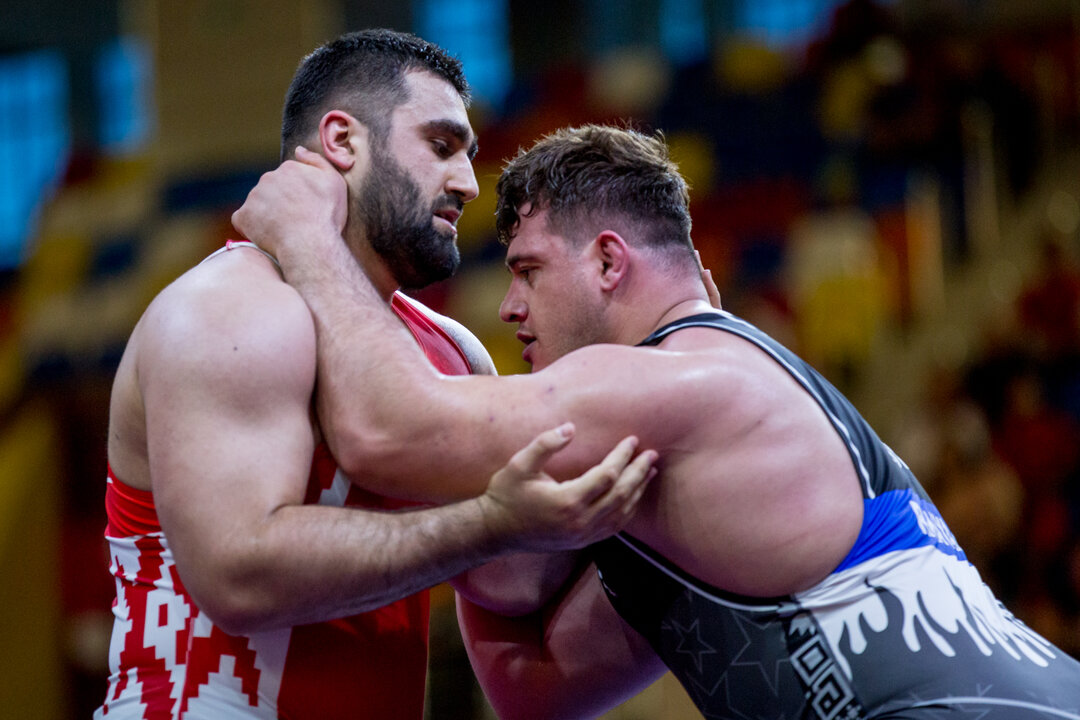 df. Georgi CHUGOSHVILI (BLR) -by VPO, 5 - 0-13.jpg) Kayaalp standing tall during early round action at the 20187 European Championships in Kaspiysk. (Photo: Max Rose-Fyne)
Kayaalp standing tall during early round action at the 20187 European Championships in Kaspiysk. (Photo: Max Rose-Fyne)
For Kayaalp the night’s on-the-mat activity seemed rote as he plodded through opponents with his bullying style of aggressive heads up wrestling. The barrel-chested Kayaalp came out firing in in his seminal match against Alin ALEXUC CIURARIU (ROU) earning a quick go behind takedown, followed only moments later by a gut wrench. He would take the lead the rest of the way and head to the finals with a 4-0 victory.
Kaayalp, who is looking for his eighth European titles, will face 2017 European bronze medalist Vitalii SHCHUR (RUS) in Tuesday’s finals. The Russian made his way to the finals on the back of an early four-point throw against Iakobi KAJAIA (GEO). The move propelled Shchur to a 5-4 and his first European finals.
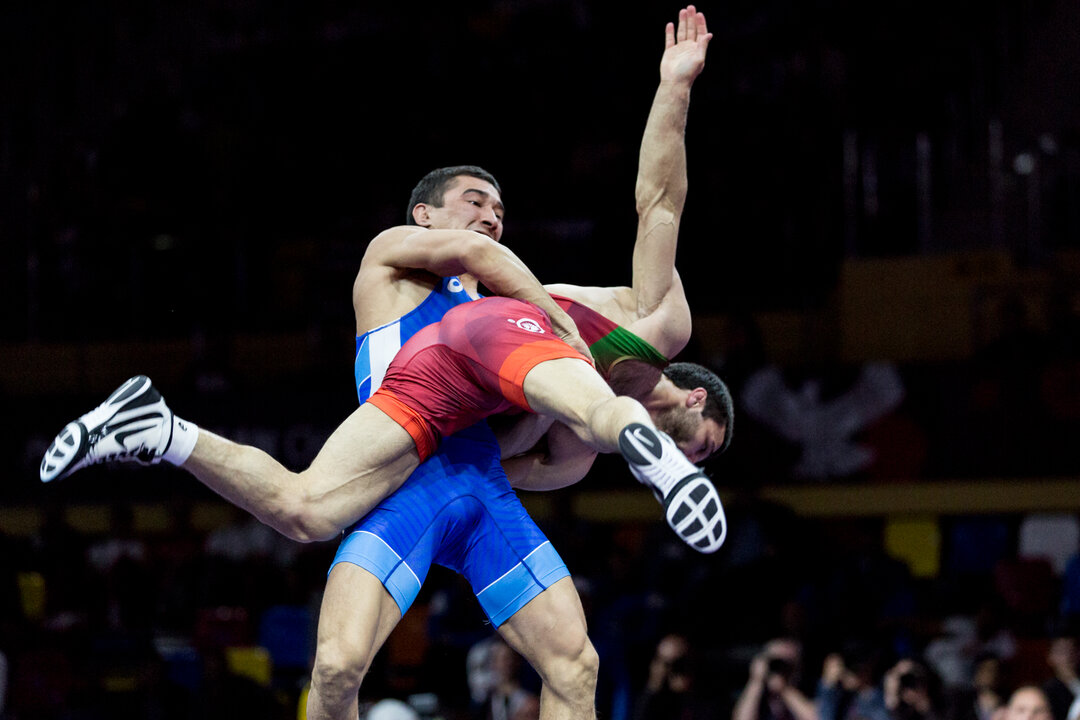 vs. VasilII TOPOEV (RUS).jpg) Eldaniz AZIZLI (AZE) survived this five-point throw to climb back for an impressive 9-7 semifinal victory. (Photo: Max Rose-Fyne)
Eldaniz AZIZLI (AZE) survived this five-point throw to climb back for an impressive 9-7 semifinal victory. (Photo: Max Rose-Fyne)
Eldaniz AZIZLI (AZE) took a curious route to the 55kg finals, finding himself down 7-0 to Vasilil TOPOEV (RUS) within the first :45 seconds of the 55kg semifinals. Topoev opened the match with a quick slide by takedown and then immediately lifted his Azerbaijani opponent for an incredible, picturesque five-point throw.
Azizli scored a single point in the first period, but in the second came back with eight unanswered points off a two-point takedown, two-point gut wrench and the decisive four-point front headlock with 1:30 remaining in the bout.
Azizili will face Estonia’s Helary MAEGISALU (EST) tomorrow after he bested Ekrem OZTURK (TUR), 4-4 in the night’s other 55kg semifinal.
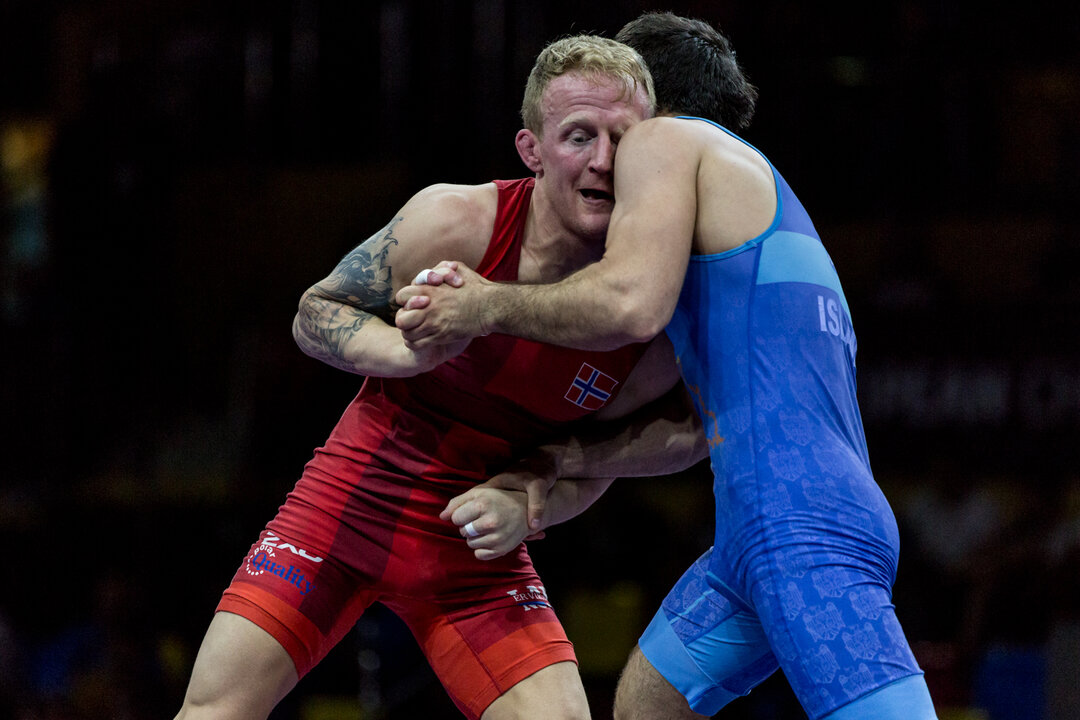 df. Donior ISLAMOV (MDA) -by VPO1, 2 - 1--2.jpg) Stig-Andrew BERGE (NOR) returns to the European finals for the first time since 2007. (Photo: Max Rose-Fyne)
Stig-Andrew BERGE (NOR) returns to the European finals for the first time since 2007. (Photo: Max Rose-Fyne)
At 63kg it was Rio bronze medalist Stig-Andre BERGE (NOR) who used a second period arm drag to top Donior ISLAMOV (MDA), 2-1. Berge will meet Mihai Radu MIHUT (ROU) in the finals after the Romanian bested Russia’s Zaur KABALOEV, 7-5.
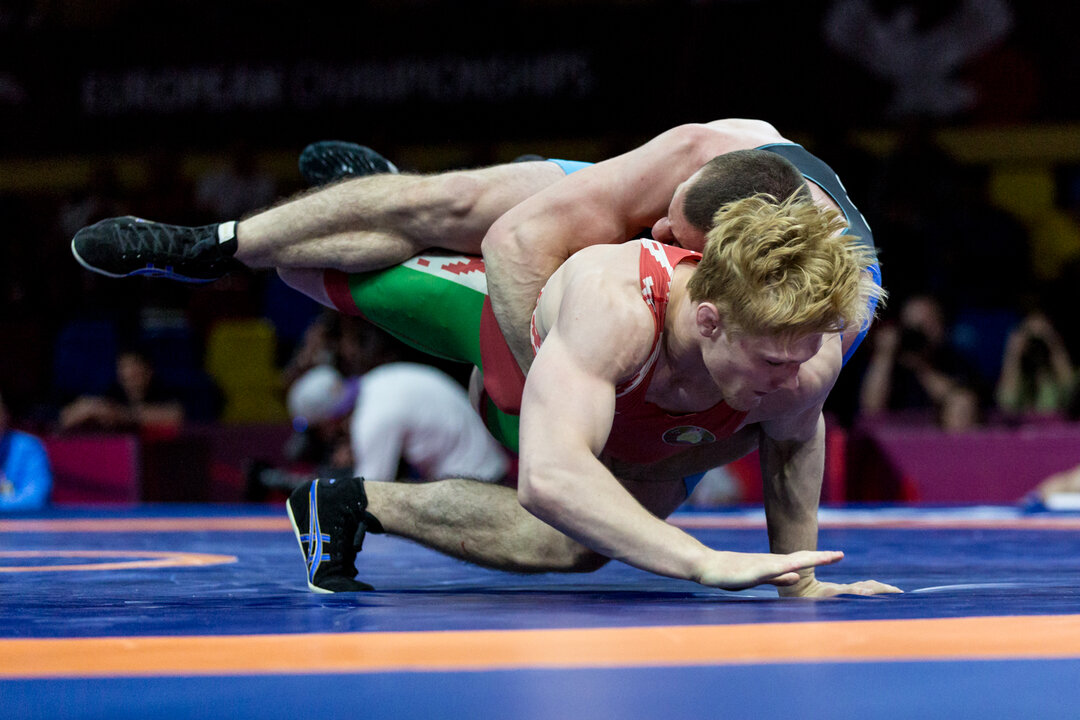 df. Mikita KLIMOVICH (BLR) -by VSU, 8 - 0-2.jpg) Roberti KOBLIASHVILI (GEO) dominated Mikita KLIMOVICH (BLR) at 87kg. (Photo: Max Rose-Fyne)
Roberti KOBLIASHVILI (GEO) dominated Mikita KLIMOVICH (BLR) at 87kg. (Photo: Max Rose-Fyne)
In the 87kg semifinals Roberti KOBLIASHVILI (GEO) made easy work of Mikita KLIMOVICH (BLR) earning the 8-0 technical fall with 2:20 left in the match, largely through a series of first-period gut wrenches. The young Georgian will face Bekkhan OZDOEV (RUS) in the finals after the Russian edged Azerbaijan’s Islam ABBASOV, 4-3 in a heart-pounding semifinal.
Finals for the first five Greco-Roman matches will begin Tuesday at 7pm local time.
---
Greco-Roman, 55kg
GOLD: Helary MAEGISALU (EST) vs. Eldaniz AZIZLI (AZE)
Semifinal: Eldaniz AZIZLI (AZE) df. VasilII TOPOEV (RUS), 9-7
Semifinal: Helary MAEGISALU (EST) df. Ekrem OZTURK (TUR), 4-4
Greco-Roman, 63kg
GOLD: Stig-Andre BERGE (NOR) vs. Mihai Radu MIHUT (ROU)
Semifinal: Mihai Radu MIHUT (ROU) df. Zaur KABALOEV (RUS), 7-5
Semifinal: Stig-Andre BERGE (NOR) df. Donior ISLAMOV (MDA), 2-1
Greco-Roman, 77kg
GOLD: Roman VLASOV (RUS) vs. Viktor NEMES (SRB)
Semifinal: Viktor NEMES (SRB) df. Alex Michel BJURBERG KESSIDIS (SWE), 2-0
Semifinal: Roman VLASOV (RUS) df. Elvin MURSALIYEV (AZE), 4-0
Greco-Roman, 87kg
GOLD: Roberti KOBLIASHVILI (GEO) vs. Bekkhan OZDOEV (RUS)
Semifinal: Bekkhan OZDOEV (RUS) df. Islam ABBASOV (AZE), 4-3
Semifinal: Roberti KOBLIASHVILI (GEO) df. Mikita KLIMOVICH (BLR) by TF, 8-0
Greco-Roman, 130kg
GOLD: Riza KAYAALP (TUR) vs. Vitalii SHCHUR (RUS)
Semifinal: Vitalii SHCHUR (RUS) df. Iakobi KAJAIA (GEO), 5-4
Semifinal: Riza KAYAALP (TUR) df. Alin ALEXUC CIURARIU (ROU), 4-0

 Women's Wrestling at the 2004 Athens Olympic Games. (Photo: United World Wrestling / Martin Gabor)
 Tayla FORD (NZL) is the first wrestler from New Zealand who will compete at the Olympics. (Photo: United World Wrestling / Amirreza Aliasgari)
Share your thoughts.
Comments