

Olympic champ Kusaka falls to Amoyan as Mirzazadeh repeats at 130kg
Friday, September 19, 2025 - 22:54 By Vinay Siwach
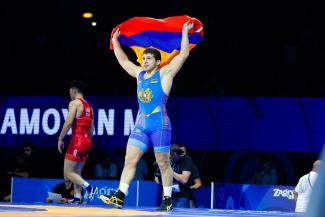
ZAGREB, Croatia (September 19) -- The Zagreb World Championships has seen a number of Paris Olympic medalists humbled over the last six days.
On Friday, it was Greco 77kg champion Nao KUSAKA (JPN) who joined that growing list, after he was dealt a one-sided loss in the final by Malkhas AMOYAN (ARM).
Amoyan's thumping 9-1 victory gave him a second world title and the first at 77kg, a goal he had been working on for two years.
"I became a world champion back in 2021 [at 72kg], and it seemed very difficult for me to move up to this weight class," Amoyan said. "I really wanted to become world champion at 77kg.
"But for two years, I struggled with injuries, and nothing was going as it should. Thankfully, at this World Championships I was prepared -- mentally, physically, and functionally -- and by God's grace I managed to triumph and become a two-time world champion."
The win avenged Amoyan's 3-1 loss to Kusaka in the semifinals of the Paris Olympics, where the Armenian wrestler won a bronze medal.
In the three other weight classes contested, Iran had a wrestler in all three finals and came away with two golds, as Amin MIRZAZADEH (IRI) defended his title at 130kg while debutant Gholamreza FAROKHI (IRI) made sure that the 82kg title remained in Iranian hands.
The other gold medal went to Vakhtang LOLUA (GEO) at 55kg, giving Georgia its second world title in the last six years.
In the 77kg final, Amoyan, after defending from par terre in the first period, broke open the match in the second period from the par terre position. He lifted Kusaka and moved to the zone, loading to perform a suplex. However, he switched and slammed Kusaka to the mat with a reverse throw in front for four points.
Kusaka was also docked two points for a defensive foul while Amoyan was working on the lift, giving the Armenian a 7-1 lead. As the bout restarted in par terre, Amoyan once again lifted Kusaka and completed a correct throw for two points for a 9-1 technical superiority win over the Olympic champion.
Despite the one-sided final, Amoyan said that Kusaka was one of the strongest wrestlers he has ever faced in his weight class.
"Let me say, the Japanese wrestler I faced is one of the strongest in our weight category," he said. "With him, the only way to get through was by wrestling with full strength and giving everything to win. It seems that today was my day to confidently and firmly become the world champion."
The gold medal adds to two bronze medals the 26-year-old previously won at the Olympic weight class of 77kg. But Amoyan said that the real struggle to remain on top begins now.
"It will be very hard for me to keep it -- for that I must be able to train properly, be disciplined, so that I can keep the title," he said. "Honestly, I don't really understand what I'm feeling; I think when I return to my homeland I'll understand it."
Friday's loss was Kusaka's first since January 2024 which incidentally came in Zagreb at the Ranking Series event. But he said it will only serve as a motivation.
"The last time I lost was also in Croatia. Actually, there is no connection. At the very least, I feel that I am not nearly at my strongest," Kusaka said. "Conversely, instead of a close score, I was teched, so all I can do is acknowledge the defeat. I have to continue to make progress. I'm told there is still room for growth. From now, it will be my motivation to be blessed with such a rival. I can train keeping him in the back of my mind and next time, I will definitely win."
One of the areas of improvement which Kusaka has already identified is the par terre defense from which he gave up six points in the final.
"When it comes to ground defense, I'm a bit insecure, it's a weakness of the mind, a part of me that is a weak point," he said. "I always plan to not give up points. But I gave them up. Then I gave him a bonus by touching the leg during the move. That was the worst possible pattern."
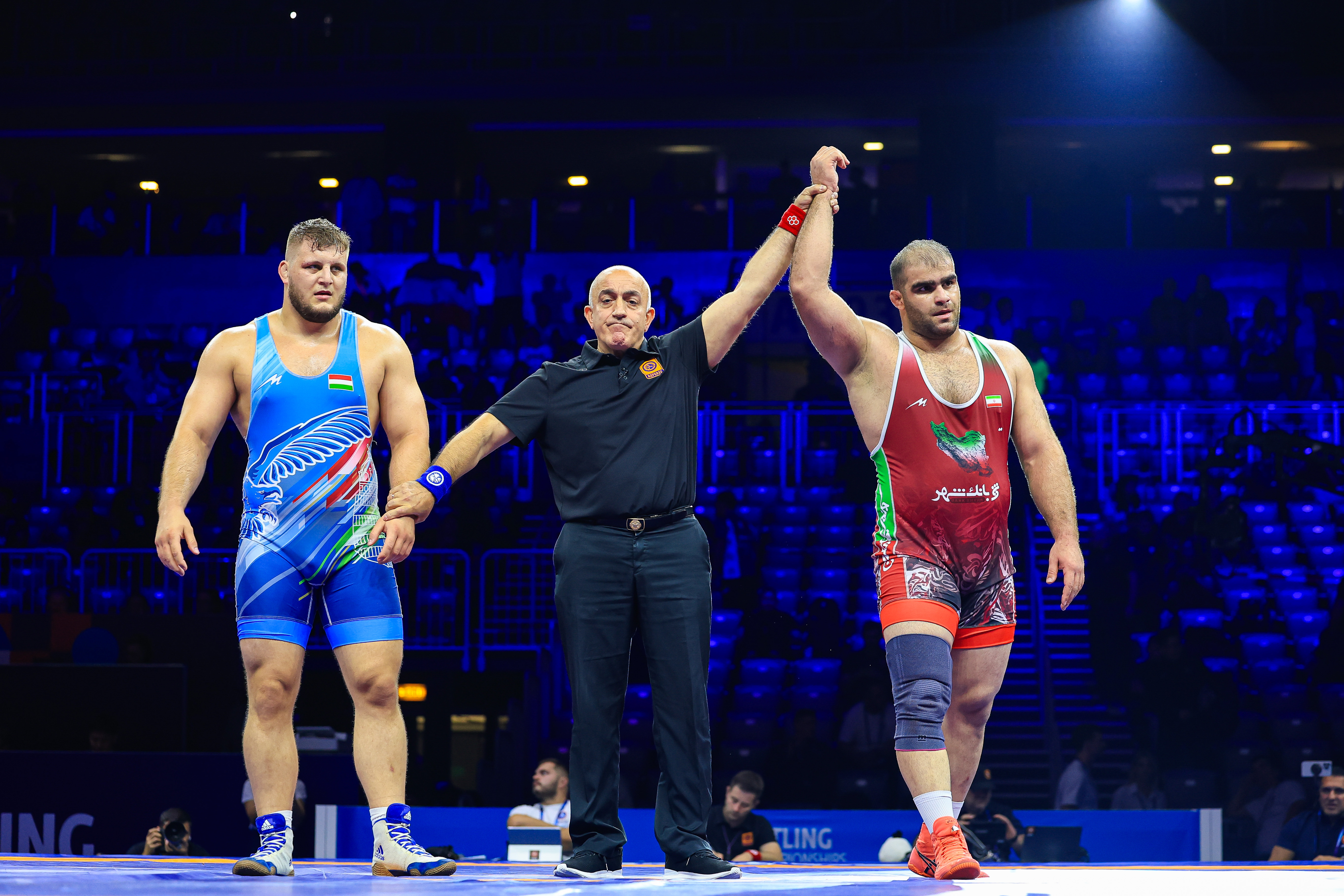 Amin MIRZAZADEH (IRI) is now a two-time world champion. (Photo: United World Wrestling / Kadir Caliskan)
Iran doubles up
Defending champion Mirzazadeh made sure there were no more upsets as he defeated Darius VITEK (HUN) 7-2 to win his second gold medal at the World Championships.
A gasp went through Arena Zagreb when Vitek scored a takedown after Mirzazadeh lost his balance after a throw and he quickly gained control. But Mirzazadeh reversed the positions and got one point to make it 2-1.
Mirzazadeh then added two stepouts in the first period to take the lead and go into the break leading 3-2. There were no more surprises in the match as Mirzazadeh scored a takedown soon after the whistle in the second period. Two turns were enough to give him a 7-2 lead which he defended to win the gold medal.
"Winning this gold and standing on top of the world's heavyweight podium makes me really proud," Mirzazadeh said. "I just hope my people are happy, too, because their joy is my joy."
Mirzazadeh brushed aside the opening takedown that Vitek scored on him, saying, "I think that's the nature of wrestling and these things happen. I'm glad I was able to wrestle well and come out on top."
With his second world gold medal, Mirzazadeh has clearly set himself apart from the field at 130kg. The real challenge can come domestically from multiple age-group world champion Fardin HEDAYATI (IRI), but Mirzazadeh is determined to rule the weight class for a long time.
"I'll keep giving it my all to improve every year, to raise my level, and to represent my country again and again," he said. "My goal is to bring home world and Olympic gold medals and make my people proud."
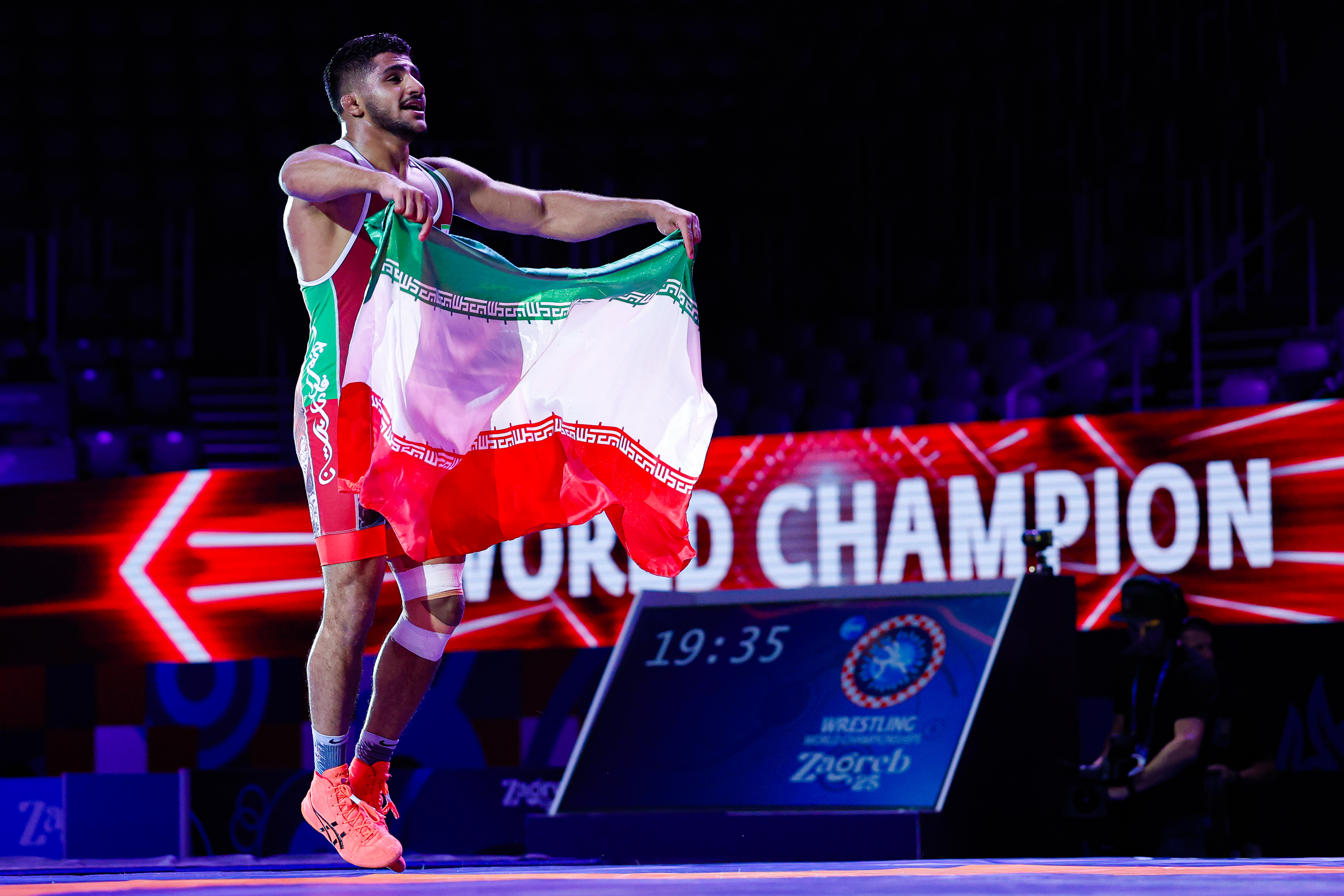 Gholamreza FAROKHI (IRI) celebrates after winning the 82kg final. (Photo: United World Wrestling / Kostadin Andonov)
While experienced Mirzazadeh repeated as champion, debutant Gholamreza FAROKHI (IRI), who won the Zagreb Open Ranking Series gold in February at the same arena, showed no nerves in blanking Gela BOLKVADZE (GEO) to win the 82kg title.
Farokhi went straight to work in the final and was awarded with the first par terre position, from which he scored two points from a correct throw to lead 3-0. A stepout just before the break extended the lead to 4-0.
There were no points or positions in the second period, and Farokhi was happy to defend the four-point lead and claim the gold medal, the first for Iran in Greco at the World Championships.
"Winning a medal in my very first World Championships felt like a dream," Farokhi said. "I had always thought about it and even dreamed of this belt. I was able to put on my best performances and win the gold medal."
Farokhi, who had to beat world champion Mohammadali GERAEI (IRI) to make the Iran team, gave up only a single point in five matches at the tournament while scoring 37.
"I managed to win all my matches while giving up only one point," he said. "Geraei is not only one of Iran's greatest champions, but also a close friend of mine. In the qualifiers I was able to beat him. As for the future, it depends on the coaches' decisions, but for now I'll stay at 82kg."
Earlier, Iran missed out on the gold at 55kg when world U20 champion Payam AHMADI (IRI) fell to Vakhtang LOLUA (GEO) 9-7 in a thrilling final.
The 18-year-old Lolua, who himself won a bronze medal at 60kg from last month's World U20 Championships, got a turn from par terre in the first period to lead 3-0. But the par terre in the second period saw 10 points scored.
As Ahmadi got the position, it made the score 3-1. He went for the front head lock instead of the preferred gut-wrench and managed to turn Lolua three times to rack up six points, while Lolua blocked him once from the headpinch to earn two points.
When the referees called it neutral, Ahmadi led 7-5 and just 1:52 away from winning a senior world title. However, a third passivity was called by the officials, putting Ahmadi down in par terre.
Lolua made the most of that and used a chestwrap to turn Ahmadi for two points. He then lifted Ahmadi and completed a correct throw for a 9-7 lead with 34 seconds left. Lolua defended the lead without any trouble to win the gold.
"I had prepared well. This was my first time competing at the World Championships, and this year I became a world champion," Lolua said. "The clock never stops, and everyone dreams of becoming a world champion -- now that dream has come true."
The teenager, who has already won a European Championships medal, said he came to Zagreb to fight with all his grit.
"I don't even know what to say -- I feel so many emotions, and it's hard to describe everything," he said. "I came here to fight. Everyone came out to support me. What matters most is that, first of all, you must fight with your own strength and determination."
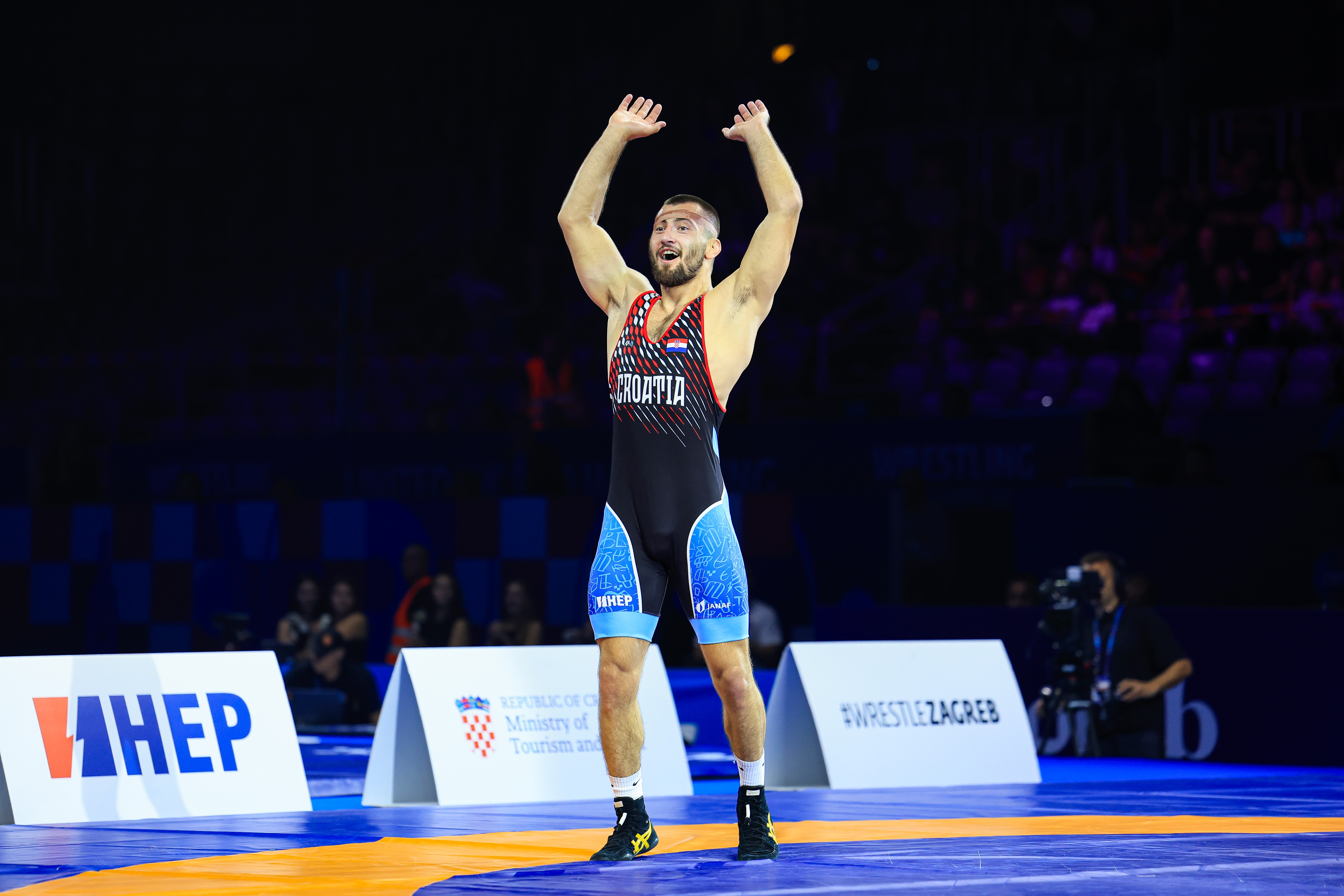 Karlo KODRIC (CRO) celebrates with home fans after winning Croatia's first world medal since 2014. (Photo: United World Wrestling / Kadir Caliskan)
Host Croatia, Finland end medal droughts
Host Croatia ended a decade-long drought for a World Championships medal when Karlo KODRIC (CRO) won the bronze medal at 82kg with a 5-0 victory over Ramon BETSCHART (SUI).
Kodric became only the third world medalist for Croatia after brothers Neven and Nenad ZUGAJ (CRO). Neven won silver in 2014 and bronze in 2011 while Nenad won bronze in 2010.
Kodric got both par terre positions in the match. While he failed to score in the first period, he scored two points via forward exposure instead of rolling Betschart. The Switzerland corner challenged the call, but it was upheld and Kodric got one more point for the lost challenge to win 5-0.
"It's the best feeling in the world," Kodric said. "Before the match, I felt a lot of pressure. It's the biggest I've ever felt. But I beat him. This is all I do, training and thinking of every medal possible to take. That is all my life."
The second bronze at 82kg went to Taizo YOSHIDA (JPN), a month after he won bronze at the World U20 Championships, by rallying to edge Adlet TIULIUBAEV (UWW) 3-3.
Yoshida gave up a turn from par terre and fell 3-0 behind at the break, and was in further trouble when he failed to score from par terre in the second period. But he powered his way to a takedown with 45 seconds left when he dragged Tiuliubaev and quickly got behind for two points, giving him a 3-3 criteria lead to win the bronze medal.
At 19 years 4 months and 24 days, Yoshida became the youngest Japanese male wrestler to win a medal at the World Championships. Before Yoshida, it was Yuji TAKADA (JPN) who won bronze at the 1973 World Championships in Freestyle 52kg at the age of 19 years 6 months and 20 days.
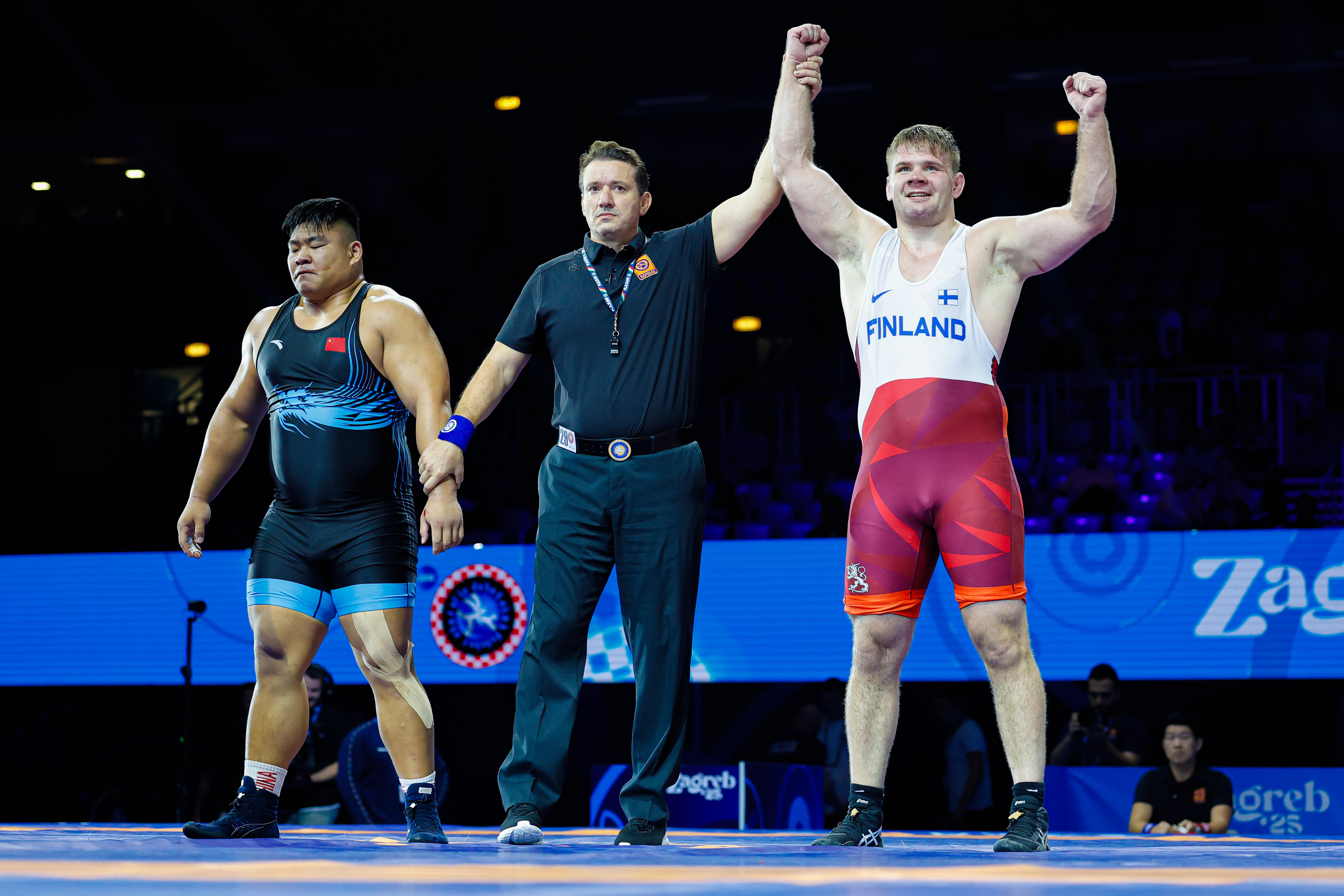 Elias KUOSMANEN (FIN) wins the bronze medal bout against Wenhao JIANG (CHN). (Photo: United World Wrestling / Kostadin Andonov)
Another country that ended a medal drought at the World Championships was Finland, as Elias KUOSMANEN (FIN) scored a late stepout to beat Wenhao JIANG (CHN) 3-3. It was Finland's first medal since 2011, when Rami HIETANIEMI (FIN) won bronze at 84kg.
Kousmanen led 1-1 on criteria thanks to an early stepout. His lead became 2-1 when he got the par terre position in the second period. But he failed to completely turn Jiang from par terre and gave up a stepout to fall behind 2-2 on criteria, and then lost the challenge to give one more point to Jiang.
Kousmanen, however, kept the pressure on and managed to get a stepout with 33 seconds left in the match. He defended his 3-3 criteria lead to win bronze, a first for Finland in any weight class above 90kg.
Pavel HLINCHUK (UWW) won a bronze medal at 130kg after he rolled to a 9-1 technical superiority win over Mykola KUCHMII (UKR). Hlinchuk, a world U23 champion at 97kg, jumped to 130kg last year and despite being only 110kg, managed to win a medal in the heaviest weight class.
At 77kg, Robert FRITSCH (HUN) upset Paris silver medalist Demeu ZHADRAYEV (KAZ), 6-5, to capture the bronze medal.
Fritsch trailed 5-0 at the break but launched a big four at the start of the second period to make it 5-4. A stepout made it 5-5 with Fritsch leading on criteria before he got the par terre which put him ahead 6-5.
Turkiye finally won its first medal of the World Championships from a male wrestler when Ahmet YILMAZ (TUR) defeated world U20 champion Alireza ABDEVALI (IRI) 6-3 for the the other 77kg bronze.
Four-time world champion Eldaniz AZIZLI (AZE) returned to win a bronze medal at 55kg by beating Ulan MURATBEK UULU (KGZ), 9-0, using turns from par terre to win his seventh world medal overall.
The other bronze went to China as Huoying SHI (CHN) used the third passivity to score two turns on Emin CAKIR (TUR) for a 5-1 win.
Day 7 Results
Greco-Roman
55kg (18 entries)
GOLD: Vakhtang LOLUA (GEO) df. Payam AHMADI (IRI), 9-7
BRONZE: Huoying SHI (CHN) df. Emin CAKIR (TUR), 5-1
BRONZE: Eldaniz AZIZLI (AZE) df. Ulan MURATBEK UULU (KGZ) by TF, 9-0, 1:53
60kg (25 entries)
SEMIFINAL: Aidos SULTANGALI (KAZ) df. Amiran SHAVADZE (GEO) by TF, 10-2, 5:57
SEMIFINAL: Alisher GANIEV (UZB) df. Georgij TIBILOV (SRB), 5-5
72kg (30 entries)
SEMIFINAL: Ulvu GANIZADE (AZE) df. Abdullo ALIEV (UZB), 5-0
SEMIFINAL: Ibrahim GHANEM (FRA) df. Merey MAULITKANOV (KAZ) by Fall, 5:49 (7-2)
77kg (33 entries)
GOLD: Malkhas AMOYAN (ARM) df. Nao KUSAKA (JPN) by TF, 10-1, 4:23
BRONZE: Ahmet YILMAZ (TUR) df. Alireza ABDEVALI (IRI), 6-3
BRONZE: Robert FRITSCH (HUN) df. Demeu ZHADRAYEV (KAZ), 6-5
82kg (26 entries)
GOLD: Gholamreza FAROKHI (IRI) df. Gela BOLKVADZE (GEO), 4-0
BRONZE: Taizo YOSHIDA (JPN) df. Adlet TIULIUBAEV (UWW), 3-3
BRONZE: Karlo KODRIC (CRO) df. Ramon BETSCHART (SUI), 5-0
97kg (29 entries)
SEMIFINAL: Mohammadhadi SARAVI (IRI) df. Kiryl MASKEVICH (UWW), 3-1
SEMIFINAL: Artur SARGSIAN (UWW) df. Murad AHMADIYEV (AZE), 1-1
130kg (27 entries)
GOLD: Amin MIRZAZADEH (IRI) df. Darius VITEK (HUN), 7-2
BRONZE: Pavel HLINCHUK (UWW) df. Mykola KUCHMII (UKR) by TF, 9-1, 4:09
BRONZE: Elias KUOSMANEN (FIN) df. Wenhao JIANG (CHN), 3-3
Share your thoughts.
Comments