BISHKEK, Kyrgyzstan (April 9) -- In what was turning out to be a miserable semifinal session for Japan, two-time Asian champion Nonoka OZAKI (JPN) restored normal order as she reached the 62kg final at the Asian Championships in Bishkek.
Japan saw two of its returning medalists -- Moe KIYOOKA (JPN) and Sara NATAMI (JPN) -- get pinned in their respective semifinals at 53kg and 57kg before Ozaki stepped on the mat for her own 62kg semifinal.
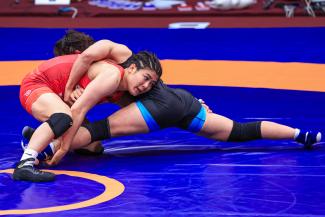
She left no room for error in securing a fall over Nigina SABIROVA (UZB) in just under two minutes. After grabbing a single-leg takedown, Ozaki spun behind for a 4-0 lead. She stayed on the offensive, getting an exposure before securing a cradle, by which she ended the match. Ozaki, who was dealt an upset loss herself last year when she had to settle for a bronze, will be look to add to the Asian titles she won in 2022 and 2024.
"[My condition] is not bad]," Ozaki said. "I didn't want to let up and was determined to keep fighting to the end. That's how I could have matches like my first one and this one. It went well."
If Ozaki wants to win the gold medal on Friday, Ozaki will have to beat one of the few wrestlers who have dealt her an international loss -- Hyon Gyong MUN (PRK).
The two had clashed in the final of the Asian Games in 2023 when Mun secured a 6-6 criteria win over Ozaki for the gold medal On Thursday, Mun reached the final with a dominant 11-0 victory over Tynys DUBEK (KAZ) using her strong gut-wrench sequences.
Ozaki is looking to the challenge of facing Mun again, especially a month before the Meiji Cup.
"This time, the [DPR] Korea team was entered in few weight classes," she said. "But looking ahead to the Meiji Cup, I came to this competition expecting to face opponents who are as strong as the top-class wrestlers in Japan."
Soon after Ozaki, two more Japanese wrestler made it to the finals. Nana IKEHATA (JPN) and Mahiro YOSHITAKE (JPN) will look to add golds to Japan's tally at 65kg and 72kg, respectively.
In the 65kg semifinals, a takedown in each period was enough for Ikehata to secure a 4-0 win over Hanbit LEE (KOR) and reach her first Asian Championships final. She will face LILI (CHN) for the gold medal.
Lili, a world bronze medalist in 2023, earned a shot at an Asian gold by muscling her way to a victory by fall over Firuza ESENBAEVA (UZB). Lili opened the scoring by shrugging by and getting behind for a takedown. After being put back on their feet, the two were on their knees when Esenbaeva suddenly found herself on her back, courtesy of a powerful pancake. The fall came at 2:09.
At 72kg, Yoshitake pinned HARSHITA (IND) in the semifinals. Harshita opened the scoring in the match with a takedown and she was working on a second one, when Yoshitake escaped and caught Harshita in a quad-pod. The Japanese then threw Harshita directly to danger to get four points. India challenged the call but lost it to give one more point to Yoshitake who led 5-2 at the break.
There was no more scoring sequence in the match until the last 15 seconds when Harshita tried to throw Yoshitake for a four-pointer. She almost succeeded but the Japanese did not land in danger and used a headlock to secure the fall just as the time expired.
Yoshitake will have to beat former 65kg world champion Jia LONG (CHN) to win the gold medal. Long defied the vocal home crowd and took out Nurzat NURTAEVA (KGZ) with an 11-1 win.
Long, who moved up from 68kg, struck first with a single-leg takedown and gut wrench, but gave up a reversal point when Nurtaeva stepped over on a second roll attempt, making it 4-1 at the break. In the second period, Long added a stepout, then whizzered Nurtaeva to her back in countering a takedown shot to make it 7-1. A scramble resulted in her getting behind for 2 more, from which she used her high gut wrench to end the match in 4:32. Long will get a chance at a second Asian gold, having won the 65kg title in 2023.
The two upsets for Japan came at 53kg and 57kg. In a rematch of the 2024 world final at 55kg, Jin ZHANG (CHN) avenged that loss in Tirana in devastating fashion by catching Kiyooka in a momentary lapse and securing a victory by fall in their 53kg semifinal in Bishkek.
Kiyooka, the silver medalist last year, opened with a low single for a takedown and a 2-0 lead. But when she shot in again later, Zhang put in double underhooks and pancaked the Japanese onto her back, ending the match at 2:32. Kiyooka, the 2024 champion at 55kg, will find little comfort in completing her collection of Asian medals with a bronze in Bishkek.
Jang will face MEENAKSHI (IND) in the gold medal bout on Friday. Meenakshi, who defeated two-time world bronze medalist ANTIM (IND) to make the team for the Asian Championships, booked her spot in the final after a 4-2 win over Seoyoung PARK (KOR). Down 2-0 till the last 30 seconds of the semifinals, Meenakshi used a slick pick to throw Park in danger for four points.
At 57kg, Khulan BATKHUYAG (MGL) was too much to handle for defending champion Sara NATAMI (JPN). She opened the scoring with a takedown and almost got a fall. However, the Japanese survived but not before giving up two points. A stepout for Natami cuts Batkhuyag's lead to 4-1 at the break.
Both wrestlers got into a bear hug in the second period but it is the Mongolian who managed to trip Natami and held the Japanese down for the fall.
Olympic bronze medalist Kexin HONG (CHN) will challenge Batkhuyag in the final. Hong overwhelmed Youngjin KWON (KOR) with a 10-0 win in 31 seconds.
Hong got a quick takedown and, as Kwon clinged to a leg, Hong reached back for the head and turned the Korean over. From there, she got an arm between the legs, lifted and chalked up three more exposures to end the match.
Hong's Bronze Age included taking home medals of that color at the 2023 Asian Games, 2024 Paris Olympics, 2025 Asian Championships and 2025 World Championships.
Qualification Session Higlights
12:46: LILI (CHN), a 2023 world bronze medalist, charges into the 65kg semifinals with a solid 10-0 win over former Asian bronze medalist Gulnura TASHTANBEKOVA (KGZ) that she completes with a takedown with two seconds left in the first period. Lili started the rout with a slick backwards trip for a 4-point takedown.
12:46: Nana IKEHATA (JPN), winner at the Zagreb Ranking Series and the 2024 world U20 champion, breaks open a close match with two-time world U23 bronze medalist MONIKA (IND) in the final minute of their 65kg quarterfinal, scoring a takedown, arm-bar exposure and two lace-lock rolls for a 10-1 victory.
12:41: Firuza ESENBAEVA (UZB) opens with a 4-point takedown, and that will prove crucial when Narkhajid NYAMSUREN (MGL) continually chipped away at the lead in their 65kg quarterfinal.
12:40: Defending champion at 57kg Sara NATAMI (JPN) muscles her way into the semifinals with a 13-2 technical superiority over Nilufar RAIMOVA (KAZ). She scored a stepout before blocking an arm-spin from Raimova to score a takedown during the Kazakhstan wrestler's activity time, making her lead 4-0. Raimova began the second period completing the arm-spin and getting two points. Natami regroups and pancakes Raimova for four points before turning her for two more. She finishes the match 12-2 with a takedown and one more point for a lost challenge.
12:37: Asian Games champion Hyon Gyong MUN (PRK) spins behind for a takedown early in the second period and holds on for a 3-0 victory over former world bronze medalist MANSI (IND) to advance to the 62kg quarterfinals.
12:27: MANISHA (IND), the 62kg champion last year who has dropped all the way down to 57kg, falls at the first hurdle, sent to an 8-2 defeat by Khulan BATKHUYAG (MGL) in their quarterfinal clash.
12:21: Two-time world champion and Olympic bronze medalist Nonoka OZAKI (JPN) looks like a woman on a mission as she aims to make up for a bronze-medal finish last year. In what could have been regarded as the marquee matchup of the session, Ozaki puts on a takedown clinic in forging out a 10-0 victory over former world and Asian champion Qi ZHANG (CHN) to advance to the 62kg semifinals. Ozaki gains her fifth takedown of the match at the 2:37 mark.
12:20: Former Asian champion Zhamila BAKBERGENOVA (KAZ) drops her 72kg bout against HARSHITA (IND) despite on a scoring spree in the final minute. Down 6-2, Bakbergenova scored a stepout and a takedown to make it 6-5. She tried got another stepout just as the clock expired which made the score 6-6 but Harshita kept the criteria. Kazakhstan challenged for a foul but on review, even the last stepout point was removed as Harshita was still inside when the time expired. That made Harshita a 6-5 winner.
12:17: World, Asian and Olympic bronze medalist Kexin HONG (CHN) quickly secures her spot in the 57kg semifinals, gaining a takedown against Thi My Trang NGUYEN (VIE), securing a lace lock and getting the requisite four spins for a 10-0 win :35.
12:06: Former world and Asian champion Moe KIYOOKA (JPN), aiming to improve on her silver medal from last year, faces stiff resistance from 2025 bronze medalist Zeinep BAYANOVA (KAZ) in their 53kg quarterfinal, but grinds out a 10-0 win that she finishes with a takedown at 3:58.
12:05: Mahiro YOSHITAKE (JPN), the 2024 Asian champion at 65kg, is into the 72kg semifinals with victory by fall over Sevinchoy POLVONOVA (UZB). Yoshitake gets a 2-point exposure countering a takedown attempt, then turns Polvonova to secure the fall in 1:50.
12:01: Jia LONG (CHN), owner of a full collection of world medals and an Asian champion in 2023, finishes off a 10-0 win over Odgerel ERDENE OCHIR (MGL) just inside the first-period buzzer to book her place in the 72kg semifinals.
12:00: Asian Games champion Hyon Gyong MUN (PRK) and former world champion Tserenchimed SUKHEE (MGL) don't give any chance but Sukhee is called passive in the second period and Mun gets a 2-1 lead. She holds on to that lead to win the 62kg bout.
11:59: World bronze medalist Nurzat NURTAEVA (KGZ) breaks through the defense of Soobin KIM (KOR) for a single-leg takedown, then applies the lace lock and that's all she wrote in their 72kg qualification round match. Four quick spins and Nurtaeva is a 10-0 winner and into the semifinals.
11:55: It was a repechage bout but Paris bronze medalist Ziqi FENG (CHN) and Asian bronze medalist NEELAM (IND) put on one of the most exciting bouts of the tournament. Feng had a comfortable 8-2 lead but Neelam found a way to score a takedown and two turns to take an 8-8 criteria lead with just about a minute remaining. But Feng stepped over in a scramble to get a two points and lead 10-8. However, Neelam also exposed Feng and she was awarded two points making her a 10-10 winner. China challenged the call as it may have been after the time expired. On review, it was called no points as the clock did it zero before the Feng was in danger. Neelam is distraught while Feng will wrestle for a bronze medal later
11:41: Defending Asian champion Sara NATAMI (JPN) fell behind against Laylokhon SABIROVA (UZB), 2-2, on criteria with more than a minute remaining but Natami with an exposure and then holds Sabirova's back on the mat to claim a fall and advance to the 57kg quarterfinals.
11:39: Blink and you missed the 10-0 whitewashing by returning bronze medalist and former champion Qi ZHANG (CHN) of Dilnaz SAZANOVA (KGZ) at 62kg. Zhang gets a quick takedown and uses a trap arm to turn her opponent four times.
11:37: Former world and Asian silver medalist Khulan BATKHUYAG (MGL) gets her campaign at 57kg off to a strong start with a 10-0 over Tancholpon KYBALBEKOVA (KGZ), needing just 1:10 to complete the rout.
11:35: Aziza KELDIBEKOVA (KGZ) gets the ball rolling for the home team with a 12-1 win at 53kg over Pabasara GAMAGE (SRI). After a takedown and two exposures, Keldibekova is close to scoring another tilt when Gamage goes over the back and gets a reversal. But Keldibekova repeats her initial sequence and she's into the quarterfinals.
11:34: Sakibjamal ESBOSYNOVA (UZB) gets the action started on Mat A with a 30-seconc fall of Ya Hsin CHEN (TPE) in their 53kg qualification-round bout.
11:30: Asian Championships third day and we have five more Women's Wrestling weight classes in action. Japan had four finalists on Wednesday. Will it continue it's hot streak?



Share your thoughts.
Comments