

NF Roundup Blog, Nov. 30 - Dec. 4
Monday, November 30, 2020 - 13:07 By United World Wrestling Press

By Vinay Siwach
India have witnessed many celebrity weddings in the last couple of years. Bollywood movie 'Dangal' fame wrestlers Geeta Phogat and Babita Phogat married fellow wrestlers. So did their cousin and India's most successful female wrestler Vinesh Phogat.
Now, India's three-time World Championship medalist Bajrang Punia has tied the nuptial knot on November 25 in a restricted ceremony in northern state of Haryana.
Incidentally, he married youngest sister of Phogat family Sangeeta, a Asian Championship bronze medalist from 2018. The two were in a relationship for the last three years.
The wedding was held in traditional north-Indian manner with festivities going on for four days. Punia hosted the function at his home in Sonipat district of Haryana while Phogat was in Balali village, Charkhi Dadri district, of the same state.
The 65kg wrestler, who has decided to skip the Individual World Cup in Belgrade, Serbia next month, will travel to the United States for a training camp at Cliff Keen Wrestling Club in Michigan. He will also wrestle at the FloWrestling's 8-man challenge on December 18. Punia has already qualified the weight category for the Tokyo Olympics.
Phogat, who has been out of action for the last couple of years, is gearing up for return next year with the Asian Championship next year in February in the Olympic weight category of 62kg. India are yet to qualify the weight for the Olympics. This presents her the opportunity to win the national trials and compete at the Asian Olympic qualifiers scheduled to be held in Xi'an, China in March, 2021.

Yuka Kagami (Toyo Univ.), Who has high expectations for post Minagawa, won the first title after going on to school.
by Ken Marantz
Miwa MORIKAWA and Yuka KAGAMI, two of Japan's top future women prospects in the upper weights with an impressive list of world age-group titles, returned to competition from long pandemic-induced layoffs by winning titles at the East Japan Collegiate Championships.
Both only needed one victory to secure gold medals in the tournament held at Tokyo's Komazawa Gym on Nov. 24, which they entered as a warmup for the Emperor's Cup All-Japan Championships next month.
Nippon Sport Science University's Morikawa, who came close to snatching Japan's 68kg spot at the Tokyo Olympics from Rio 2016 champion Sara DOSHO, needed just 38 seconds to overwhelm Kokushikan University's Chinae MUTO by 10-0 technical fall at 65kg.
"It had been this long since my last match in the playoff, but I wanted to get some action in before the Emperor's Cup," Morikawa said. "I was glad to be have a solid match."
Kagami, making her delayed collegiate debut as a Toyo University freshman, scored five takedowns in topping Daito Bunka's Mizuki NAGASHIMA by 12-2 technical fall in the 76kg final.
Kagami finished the match with a gut-wrench roll, but rued her lack of points from the top position against the bigger opponent. "I don't feel like [she] was heavy. This time, I was a bit nervous and didn't move well."
Morikawa, the 2019 world junior champion at 65kg, had moved up to 68kg last year in attempt to depose Dosho, who had earned the Olympic spot for Japan by finishing fifth at the World Championships in Nur-Sultan.
Morikawa came close. She shocked Dosho at last year's All-Japan Championships by thrashing her 9-2 in the semifinals, then went on to win the title with a 2-1 win over Naruyo MATSUYUKI in the final.
That set up a playoff on March 8 for the 68kg berth between Morikawa and Dosho, which Morikawa was unable to repeat her victory and Dosho came out with a 3-1 win.
That would prove to be Morikawa's last live action before the East Japan tournament, where she captured a third straight title.
"Up to now, I was always at 65kg as a junior," Morikawa said. "[Last year], as 68kg is an Olympic weight, Coach [Chikara] TANABE pushed me to make the challenge at the All Japan, so I moved up. Going back to my regular weight class, I came out with the win and want to ride that to the All Japan."
Kagami, the world junior and U23 champion last year at 72kg and 76kg, respectively, looks to have made a permanent move to the heavier weight class as she sets her sights on the Paris 2024 Olympics.
Kagami is a product of the JOC Elite Academy, and has supplemented her training by working out with the group at its National Training Center base. She joins in morning practice, then either trains at Toyo--where she often spars with the lightweight men--or returns in the afternoon for a second session.
"Since I started college, the amount of practice time is less," said Kagami, a former two-time world cadet champion who also won the senior Asian gold last year. "I tried to think of ways to make up for it. I arranged with the Academy to let me join practice there, so I was able to train as usual."
In fact, Kagami said the main reason she chose Toyo, as opposed to powerhouse Shigakkan or another strong wrestling school, was because of its proximity to the NTC---just a 3km bicycle ride away.
"The main reason I chose Toyo is because it's somewhat close to the Academy," said Kagami, who is studying media communications. "When I got to college, I thought I might tend to relax. But with the Academy close, I knew I wouldn't let up, so I chose it."
Living in the college dormitory, Kagami likes her new freedom. But she also keeps her feet on the ground when it comes to her commitment to wrestling.
"There is a fun side to it," she said in regard to college life. "But I know I have to keep in mind that if I don't do what I need to do, I will decline [physically]. It's a little hard to resist temptation."
In other finals, 2018 world cadet champion Sakura MOTOKI of Ikuei University scored a decisive 6-1 victory over world U23 champion Yumeka TANABE of NSSU for the 59kg gold.
At 62kg, 2018 world junior champion Atena KODAMA of Waseda University won her second straight title, but it didn't come easy. She needed two takedowns in the final 20 seconds to beat NSSU's Rin MIYAGI 6-5 in the semifinals, then secured a second-period takedown for a 3-2 win in the final over NSSU's Mahiro YOSHITAKE.
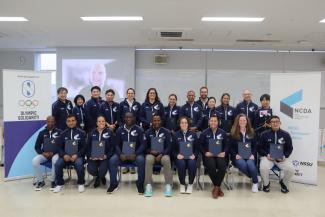
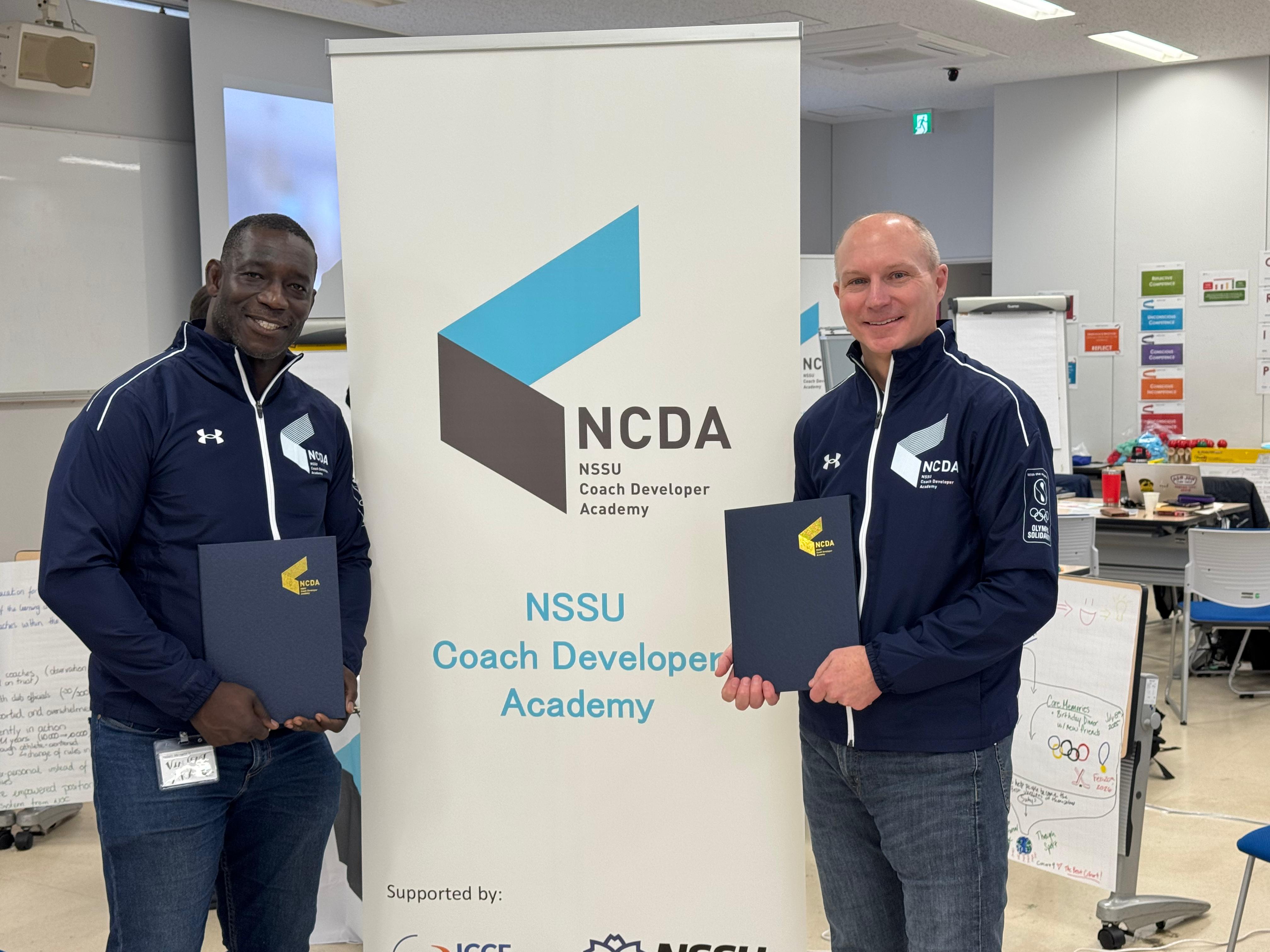 UWW Educators Vincent AKA, left, and Zach ERRETT.
Share your thoughts.
Comments