

Nasibov hopes to build on golden start in Olympic year
Thursday, February 1, 2024 - 20:21 By Vinay Siwach

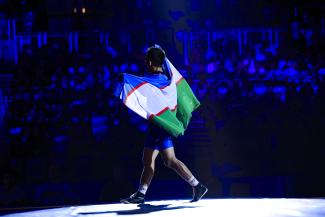
BUCHAREST, Romania (February 1) -- Parviz NASIBOV (UKR) was never under the spotlight. Not until he reached the final of the Tokyo Olympics in 2021 and won a silver medal.
For Tokyo, he qualified at the World Olympic Qualifier in Sofia, the last of the qualifiers and the only chance he got. But as he prepares to qualify for the Paris Olympics, Nasibov is on the radar of his opponents.
He lost in the first round of the World Championships last year and is yet to win a UWW tournament. But in the season-opening Ranking Series Zagreb Open, Nasibov seemed to find his form and gear up for the Olympic year.
Wrestling in Zagreb, Nasibov won gold in 67kg after beating world silver medalist Hasrat JAFAROV (AZE) in the semifinal and Gagik SNJOYAN (FRA) in the final.
"It’s important for me to try myself [in such tournaments] before the important one," Nasibov said. "I think this Ranking series event is more or less similar to the World championships level, because most of the leaders were present here in our weight class."
In a 34-wrestler bracket, Nasibov got past 2023 Zagreb Open champion HUSIYUETU (CHN), Lei LI (CHN) and U20 world champion Moustafa ALAMELDIN (EGY) before beating Jafarov and Snjoyan. Nasibov later said that he expected Jafarov to come out strong in the semifinal.
"We have done research on that athlete together with the coaches," he said. "That’s why I got everything I had expected from him. He is a good guy, he is young and prospective."
Nasibov also hoped to face world champion Luis ORTA (CUB) in Zagreb but Orta pulled out of the competition. Orta won the 67kg world title in Belgrade, completing a successful switch from 60kg, a weight class in which he won the gold medal in Tokyo.
"Orta is a very good opponent. I met his at the training camp," Nasibov said. "But you know we are wrestling at such a high level that we are all pretty much similar. The one who thinks better and stays calmer will win. That’s why, I respect him a lot and can’t wait to meet him."
Nasibov has got a golden start to the season and would like to continue that at the European Championships in Bucharest, Romania from February 12 to 19. He will hope to win his first European title at 72kg as he is entered in the non-Olympic weight class. And later the qualifying event in Baku in April.
"At the 2023 European Championships I was the third," he said. "The qualifying world championships was unsuccessful for me. I lost my first match. The main event is ahead. I need a quota for Paris Olympic Games, I will do my best to get it and repeat my Tokyo result and maybe even improve. I believe in it and I do my best to be there."
Share your thoughts.
Comments