

Motoki moves up to stun Ozaki; Otoguro, Fujinami, Fumita all prevail
Sunday, December 25, 2022 - 14:42 By Ken Marantz

TOKYO (December 25) -- In a tournament that had its share of shocks, none was as stunning as the one pulled off in the finale by Sakura MOTOKI, who followed up her upset of the Olympic champion at women's 62kg by taking down the reigning world champion.
Motoki, moving up to the Olympic weight class from 59kg, handed world champion Nonoka OZAKI her first domestic loss in four years with a come-from-behind 4-2 victory in the final at the Emperor's Cup All-Japan Championships on Sunday at Tokyo.
"Since losing at the World Championships, I've thought for the last three months of winning here and I'm happy I was able to pull it off," said Motoki, who won a world bronze medal at 59kg in Belgrade in September a month after winning the world U20 gold.
The other featured finals went according to form, with Olympic champion Takuto OTOGURO and former world champions Akari FUJINAMI and Kenichiro FUMITA all emerging victorious on the last day of the four-day tournament that is also serving as the first domestic qualifier for next year's World Championships, to also be held in Belgrade.
Otoguro, appearing in his first competition since winning the gold medal at the Tokyo Olympics at freestyle 65kg, finished up an unscored-upon run to his third national title and first since 2019 with a 4-0 victory over world U23 bronze medalist Ryoma ANRAKU.
Teen phenom Fujinami, returning from a spate of injuries that cause her to withdraw from both the senior and U20 worlds, captured her third straight title at women's 53kg with a 5-0 victory over a rejuvenated Haruna OKUNO that also extended her current winning streak to 106.
Okuno had pulled off one of the tournament's upsets by knocking off Olympic champion Mayu SHIDOCHI in the semifinals on Saturday.
Olympic silver medalist Fumita continued an unusual pattern of winning in even-numbered years, defeating Maito KAWANA in the Greco 60kg final to add to the titles he won in 2016, 2018 and 2020.
The victorious wrestlers moved halfway to securing spots on the world team to Belgrade, where, for those in the Olympic weight classes, the first qualifying berths for the 2024 Paris Olympics will be at stake.
The losers will get another chance at the second domestic qualifier, the Meiji Cup All-Japan Invitational Championships in June, where a victory will set up a playoff with the Emperor's Cup champions.
 Sakura MOTOKI became the first Japanese to beat Nonoka OZAKI in four years with a victory in the women's 62kg final. (Photo: Takeo Yabuki/Japan Wrestling Federation)
The Japan federation has sweetened the pot for making the team to the Belgrade worlds, as a medal there in an Olympic weight means an automatic ticket for that wrestler to Paris. For women, in particular, the sense of urgency for getting to Belgrade is high.
Motoki has her own incentive for getting to the Olympics. Since she started wrestling at age 3, the Ikuei University student has been aiming to follow in the footsteps of her father, Yasutoshi, who competed at the 2000 Sydney Olympics, where he placed ninth at Greco 63kg.
"My father had a tough road leading up to the Olympics, with injuries and losses along the way," the 20-year-old Motoki said. "I expected to have the same hard road. So like my father, I will never give up until the end so I can get to the Olympics."
Such conviction was on full display against Ozaki when Motoki trailed 2-0 in the second period, having given up a pair of activity points. Motoki cut the lead with a stepout, then clinched the win with a duck-under takedown with :24 left.
Ozaki made a desperate attempt for the winning takedown when she tried to spin behind in the final seconds, but Motoki managed to hold on for the victory. An unsuccessful challenge added the final point.
"In the three months after the World Championships, I feel I've made progress technique-wise and mentally," Motoki said. "I wasn't confident of being the strongest at 62kg, but I was confident that I was stronger compared to where I was at the World Championships."
It was in Belgrade that Motoki suffered a disappointing loss that, upon reflection, indirectly laid the groundwork for her win over Ozaki.
In the semifinals, Motoki had taken the lead against Anastasia NICHITA (MDA), only to be reversed to her back late in the match and eventually lose 7-5. Motoki had tried desperately to score at the end, which she later realized was a losing strategy.
"In the last 30 seconds, I was haphazardly trying anything and I couldn't win, which I later regretted," Motoki said. "I practiced a lot looking at how much time was left and thinking about what to do, and I think that paid off today."
The victory came in the wake of her 9-2 victory in the semifinals over Olympic champion Yukako KAWAI, who later revealed she had not fully recovered from a back injury that had forced her to withdraw from a domestic tournament in October.
"Looking just at results, Kawai and Ozaki are above me," Motoki said. "I finished third at the World Championships in a non-Olympic weight class. They have the gold medals from the Olympics and World Championships that I am aiming for. I saw myself as the challenger."
The 19-year-old Ozaki was left in tears, having come into the tournament on an amazing roll that included a win over Kawai at the Meiji Cup last May. In a three-month span this fall, she picked up in succession the world U20, senior and U23 golds.
"I always try to be aggressive in my wrestling, and when I try to think about what was lacking today, I don't know," said Ozaki, whose last loss to a fellow Japanese was in the semifinals of the inter-high school championships in August 2018 to Yuzuka INAGAKI.
Looking ahead to the Meiji Cup, Ozaki said, "There is nothing beyond that. I have to change gears and make next year mine."
 Takuto OTOGURO works to score a takedown against Ryoma ANRAKU in the freestyle 65kg final. (Photo: Takeo Yabuki/Japan Wrestling Federation)
Otoguro, the 2018 world champion, showed no rust from the 14 months he had been away from competition, as he wrestled a solid match against a formidable opponent in Anraku.
After gaining an activity point, Otoguro showed one of his best traits of quickly transitioning to score a takedown off a single-leg attack that Anraku fiercely resisted. In a tense second period with few attacks, Otoguro added a stepout at the buzzer.
"Today and yesterday, I had three matches in my first tournament in a while," Otoguro said. "As it went on, it got more enjoyable. I was able to beat strong opponents, so I think it was a good performance."
Otoguro said that he considered his time away from the mat as a positive. "There were no real drawbacks," he said. "Instead, I was able to focus on this tournament. There were only good aspects."
In Otoguro's absence, a new young champion has emerged in Rahman AMOUZAD (IRI). Otoguro said he did not watch this year's World Championships, but is aware of the Iranian. As for a possible meeting at this year's Asian Championships, Otoguro, who won back-to-back Asian titles in 2020 and 2021, would not commit.
"I'll talk it over with my coach," he said. "If I have the chance, I want to get started on having international matches."
 Akari FUJINAMI shoots for a takedown in the women's 53kg final against Haruna OKUNO. (Photo: Takeo Yabuki/Japan Wrestling Federation)
Fujinami's absence from the competition was not her choice, as a foot injury kept her from defending her senior world title in Belgrade and a knee injury forced her out of the world U20.
That meant she had not had a match since the national collegiate championships in August, where she won the 55kg title.
"Even though I was confident," Fujinami said. "I had had a series of injuries and there was a time I couldn't compete, so there was also uncertainty as well as pressure. I'm glad I could still come out with the win."
In the final, Fujinami used her low single attack to score takedowns in both periods and fend off all attacks to defeat Okuno for the fourth time in four career meetings, most recently a 4-0 win in the Meiji Cup final.
"I expected her to come up with a strategy, but I'm confident of my training and I put it all out on the mat," Fujinami said.
 Kenichi FUMITA positions himself for a throw in the Greco 60kg final against Maito KAWANA. (Photo: Takeo Yabuki/Japan Wrestling Federation)
For Fumita, winning the Greco 60kg gold for his fourth career title and first since 2020 helped restore the good name of the Nippon Sports Science University (NSSU) alumni in Greco, which was dealt a number of setbacks earlier in the tournament.
Olympic bronze medalist Shohei YABIKU lost in the third-place match at 77kg, while Katsuaki ENDO failed to defend his title at 67kg with a loss in the final.
"Overall, it hadn't been a good tournament for the alumni from Nittaidai, for Shohei and Katsuaki," Fumita said, using the familiar term for NSSU. "In Greco, we have wrestled poorly."
Fumita, the 2017 and 2019 world champion who had to settle for a bronze this year, scored three points in each period for a 6-0 victory over Maito KAWANA to restore NSSU to good standing. He had a gut wrench from par terre in the first period and a takedown and stepout in the second.
It was far better than his opening match when he got thrown for 4 in a 7-4 victory over Kaito INABA, a current student at NSSU.
"In my first match yesterday, the bad side of me came out," Fumita said. "After that, I thought I had to turn it around and stop the bad flow so I aimed to get a good result. And I won and took a step closer to Paris."
 In-laws Shota TANOKURA and Mayu SHIDOCHI indicate the place each took in the tournament. (Photo: Takeo Yabuki/Japan Wrestling Federation)
Tanokura takes bronze in return pushed by in-law
One of the more interesting stories of the tournament culminated with former Asian champion Shota TANOKURA taking third place at Greco 55kg in his return from a four-year absence.
The 32-year-old Tanokura, currently the coach at Tokyo's Jiyugaoka Gakuen High School, was urged to give it another whirl by a family member, who just happens to be Shidochi. Tanokura's wife is the younger sister of Shidochi's husband and coach, Shota SHIDOCHI -- a classmate of Tanokura's at NSSU.
"'Let's go to [the] Paris [Olympics] together,'" Tanokura said was the line that Mayu used to pester him into returning to competition. "'Do it one more time.'"
Tanokura agreed, not so much over his own desire to make the Olympics but to assuage Mayu. "I wasn't thinking of Paris, but Mayu wanted to us to go together," he said. "If I went, she said it would give her mental strength."
He qualified for the Emperor's Cup by winning the title at the All-Japan Non-Student Championships in October. That was his first competition since placing eighth at 55kg at the 2018 World Championships in Budapest.
Tanokura won the Asian gold earlier that year in Bishkek, beating local favorite Zholoman SHARSHENBEKOV (KGZ) in the final. He also came away with the gold in his most recent Emperor's Cup appearance in 2017, adding to the titles he won in 2012 and 2013.
In Sunday's bronze-medal match, Tanokura showed some of his old magic with a majestic five-point throw in a 7-4 victory over collegian Yuto GOMI.
"I'm really happy," Tanokura said of coming away with a bronze, which qualifies him for the Meiji Cup. He is still undecided whether he will enter that tournament. "If I enter, I'll give it my all. Right now I'm torn. If my family pushes it, I might do it."
In the quarterfinals, Tanokura executed a nifty duck-under-and-lift that sent Kawana sailing head over heels and onto his back for 4 points, but he still came out on the short end of a 7-4 decision.
"That's the level I am at now," Tanokura said. "I didn't practice and you can't take matches lightly."
Tanokura's lone regret was that he didn't get to face either Fumita or Yu SHIOTANI, his former team member at Jiyugaoka Gakuen and a world 55kg bronze medalist, who had moved up to the Olympic weight class but lost to Gomi in his opening match.
 Mayu SHIDOCHI records a fall over Yumi SHIMONO in a women's 53kg bronze-medal match. (Photo: Takeo Yabuki/Japan Wrestling Federation)
As it turned out, bronze became the family color of the day as Shidochi bounced back from her stunning loss to Okuno to finish third at women's 53kg with a victory by fall over collegiate champion Yumi SHIMONO.
"Finishing up with a win is good leading up to the Meiji Cup," Shidochi said. "I'm glad I was able to turn it around. In the past, I wasn't able to do that."
Shidochi led 2-0 after receiving activity points in both the first and second periods, then fought off a Shimono takedown attempt that would have put her behind. When Shimono shot again, Shidochi straightened her up and pancaked her to her back, notching the fall at 4:59.
"The new generation of wrestlers are getting stronger," the 25-year-old Shidochi said. "They are providing the motivation for me to train hard to beat them. The Tokyo Olympics are in the past."
Shidochi knows that to have any chance of defending her Olympic gold, she will first have to face and defeat Fujinami.
"She's a really strong athlete, with a long reach and good speed," Shidochi said. "She's at the top of the world. To get to Paris, I have to beat her. Even for Fujinami, the 53kg class is deep."
Day 4 Results
Freestyle
61kg (14 entries)
Gold - Kodai OGAWA df. Hayato FUJITA, 7-0
Bronze - Kaito MORITA df. Kazuya KOYANAGI by TF, 11-0, 2:21
Bronze - Taichi YAMAGUCHI df. Kosei KANEKO, 10-8
Semifinal - Kodai OGAWA df. Kazuya KOYANAGI, 10-4
Semifinal - Hayato FUJITA df. Kosei KANEKO by TF, 14-4, 4:25
65kg (14 entries)
Gold - Takuto OTOGURO df. Ryoma ANRAKU, 4-0
Bronze - Kaiji OGINO df. Kenho UTO by TF, 11-0, 6:00
Bronze - Kotaro KIYOOKA df. Yujiro UENO, 14-6
Greco-Roman
60kg (11 entries)
Gold - Kenichiro FUMITA df. Maito KAWANA, 6-0
Bronze - Kaito INABA df. Kosei TAKESHITA by TF, 11-1, 4:22
Bronze - Shota TANOKURA df. Yuto GOMI, 7-4
72kg (11 entries)
Gold - Taishi HORIE df. Shoki NAKADA by TF, 9-0, 3:32
Bronze - Daigo KOBAYASHI df. Seiya TERADA by Fall, 4:03 (7-3)
Bronze - Tetsuto KANUKA df. Yuga KASUGAI, 9-5
Semifinal - Taishi HORIE df. Daigo KOBAYASHI, 3-1
Semifinal - Shoki NAKADA df. Tetsuto KANUKA, 7-1
Women
53kg (9 entries)
Gold - Akari FUJINAMI df. Haruna OKUNO, 5-0
Bronze - Mako ONO df. Nagisa HARADA, 6-0
Bronze - Mayu SHIDOCHI df. Yumi SHIMONO by Fall, 4:59 (6-0)
62kg (11 entries)
Gold - Sakura MOTOKI df. Nonoka OZAKI, 4-2
Bronze - Naomi RUIKE df. Nayu UCHIDA by Fall, 5:58 (10-0)
Bronze - Kiwa IWASAWA df. Yukako KAWAI by Def.
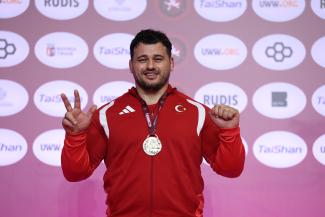
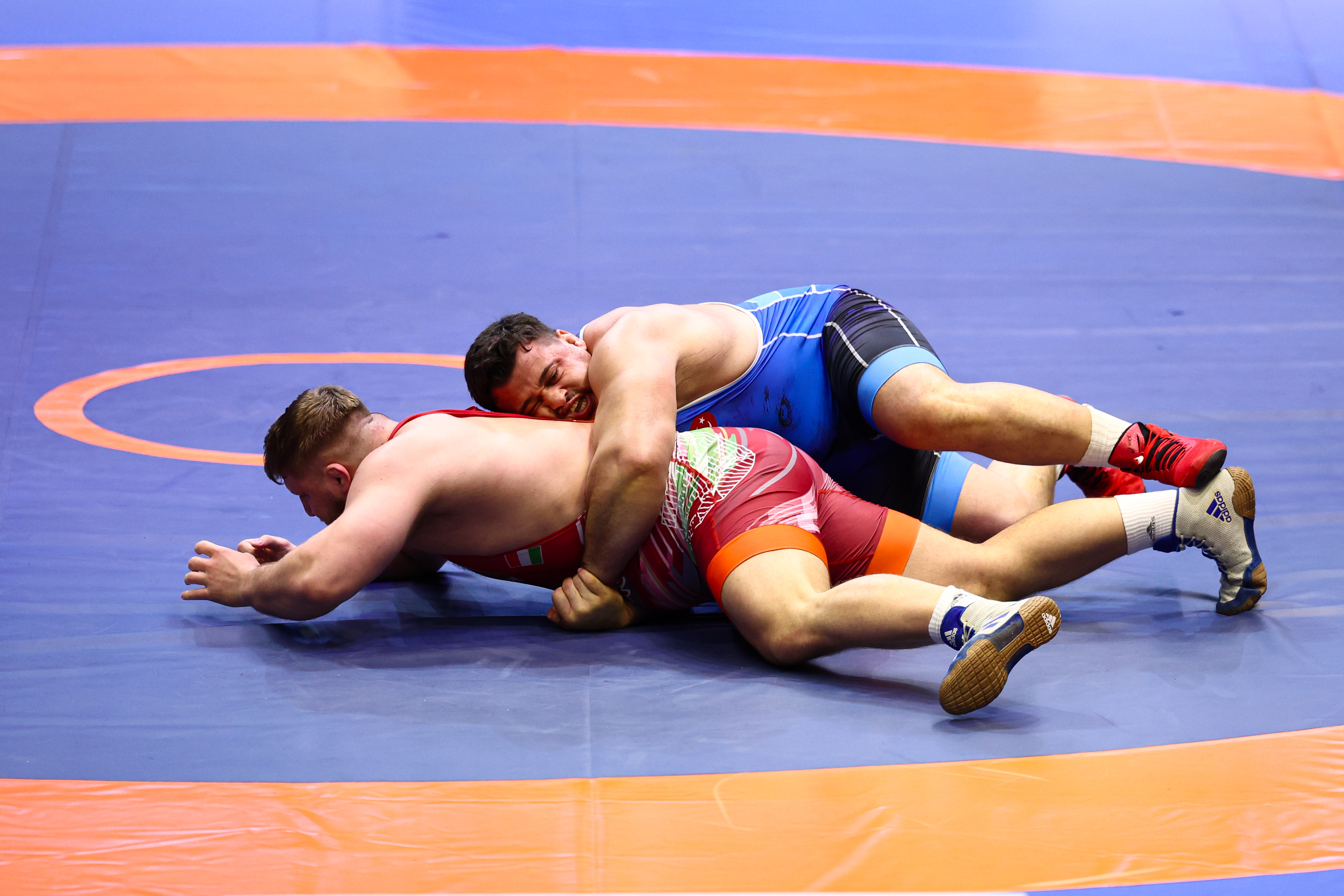 Riza KAYAALP (TUR) turns Darius VITEK (HUN) in the 130kg final. (Photo: United World Wrestling / Kadir Caliskan)
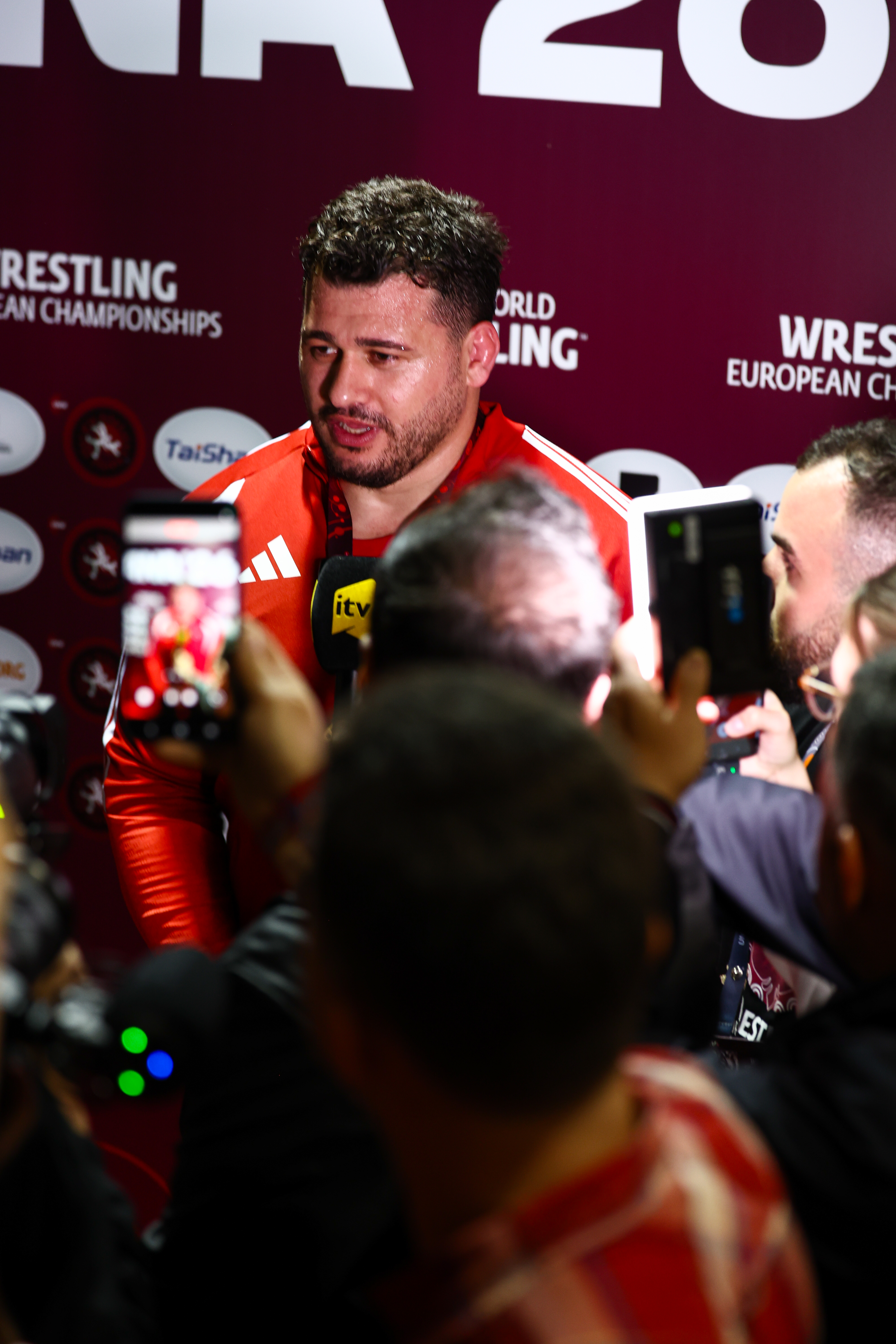 Riza KAYAALP (TUR) speaks to the media after winning the gold medal at the European Championships. (United World Wrestling / Jake Kirkman)
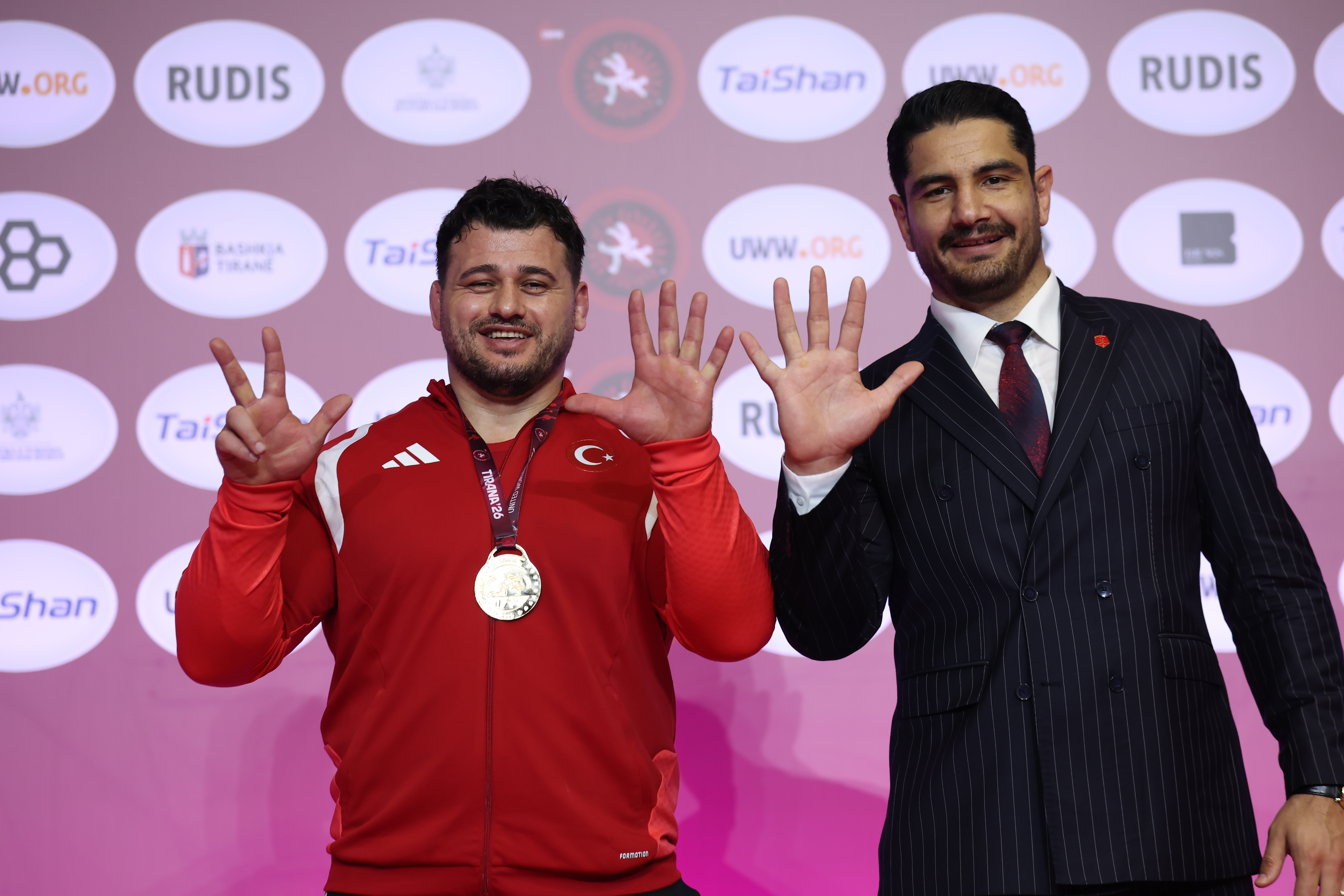 Riza KAYAALP (TUR) with Taha AKGUL (TUR) at the medal ceremony in Tirana. (Photo: United World Wrestling / Kadir Caliskan)
Share your thoughts.
Comments