

#Trnava2018

Komarov Chasing Fourth World Title

By Eric Olanowski

TRNAVA, Slovakia (September) - The 2018 Junior World Championships kick off September 17-23 and nearly 265 Greco-Roman wrestlers from 43 nations will make the journey to Trnava, Slovakia with hopes of becoming a Junior World Champion. 

Kamal BEY (USA), Kerem KAMAL (TUR), Amin KAVIYANINEJAD (IRI), and Aleksander KOMAROV (RUS) will all make the trek to Trnava with hopes of defending their titles from last year’s Tampere Junior World Championships. 

Aleksander Komarov, the three-time age-level world champion and most decorated age-level wrestler in the world wasn’t registered to represent Russia’s Greco-Roman Trnava squad at 82kg. Instead, Russia registered Shamil OZHAEV (RUS) at 82kg but has since changed their mind and entered Komarov. 

Komarov is the overwhelming favorite to win the 82kg gold medal, which would make it his fourth age-level world title. 

Since stepping on the World scene in 2015, he’s won every Cadet, Junior, and Senior tournament that he’s entered. In addition to the previously mentioned three age-level world titles, Komarov has won four European championships and four Senior-level tournaments. 

The tall task of handing Komarov his first international loss will be placed on the back of 2017 Cadet World finalist, Istvan TAKACS (HUN). Takacs will be representing Hungary at the age-level World Championships for the third time in as many years. 

Meanwhile, American Kamal Bey will have the toughest road to repeat as Junior World Champion, as every 74kg medalist from last year’s Tampere World Championships is listed alongside Bey at 77kg. 

Of the returning 74kg Tampere medalists, none will be targeting Bey more than 2017 runner-up, Akzhol MAKHMUDOV (KGZ). Bey defeated Makhmudov, 16-11 in the epic 27 points gold medal shootout that was voted as United World Wrestling’s No. 2 2017 Greco-Roman Match of the Year.

The reigning Tampere bronze medalists that are enrolled at 77kg are Nasir HASANOV (AZE) and Sajan SAJAN (IND). 

Sajan, India's four-time World representative will be competing for the first time since his gold medal performance at the New Delhi Junior Asian Championships. In the finals, Sajan defeated Iran's Shayan Hossein AFIFI (IRI), 3-0, claiming the 77kg gold medal. 

Rounding out the returning medalists at this weight is Nasir Hasanov who will be looking for his third straight age-level World medal after taking second at the 2016 Cadet World Championships and third a year ago at the Junior World Championships. 

Though the other two returning champions Kerem Kamal and Amin Kaviyaninejad will be tested, no returning Cadet or Junior world medalists are set to compete at 60kg and 72kg respectively. 
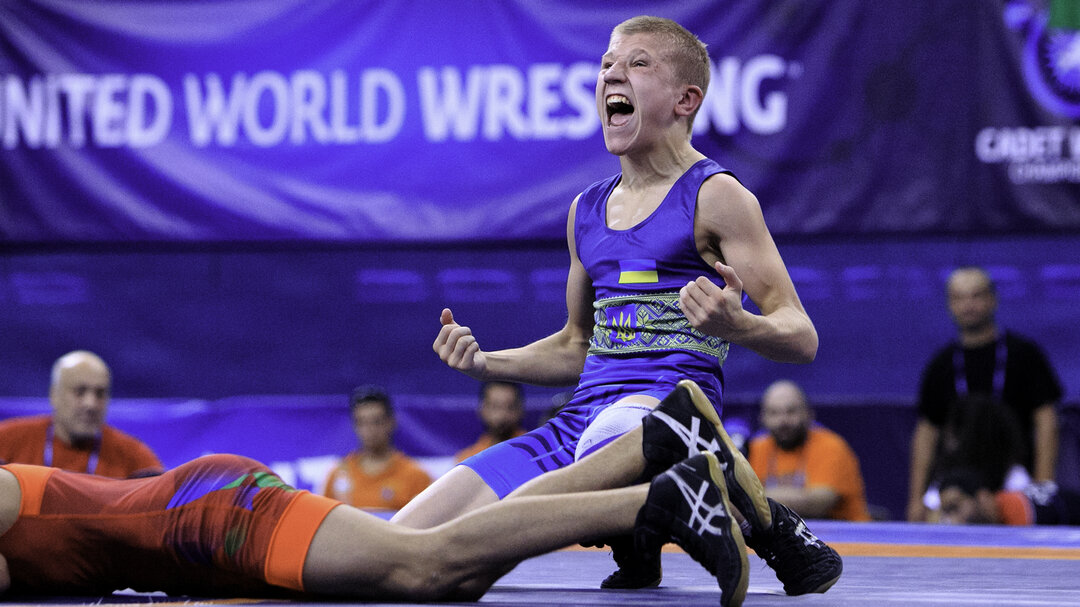

Vladyslav KUZKO (UKR) celebrates after winning the 2017 Cadet World Championships. (Photo by Martin Gabor) 

In addition to the four reigning Junior World champions, Cadet World champions Vladyslav KUZKO (UKR) and Cohlton SCHULTZ (USA) are also entered into the Trnava field. 

Kuzko will compete at 55kg, while Schultz is registered at 130kg. 

Greco-Roman action will kick off the World Championships on Monday, September 17 and will be wrestled through Wednesday, September 19.
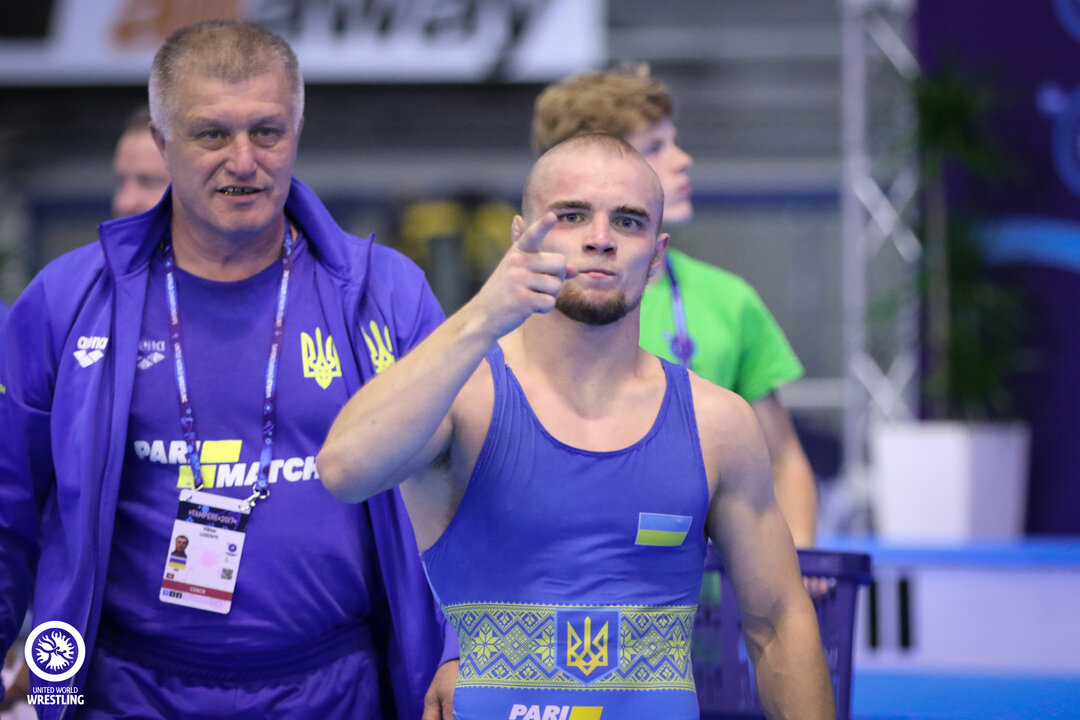

Oleksandr HRUSHYN (UKR), last year's Junior World runner-up. (Photo by Marion Stein)

Other World Medalists in Action 
63kg
Oleksandr HRUSHYN (UKR) - Junior World silver medalist 
Turabek TIRKASHEV (UZB) – Junior World bronze medalist 
Hassan MOHAMED (EGY) - Junior World bronze medalist

67kg
Miakhdi IAKHIAEV (RUS) - Junior World bronze medalist

82kg
Istvan TAKACSHUN (HUN) – Cadet World bronze medalist 

87kg 
Alex SZOKE (HUN) - Cadet World bronze medalist  

97kg
Artur SARGSIAN (RUS) – Junior World silver medalist 
Arvi Martin SAVOLAINEN (FIN) - Junior World bronze medalist   
Balint VATZI (HUN) – Cadet World bronze medalist 

130kg
Amin MIRZAZADEH (IRI) - Junior World bronze medalist      

Reigning Junior World champion, Amin KAVIYANINEJAD (IRI). (Photo by Marion Stein)

SCHEDULE 
Monday (September 17) (Local times) 
10:30 - Qualification rounds GR – 55-63-77-87-130kg 
18:00 - Semifinal GR – 55-63-77-87-130kg

Tuesday (September 18)
10:30 - Qualification rounds GR – 60-67-72-82-97kg
10:30 - Repechage GR – 55-63-77-87-130kg
16:45 - Opening Ceremony 
17:15 - Semifinal GR – 60-67-72-82-97kg
18:00 - Finals GR – 55-63-77-87-130kg

Wednesday  (September 19)
10:30 - Repechage GR – 60-67-72-82-97kg
18:00 - Finals GR – 60-67-72-82-97kg

Development

DNSS Program in Cambodia: Building Foundations for Wrestling Growth

By United World Wrestling Press

PHNOM PENH, Cambodia (December 2) --- From July 18 to November 30, 2024, the Development of the National Sports System (DNSS) program in Cambodia marked a significant milestone for the growth of wrestling in the country. Led by UWW Educator Martin Hauck (USA), this program provided a comprehensive approach to enhancing coaching, athlete development, and refereeing in Cambodia. Through a mix of workshops, camps, and tournaments, the initiative sought to foster collaboration, education, and enthusiasm for wrestling at all levels.

During the program, more educational opportunities were created for coaches, athletes, and referees. A key highlight was a youth national tournament held during the second visit, which connected athletes and coaches from several provinces, promoting competition and collaboration. Plans were made to make this event an annual tradition, further strengthening the sport’s foundation in Cambodia.

The program objectives included observing and assessing the national team during a high-performance camp in July, educating coaches on long-term athlete development, and organizing a one-day seminar in a neighboring province to introduce wrestling games to youth. Meetings with the Cambodia Wrestling Federation leadership helped establish a roadmap for future development and in-person training sessions.

Key deliverables included:

  • Running camps and seminars for coaches and athletes, focusing on practical and theoretical education.
  • Creating a Cambodian Coaches Course Curriculum and teaching topics such as emergency action planning, practice structuring, periodization, talent identification, and connecting traditional Cambodian wrestling with Olympic styles.
  • Organizing a youth national tournament and camp, which saw participation from almost all provinces, showcasing significant growth on and off the mat.
  • Promoting communication, education, and resource-sharing platforms for ongoing development.

The DNSS program not only strengthened technical skills but also built excitement and unity within the Cambodia Wrestling Federation. With a focus on collaboration among referees, coaches, athletes, and stakeholders, this initiative laid the groundwork for sustained development and opportunities in wrestling throughout Cambodia.

The Development of National Sports System (DNSS) program, conducted in Cambodia from July 18 to November 30, 2024, marked a significant step toward developing wrestling in the country. Led by UWW Educator Martin Hauck (USA), the program aimed to address critical gaps in coaching, athlete development, and organizational structure while fostering growth and enthusiasm for the sport nationwide.

CAMOver 100 participants competed in the national youth tournament during the Development of the National Sports System (DNSS) program in Cambodia.

Program Activities and Achievements

The DNSS program implemented a range of initiatives to address these challenges and lay the groundwork for wrestling’s growth:

  1. Youth Development and Competitions:
    The program introduced a national youth tournament, drawing over 100 athletes from nearly all provinces. This event not only provided a platform for competition but also fostered excitement and collaboration among athletes, coaches, referees, parents, and stakeholders.
  2. Coaching Education and Communication:
    Coaches participated in comprehensive seminars covering emergency action planning, athlete development, periodization, video analysis, coaching females, and practice structuring. A centralized communication platform on the Cambodia Wrestling Federation website improved collaboration among coaches and clubs, helping connect rural and urban areas.
  3. Structured Athlete Development:
    New frameworks for athlete progression were introduced, enabling coaches and athletes to engage in long-term development cycles. Practical sessions during national team camps allowed coaches to apply their learning while working with athletes from across the country.
  4. Safety and Inclusivity:
    Emphasis on mental health, recovery practices, and safety protocols improved understanding and implementation of safe wrestling environments.
  5. Stakeholder Engagement:
    Meetings with the Cambodia Wrestling Federation leadership resulted in a shared vision for growth, including plans to strengthen partnerships, increase opportunities, and enhance stakeholder representation.

Key Outcomes

The program’s efforts led to several important outcomes:

  • Improved communication and collaboration within the wrestling community.
  • Significant growth in coaches’ theoretical and practical knowledge.
  • Increased participation and retention among athletes and coaches.
  • The successful execution of Cambodia’s first youth national tournament.
  • The identification of Coach Sotheara as a future leader for the sport.

Path to Success

The success of wrestling in Cambodia will depend on sustained education, participation, and collaboration. With improved communication, increased opportunities, and the emergence of local leaders like Coach Sotheara, the sport is well-positioned for growth. The DNSS program has laid a strong foundation, and with continued effort, wrestling in Cambodia has the potential to thrive at both national and international levels.

By fostering education, inclusivity, and passion, this program has not only addressed immediate needs but also set a vision for wrestling’s bright future in Cambodia.