

Kazakhstan's Assetuly Headlocks Way to Greco 63kg Title, Limits Iran to 3 Golds
Tuesday, April 13, 2021 - 16:54 By Ken Marantz

ALMATY, Kazakhstan (April 13) --- Had there been a crowd at the Baluan Sholak Palace of Culture and Sports, it would surely have gone wild over the impressive victory delivered by Sultan ASSETULY (KAZ) that prevented Iran from going 4-for-4 in the finals.
Assetuly missed out on the adulation, but not the gold medal when he used the potent headlock that got him into the Greco-Roman 63kg final to secure a victory by fall over Meysam DALKHANI (IRI) at the Asian Championships on Tuesday in Almaty.
Iran still came away with three of the five Greco golds at stake on the opening day of the six-day tournament, while a Japanese teenager grabbed the other title in the spectator-less arena with coronavirus protocols firmly in place.
Assutuly was undeterred by the credentials that Dalkhani brought to Almaty that include the 2019 world U-23 title and 2020 Asian bronze medal, nor when Dalkhani built a 3-0 lead off of the par terre position. A 4-point move with a headlock roll put him on top to end the first period
In the second period, he once again got Dalkhani into a headlock for 4 points, but this time he clamped down and ended the match by fall at 3:55.
"The final was a very tough bout because Iran has the best wrestlers," said Assetuly, the silver medalist at last month's Matteo Pellicone tournament. "Before that, the semifinal and quarterfinal were very easy for me. All the three fights today I won before time, so that was good."
Assetuly was a dynamo all day, ending both of his two previous matches in the first period, the first by technical fall and the second by fall (with a headlock, of course). Having conquered the continent, he is setting his sights higher.
"I just want to win the world championships," he said. "In the next four years, I am planning to participate in the Olympics in the 67kg weight class and I want to be the champion."
A new Iranian face on the international scene emerged victorious in unheralded Naser ALIZADEH (IRI), who claimed the 87kg gold with a 3-1 victory Atabek AZISBEKOV (KGZ), who had to settle for the third Asian silver medal of his career.
Aliazadeh, who does not come from a wrestling family but hails from the wrestling-rich province of Mazandaran, scored with a gut wrench from the par terre position, then held off Azisbekov when he was on bottom in the second.
In the 130kg final, 2019 world junior and U-23 champion Aliakbar YOUSOFIAHMADCHALI (IRI) picked up his first major senior title when he scored two takedowns in the final two minutes to defeat Alimkhan SYZDYKOV (KAZ) 5-1.
Pejman POSHTAM (IRI), last year's silver medalist at 77kg, walked off with the gold this time without a fight, as Daler REZA ZADE (TJK) defaulted due to injury, wiping away his chance to become Tajikistan's first-ever Asian champion in Greco.
"Thank God I was finally able to win the Asian Championships gold medal," Poshtam said. "I was at the Asian Championships last year and lost to the Kazak wrestler and won the silver medal. This time I am able to win the whole tournament so it is a special moment.
"The goal of every wrestler is to win a gold medal at the Olympics. I am the same and this is a good start to that journey. I wrestled everyone with a lot of courage and I was successful."
Ironically, Poshtam only wrestled two of four scheduled matches. After winning his qualification match, he had a bye into the semifinals because both wrestlers in the bracket feeding into his quarterfinal had withdrawn from the tournament.
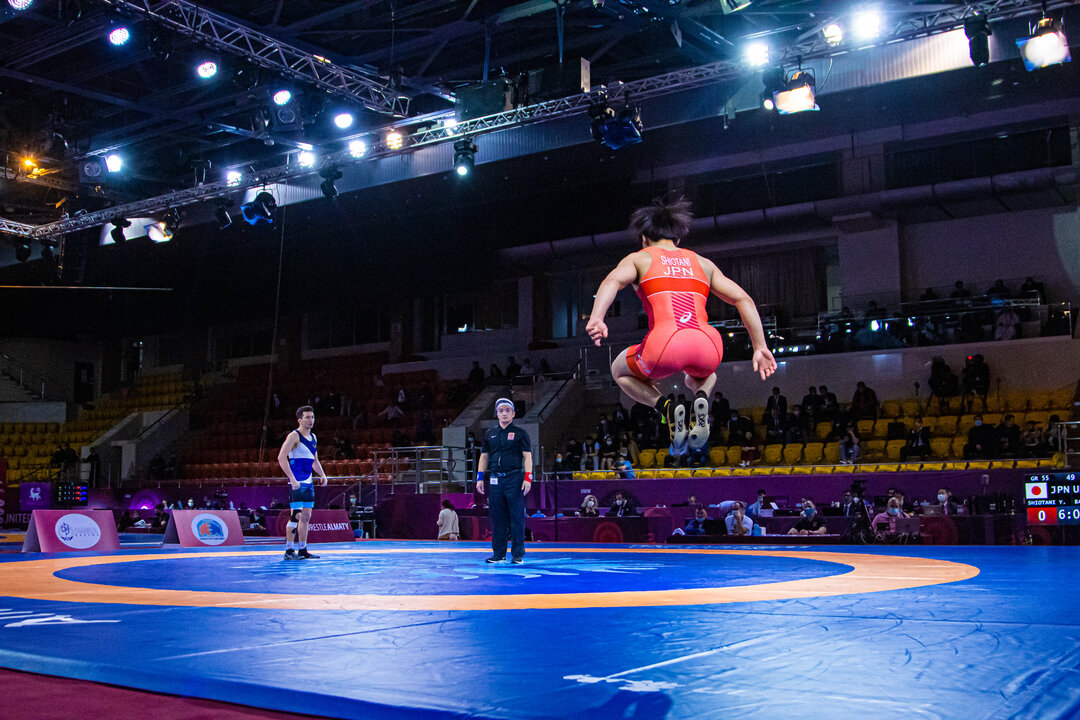 In his senior debut, Yu SHIOTANI (JPN) defeated Ilkhom BAKHROMOV (UZB) in the 55kg gold-medal match. (Photo: Sachiko Hotaka)
Teen Shiotani makes mark in senior debut
In the lone final without an Iranian, 19-year-old Yu SHIOTANI (JPN) made his second international tournament and first as a senior a memorable one by stunning 2019 Asian champion Ilkhom BAKHROMOV (UZB) at 55kg.
Shiotani shrugged off a 5-0 deficit in the second period, launching a pair of dynamic 5-point throws in chalking up a 17-7 technical fall victory over Bakhromov, who was looking to regain the Asian title he had won in 2019 in Xi'an, China.
"I don't know how to react to this because I have never felt this emotion before," Shiotani said. "This is my first-ever international medal and now I have my first ever gold medal. Today's bouts were so good and I am excited about this."
By beating Bakhromov, Shiotani did what Hiromu KATAGIRI (JPN), his senior teammate back at Takushoku University who handily defeated him in the last two finals of the All-Japan Championships, couldn't do.
It was Katagiri whom Bakhromov defeated for the 2019 gold, but Shiotani showed his career is heading upward with his masterful handling of the Uzbek -- although not so much at first.
Bakhromov took advantage of the par terre position in the first period, smoothly executing two gut wrenches for a 5-0 lead.
But in the second period, Shiotani got maximum output from his shot at par terre. Using a reverse lift, he wheeled Bakhromov through the air for 5 points, then, keeping his grip, slammed him down for 5 more and a 11-5 lead.
When Shiotani pressed forward with a bear hug, Bakhromov countered as he fell backward and over the edge. In a flurry that needed some time to sort out, Shiotani was given 4 points for the initial move, Bakhromov 2 for the counter, then Shiotani 2 more for a second exposure, ending the match with :31 left.
"I don't really remember the match," Shiotani said after the medal ceremony, at which the national anthem was played for him for the first time. "But standing on the medal podium, standing on top and hearing the national anthem, it gradually sunk in."
Last December, Shiotani lost in the final at nationals for the second straight year to Katagiri, but was picked for the team to Almaty because Katagiri has ostensibly gone into retirement following graduation.
With this boost in confidence, Shiotani is setting his sights on bigger stakes. This performance makes him the favorite at next month's All-Japan Invitational Championships, which will serve as a domestic qualifier for the World Championships slated for October in Oslo.
"I still have a national competition ahead, and I want to have a good result and make it to the World Championships," said Shiotani, whose only previous international competition was the 2016 World Cadet Championships, where he placed ninth.
Meanwhile, in a bronze-medal battle between Tokyo Olympic-bound wrestlers, a 2-point penalty for grabbing the legs late in the second period gave Rio 2016 Olympic bronze medalist Rustam ASSAKALOV (UZB) a 2-2 victory over Nursultan TURSYNOV (KAZ) at 87kg.
Hanjae CHUNG (KOR) will be taking home a second bronze medal from Almaty after he defeated Urmatbek AMATOV (KGZ) 3-0 in the third-place match at 63kg.
His other bronze might be considered more of a consolation prize, as it came at 60kg in the Asian Olympic qualifier and left him short of the two spots available at the Tokyo Games.
In the other 63kg bronze-medal match, Muhamad FWAZ (SYR) was denied in a bid to become Syria's ninth Asian medalist in history and first in 13 years when he fell 7-5 to Jui Chi HUANG (TPE).
Murat RAMONOV (KGZ) earned a fifth career Asian bronze medal dating back to 2009 -- he also has a silver from 2016 -- by defeating Sukhrob FATTOEV (UZB) 5-1 at 130kg.
Minseok KIM (KOR), the silver medalist at 130kg a year ago, gave Korea its third bronze of the night by rolling to a 9-0 technical fall victory over Sota OKUMURA (JPN).
Day 1 Finals
Greco-Roman
55kg (10 entries)
GOLD - Yu SHIOTANI (JPN) df. Ilkhom BAKHROMOV (UZB) by TF, 17-7, 5:28
BRONZE - Nurmukhammet ABDULLAEV (KGZ) df. Sandeep SANDEEP (IND), 11-5
BRONZE - Poya DAD MARZ (IRI) df. Aslamdzhon AZIZOV (TJK) by TF, 9-0, 1:19
63kg (12 entries)
GOLD - Sultan ASSETULY (KAZ) df. Meysam DALKHANI (IRI) by Fall, 3:55 (8-3)
BRONZE - Jui Chi HUANG (TPE) df. Muhamad FWAZ (SYR), 7-5
BRONZE - Hanjae CHUNG (KOR) df. Urmatbek AMATOV (KGZ), 3-0
77kg (12 entries)
GOLD - Pejman POSHTAM (IRI) df. Daler REZA ZADE (TJK) by Default
BRONZE - Demeu ZHADRAYEV (KAZ) df. Muhammetberdi MAMEDOV (TKM) by TF, 9-0, 4:33
BRONZE - Kairatbek TUGOLBAEV (KGZ) df. Singh GURPREET (IND), 5-0
87kg (10 entries)
GOLD - Naser ALIZADEH (IRI) df. Atabek AZISBEKOV (KGZ), 3-1
BRONZE - Rustam ASSAKALOV (UZB) df. Nursultan TURSYNOV (KAZ), 2-2
BRONZE - Seunghwan LEE (KOR) df. Tokhirdzhon OKHONOV (TJK), 6-1
130kg (8 entries)
GOLD - Aliakbar YOUSOFIAHMADCHALI (IRI) df. Alimkhan SYZDYKOV (KAZ), 5-1
BRONZE - Minseok KIM (KOR) df. Sota OKUMURA (JPN) by TF, 9-0, 1:49
BRONZE - Murat RAMONOV (KGZ) df. Sukhrob FATTOEV (UZB), 5-1

 Buvaisar SAITIEV (RUS). (Photo: United World Wrestling / Martin Gabor)
 Brandon SLAY (USA) over Buvaisar SAITIEV (RUS) at the 2000 Olympics. (Photo: United World Wrestling / Martin Gabor)
 Buvaisar SAITIEV (RUS). (Photo: United World Wrestling)
Share your thoughts.
Comments