

Japan Wrestle-Offs

Kawai Topples Icho in Playoff for World Team; Otoguro In, Susaki Out

By Ken Marantz

WAKO, Saitama (July 6)---Risako KAWAI all but dealt a death blow to Kaori ICHO's quest for an epoch-making fifth straight Olympic gold medal. It's now in Kawai's hands to finish the job in two months.

For the second time in three weeks, Kawai toppled her fellow Olympic champion, scoring a 3-3 victory on big-point criteria to earn the women's 57kg berth on Japan's team to the World Championships in Kazakhstan in September.

"I really don't remember much about it, but I'm glad I won," Kawai said at a post-match press conference. "Over this past year, things happened around me that I had never imagined would occur. I had changed the environment around me, and in December, I thought about quitting wrestling and talked it over with my family. I'm glad that I didn't."

The showdown was one of six on a special day of playoffs for tickets to the World Championships in Olympic weight classes, which also saw Takuto OTOGURO earn a shot at keeping the freestyle 65kg crown he won a year ago, while Yui SUSAKI was denied a chance for a third straight women's 50kg world title.

The playoffs in Wako, Saitama Prefecture, about 20 kilometers north of Tokyo, paired the winners of the two national competitions that serve as qualifiers for the World Championships. In the 12 other Olympic divisions, one wrestler won both tourneys to clinch an automatic berth.

Icho had beaten Kawai 3-2 with a dramatic takedown in the final 10 seconds at the All-Japan Championships (Emperor's Cup) in December, a loss that nearly led Kawai to abandon the sport. But she turned the tables in June at the All-Japan Invitational Championships (Meiji Cup), holding on for a 6-4 win to set up the playoff.

"It has been three weeks since the Meiji Cup," Kawai said. "I knew Kaori would approach it differently, and I carefully considered what I would do as I prepared. Strategically, it didn't really go as I had pictured. But in the end, what I had practiced as always came out naturally."

As for her strategy, Kawai said it was to "get in on tackles and firmly finish off the takedown. But it wasn't that easy."

In the nationally televised wrestle-off, Kawai was the aggressor and got in deep with a number of single-leg attempts, only to see Icho squirm free. With just over a minute left in the match, the score was still 1-1, with both points scored on the activity clock and Kawai ahead on last-point.

Just as she did in the Meiji Cup with time running out, the 35-year-old Icho dug deep with the determination that had earned her 10 world titles dating back to 2002 and went on the attack.

Icho got in deep on a single leg, but Kawai clamped down and, applying a reverse nelson, managed to gain a 2-point exposure with 50 seconds left. Icho worked her way out of the predicament and behind for a point to cut the lead to 3-2, but her frenetic efforts for a takedown in the final seconds could only result in a stepout that left her on the short end of a 3-3 score.

"It's disappointing, but I did what I needed to do to get here and prepared well, so I have no regrets," said Icho, who took a hiatus following the Rio 2016 Olympics and only returned to competition last September.

"I don't think that I was weak. Risako was strong. From the time I decided to come back, there was the difficulty of filling in a two-year blank combined with a desire that never left, and this is where I am now.

"As an experience, it was a fulfilling one year. Many friends, family and others came to this arena to give me support, and I went into this wanting to give them a chance to see me at the World Championships and Tokyo Olympics. As I won't be able to show them, that's what hurts."

Actually, the light at the end of the Tokyo 2020 tunnel has not completely gone out for Icho, although it's been reduced to a speck. The Japan federation has decreed that any Japanese wrestler winning a medal at the World Championships will automatically earn a place on the Tokyo 2020 team---which greatly enhanced the incentive to make it to the Kazakh capital of Nur-Sultan.

The door for Icho would reopen in the unlikely event that Kawai, the 63kg champion at Rio 2016 and 59kg gold medalist at last year's worlds in Budapest, fails to win a medal in Nur-Sultan. In that case, the qualifying process would go back to the beginning.

For Kawai, the victory keeps alive her dreams of appearing in the Olympics with younger sister Yukako, a world silver medalist who already secured her ticket at 62kg. Risako had taken a gamble by going down to 57kg and challenging Icho, and it paid off with the two victories that Yukako watched at matside.

The playoffs for the undecided places in the non-Olympic weights will be held July 21. Because so many top wrestlers funneled into the Olympic weights, the federation decided that, in order to send the strongest possible team to Kazakhstan, it will allow those who finished as runner-up in an Olympic weight at either the Emperor's Cup or Meiji Cup to enter the wrestle-offs at a non-Olympic weight.

That means that technically Icho could try to make the team at, say, 59kg in an attempt to win a first world title since 2015, although there have been no indications that she will do so.

Otoguro avenges loss; Irie finally gets best of Susaki

In other featured matches on a day of high drama, world champ Otoguro bounced back from his loss in the Meiji Cup final to Rei HIGUCHI by chalking up a solid 5-0 victory to fill the 65kg berth.

Otoguro, his preparations affected by knee problem that kept him out of the Freestyle World Cup and the Asian Championships, had been dealt a devastating 15-5 technical fall loss three weeks ago by Higuchi, the Rio 2016 silver medalist at 57kg.

That was Otoguro's first loss to a Japanese opponent since junior high school, but he showed he was ready this time around with his third victory over Higuchi  in 2 1/2 years.

Leading 2-0 in the second period from a pair of points off the activity clock, Otoguro sliced in on a low double for a takedown with 1:40 left. He then held off Higuchi's late attacks, adding a stepout in the waning seconds for the final margin of victory.

"I wasn't accustomed to losing, and it was so devastating, it was like I had no idea what to do," said Otoguro, who shed very different tears after this victory. "So many people helped me out, and I'm happy I could come out with a win through their support."

While the Kawai-Icho clash has garnished the most national attention, the budding rivalry at women's 50kg has been no less intense, and this time Asian champion Yuki IRIE came out on top.

Irie chalked up her third career victory over Susaki---the only losses of Susaki's career on any level dating back to junior high school---winning 6-1 to earn her first trip to a World Championships.

Irie has been a recent thorn in Susaki's side, but the reigning world champion always came up with the big win needed to get to the major events. It was almost exactly a year ago that Susaki knocked off Irie in a playoff en route to defending her world title in Budapest.

And after pulling out of the Emperor's Cup due to an elbow injury, Susaki faced a must-win situation at the Meiji Cup to keep alive her hopes of appearing at Tokyo 2020. She did it in dramatic fashion, scoring a 4-point move with two seconds left to beat Irie 6-2 in the quarterfinals, before whipping Rio 2016 champion Eri TOSAKA in the final to set up the playoff.

This time, there would be no mistakes by Irie, and no miracle finish for Susaki.

In the first period, just after losing a point on the activity clock, Irie scored a takedown to take a 2-1 lead into the second period. With 1:20 left, she scored another takedown, then topped that off with a roll to make it 6-1, which is how it ended, leaving the 20-year-old Susaki in tears.

"There were so many people supporting me, my only feeling is that I have to apologize to them," Susaki said between sobs.

The 26-year-old Irie, who capped her gold-medal run at the Asian Championships in April in China with a victory over Rio 2016 bronze medalist SUN Yanan (CHN), has tradition on her side in a bid to medal in Nur-Sultan and clinch a Tokyo 2020 spot---Japan has made the podium in the lightest women's weight class at every World Championships dating back to 2005 except one (2009).

"The Olympic [berth] has still not been secured, so I'm happy, but first I have to focus on the World Championships," Irie said. "It will be my first World Championships, so I will prepare so I can fight without being nervous."

In other playoffs, Mao OKUI scored a dramatic upset over former world bronze medalist Yuhi FUJINAMI in freestyle 74kg, winning 5-4 with a takedown at the buzzer to earn his first trip to the World Championships.

Okui trailed 3-0 early in the second period, then twice got behind a standing Fujinami, only to fail to break him down to the mat for a takedown. Both times he executed a roll at the edge, but each one was ruled to have been launched out of bounds; the first gave Fujinami a point for an unsuccessful challenge and the other one for himself for a stepout.

Down 4-3 with 10 seconds left, a flurry starting with Okui's single-leg attempt ended with Fujinami, a 2017 world bronze medalist at 70kg, on all fours. At the buzzer, Okui pulled off a roll---this time well in bounds---that was confirmed by video to be in time.

"I thought, 'If I don't get it now, everything I've done up to now will have no meaning,' and I just went for the tackle," Okui said.

At the Meiji Cup, Okui scored a victory by fall in the semifinals over a less-than-par Fujinami, who was still recovering from a knee injury suffered at the Asian Championships and a back injury suffered a week before the tournament.

At freestyle 125kg, Nobuyoshi ARAKIDA spun behind off a front headlock for a late takedown and a 4-1 win over Yasuhiro YAMAMOTO to earn his fifth trip to the World Championships and first in five years.

That reversed the outcome of a playoff last year between the two that Yamamoto won by the same score.

Shohei YABIKU, a former world junior bronze medalist, will look for his first hardware on the senior level in three tries after defeating Naotsugu SHOJI by 9-0 technical fall at Greco-Roman 77kg.
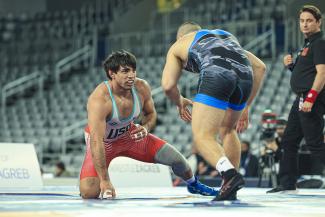
#JapanWrestling

Kiyooka, Kusaka secure chance to add first world titles to Paris golds

By Ken Marantz

TOKYO (June 22) -- Kotaro KIYOOKA and Nao KUSAKA both lived up to their lofty status as Olympic champions. Now each will get a chance to add a first world title to their Paris gold.

Kiyooka and Kusaka, competing in their first major competition since triumphing at Paris 2024, both won titles on the final day of the Meiji Cup All-Japan Championships, then returned to mat to beat the same opponent in a playoff for this year's World Championships.

In one of the most anticipated duels of the tournament, Kiyooka, the Paris champion at freestyle 65kg, pulled off a double victory over former Nippon Sports Science University teammate and Asian champion Kaisei TANABE, whose chances were hampered by a knee injury in the playoff.

"It's my first time to be involved in a playoff and to face the same opponent twice on the same day," Kiyooka said. "It was a learning experience and a good opportunity."

Also Read: Motoki stuns Ozaki with last-second win in Japan's world team playoff

Kusaka, who has a 2023 world bronze to go along with his Paris gold at Greco 77kg, showed little effects of a recent back injury that curtailed his preparation in defeating Kodai SAKURABA to earn a ticket to the World Championships to be held Sept. 13-22 in Zagreb.

The four-day Meiji Cup at Tokyo Metropolitan Gym was serving as the second of two domestic qualifiers for the team to Zagreb, along with the Emperor's Cup All-Japan Championships in December. A victory at both tournaments earned an automatic spot, while a playoff was held at the end of each day to decide between separate winners.

Both Kiyooka and Kusaka had participated in the German Bundesliga in the autumn after the Paris Olympics, but otherwise had joined the vast majority of Japan's medalists who reaped the rewards of their new-found fame, attending special events and appearing on variety TV shows.

They, along with Sakura MOTOKI at women's 62kg, were the only ones among Japan's eight gold medalists who decided to return to the mat in earnest at the Meiji Cup.

Kotaro KIYOOKA (JPN)Kotaro KIYOOKA scores four with a unique throw in the freestyle 65kg playoff with Kaisei TANABE. (Photo: Takeo Yabuki / wrestling-spirits.jp)

For the 24-year-old Kiyooka, making it to his first World Championships gives him a chance to prove that his victory in Paris was no fluke and that he is no one-hit wonder.

"Before the Olympics, the word out there was that I wouldn't win, but I managed to turn that idea on its head," Kiyooka said. "Still, I'm a champion who came out of the blue, so I'm really not the established king. I want to take the world title so that people both at home and abroad recognize that Kotaro Kiyooka is the true champion."

He and Tanabe, who won his first career Emperor's Cup title in December, have often sparred together in practice, but had never faced each other in an official match.

In an entertaining final that featured a constant tangle of legs and arms amid wild scrambles, Tanabe struck first with a takedown, but Kiyooka responded with a takedown-gut wrench combination to go into the second period ahead 4-2.

Tanabe, the son of NSSU coach and 2004 Sydney Olympic bronze medalist Chikara TANABE, put the pressure on, but could only manage a late stepout as Kiyooka held on for a 4-3 victory.

Kotaro KIYOOKA (JPN)Kotaro KIYOOKA works for a takedown against Kaisei TANABE during the freestyle 65kg playoff. (Photo: Takeo Yabuki / wrestling-spirits.jp)

In the playoff, Kiyooka opened with a stepout off a scramble, then received an activity point. But when he scored a stepout late in the period, Tanabe was slow to get up and indicated he had suffered a knee injury.

Tanabe bravely forged on and scored 2 off a counter lift off a Kiyooka takedown attempt, but Kiyooka kept his leg hold and made it 7-2 with an intriguing 4-point move.

With Tanabe on his back, Kiyooka stood straight up, then moved to the edge, where he launched an aerial cartwheel that caused Tanabe to land flat on his back.

"I wanted to lift him up and get a big point," Kiyooka said. "But Tanabe is a competitor with a high level of talent and athleticism, and if I didn't do it right, he could be the one to get the points. I was glad that I gave it a try.

"To get a big score provides an advantage later on. From now, I'm going to need a move like that, because without it, I'll have to settle for one or two points, which makes it easier for the opponent to catch up. I'm going to add it to my regular practice."

Tanabe stayed down and took an injury timeout, and it was soon after that Kiyooka put the match away with a counter lift and two exposures to win 13-2 in 5:45.

"My opponent's condition wasn't very good in the final, and then his knee became painful in the playoff," Kiyooka said. "So he wasn't at his best, but I couldn't let that sway me and I had to fight to the end.

"At this tournament, the main thing was to win, as it was where I was making my return. I'm also also making a new start with a new company affiliation and wanted it to go right, so I'm glad I could win the title and make the team to the World Championships."

Kiyooka, whose younger sister Moe lost a playoff at women's 53kg on Saturday, said the extended layoff caused him some concern.

"There was some anxiety, but as long as I did what I needed to do, I thought it would lead to a result like this," Kiyooka said. "There are only so many days until the Los Angeles Olympics, and this have given me an idea of what I will need to work on to put it all together."

Nao KUSAKA (JPN)Nao KUSAKA bulls his way to a takedown in the Greco 77kg playoff with Kodai SAKURABA. (Photo: Takeo Yabuki / wrestling-spirits.jp)

Kusaka never seemed in danger in either of his matches against Emperor's Cup champion Sakuraba, nor did he show the dominance that led to Olympic gold.

In the Meiji Cup final, Kusaka came away with a 5-1 win in which he scored no technical points. In the first period, he received a passivity point, then when Sakuraba tried to escape from the bottom of par terre, he was hit with a 2-point penalty for a leg foul, and an unsuccessful challenge made it 4-0. Kusaka then received a second passivity point in the second period and that was it.

Kusaka was more productive in the playoff, bulling his way to a takedown in the first period and a stepout in the second in chalking up a 4-1 victory.

"I became more fatigued that I expected," Kusaka said. "It's been awhile since I went all out. No matter how much you build up in practice, you don't get the tension that you get in a match."

Kusaka revealed that his preparations were curtailed when he suffered a serious back strain while weight training in late May. He said the injury was so serious, it was first time he ever had to be transported on a stretcher.

"I had good luck when it came to the Olympics, but this time I had to go through that," he said. "For two weeks, I couldn't wrestle at all and I spent a week in bed."

Like Kiyooka, Kusaka wants to enhance his relatively slim resume with a world title.

"I've been wrestling 21, 22 years, and it's something I've always aspired to," Kusaka said. "I'm getting attention as an Olympic champion, but I want to be active around the world. The 2024 season went extremely well and I received the MVP award, which was great. But I don't want to be a one-hit wonder. I have to keep getting results."

Kyotaro SOGABE (JPN)Kyotaro SOGABE squares off with longtime rival Katsuaki ENDO in the Greco 67kg playoff. (Photo: Takeo Yabuki / wrestling-spirits.jp)

Another playoff of note occurred at Greco 67kg, where Paris Olympian Kyotaro SOGABE secured his latest triumph over longtime rival and fellow NSSU alum Katsuaki ENDO.

Endo won the Emperor's Cup in Sogabe's absence, but the latter set up the playoff with a 4-0 victory in the Meiji Cup final in which he twice received passivity points, scoring a gut wrench after his second chance at par terre. In the playoff, Sogabe never gave Endo an opening and rolled to a 9-0 victory.

Rin SAKAMOTO (JPN)Teenager Rin SAKAMOTO gestures after securing his ticket to the senior worlds at freestyle 57kg. (Photo: Takeo Yabuki / wrestling-spirits.jp)

Among the two men's weight classes that did not need to go to a playoff, teenager Rin SAKAMOTO secured his ticket to Zagreb at freestyle 57kg by crushing Kento YUMIYA 10-0 to complete the Emperor's Cup-Meiji Cup double.

The 19-year-old Sakamoto is a maverick among Japanese wrestlers, in that he decided to pursue a collegiate career in the United States, where he now competes for powerhouse Oklahoma State University.

He admittedly had trouble at the Emperor's Cup adjusting back to freestyle after practicing in the American folkstyle. But this time, with the U.S. collegiate season over, he was able to focus exclusively on the international style.

Sakamoto had a disappointing showing at the Asian Championships, where he lost in the bronze-medal match, but returned to Japan in April and won the qualifying tournament for the World U20 Championships.

Regarding making his first senior worlds, Sakamoto said, "I'm excited," citing the fact that he can match Tokyo Olympic champion Takuto OTOGURO, who was also 19 when he won the world title in 2018. Unfortunately, should Sakamoto triumph in Zagreb, he will fall one month short of Otoguro's record for Japan's youngest-ever male world champion.

At Greco 60kg, Emperor's Cup champion and two-time Asian medalist Kaito INABA defeated Yu SHIOTANI 5-2 in the final to earn his first trip to the World Championships.

Asian and world U23 champion Kodai TAKAHASHI will get another shot at the senior worlds after he defeated Emperor's Cup champion Hikaru TAKATA 3-0 in the freestyle 74kg playoff.

Takahashi, who missed the Emperor's Cup due to an injury suffered while competing at 79kg at last year's non-Olympic worlds, secured a place in the playoff by beating Takata in Saturday's semifinals. then topping Masaki SATO 3-1 in the Meiji Cup final.

Day 4 Results

Freestyle

57kg (11 entries)
GOLD: Rin SAKAMOTO df. Kento YUMIYA by TF, 10-0, 2:22

BRONZE: Rikuto NAGAI df. Kodai NAKAISHI by TF, 10-0, 5:59
BRONZE: . Rikuto ARAI df. Fuga SASAKI, 4-1

65kg (9 entries)
GOLD: Kotaro KIYOOKA df. Kaisei TANABE, 4-3

BRONZE: Shinnosuke SUWAMA df. Ryuto SAKAKI, 8-5
BRONZE: Yuto NISHIUCHI df. Takuma AKIYAMA by TF, 10-0, 5:45

World Team Playoff: Kiyooka df. Tanabe by TF, 10-0, 5:45

74kg (12 entries)
GOLD: Kota TAKAHASHI df. Masaki SATO, 3-1

BRONZE: Kanata YAMAGUCHI df. Hikaru TAKATA by Def.
BRONZE: Toki OGAWA df. Tenju HOSAKA, 2-1

World Team Playoff: Takahashi df. Takata, 3-0

Greco-Roman

60kg (8 entries)
GOLD: Kaito INABA df. Yu SHIOTANI, 5-2

BRONZE: Seima TOKUHARA df. Eiru TAKAYAMA, 5-2
BRONZE: Koto GOMI df. Maito KAWANA, 7-7

67kg (12 entries)
GOLD: Kyotaro SOGABE df. Katsuaki ENDO, 4-0

BRONZE: Kensuke SHIMIZU df. Chiezo MARUYAMA, 3-2
BRONZE: Haruto YABE df. Kojiro HASEGAWA, 8-5

World Team Playoff: Sogabe df. Endo by TF, 9-0, 5:50

77kg (10 entries)
GOLD: Nao KUSAKA df. Kodai SAKURABA, 5-1

BRONZE: Fuga MISAIZU df. Shu YAMADA by Def.
BRONZE: Isami HORIKITA df. Naoki KADODE, 5-3

World Team Playoff: Kusaka df. Sakuraba, 4-1