

#WrestleAlmaty

Japan Announces Squads for Asian Olympic Qualifier, Asian Championships

By Japan Wrestling Federation

Two-time world champion Yui SUSAKI heads a contingent of 10 Japanese who will aim to earn tickets to the Tokyo Olympics at next month's Asian Qualifying tournament in Kazakhstan, the Japan Wrestling Federation announced.

The federation also announced the squad to be dispatched to the Asian Championships that will follow the Olympic qualifier at the same venue in the Kazakh city of Almaty. Among those entries are seven wrestlers who have already qualified for the Tokyo Games, four of whom are also defending Asian champions.

The Olympic qualifying tournament will be held April 9-11, with competition in the six Olympic weight classes in each style. That will be followed by the Asian Championships, to run April 13-18 in all 10 weight classes.

It will mark the first time Japan has sent a team overseas since last year's Asian Championships in New Delhi in February 2020.

For the Tokyo Olympics, Japan has already qualified at freestyle 65kg and 74kg, Greco-Roman 60kg and women 53kg, 57kg, 62kg, 68kg and 76kg, based on results from the 2019 World Championships. The top two finishers at the continental qualifier will earn Olympic berths for their country.

Susaki will be looking to earn her first Olympic spot at women's 50kg. She and the others earned the right by winning titles at the 2019 national championships. Even when the Tokyo Games were postponed a year, they were allowed to keep their places.

Also hoping to qualify for Tokyo will be 2016 Rio Olympic silver medalist Rei HIGUCHI at freestyle 57kg and Sosuke TAKATANI, who will be aiming to make his third Olympics and first at freestyle 86kg.

The team for the Asian Championships consists mainly of the champions at the most recent national championships held in December 2020. In cases where the champion opted out or was unavailable, the runner-up or a third-place finisher filled the spot.
|
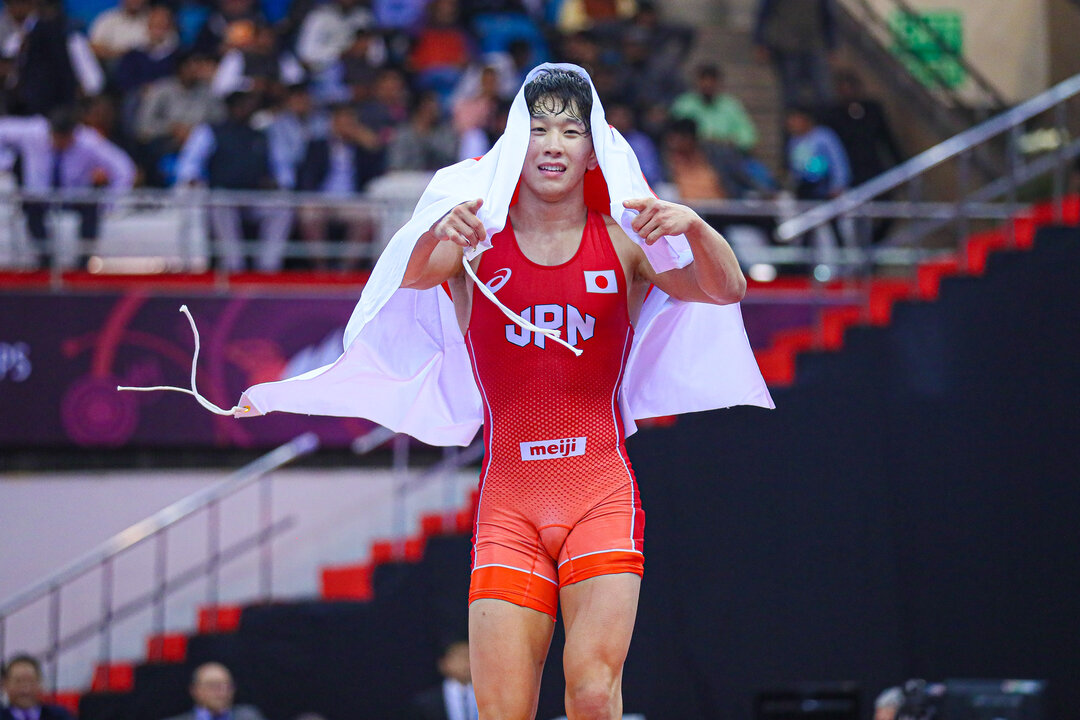
Takuto OTOGURO, Japan's '18 world champion, will wrestle at 65kg at the Asian Championships. (Photo: Kadir Caliskan)

The wrestlers who have already qualified for the Tokyo Olympics and are entered for the Asian Championships are brothers Takuto and Keisuke OTOGURO at freestyle 65kg and 74kg, respectively, and the female quintet of Mayu MUKAIDA (53kg), Risako KAWAI (57kg), Yukako KAWAI (62kg), Sara DOSHO (68kg) and Hiroe MINAGAWA (76g).

Kenichiro FUMITA, Japan's lone current Olympic qualifier in Greco-Roman, has opted to skip the tournament and the chance to defend his 2020 Asian title at 60kg. He earned his Olympic ticket by winning the 2019 world title.

Takuto Otoguro, the Kawai sisters and Minagawa are the reigning Asian champions in their weight classes. Mukaida will be looking to improve on her silver medal from 2020.

At the 2020 tournament in New Delhi, Japan took home seven medals in freestyle, but with the exception of Otoguro, none of the other medalists earned a return trip this year. Also missing out are two women's champions from 2020, Miho IGARASHI and Naomi RUIKE.

Here are the squads:

Asian Olympic Qualifying Tournament  (April 9-11, Almaty)

Greco-Roman
67kg: Shogo TAKAHASHI
77kg: Shohei YABIKU
87kg : Masato SUMI
97kg: Yuta NARA
130kg: Arata SONODA

Women
50kg : Yui SUSAKI

Freestyle
57kg : Rei HIGUCHI
86kg : Sosuke TAKATANI
97kg : Naoya AKAGUMA
125kg : Tetsuya TANAKA

Asian Championships (April 13-18, Almaty)

Greco-Roman
55kg: Yu SHIOTANI
60kg: Ayata SUZUKI
63kg: Kensuke SHIMIZU
67kg: Tsuchika SHIMOYAMADA
72kg: Taishi HORIE
77kg: Kodai SAKURABA
82kg: Satoki MUKAI
87kg: So SAKABE
97kg: Masayuki AMANO
130kg: Sota OKUMURA

Women
50kg: Remina YOSHIMOTO
53kg: Mayu MUKAIDA
55kg: Tsugumi SAKURAI
57kg: Risako KAWAI
59kg: Akie HANAI
62kg: Yukako KAWAI
65kg: Miwa MORIKAWA
68kg: Sara DOSHO
72kg: Masako FURUICHI
76kg: Hiroe MINAGAWA

Freestyle
57kg: Yuto TAKESHITA
61kg: Shoya SHIMAE
65kg: Takuto OTOGURO
70kg: Jintaro MOTOYAMA
74kg: Keisuke OTOGURO
79kg: Ryuki YOSHIDA
86kg: Hayato ISHIGURO
92kg: Yuto IZUTSU
97kg: Takashi ISHIGURO
125kg: Taiki YAMAMOTO

Development

DNSS Program in Cambodia: Building Foundations for Wrestling Growth

By United World Wrestling Press

PHNOM PENH, Cambodia (December 2) --- From July 18 to November 30, 2024, the Development of the National Sports System (DNSS) program in Cambodia marked a significant milestone for the growth of wrestling in the country. Led by UWW Educator Martin Hauck (USA), this program provided a comprehensive approach to enhancing coaching, athlete development, and refereeing in Cambodia. Through a mix of workshops, camps, and tournaments, the initiative sought to foster collaboration, education, and enthusiasm for wrestling at all levels.

During the program, more educational opportunities were created for coaches, athletes, and referees. A key highlight was a youth national tournament held during the second visit, which connected athletes and coaches from several provinces, promoting competition and collaboration. Plans were made to make this event an annual tradition, further strengthening the sport’s foundation in Cambodia.

The program objectives included observing and assessing the national team during a high-performance camp in July, educating coaches on long-term athlete development, and organizing a one-day seminar in a neighboring province to introduce wrestling games to youth. Meetings with the Cambodia Wrestling Federation leadership helped establish a roadmap for future development and in-person training sessions.

Key deliverables included:

  • Running camps and seminars for coaches and athletes, focusing on practical and theoretical education.
  • Creating a Cambodian Coaches Course Curriculum and teaching topics such as emergency action planning, practice structuring, periodization, talent identification, and connecting traditional Cambodian wrestling with Olympic styles.
  • Organizing a youth national tournament and camp, which saw participation from almost all provinces, showcasing significant growth on and off the mat.
  • Promoting communication, education, and resource-sharing platforms for ongoing development.

The DNSS program not only strengthened technical skills but also built excitement and unity within the Cambodia Wrestling Federation. With a focus on collaboration among referees, coaches, athletes, and stakeholders, this initiative laid the groundwork for sustained development and opportunities in wrestling throughout Cambodia.

The Development of National Sports System (DNSS) program, conducted in Cambodia from July 18 to November 30, 2024, marked a significant step toward developing wrestling in the country. Led by UWW Educator Martin Hauck (USA), the program aimed to address critical gaps in coaching, athlete development, and organizational structure while fostering growth and enthusiasm for the sport nationwide.

CAMOver 100 participants competed in the national youth tournament during the Development of the National Sports System (DNSS) program in Cambodia.

Program Activities and Achievements

The DNSS program implemented a range of initiatives to address these challenges and lay the groundwork for wrestling’s growth:

  1. Youth Development and Competitions:
    The program introduced a national youth tournament, drawing over 100 athletes from nearly all provinces. This event not only provided a platform for competition but also fostered excitement and collaboration among athletes, coaches, referees, parents, and stakeholders.
  2. Coaching Education and Communication:
    Coaches participated in comprehensive seminars covering emergency action planning, athlete development, periodization, video analysis, coaching females, and practice structuring. A centralized communication platform on the Cambodia Wrestling Federation website improved collaboration among coaches and clubs, helping connect rural and urban areas.
  3. Structured Athlete Development:
    New frameworks for athlete progression were introduced, enabling coaches and athletes to engage in long-term development cycles. Practical sessions during national team camps allowed coaches to apply their learning while working with athletes from across the country.
  4. Safety and Inclusivity:
    Emphasis on mental health, recovery practices, and safety protocols improved understanding and implementation of safe wrestling environments.
  5. Stakeholder Engagement:
    Meetings with the Cambodia Wrestling Federation leadership resulted in a shared vision for growth, including plans to strengthen partnerships, increase opportunities, and enhance stakeholder representation.

Key Outcomes

The program’s efforts led to several important outcomes:

  • Improved communication and collaboration within the wrestling community.
  • Significant growth in coaches’ theoretical and practical knowledge.
  • Increased participation and retention among athletes and coaches.
  • The successful execution of Cambodia’s first youth national tournament.
  • The identification of Coach Sotheara as a future leader for the sport.

Path to Success

The success of wrestling in Cambodia will depend on sustained education, participation, and collaboration. With improved communication, increased opportunities, and the emergence of local leaders like Coach Sotheara, the sport is well-positioned for growth. The DNSS program has laid a strong foundation, and with continued effort, wrestling in Cambodia has the potential to thrive at both national and international levels.

By fostering education, inclusivity, and passion, this program has not only addressed immediate needs but also set a vision for wrestling’s bright future in Cambodia.