

Japan and Georgia Claim Two Champions in 2018 U23 World Men's Freestyle
Saturday, November 17, 2018 - 19:20 By Taylor Miller

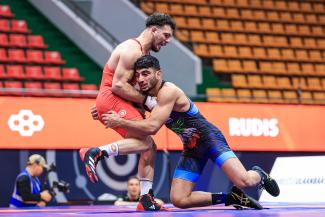
Photo of Givi MATCHARASHVILI (GEO) by Martin Gabor.
BUCHAREST, Romania – The first five men’s freestyle 2018 U23 World champions were determined on Saturday night in Bucharest, Romania, with Japan and Georgia each claiming two champions.
Japan started the night with back-to-back gold medals, coming from Toshihiro HASEGAWA (JPN) at 57 kg and Rei HIGUCHI (JPN) at 65 kg.
Hasegawa, a 2013 Cadet World bronze medalist, went up 4-0 halfway through the first period against Kumar RAVI (IND) before locking up a cradle and getting the pin at the 2:08 mark.
2016 Olympic silver medalist Higuchi edged out 2018 Yasar Dogu runner-up Ali RAHIMZADE (AZE) in 5-4 battle. Rahimzade rallied from a 4-1 deficit to tie the score as the clock ran out, but Higuchi held criteria. Azerbaijan’s corner challenged, looking for a fleeing call, but lost the challenge, resulting in another point for Higuchi.
Georgia ended the night with back-to-back World champions as Nika KENTCHADZE (GEO) and Givi MATCHARASHVILI (GEO) were victorious in their gold-medal matches.
Kentchadze won the crown at 79 kg, defeating 2015 Junior World champion Gadzhi NABIEV (RUS).
In the final bout of the night, Matcharashvili dominated Kollin MOORE (USA), scoring 10 points in two sequences for a first-period technical fall and his second age-group World title.
Matcharashvili won a Cadet World championship in 2014 and also owns a 2017 Junior World silver and a 2013 Cadet World bronze.
At 70 kg, Taimuraz SALKAZANOV (SVK) dominated 2017 Junior World champion and 2014 Cadet World champion David BAEV (RUS) for gold, scoring four takedowns en route to a 9-1 victory.
Finals results
57 kg
GOLD: Toshihiro HASEGAWA (JPN) df. Kumar RAVI (IND), fall
BRONZE: Wanhao ZOU (CHN) df. Jack Michael MUELLER (USA), 11-9
BRONZE: Taras MARKOVYCH (UKR) df. Jahongirmirza TUROBOV (UZB), 11-6
65 kg
GOLD: Rei HIGUCHI (JPN) df. Ali RAHIMZADE (AZE), 5-4
BRONZE: Maxim SACULTAN (MDA) df. Roman ASHARIN (HUN), 7-2
BRONZE: Islam DUDAEV (RUS) df. Morteza Hassanali GHIASI CHEKA (IRI), 6-0
70 kg
GOLD: Taimuraz SALKAZANOV (SVK) df. David BAEV (RUS), 9-1
BRONZE: Enes USLU (TUR) df. Ramazon IBODOV (UZB), 4-2
BRONZE: Jintaro MOTOYAMA (JPN) df. Oleksii BORUTA (UKR), 9-2
79 kg
GOLD: Nika KENTCHADZE (GEO) df. Gadzhi NABIEV (RUS), 3-0
BRONZE: Dovletmyrat ORAZGYLYJOV (TKM) df. Isa SHAPIEV (UZB), 13-3
BRONZE: Omaraskhab NAZHMUDINOV (ROU) df. Yajuro YAMASAKI (JPN), 9-8
97 kg
GOLD: Givi MATCHARASHVILI (GEO) df. Kollin MOORE (USA), 10-0
BRONZE: Igor OVSIANNIKOV (RUS) df. Magamed ZAKARIIEV (UKR), 6-0
BRONZE: Ali Khalil SHABANIBENGAR (IRI) df. Chaoqiang YANG (CHN), 11-0
Team results
1. Russia – 76
2. Japan – 75
3. Georgia – 58
4. USA – 50
5. Ukraine – 35
Share your thoughts.
Comments