

Icho Pulls Off Dramatic Win over Kawai to Move Step Closer to Shot at Olympic 5-peat
Sunday, December 23, 2018 - 19:27 By Ken Marantz

TOKYO---Adding another chapter to her bulging legend, Kaori ICHO pulled off a dramatic last-second victory over the new titan on the block, and moved a step closer to gaining a shot at winning a historic fifth Olympic gold medal in her home country.
Icho scored a takedown with 10 seconds left to clinch a 3-2 victory over fellow Rio 2016 Olympic champion Risako KAWAI in a nationally televised women’s 57kg final that brought a close to the All-Japan Championships in Tokyo.
Icho’s stunning victory came a day after Kawai, this year’s world champion at 59kg, edged the four-time Olympic champion 2-1 in a preliminary round-robin group match, handing Icho her first loss to a Japanese opponent since 2001.
“I knew it was going to be a tough match, but I’m happy I could pull it off,” said Icho, who let out a short scream of joy and clenched her fists after the victory. “It’s been awhile since I’ve felt this nervousness, so I thought to just try and stay relaxed.”
The 34-year-old Icho won her first national title since 2015 and 13th overall dating back to 2002, despite spending more than two years away from the mat after winning the gold in Rio, which made her the first woman in Olympic history to win four straight titles in a single event.
She returned to competition in September as a prelude for the All-Japan Championships, also referred to as the Emperor’s Cup and which was serving as the first stage in the qualifying process for the Tokyo 2020 Olympics.
It is for that reason that Kawai and many other top wrestlers have shifted to Olympic weight classes, which put her and Icho on a well-hyped collision course.
Icho had beaten Kawai in three previous encounters spanning 2013 and 2014, but she found a far more formidable and mature foe facing her across the mat at Komazawa Gym.
Their first match on Saturday featured little action, and Kawai came out on top by being awarded two activity-clock points to Icho’s one.
“Now I’m the challenger, and for two years, she’s been leading the pack in Japan and raised her level, which became clear to me when I faced her,” Icho said. “As the challenger, I thought all day how I could control the match.”
Sunday’s match was a slightly more open affair. Kawai took the lead, although a rule quirk left her with less points than she should have earned. With Icho on the activity clock and it about to expire, Kawai grabbed a single leg and had Icho perched on one foot, but could only managed to force Icho out for a point.
Had she waited another three seconds for the activity clock to expire, she would have gotten a point each for the passivity and the step-out.
She doubled the lead to 2-0 with an activity-clock point midway through the second period, before she was put on the clock and Icho gained a point with :26 remaining.
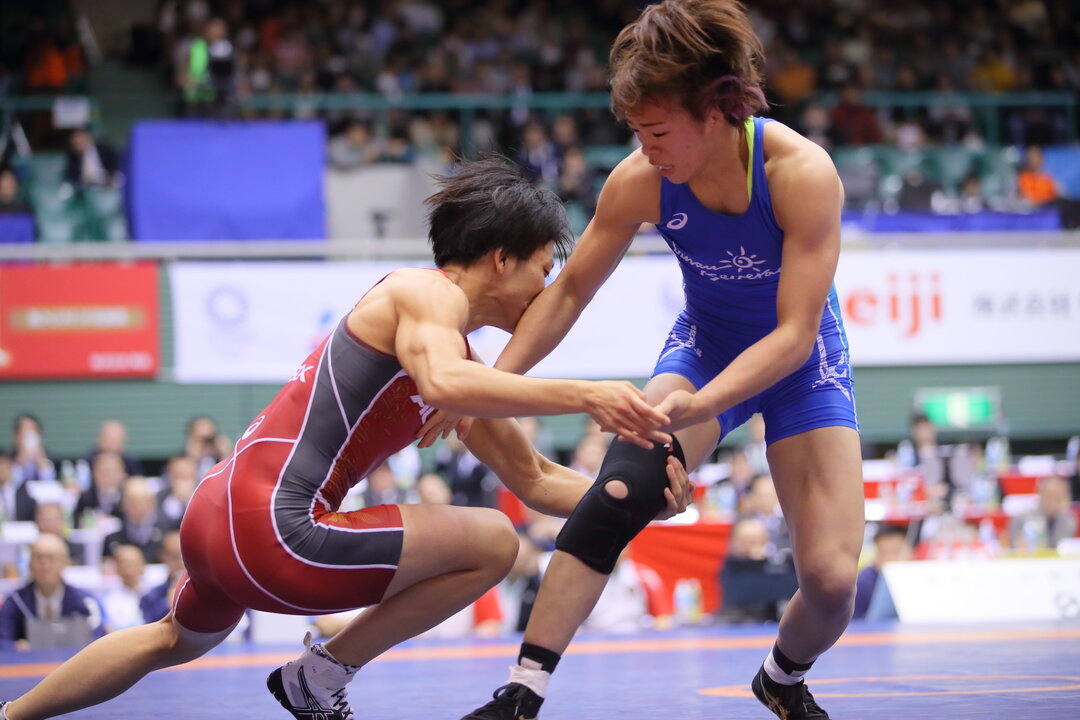
Four-time Olympic champion Kaori ICHO scored a takedown with 10 seconds left to clinch a 3-2 victory over fellow Rio 2016 Olympic champion Risako KAWAI. (Photo: Sachiko Hotaka)
It was then Icho made her move and snatched victory from the jaws of defeat. A quick snapdown and shuffle to the left left Kawai’s right leg open, and Icho latched onto it. When Kawai attempted a switch, Icho pressed ahead and stepped over to gain control and the crucial two points with just :10 left on the clock.
“Actually, I wanted to go all out from the beginning, but Kawai’s defense was strong, I lacked the courage and I’m not completely back. So I couldn’t get an attack going. At the end, there was an emotional factor as well, and I was able to catch her leg.”
While Kawai was visibly shaken by the stunning loss, her dream of a second straight Olympic gold is not over. She will get another shot at Icho at the All-Japan Invitational Championships (Meiji Cup) in June, where a victory would force a playoff with Icho for the spot on Japan’s team to the 2019 world championships.
A medal at Astana 2019---a world gold for Icho would be her 11th and first since 2015--- would mean an automatic place on the Japan squad at the Tokyo Olympics, which is why this year’s Emperor’s Cup had taken on such importance.
Icho said she is considering her plans prior to Meiji Cup, which will likely mean an overseas trip for training and/or competition. She is also mulling the Asian Championships in Xian in April, she said.
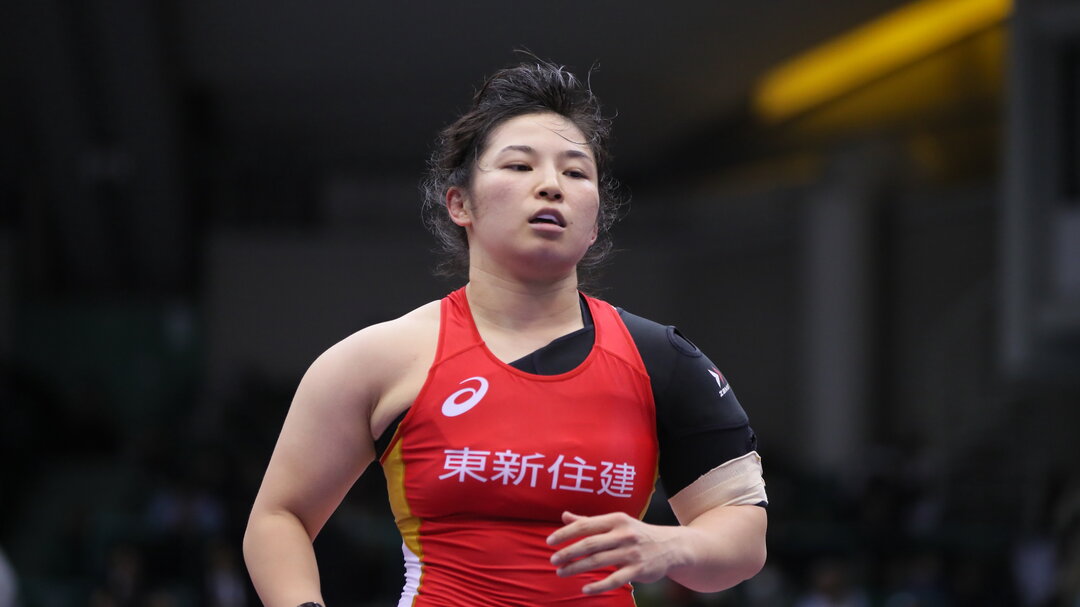
Rio Olympic champion Sara DOSHO returned from shoulder surgert and still won the 68kg gold medal. (Photo: Sachiko Hotaka)
Meanwhile, fellow Rio 2016 champion Sara DOSHO, returning from shoulder surgery necessitated from an injury at the Women’s World Cup in March, was less than her brutally dominating self, but still managed to capture the women’s 68kg gold for her eighth straight national title.
With just five entries, the weight class had a round-robin format, and Dosho clinched the gold in her final match with a 2-1 victory over Rio WATARI, who had an inspirational return last year from life-threatening lymphoma.
Dosho won all four of her matches by decisions, and in the finale against Watari, all points came with the opponent on the activity clock. Still, it’s a step in the right direction for Dosho, who won a world title in 2017.
“I wasn’t concerned about the details of my match, I was thinking only to go for the win,” Dosho said.
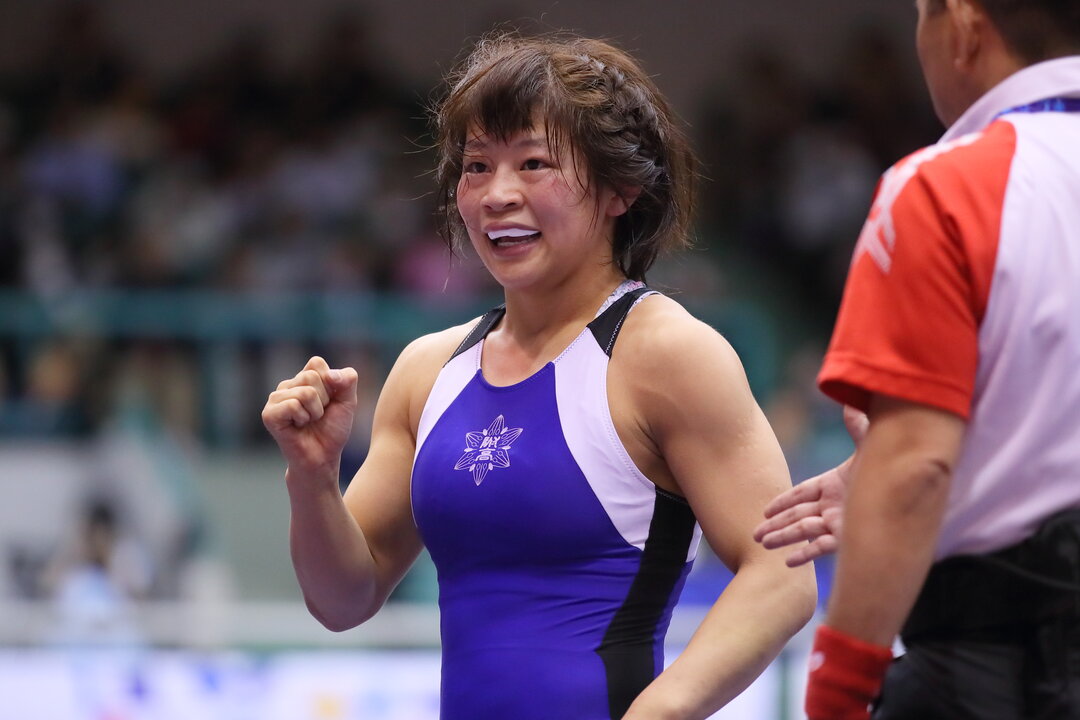
Reigning world champion Mayu MUKAIDA dropped down from 55kg and won the 53kg gold medal. (Photo: Sachiko Hotaka)
In the women’s 53kg class, Mayu MUKAIDA, who dropped down from 55kg, didn’t have to contend with fellow Budapest 2018 world champion Haruna OKUNO, but she had to sweat out some anxious moments at the end of her 8-6 victory over Nanami IRIE.
Mukaida scored with a takedown and ankle roll for an 8-2 lead early in the second period, only to see Irie fight back with a pair of slick takedowns. Mukaida then spent the final 20 seconds clinging desperately onto a single leg to clinch her third straight national title.
Mukaida has appeared to learn her lesson from the Paris 2017 final, where she suffered a devastating last-second loss to Vanesa KALADZINSKAYA (BEL) that cost her the 53kg gold.
“I saw my senior teammates fighting to the end, so I was determined to never give up,” Mukaida said. “It was tough cutting weight, but I want to get to the Olympics and I’m happy I could win the title.”
The other women’s title at stake on the final day of the four-day tournament at Komazawa Gym went to Yuki IRIE, who successfully defended her title at 50kg with a solid 6-0 victory over Kika KAGATA.
Irie defeated Rio 2016 gold medalist Eri TOSAKA in the semifinals, while her other main competition, Budapest 2018 champion Yui SUSAKI, had withdrawn after not fully recovering from a dislocated elbow suffered last month.
“I think I was able to put out [on the mat] what I acquired in practice,” said Irie, who expressed confidence of winning out among the trio at the Meiji Cup for the ticket to Astana.
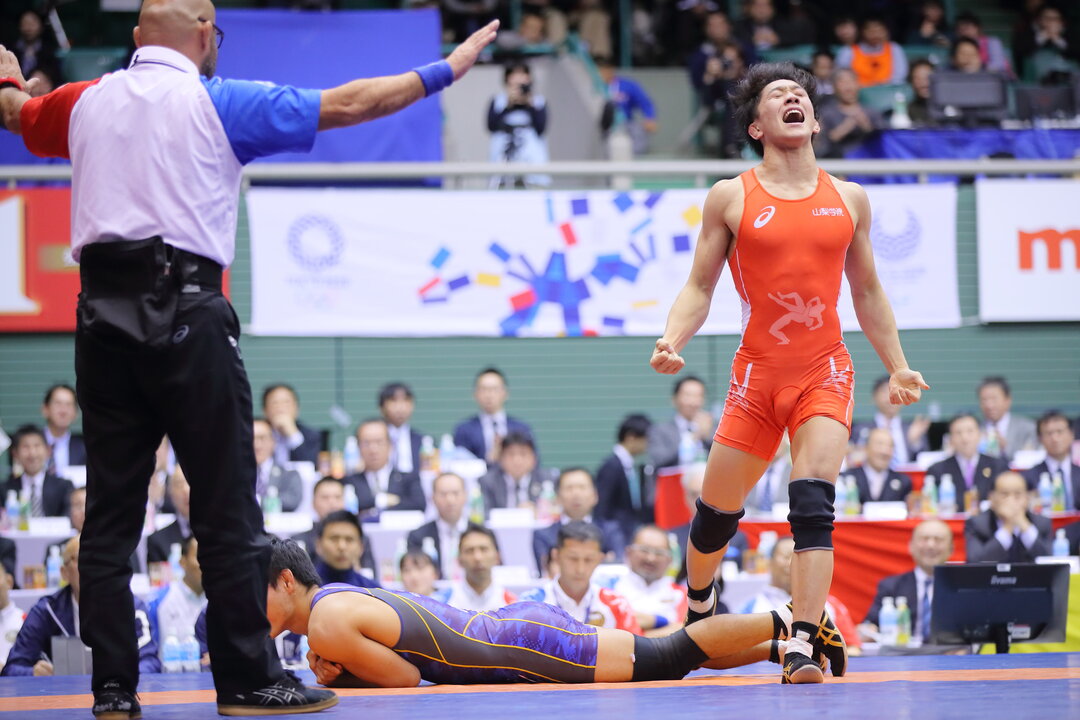
Reigning world champion Takuto OTOGURO defeated Daichi TAKATANI, 10-0, in the finals at 65kg. (Photo: Sachiko Hotaka)
Japan’s newest star among its male contingent lived up his billing, but anyone who blinked while Takuto OTOGURO was on the mat might have missed his victory in the freestyle 65kg final over Daichi TAKATANI.
Otoguro, who became the youngest-ever male Japanese world champion when won the gold in Budapest at 19 years 10 months, needed just 33 seconds to finish off a 10-0 technical fall over Takatani, topping off a double-leg takedown with four rapid-fire ankle rolls in succession.
In addition to winning his first senior national title, Otoguro also walked off with the prestigious Emperor’s Cup as the outstanding wrestler of the year. He swept through the competition despite falling behind in his preparation due to an injury that kept him out of the national collegiate championships in November.
“I didn’t have practice that I could be satisfied with,” Otoguro said. “From now, the most important thing is to not take anything lightly.”
There was another tale of redemption when Paris 2017 world champion Kenichiro FUMITA regained the Greco 60kg title that he lost last year to long-time rival and Rio 2016 silver medalist Shinobu OTA.
Fumita, ahead 2-1 (all passivity points) with a minute to go, countered an Ota spinning arm throw attempt, sending his opponent sprawling onto his back for a 4-point move. An unsuccessful challenge made the final score 7-1.
“In the last minute, I was leading and while avoiding risk, I wanted to stand firm and ensure the victory. Last December while I was winning, I went half-heartedly on my attack and he countered and I lost. I wanted to make sure that didn’t happen this year.”
After Ota rallied to defeat Fumita in last year’s final, he earned the place on Japan’s team to Budapest when Fumita suffered a left knee injury in May and had to pull out of the Meiji Cup.
Fumita, who considered quitting, returned to practice in mid-August, dead set on avenging the loss and making the Tokyo 2020 team.
“I lost in December, then just before the tournament that I had to win in June, I got injured. I was so depressed I was ready to throw it all away. But my dreams of a gold medal at Tokyo 2020 have never wavered.
“It was too soon to give up. And because of the injury, it gave me time to think about many things and look closely at my techniques, and I think that led to today’s result.”
Fumita now holds a 5-4 advantage over Ota in career meetings dating back to 2014. Ota might find some consolation in the fact that the two---they are both Nippon Sport Science University alumni and train together---have now alternated victories in seven straight matches.
Day 4 Results
Freestyle
65kg (27 entries)
Final: Takuto OTOGURO df. Daichi TAKATANI by TF, 10-0, :33
3rdPlace: Rinya NAKAMURA df. Rei HIGUCHI by DEF.
3rdPlace: Koki SHIMIZU df. Yosuke KAWANO, 9-4
79kg (11 entries)
Final: Yuto ABE df. Yuto IZUTSU, 12-5
3rdPlace: Komei KAWABATA df. Daichi KURIHARA, 5-2
3rdPlace: Yudai TAKAHASHI df. Kazuto KATO by TF, 11-0, 3:27
Semifinals
Izutsu df. Kurihara by TF, 10-0, 1:44
Abe df. Takahashi by TF, 10-0, 4:47
Greco-Roman
6o kg (13 entries)
Final: Kenichiro FUMITA df. Shinobu OTA, 7-1
3rdPlace: Kazuki YABE df. Kensuke SHIMIZU by FALL, 1:40 (3-0)
3rdPlace: Kyotaro SOGABE df. Kiyoshi KAWAGUCHI by TF, 8-0, 2:26
82kg (13 entries)
Final: Yuya OKAJIMA df. Yoji KAWAMURA, 3-1
3rdPlace: Kohei KITAMURA df. Kosuke KOBAYASHI, 6-5
3rdPlace: Satoki MUKAI df. Tatsuya FUJII, 5-5
Semifinals
Okajima df. Kitamura by TF, 9-0, 1:45
Kawamura df. Mukai by Fall, 4:21 (1-5)
Women’s Wrestling
50kg (8 entries)
Final: Yuki IRIE df. Kika KAGATA, 6-0
3rdPlace: Eri TOSAKA df. Remina YOSHIMOTO, 7-3
3rdPlace: Miho IGARASHI df. Chihiro SAWADA by TF, 10-0, 1:27
53kg (8 entries)
Final: Mayu MUKAIDA df. Nanami IRIE, 8-6
3rdPlace: Yuka YAGO df. Katsura KONISHI by TF, 10-0, 1:58
3rdPlace: Umi IMAI df. Momoka KADOYA, 2-0
57kg (7 entries)
Final: Kaori ICHO df. Risako KAWAI, 3-2
3rdPlace: Akie HANAI df. Hanako SAWA, 4-1
68kg (5 entries)
Round-Robin (Final Standings)
1. Sara DOSHO (4-0, 12 pts)
2. Rio WATARI (3-1, 12)
3. Chiaki SEKI (2-2, 8)
Key Match: Dosho df. Watari, 2-1 in 5thround

Share your thoughts.
Comments