

Higuchi earns first trip to Worlds; Sakurai squeezes through
Friday, June 17, 2022 - 16:39 By Ken Marantz

TOKYO, Japan (June 17) -- Rei HIGUCHI will be going to his first World Championships, but make no mistake about it -- his ultimate goal remains winning the Olympic gold that eluded him six years ago in Rio.
Higuchi, the 2016 Olympic silver medalist at 57kg, earned a ticket to this year's World Championships at freestyle 61kg by defeating Kodai OGAWA 4-0 in the final at the Meiji Cup All-Japan Invitational Championships on Friday.
The 26-year-old had a fall and a technical fall in his two other matches as he ended the day unscored upon in winning the second of Japan's domestic qualifying tournaments for places on the team to the World Championships in September in Belgrade, Serbia.
Tsugumi SAKURAI, the reigning women's world champion at 55kg who has moved up to 57kg, secured a trip back to the worlds at that weight class but not without a bit of drama, while 2021 world silver medalist Miwa MORIKAWA will also be Belgrade-bound after triumphing at 65kg.
Winners of the Meiji Cup who previously won titles at the Emperor's Cup All-Japan Championships last December automatically secured places on the team to Belgrade; if the champions are different, they meet in a playoff after that day's action at Tokyo's Komazawa Gym.
On Friday, there were no playoffs held. In six of the eight weight classes held on the second day of action, the Emperor's Cup champion prevailed again, while in the two others, that champion skipped the tournament due to injury, conceding the berth to the Meiji Cup winner.
 Rei HIGUCHI controls Kodai OGAWA in the freestyle 61kg final. (Photo: Takeo Yabuki / Japan Wrestling Federation)
Higuchi fell into the latter case. Having moved up to 61kg after an ill-fated attempt to make the Tokyo Olympics at 57kg, he lost in the final at the Emperor's Cup to Ryuto SAKAKI, who is out injured.
The last time Higuchi was involved in a playoff, it was for the 57kg berth at the Tokyo Olympics, which he lost to Yuki TAKAHASHI. That came after he blew a chance to win the berth outright at the Asian Olympic qualifying tournament by failing to make weight.
Now his focus is on the 2024 Paris Olympics, and his efforts are aimed at getting off to a good start in the qualifying process that starts with this year's Emperor's Cup in December when he will drop back down to 57kg.
"The path to qualifying for the Olympics starts in December, so I thought that more than this tournament, and the World Championships if I qualified, December is the main event that I have to win," Higuchi said.
"If I don't win at 57kg in December, there will be no Olympics for me. The younger generation is emerging. I want to head into December with the feeling that I am the main challenger."
Not that he's not going to go all out at the World Championships.
"I move better against foreign opponents than against my fellow Japanese, so I going to take the offensive," Higuchi said. "I want to give everything I've got and win the world championship convincingly.
"I don't know if he will be able to compete, but if I can't beat [Tokyo Olympic 57kg] Zavur UGUEV (ROC) of Russia, I can't be No. 1 in the world. So I will devise a strategy to beat Uguev. There are many strong competitors in the world, but I will make that my primary goal."
At the Rio Olympics, Higuchi suffered a heart-breaking and controversial 3-3 loss in the gold-medal match to Vladimer Khinchegashvili (GEO). So desperate was he to get to the Tokyo Games, Higuchi at one time moved up to 65kg, where he won his lone other Meiji Cup title in 2019.
Although not an Olympic weight, the 26-year-old Higuchi seems to have found his niche at 61kg, in which he won the gold in his Asian Championships debut in April.
In Friday's final against fellow Nippon Sports Science University alumnus Ogawa, who knows him well, Higuchi tried new ways to crack his opponent's defense. But after gaining an activity point in the first period, he scored his lone technical point with a counter to the back in the second before receiving a second activity point.
"In the final, I reversed how I tie-up," Higuchi said. "I wanted to try shooting to the right after making him cautious of a single-leg tackle to the left. But as he's a junior teammate, he knew well what hand I was playing, so I wasn't able to do the move. Also, I was lacking a bit of confidence in trying it, so I'll work to perfect it before the World Championships."
 Tsugumi SAKURAI rises up before turning over Sae NANJO for the winning takedown in the last seconds of the women's 57kg final. (Photo: Takeo Yabuki / Japan Wrestling Federation)
For Sakurai, it was deja vu all over again as she barely beat the clock to beat world bronze medalist Sae NANJO 5-3 in the final -- much as she did six months earlier in the Emperor's Cup final.
Nanjo gained an activity point and a takedown to take a 3-0 lead into the second period, in which Sakurai closed the gap to 3-2 with a takedown. With 10 seconds left, Sakurai shot in on a single, and Nanjo went over the back and clamped on a leg, looking to ride out the clock.
But with the seconds ticking down, Sakurai raised up and managed to dump Nanjo onto her bottom as time expired. Was it in time? After an extraordinarily long challenge review, it was decided that Sakurai had gained control with milliseconds to spare.
"I went for the tackle with my last bit of energy," said Sakurai, last year's Meiji Cup champion at 55kg. "I didn't see the clock so I didn't know how much time was left, but I came out on top in the situation, so I thought I got the points."
What was going through her mind as the judges deliberated the call? "If I didn't get it, I would lose and we would go to a playoff, so I thought I had to be ready to face that possibility."
In the final of the Emperor's Cup, where Sakurai made her debut at 57kg, she scored a stunning 4-point takedown in the final seconds for a 5-2 win over Nanjo.
Making her latest victory even sweeter is that it came a day after two Ikuei University teammates, Sakura MOTOKI (59kg) and Ami ISHII (68kg), earned their first trips to the World Championships, which also put pressure on her to do so, too.
"At the end, I again won in the final by coming from behind, but I am confident that I practice harder than anyone, so even if it is tough at the end, I'm glad I could get in on a tackle and score points," Sakura said. "At the same time, yesterday two of my teammates at Ikuei University won titles, and while I also wanted to win, I felt like I had to win. I feel like it's a relief."
Sakurai's emergence as Japan's top wrestler at 57kg comes in the absence of Tokyo Olympic champion Risako KAWAI, who last month gave birth to her first child and plans to return at the Emperor's Cup to start a run at a third straight Olympic title.
"For me to get to the Olympics, she a competitor who I will have to beat," said Sakurai, who was one of Japan's seven women gold medalists at the Asian Championships. "I have youth and a bit of room timewise to still build strength, so I think I will get more powerful from now -- enough, I hope, to beat Kawai."
 Miwa MORIKAWA works to get behind Miyu IMAI in the women's 65kg final. (Photo: Takeo Yabuki / Japan Wrestling Federation)
At 65kg, Morikawa had a far less dramatic day in winning her second straight title with an 8-1 victory in the final over 2018 world U20 champion Miyu IMAI, although she was a bit dissatisfied with her showing.
"I missed some chances for points," Morikawa said. "In order to win at the worlds, I have been able to firmly get those."
In Belgrade, Morikawa will be looking to make up for her loss in the 2021 world final in Oslo to Irina RINGACI (MDA). "That ended with a disappointing result, so I'm going to get the gold," Morikawa pledged.
 Kensuke SHIMIZU battles with Kyotaro SOGABE in the Greco 67kg semifinal. (Photo: Takeo Yabuki / Japan Wrestling Federation)
Shimizu comes up short at 67kg
A third medalist from the 2021 World Championships won't be getting another shot this year, as Greco 63kg bronze medalist Kensuke SHIMIZU came up short after moving up 67kg.
Shimizu, wanting to get an early start at adjusting his body to the Olympic weight, was dominated in the semifinals by Nippon Sport Science University's Kyotaro SOGABE, who built up a 7-1 lead before securing a fall in the waning seconds of the match.
"It's my first time in the higher weight class, and of course, my aim was to win the championship," said Shimizu, who came away with the bronze medal. "Beyond that, I want this to lead into my next competition. I particularly felt in the semifinal with Sogabe that there is still a real difference in power. I am determined to get stronger before December."
Shimizu was coming off a disappointing showing at the Asian Championships, where he lost in the second round for the second year in a row.
"At the Asian Championships, I let the opponent use his favored moves to dictate the match, and I wasn't able to show any of my best sides," Shimizu said. "It was really a terrible match. I never want to have a match like that again, and after I came back to my team, I talked it over with my coach thoroughly about what I should do. Every day, I think more in practice than I've ever done."
Shimizu changed his training environment by joining the Self-Defense Forces team upon graduating from Takushoku University, providing an ideal setting for making a run at the Olympics at 67kg.
"My weight training regimen and diet have gotten far better and I can put together a plan for tailoring my body to the heavier weight class," Shimizu said. "In regular practice, I can work out with wrestlers in higher weight classes, and train with more powerful ones."
Shimizu, who won the Emperor's Cup at 63kg to put him halfway back to the World Championships at that weight, said he decided it was better to make the move now to 67kg.
"Looking ahead, I thought instead of losing weight now, it was better to properly make the move up in weight class and get started on reforming my body and getting used to the new weight. I thought it was more important to start competing at this weight class."
Filling Japan's spot at 67kg in Belgrade will be Asian bronze medalist Katsuaki ENDO, who beat Sogabe 6-1 in the final for his first Meiji Cup title since winning at 63kg in 2018. The result, down to the score, was a repeat of Endo's victory over Sogabe at the Emperor's Cup.
Endo, an alumnus of NSSU, countered a forced throw attempt by Sogabe for 4 points in the second period, then followed that with a quick roll to put away his practice partner.
"I'm good from the ground, so maybe Kyotaro thought it was worth giving it a shot there and forced it too much," Endo said.
Sogabe, still looking for his first senior national title, first put himself onto the radar while at Imabari Nishi High School in his native Ehime Prefecture, when in 2019 he became the 10th wrestler in Japan history to win three straight titles in the high school division at the National Games. Among his notable predecessors was future world champion Kenichiro FUMITA.
In other Greco finals, veterans Tomohiro INOUE and Masato SUMI followed up their Emperor's Cup triumphs to secure tickets to Belgrade at 72kg and 87kg, respectively.
The 34-year-old Inoue won his second straight Meiji Cup title and fourth overall with a 3-1 victory over Taishi HORIE, while Sumi, 28, defeated Self-Defense Forces teammate So SAKABE 5-1 for his third title and first since 2019.
In freestyle, Asian bronze medalist Daichi TAKATANI chalked up a 5-2 victory in the final over Kirin KINOSHITA to capture his first Meiji Cup crown since 2013 and earn his first trip to the World Championships since 2014.
Taiki YAMAMOTO maintained his firm grip on the 125kg title, defeating Hiroto NINOMIYA 2-1 on activity points for his fourth straight title and fifth overall.
Day 2 Results
Freestyle
61kg (9 entries)
Final - Rei HIGUCHI df. Kodai OGAWA, 4-0
3rd Place - Kaito MORIKAWA df. Hayato FUJITA by TF, 10-0, 3:35
74kg (10 entries)
Final - Daichi TAKATANI df. Kirin KINOSHITA, 5-2
3rd Place - Yuto FUKADA df. Iori KOSHIBA, 6-1
125kg (7 entries)
Final - Taiki YAMAMOTO df. Hiroto NINOMIYA, 2-1
3rd Place - Yuji FUKUI df. Asahi TSUIHIJI by TF, 10-0, 3:57
Greco-Roman
67kg (11 entries)
Final - Katsuaki ENDO df. Kyotaro SOGABE, 6-1
3rd Place - Kensuke SHIMIZU df. Yoshinobu ITO by Inj. Def.
72kg (10 entries)
Final - Tomohiro INOUE df. Taishi HORIE, 3-1
3rd Place - Daigo KOBAYASHI df. Haruto YABE, 2-1
87kg (9 entries)
Final - Masato SUMI df. So SAKABE, 5-1
3rd Place - Kanta SHIOKAWA df. Satoki MUKAI by Fall, 2:18 (2-3)
Women's Wrestling
57kg (9 entries)
Final - Tsugumi SAKURAI df. Sae NANJO, 5-3
3rd Place - Sena NAGAMOTO df. Ruka NATAMI by TF, 12-2, 4:55
65kg (6 entries)
Final - Miwa MORIKAWA df. Miyu IMAI, 8-1
3rd Place - Ayana GEMPEI df. Rin TERAMOTO, 7-1

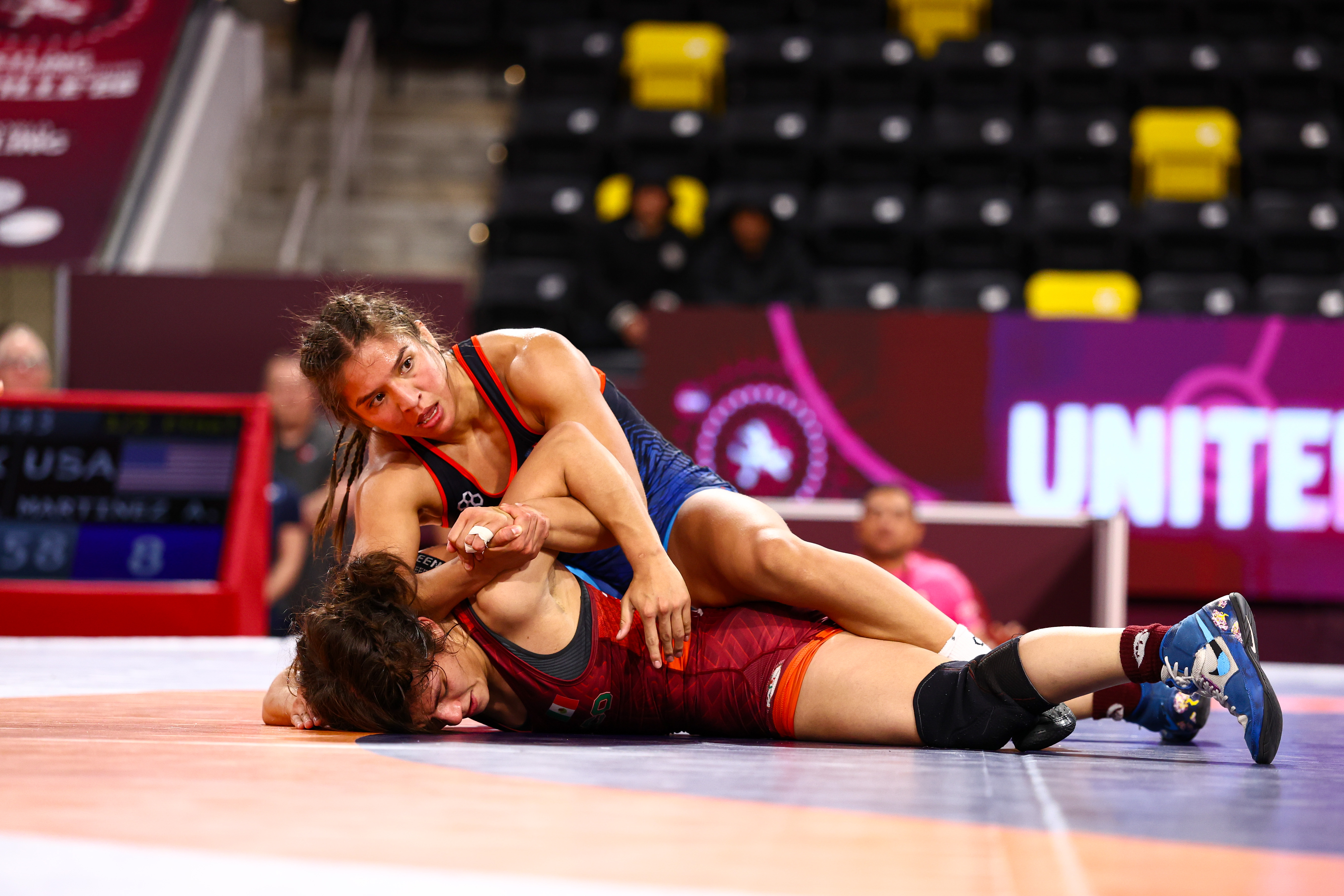 Amanda MARTINEZ (USA) won the 57kg gold medal to be one of the five champions for the U.S. on Friday. (Photo: United World Wrestling / Jake Kirkman)
Share your thoughts.
Comments