ZAGREB, Croatia (September 15) -- For all of Greece's history in the sport of wrestling-- one of the current styles even bears the country's name -- it had never produced a male world champion.
Georgios KOUGIOUMTSIDIS (GRE) rectified that situation with a determined performance, defeating Levi HAINES (USA) 3-2 in the 79kg final on Monday night, the third day of the World Championships in Zagreb when four freestyle golds were up for grabs.
"I'm very proud," Kougioumtsidis said. "I'm the first one who won a gold medal at the World Championships. It's my dream come true. I failed at the Olympics last year. I think this year is a good achievement. I achieved my goal."
In other finals, Chongsong HAN (PRK) gave his country its first world gold since 2019 with a come-from-behind victory at 57kg, while Japan and the United States each picked up their second golds of the competition, with Kota TAKAHASHI (JPN) winning at 74kg under sad circumstances and Trent HIDLAY (USA) putting on a comeback for the ages to triumph at 92kg.
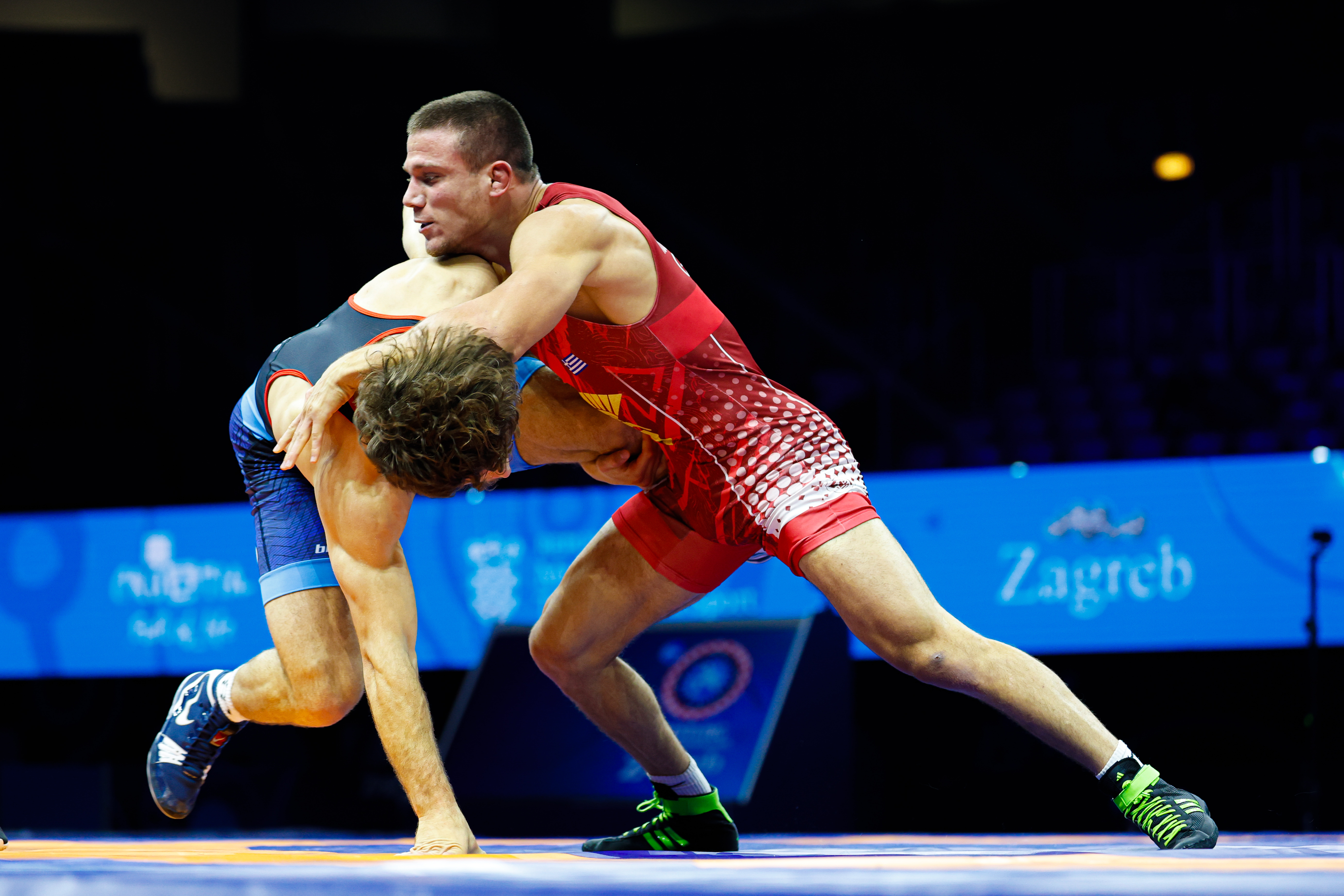 Georgios KOUGIOUMTSIDIS (GRE) scores a stepout against Levi HAINES (USA) in the 79kg final. (Photo: United World Wrestling / Kostadin Andonov)
The 23-year-old Kougioumtsidis came to Zagreb flying under the radar for title favorites. He was a two-time European U23 champion, and won the senior gold in 2022, but had lost in the first round at 74kg at the Paris Olympics and was third at this year's Budapest Ranking Series.
But he steadily battled his way through the rounds to advance to final, where he wrestled a solid and sensible match that took advantage of opportunities while keeping his American foe at bay.
After receiving an activity point, Kougioumtsidis got in on a single that led to a stepout and a 2-0 lead at the break. He repeated the move again in the second period and, although he surrendered a takedown with :02 left, it wasn't enough to deter him from his appointment with destiny.
"He's a very offensive wrestler, I know that," Kougioumtsidis said. "He has very good conditioning. My condition is also good. I was a bit tired from yesterday because of four matches. But I won, that's what matters most."
Kougioumtsidis said that after his disappointment in Paris, he took some time off, then spent time training in Georgia.
"After the Olympics I had maybe five months off because I wasn't feeling very good," he said. "I had very good training. This year, I mostly was in Georgia for camp and thanks to my sparring partners from Georgia that helped me. I achieved the biggest goal here."
Until Kougioumtsidis' victory, the lone Greek to ever step to the top of the medal podium at the World Championships was Sofia POUMPOURIDOU (GRE), who won the women's 51kg gold in 2002 on home soil in Chalkida, Greece.
Only three times has a Greek man ever even advanced to a world final (Giorgios ATHANASSIADIS (GRE) did in twice), all in freestyle, but never did they come away with a gold. The last time was in 1991.
"I'm very lucky also that I am Greek," Kougioumtsidis said. "So I feel like I made all Greeks proud. I am Greek and I love my country."
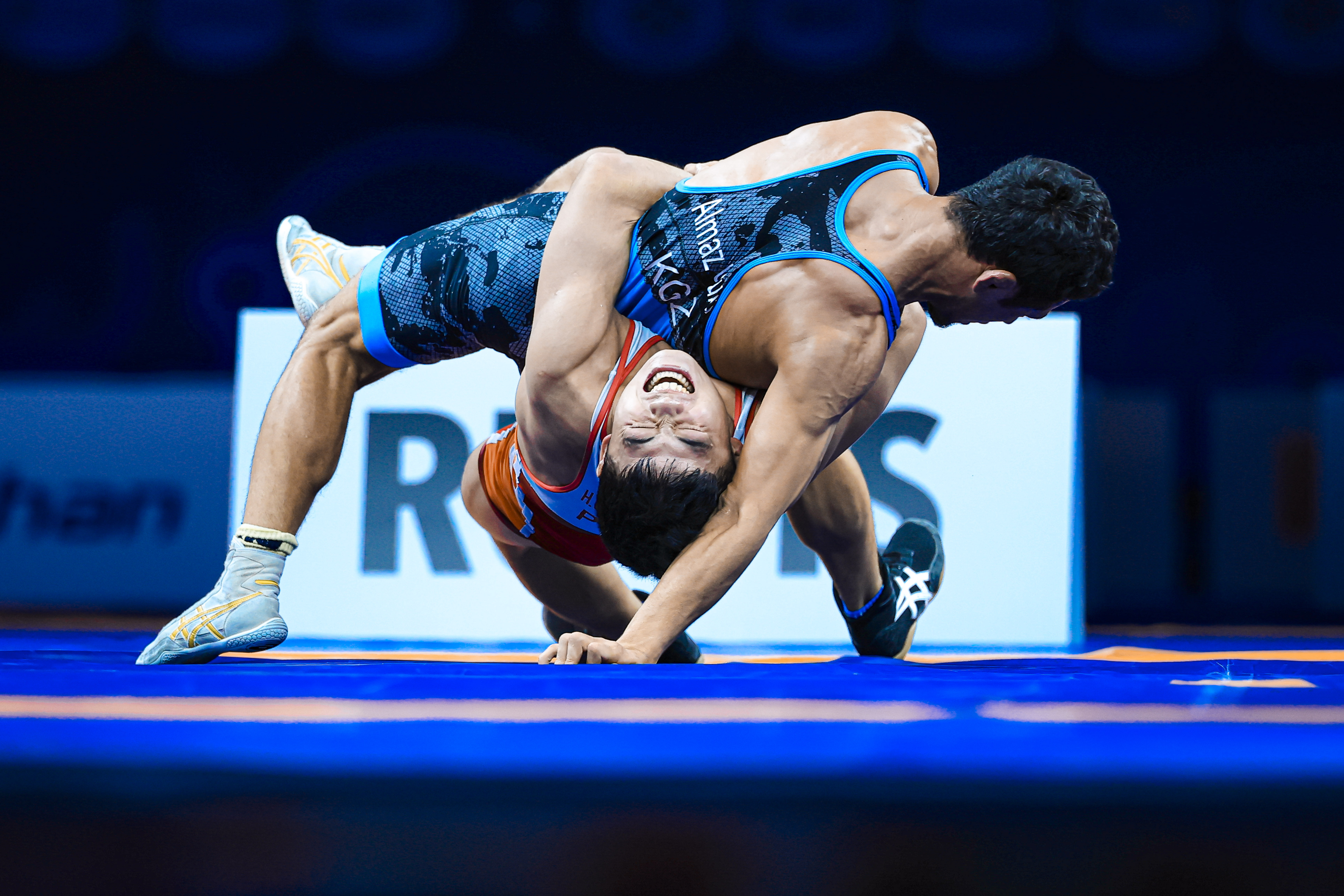 Chongsong HAN (PRK) works on a gut-wrench against Bekzat ALMAZ UULU (KGZ) during the 57kg final. (Photo: United World Wrestling / Kadir Caliskan)
At 57kg, things could hardly have gone worse for Han in his gold-medal match with Bekzat ALMAZ UULU (KGZ), which was a rematch of their semifinal clash at the 2023 Asian Games, which Han won 4-2.
Ahead 1-0 in the second period, Almaz Uulu stopped an arm throw attempt -- which, if challenged, could possibly have been overturned as a slip -- then added two 2-point exposures to go up 7-0.
Han determinedly fought on, and a scramble that he initiated with a front headlock roll gave him six points to cut the lead to 9-6. He then scored a takedown and added two gut wrenches to notch a 12-9 victory.
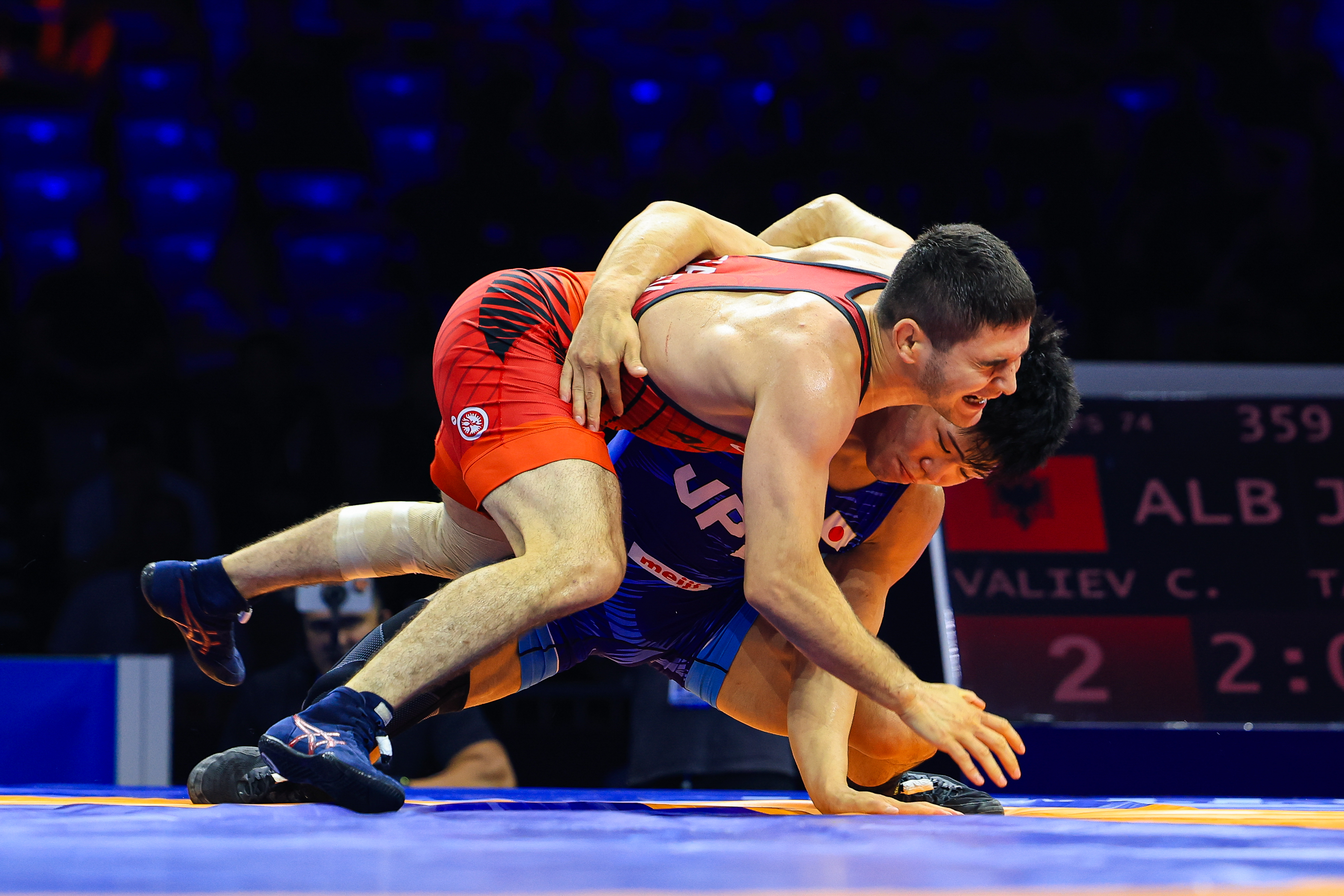 Kota TAKAHASHI (JPN) and Chermen VALIEV (ALB) wrestle in the 74kg final. (Photo: United World Wrestling / Kadir Caliskan)
At 74kg, Takahashi won by injury default after his opponent in the final, Olympic bronze medalist Chermen VALIEV (ALB), suffered a serious knee injury and, after trying to soldier on for a short time, was forced to give up the fight.
"It leaves a bit of a bad aftertaste, but I feel like I won the world title with the tackle that works best for me, so I'm happy," Takahashi said.
Takahashi, the 2024 world U23 champion, had a 3-2 lead when Valiev tried to counter a single-leg attempt 35 seconds into the second period by going over the top.
Takahashi had Valiev's left leg at an acute angle and his own action caused the knee to pop, after which he immediately sank to the mat in pain.
"When I got in on the single, I tried to get my head out and finish it off as I always do," said Takahashi, who scored off an identical move in the first period. "It was all but done, I thought. But the opponent was entangled deeper than I thought, and I heard a snap."
Valiev's leg was taped and he limped into the circle, but it was obvious it would be almost an impossible task to continue, much less win. Takahashi scored a stepout, then got a takedown that Valiev initially countered -- much to everyone's surprise -- but could not continue the move. Another takedown finally proved to Valiev that it was futile to go on and the match was ended at 4:07.
While Takahashi did not deliberately target the injured leg, nor did he let up on Valiev, which he said would have been disrespectful to such a high-level competitor. He also recalls not being given any special treatment when he suffered a similar injury himself while winning last year's U23 title.
"He's a strong competitor, and once you take the mat, you can't let your guard down," Takahashi said. "I thought to just give everything I had. When I had my injury a year ago, the opponent came right at me without thinking about it. Conversely, it would be rude to have eased up."
Takahashi's victory comes at what is increasingly looking like a golden era for Japan in freestyle. Following up on the two golds and a silver at the Paris Olympics, Japan got one of the first golds in Zagreb when Yoshinosuke AOYAGI (JPN) won the 70kg title on Sunday. And earlier Monday, Olympic champion Kotaro KIYOOKA (JPN) advanced to the 65kg final.
"At the Olympics, Japan really did amazingly well, so there were high expectations for this [competition]," Takahashi said. "Instead of feeling pressure or nerves, we want to show 'Japan is strong' and that actually gives us more confidence."
Looking ahead, which could include a direct clash with Paris silver medalist Daichi TAKATANI (JPN), Takahashi has his eyes firmly set on 2028.
"I'm really happy to be the world champion, but what I am aiming for is the Los Angeles Olympics," he said. "The Olympics is a stage where you can be a champion just once every four years. I will work on sharpening my tackles."
In the last bout of the evening, Hidlay was being tossed around like a rag doll by Amanula GADZHIMAGOMEDOV (UWW), only to rally from an eight-point deficit through sheer persistence and determination. When the dust cleared, Hidlay had himself a 13-10 win and a gold medal in his senior world debut.
"It wasn't my best wrestling match as I wrestle a lot better and cleaner than that," the 26-year-old Hidlay said. "But I would say nothing probably describes my wrestling style and career better than being down by eight points and figuring out a way to win within a short time."
Gadzhimagomedov, a relative unknown on the scene, relied almost solely on a counter lift and throw that he used to great effect early on, scoring a pair of 4-pointers to take a 10-2 lead. When he tried a third one that could have ended the match, Hidlay managed to hold his position enough to get an exposure, which, with an unsuccessful challenge, cut the gap to 10-5 at the break.
In the second period, Gadzhimagomedov didn't seem to have the energy to get the necessary height to complete the move, and Hidlay finished off a pair of double-leg takedowns to pull within one with a minute to go. Then he hit the coup de grace, a 4-point takedown with :15 left to complete the miracle.
"I think the work I put in in the first period, I wasn't scoring, but it was taking it out of him a little bit," Hidlay said. "It was just a matter of time before I was able to get to my scores."
Hidlay, the 2022 world U20 silver medalist at 86kg, called being a senior world champion "surreal" and said that it hadn't fully sunken in yet.
"I just had so many emotions kind of flood over you in that moment and you kind of just go blind to the world," he said. "Just for a couple of seconds, you just feel like you're floating.
"It's just something I've worked for my entire life, my entire career. To have it all come together in that fashion is just pretty incredible."
Harutyunyan denies Mexico first-ever world medal
Earlier, Roman BRAVO YOUNG (MEX) came an agonizing few centimeters from giving Mexico its first-ever world medalist.
That was the distance Arsen HARUTYUNYAN (ARM) kept his knee off the mat, preventing what would have been a last-second winning takedown in their 57kg bronze-medal match.
With a denied challenge giving him a final point, four-time European champion Harutyunyan secured a 7-4 win and a fourth world medal in five years.
Harutyunyan looked to be cruising to victory when he added a takedown and exposure to an activity point for a 5-0 lead going into the second period. But Bravo Young, a collegiate star in the United States, launched a comeback, sandwiching two takedowns around a Harutyunyan stepout to cut the gap to 6-4.
With the clock ticking down, Bravo Young deftly deked his way behind Harutyunyan, but the Armenian resisted as the Mexican did all he could to get his opponent's knee to hit the mat.
The other 57kg bronze went to Gulomjon ABDULLAEV (UZB), who was on the activity clock when he scored a second-period takedown to give him a 3-1 victory over Vladimir EGOROV (MKD). With the victory, Abdullaev adds the world bronze to his Olympic bronze from last year in Paris.
Former Olympic and three-time world champion Zaurbek SIDAKOV (UWW) assured he wouldn't leave Zagreb empty-handed, and he did it with a dramatic last-second victory over David CARR (USA) at 74kg.
Sidakov received an activity point in the first period, but he was on the clock in the second when Carr scored a stepout. Seconds later, the activity point was added to Carr's tally to put him ahead 2-1.
It looked like that was how it was going to end, but the cagey Sidakov managed to slip behind and force Carr over the edge for a stepout with :05 left to secure a 2-2 win on criteria.
Taimuraz SALKAZANOV (SVK) earned the other 74kg bronze with a 3-1 victory over Yones EMAMI (IRI), securing the decisive points with a second-period takedown for his fourth career world medal.
Iran picked up two bronze medals, with 2024 Asian champion Mohammad NOKHODI (IRI) taking home one at 79kg and reigning Asian champion Amirhossein FIROUZPOUR (IRI) winning the other at 92kg.
Nokhodi, the 2024 Asian champion, took home his fifth world medal -- alas, still no gold -- when he scored a takedown and stepout in the first period and held on for a 4-2 victory over Dzhabrail GADZHIEV (AZE) at 79kg.
Firouzpour quickly finished off Kamil KURUGLIYEV (KAZ), latching onto a cradle as he defended against a takedown attempt, then rocking backward to put the Kazakh onto his back and secure a fall in 1:49 for his first senior world medal.
The other 79kg bronze was claimed by Asian silver medalist Khidir SAIPUDINOV (BRN), who was trailing Suldkhuu OLONBAYAR (MGL) until the last minute when he went on a point-scoring spree, including a 4-point pancake, for a 9-2 victory.
European silver medalist Osman NURMAGOMEDOV (AZE) broke open a close match in the second period to beat Miriani MAISURADZE (GEO) 5-1 for the other 92kg bronze, upping his tally of world medals to four.
Day 3 Results
Freestyle
57kg (31 entries)
GOLD: Chongsong HAN (PRK) df. Bekzat ALMAZ UULU (KGZ), 12-9
BRONZE: Arsen HARUTYUNYAN (ARM) df. Roman BRAVO YOUNG (MEX), 7-4
BRONZE: Gulomjon ABDULLAEV (UZB) df. Vladimir EGOROV (MKD), 3-1
65kg (34 entries)
SEMIFINAL: Rahman AMOUZAD (IRI) df. Peiman BIABANI (CAN), 5-0
SEMIFINAL: Kotaro KIYOOKA (JPN) df. Umidjon JALOLOV (UZB), 5-0
74kg (35 entries)
GOLD: Kota TAKAHASHI (JPN) df. Chermen VALIEV (ALB) by Inj. Def., 4:07 (8-2)
BRONZE: Zaurbek SIDAKOV (UWW) df. David CARR (USA), 2-2
BRONZE: Taimuraz SALKAZANOV (SVK) df. Yones EMAMI (IRI), 3-1
79kg (27 entries)
GOLD: Georgios KOUGIOUMTSIDIS (GRE) df. Levi HAINES (USA), 3-2
BRONZE: Mohammad NOKHODI (IRI) df. Dzhabrail GADZHIEV (AZE), 4-2
BRONZE: Khidir SAIPUDINOV (BRN) df. Suldkhuu OLONBAYAR (MGL), 9-2
92kg (26 entries)
GOLD: Trent HIDLAY (USA) df. Amanula GADZHIMAGOMEDOV (UWW), 13-10
BRONZE: Osman NURMAGOMEDOV (AZE) df. Miriani MAISURADZE (GEO), 5-1
BRONZE: Amirhossein FIROUZPOUR (IRI) df. Kamil KURUGLIYEV (KAZ) by Fall, 1:49 (4-0)
97kg (29 entries)
SEMIFINAL: Amirali AZARPIRA (IRI) df. Akhmed TAZHUDINOV (BRN), 5-2
SEMIFINAL: Kyle SNYDER (USA) df. Arash YOSHIDA (JPN), 9-1
Women's Wrestling
55kg (18 entries)
SEMIFINAL: Kyong Ryong OH (PRK) df. Sowaka UCHIDA (JPN) by Fall, 1:06 (4-0)
SEMIFINAL: Ekaterina VERBINA (UWW) df. Andreea ANA (ROU), 5-3
59kg (22 entries)
SEMIFINAL: Sakura ONISHI (JPN) df. Altjin TOGTOKH (MGL), by Fall, 1:22 (6-0)
SEMIFINAL: Maria VYNNYK (URK) df. Laurence BEAUREGARD (CAN), 10-5


Share your thoughts.
Comments