

Gadzhiev returns to top with gold at U23 Europeans
Sunday, May 26, 2024 - 18:58 By United World Wrestling Press
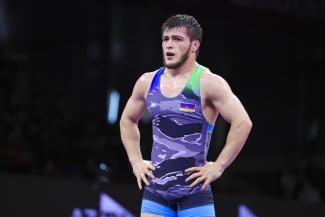
BAKU, Azerbaijan (May 26) -- Only a minute and 16 seconds were remaining on the clock when Dzhabrail GADZHIEV (AZE) and Kamil ABDULVAGABOV (AIN) retreated to their respective corners. Their bleeding faces required medical intervention.
As the doctors patched them up, both wrestlers could not wait to return to the mat to resume their thrilling 74kg U23 European Championship gold medal bout. Understandably so. Both the wrestlers felt the momentum was their way, and each one knew he had a good chance to win the gold.
The final day of the competition was providing the right kind of fireworks.
At that stage, when the medical timeout was taken, Gadzhiev was 6-3 ahead but Abdulvagabov was on the ascendency, fighting his way back into the bout which seemed a lost cause not too long ago. That break would eventually prove to be crucial.
The physical differences between the two were glaring. Lean and gifted with long limbs, Abdulvagabov was at least a head higher than Gadzhiev and he tried to use the height factor to his advantage. He planted his left leg so far back that it became out of reach for Gadzhiev and each time the Azerbaijani tried too hard, a counter-attacking opportunity would arise.
 Dzhabrail GADZHIEV (AZE) scores a crucial four-pointer in the 74kg final. (Photo: United World Wrestling / Javid Gurbanov)
Gadzhiev raided Abdulvagabov’s defense with multiple single-leg attacks, targeting his right leg, which was relatively closer. But each time Gadzhiev caught his opponent’s right ankle, Abdulvagabov used his physical might to ensure it couldn’t be converted into a takedown.
This trend repeated several times, with Gadzhiev going all-out employing single-leg takedowns and ankle trips. But Abdulvagabov looked hardly troubled. Until the Azerbaijani wrestler surprised him with a feet-to-back throw, slamming Abdulvagabov on his mat from a standing position in a dramatic move to be awarded four points.
When the bout was halted for the first medical timeout, Abdulvagabov was trailing 6-3. He reduced the deficit to one point by two stepouts, and with 16 seconds left, the match was paused for another medical timeout to treat both wrestlers who again started bleeding.
Abdulvagabov threw the proverbial kitchen sink at Gadzhiev but the match-winning two-point throw that he sought never came. Gadzhiev used the sprawls to good effect, doing just enough to win the bout 6-5.
The 22-year-old ran to his corner to celebrate the gold medal which came after a long drought. The 2022 U23 European Champion and U20 World and European Champion endured a difficult last year in which he earned a couple of podium finishes but a title eluded him.
He started this year strongly with a bronze medal at the Ranking Series in Zagreb and the gold medal here will come as a huge confidence booster. It was also Azerbaijan’s only gold medal in men’s freestyle at this competition.
 Arslan BAGAEV (AIN) blanked defending champion Rakhim MAGAMADOV (FRA) 10-0 in the 86kg final. (Photo: United World Wrestling / Javid Gurbanov)
Bagaev stuns Magamadov
In the 86kg category, Arslan BAGAEV (AIN) built on his fifth-place finish at the senior European Championships with a remarkable gold medal.
Bagaev conceded just one point, scored 25, and spent a little less than 12 minutes on the mat for his first-ever title since winning the U20 European Championship gold in 2021.
The manner in which Bagaev won was stunning. He was up against defending champion Rakhim MAGAMADOV (FRA), whose trophy cabinet in age-group events is brimming with medals. But the moment the referee began the bout, Bagaev stopped caring about reputations.
Magamadov looked stronger in the opening exchanges and launched the first leg attack, which Bagaev escaped. Bagaev waited for Magamadov to come searching for his leg again. When he did, a little after one minute, the 20-year-old used his quick reflexes to evade Magamadov’s advances and then launched a blistering counterattack, affecting three roll-overs to earn three points.
In between the second and third roll-over, Magamadov held his face and signaled that he was hurt. The doctors, who were kept busy all evening, rushed to treat him but the break in momentum didn’t impact Bagaev, who finished the bout with a two-point takedown.
 Alen KHUBULOV (BUL), right, won the 125kg title after beating Solomon MANASHVILI (GEO). (Photo: United World Wrestling / Javid Gurbanov)
Maiden titles for Khubulov, Bliatze
Bagaev wasn’t the only wrestler who won his first-ever U23 European Championship title.
At 125kg, Alen KHUBULOV (BUL) made a stunning comeback to beat Solomon MANASHVILI (GEO) 6-5 in another dramatic bout to win the gold medal.
Khubulov had overturned a two-point deficit with a couple of well-timed leg attacks. But with around 40 seconds remaining, Manashvili again took the lead with a two-point takedown. Khubulov responded almost immediately, scoring two more points via exposure to restore his lead and then clung to it desperately to clinch the gold medal.
Minutes earlier, Gkivi BLIATZE (GRE) defeated Adlan VISKHANOV (FRA) 8-7 in a thrilling bout to reign supreme in the 92kg category. This was a momentous win for Bliatze, who has been competing on the circuit since 2018 but never came close to a podium finish. He ended the long wait in style by getting the better of the 2023 U23 European Championship bronze medallist in an action-filled bout.
In 61kg, Bashir MAGOMEDOV (AIN) defended his gold medal with a clinical performance against Mykyta ABRAMOV (UKR), winning 10-0.

RESULTS
61kg
GOLD: Bashir MAGOMEDOV (AIN) df. Mykyta ABRAMOV (UKR), 10-0
BRONZE: Nuraddin NOVRUZOV (AZE) df. Yahor RUDAUSKI (AIN), 13-12
BRONZE: Emre KURAL (TUR) df. Simone PIRODDU (ITA), 4-3
74kg
GOLD: Dzhabrail GADZHIEV (AZE) df. Kamil ABDULVAGABOV (AIN), 6-5
BRONZE: Luka CHKHITUNIDZE (GEO) df. Theocharis KOUGIOUMTSIDIS (GRE), 7-2
BRONZE: Ibrahim YAPRAK (TUR) df. Krisztian BIRO (ROU), 6-4
86kg
GOLD: Arslan BAGAEV (AIN) df. Rakhim MAGAMADOV (FRA), 10-0
BRONZE: Emre CIFTCI (TUR) df. Ilya KHAMTSOU (AIN), 6-4
BRONZE: Arsenii DZHIOEV (AZE) df. Miko ELKALA (FIN), 11-0
92kg
GOLD: Gkivi BLIATZE (GRE) vs. Adlan VISKHANOV (FRA)
BRONZE: Mustafagadzhi MALACHDIBIROV (AIN) df. Muhammed GIMRI (TUR), 6-2
BRONZE: Ion DEMIAN (MDA) df. Denys SAHALIUK (UKR), 16-6
125kg
GOLD: Alen KHUBULOV (BUL) df. Solomon MANASHVILI (GEO), 6-5
BRONZE: Milan KORCSOG (HUN) df. Volodymyr KOCHANOV (UKR), 8-1
BRONZE: Abdulla KURBANOV (AIN) df. Adil MISIRCI (TUR), 12-8

 Women's Wrestling at the 2004 Athens Olympic Games. (Photo: United World Wrestling / Martin Gabor)
 Tayla FORD (NZL) is the first wrestler from New Zealand who will compete at the Olympics. (Photo: United World Wrestling / Amirreza Aliasgari)
Share your thoughts.
Comments