

Fujinami preps for Belgrade worlds with 1st Japan collegiate title
Tuesday, August 23, 2022 - 18:14 By Ken Marantz

TOKYO (Aug. 22) --- With less than a month to go before she attempts to defend her world 53kg title in Belgrade, Japanese teen star Akari FUJINAMI opted to forego a chance at another world age group title, instead staying home and winning her first national collegiate championship.
In a women's competition that can be regarded as comparable to the World U20 Championships that ran concurrently in Sofia, Bulgaria, the Nippon Sports Science University freshman moved up to 55kg and cruised to the gold medal at the Japan collegiate championships held Aug. 15-18 in Tokyo.
"There were things I found I need to work on, and things that worked well," the 18-year-old Fujinami said. "I want to fix the small things in the leadup to the World Championships."

Akari FUJINAMI counters a takedown attempt by Umi IMAI in the women's 55kg final.(Photo: Japan Wrestling Federation)
With three dominant wins without conceding a point, including a fall in the final over fellow Asian champion Umi IMAI, Fujinami will head to Belgrade riding a 103-match winning streak that dates back to 2017 and her junior high school days.
Fujinami, a 2018 world cadet (U17) champion, had qualified for the World U20 by winning the Junior Queens Cup title in April, which she followed up by adding her first senior Asian title later that month then securing her ticket to Belgrade with a victory at the domestic Meiji Cup in June.
But a trip to Sofia was taken off the table after taking into account a number of factors, which also played into her decision to wrestle at 55kg for the first time in her career (although she did win the 54kg title at the Asian U15 in 2018).
"It takes a toll to get down to 53kg many times," Fujinami said. "And thinking of the time needed to go overseas and come back, it's better to keep working hard here with the target of the World Championships. So I chose this [tournament]."
Wrestling at the heavier weight meant a new challenge and opponents with different physiques, but the two-time national senior champion was more than up to the task at Tokyo's Komazawa Gym.
"By entering 55kg, there is more power and I can find things to work on," she said. "At 55kg, I could give myself a test. After trying it, I feel a difference in power with 53kg, although the difference was not really that big."
After chalking up a pair of technical falls by a combined score of 21-0, Fujinami had her hands full with a determined Imai, a 2018 world junior (U20) champion who won her second senior Asian gold in April as a teammate of Fujinami's in Mongolia.
While Fujinami has earned a reputation for her lightning-quick single-leg takedowns, it was Imai who was the aggressor. Fujinami scored no offensive points, instead building up a 6-0 lead by countering three attacks by Imai, including the final time when she caught Imai and put her onto her back, finishing the match with a fall at 4:47.
Even so, Fujinami regarded the performance as a positive. "My counters were decisive," she said. "I didn't create chances to score from my own attacks. But I had foreseen that and thought I will have future matches like this. I went on the attack, but that also gave the opponent a chance to get in on a tackle."

Akari FUJINAMI works for a fall against Umi IMAI in the women's 55kg final.(Photo: Japan Wrestling Federation)
Fujinami, whose father left his job as the coach of the high school she attended in central Japan to become the coach at NSSU in Tokyo, said she is enjoying her first year of college life. Although she won her world title last year prior to starting at NSSU in April, she feels like she's just one of the crowd at a school that produces top athletes in a variety of sports.
"I'm just a regular college student," said Fujinami, who lives with her father in a nearby apartment, where he does the majority of the cooking and housework. "There are many Olympic athletes all around me. I'm nothing special."
Fujinami has a single-minded goal of winning an Olympic gold medal, so it's no wonder that she can get a bit star-struck by someone who has already reached that lofty perch. She said that she recently got up the courage to ask Uta ABE, the women's 52kg gold medalist in judo at the Tokyo Olympics, to share a meal.
"It made me unbelievably happy," said Fujinami, who is three years Abe's junior. "She was so kind to me. It is really nice to have someone so close by who I respect so much."
While Fujinami would not go into details about what the two talked about, she said Abe is open to someday working out together and sharing techniques from the two sports. "I think it would be good for both of us," she said.
Fujinami never has to go far to be reminded of what hard work can achieve. Every day at practice she gets first-hand advice from, and an occasional thrashing by, NSSU coach Kaori ICHO, the only four-time female Olympic gold medalist in any sport.
"I get the chance to always be close to a great person like Icho," Fujinami said. "She won over 100 straight matches and has even greater records."
 Ken MATSUI battles with NSSU teammate Kuranosuke OKAWARA in the Greco 60kg final.(Photo: Japan Wrestling Federation)
Matsui, Yoshimoto rebound with titles
In other action, world champions Ken MATSUI and Remina YOSHIMOTO bounced back from losses that prevented them from being able to defend their world titles in Belgrade by winning collegiate crowns, although through very different routes.
NSSU's Matsui, who won the Greco 55kg gold last year in Oslo but lost out to Asian champion Yu SHIOTANI for the ticket to Belgrade, moved up to 60kg and needed come-from-behind victories in the final three of his four matches to snatch the gold.
"In June, I lost at the Meiji Cup and so I lost the chance to go to the World Championships," Matsui said. "Recently, when I'm at 55kg, I can't feel good about my match as I feel pressure to go out and win. By trying 60kg here, I was able to relax, and I thought I could simply enjoy wrestling."
His opponents hardly made it fun for Matsui. Moving up a weight class may have taken much of the pressure off him, it also made him more vulnerable while in the bottom of par terre position.
In the quarterfinals, he fell behind 9-4 against Senshu University's Keijiro SONE when he was tossed not once, but twice for 4 points. Matsui managed to come back and win 11-9, going ahead with :45 left.
In the final, Matsui defeated NSSU teammate Kuranosuke OKAWARA 4-2, scoring all four points by wiggling out from the bottom, getting behind and rolling his opponent out at the edge.
"My opponent in the final is a teammate, he knows my game, so it was tough going against him," Matsui said. "But I thought that definitely a chance would come my way, and I had to make sure not to let it get away. Normally, I can defend on the ground, but this time at 60kg, I could be turned, so I practiced standing up. If I could escape, I would avoid getting in dangerous positions."
Matsui, who also has a 2017 world cadet (U17) gold medal and 2019 world junior (U20) bronze to his credit, said that he was able to clear his head after the disappointment of losing to Shiotani both at the Meiji Cup and the subsequent world team playoff that followed.
"After the Meiji Cup, I went back to my home [in Aichi Prefecture] and did my student teaching for three weeks [in P.E. in high school]," Matsui said. "That allowed me to refresh my mind and get my thoughts in order. I had been down in the dumps and that was a good way to start anew. It was a good experience and a plus for my wrestling."
Will he be watching rival Shiotani at the World Championships?
"I don't want to watch, but if I don't, it won't be to my benefit," he said. "So I'll watch in support of all Japanese wrestlers who are entered."

Remina YOSHIMOTO works for a takedown in the women's 50kg final against Shigakkan teammate Minoriho YONEHARA. Photo: Japan Wrestling Federation)
Yoshimoto, a senior at Shigakkan University, earned her third national collegiate title--the 2020 tournament was canceled, preventing her from becoming a four-time champion--by ripping through the women's 50kg field with four straight technical falls without giving up a point.
Yoshimoto, the gold medalist in Oslo at 50kg, had her national team place usurped by Tokyo Olympic champion Yui SUSAKI, who returned to the mat to handily defeat Yoshimoto both in the Meiji Cup final and world team playoff.
Yoshimoto had to choke back tears when replying to a question about bouncing back from those losses.
"It was really heartbreaking," she said. "It's tough to think that 50kg is Yui's. But I have to accept it. The reality is that I lost, and that I lost completely. I accepted that and went back to practice."
Asked if she will watch the Belgrade worlds, she replied. "I will," but not just scout Susaki. "It's important to have a strategy, but no matter who the opponent is. I just want to pursue my own wrestling."
Yoshimoto's next shot at Susaki will come at the Emperor's Cup All-Japan Championships in December, which will mark the start of the qualifying process for the 2024 Paris Olympics. It will also be her next competition.
"I have my student teaching coming up, so I can't go overseas," she said. "This will be the last tournament before December, and I will put everything into [the Emperor's Cup]."
Another medalist from the Oslo worlds who won't be going to Belgrade, NSSU's Rin MIYAJI, also came away with a collegiate title, taking the women's 68kg crown.
Miyaji won the silver medal at 68kg in Oslo, but suffered a serious knee injury in the final. She was in less-than-top shape at the Meiji Cup and lost in the semifinals to Ami ISHII, knocking her off the team to Belgrade.
Coming off a third-place finish at the Poland Open in July, she looked like a different person on the mat at Komazawa Gym, winning both of her matches by 10-0 technical falls.
"I got hurt at last year's World Championships, and I entered the Meiji Cup as my comeback tournament," Miyaji said. "At that time, because of the coronavirus, there were many times I couldn't practice. There was also still some fear factor. I couldn't be confident when I took the mat.
"This time, it was good because I was able to take the mat with confidence."
 Yudai TAKAHASHI won the freestyle 86kg title with his fifth straight technical fall of the competition. (Photo: Japan Wrestling Federation)
Belgrade-bound Takahashi triumphs
NSSU's Yudai TAKAHASHI, another wrestler who will be on the plane to Belgrade, moved up to freestyle 86kg and stormed to the gold in his final preparation for his second senior World Championships appearance.
The bullish Takahashi, who will wrestle at 79kg in Belgrade, strung together five technical falls in five matches, while allowing just a single point.
Asked if the move up was to provide a tougher challenge ahead of Belgrade, he replied, "It's also for the World Championships, but my ultimate goal is getting to the Olympics. This time I will be wrestling 79kg at the World Championships, so I want to win there and build momentum for the All-Japan Championships in December."
Takahashi first appeared at the worlds while still a high schooler in 2019, and he is now older, wiser and somewhat more self-assured.
"I went to the Asian Championships in April and I finished third, so it was a tournament where I gained a lot," Takahashi said. "That's no guarantee I can be successful [at the World Championships], but it made me aware of my strengths. But I have to build them up further, and the Asian Championships also brought up other things to work on. I want to overcome those issues."
Two of Takahashi's NSSU teammates pulled off the remarkable feat of completing the freestyle-Greco double. Hibiki ITO won titles in both styles at 97kg, while Tatsuya SHIRAI took the Greco gold at 87kg, then returned to the mat to win at freestyle 92kg.
Ito is one worth keeping an eye on just because he is such an anomoly in Japanese. He not only literally stands out because he stands 1.93 meters--an unheard-of height for a wrestler here--but also from an athleticism derived from his intriguing pedigree.
Ito's father Hiromichi competed at Greco 74kg at the 1988 Seoul Olympics, while his mother Keiko was a member of the Japanese women’s volleyball team that won a bronze medal at the 1984 Los Angeles Olympics. She stands 1.78 meters.
Ito said wrestling caught his eye as a youth, a decision that met no resistance from his mother. "I didn't think about [playing volleyball]," he said. "From the beginning, I went solely with wrestling under my father's influence. [My mother] said, wrestling's OK, you don't have to play volleyball."
Ito said he prefers freestyle, and will concentrate on that now as he aims for the Emperor's Cup in December, where he will look to avenge a loss in last year's final to 2021 Asian bronze medalist Takashi ISHIGURO.
"I haven't closed the gap yet [on Ishiguro]," he said. "The test will come in December and after that, so I'll do what I can to get closer."
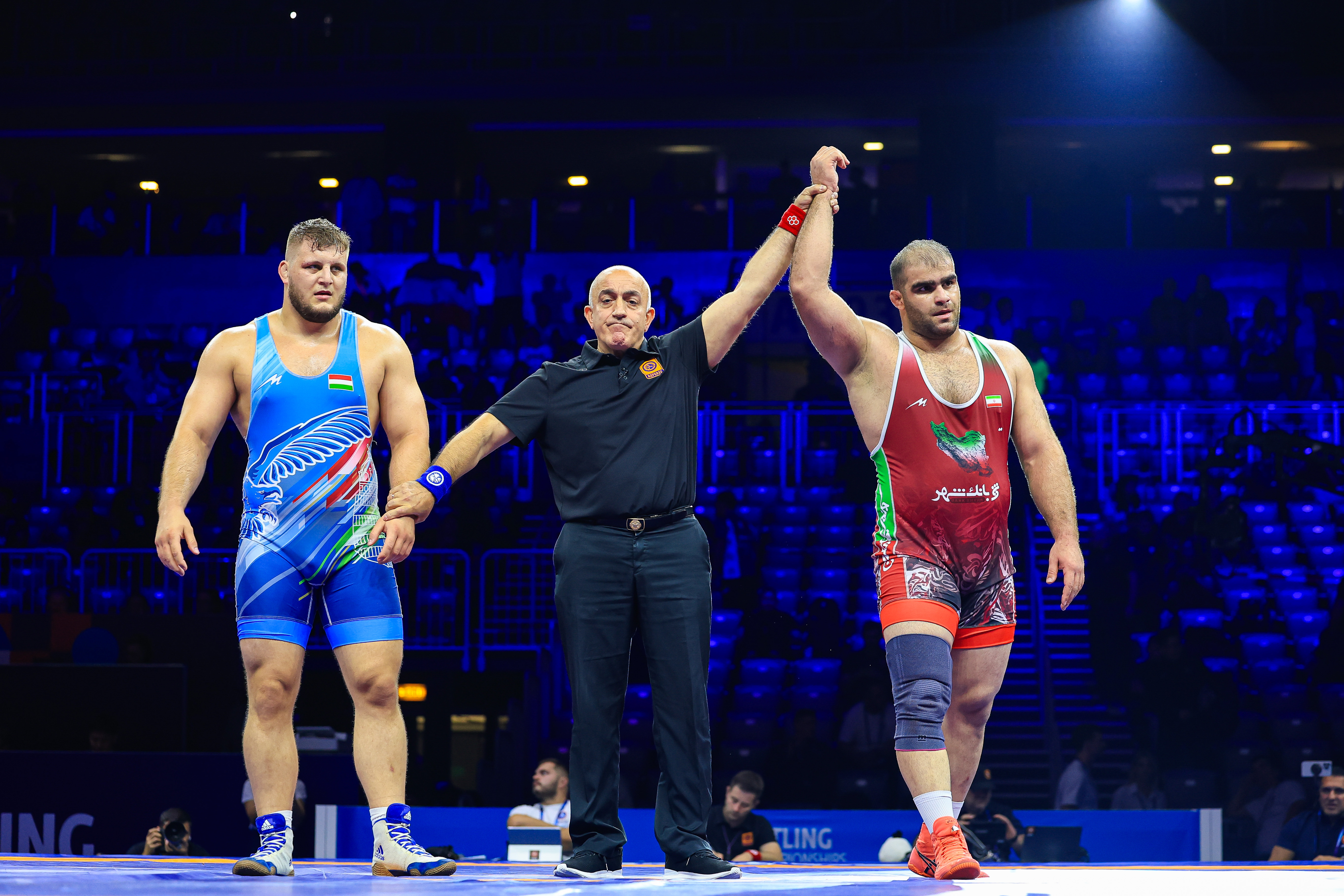 Amin MIRZAZADEH (IRI) is now a two-time world champion. (Photo: United World Wrestling / Kadir Caliskan)
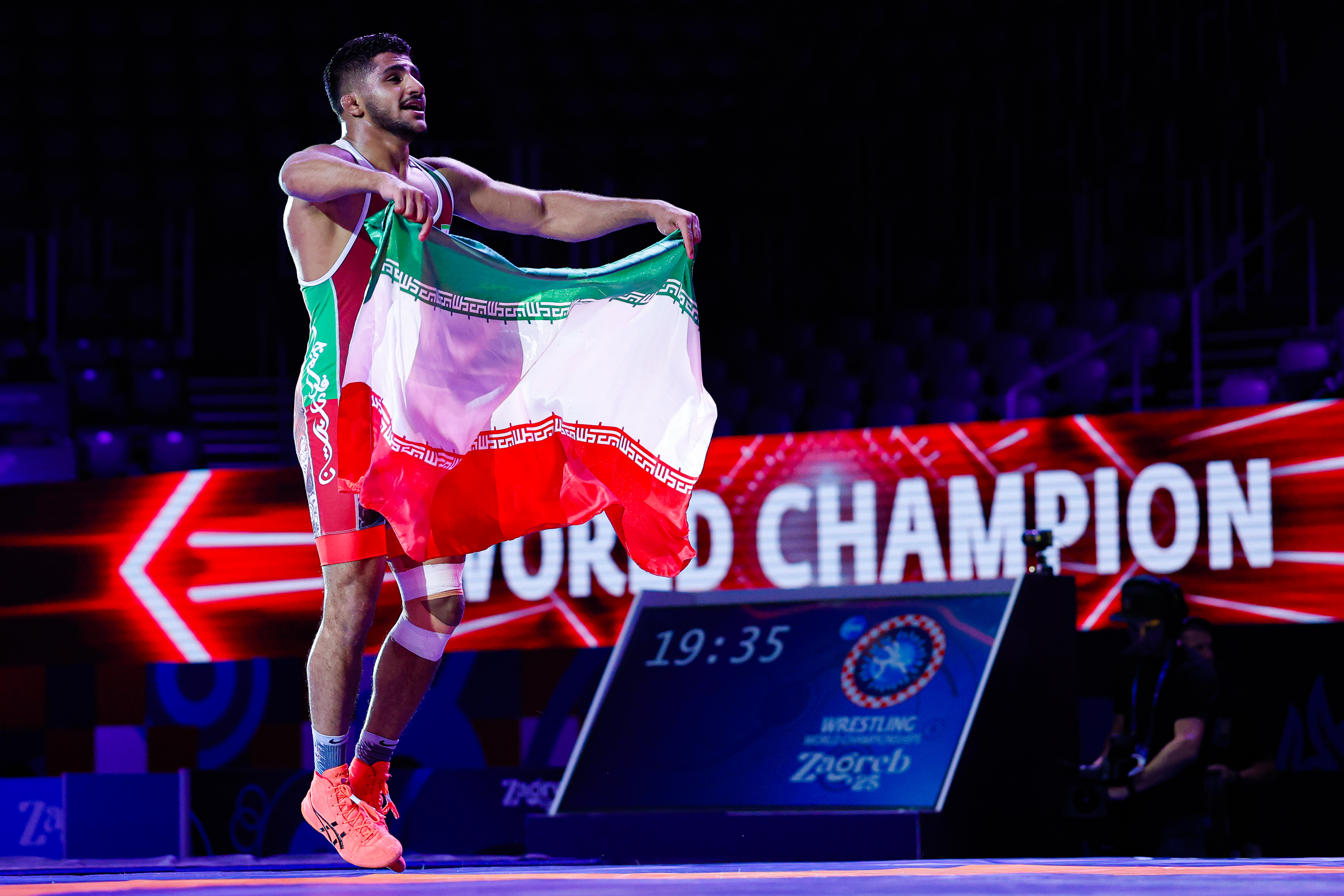 Gholamreza FAROKHI (IRI) celebrates after winning the 82kg final. (Photo: United World Wrestling / Kostadin Andonov)
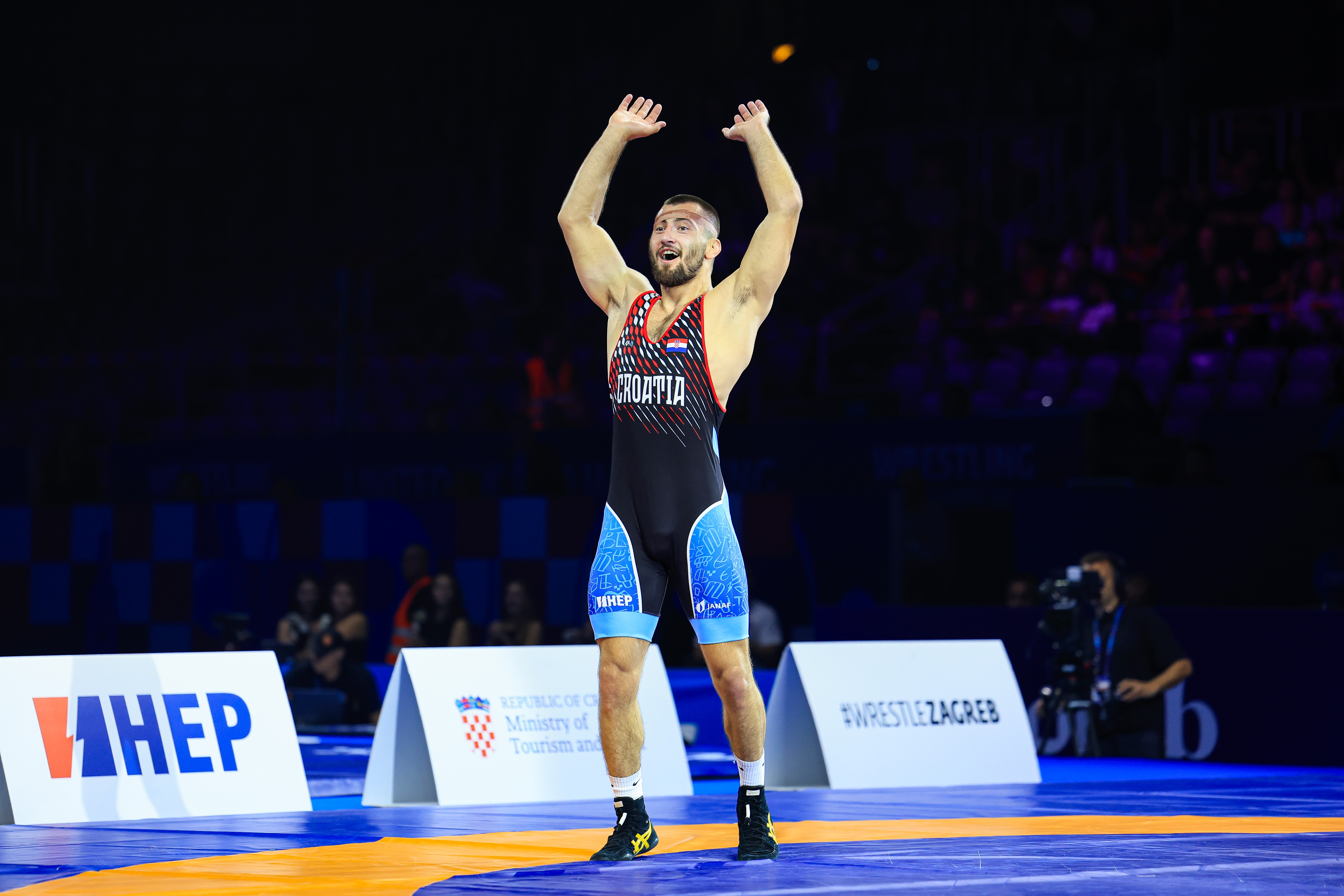 Karlo KODRIC (CRO) celebrates with home fans after winning Croatia's first world medal since 2014. (Photo: United World Wrestling / Kadir Caliskan)
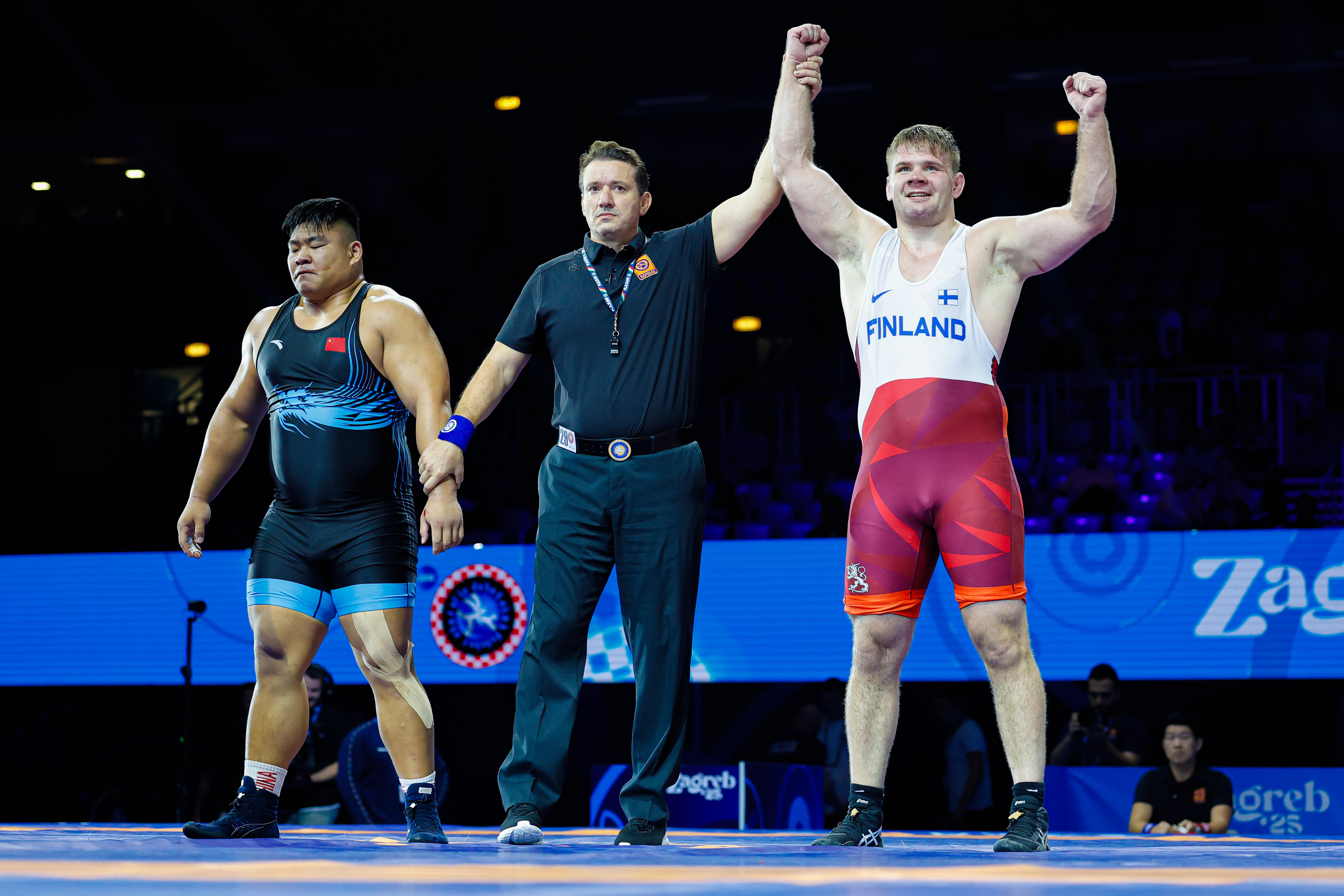 Elias KUOSMANEN (FIN) wins the bronze medal bout against Wenhao JIANG (CHN). (Photo: United World Wrestling / Kostadin Andonov)
Share your thoughts.
Comments