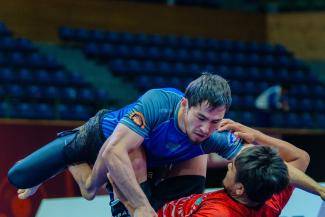
DA NANG, Vietnam (June 6) -- Kazakhstan showed up in style at the Asian & Oceania Grappling Championships, held in Da Nang, Vietnam from June 4 to 6. The country won six gold medals and one silver medals at the senior Grappling event and claimed the team title as well.
Out of the 10 weight classes, Kazakhstan entered only seven grapplers with all seven returning home with a medal. Kazakhstan won the team title with 170 points, far ahead of second-placed Philippines which finished with 89 points. India finished third with 64 points in a nine-team competition.
The first gold medal for Kazakhstan was won by former U20 Asian champion Nurassyl TURUSPEKOV (KAZ) after he won all four of his bouts in round-robin. He won three via submission while one, against J Han TAN (MAS), was by a 3-2 decision. He also won the gold medal at the U20 Grappling event at 71kg, beating Alonso AGUILAR (PHI), 3-2, in the final.
Maral SARTBAEV (KAZ) added the second gold medal by winning all his bouts at 71kg via submission. None of his bouts went the distance and he finished two of the four inside a minute.
Next was Ilyas SAIDULLAYEV (KAZ) who captured the 77kg with three wins. He won his first two bouts via submission but was checked by Welton WEI (MAS) in Round 3 bout. However, Saidullayev came out victorious 5-2 to capture the gold medal. Saidullayev scored pushout to start the bout before the two got holds on each others legs. Saidullayev managed to escape the control Wei from top for two points.
The bout restarted with Saidullayev on but Wei reversed with an arm lock for two points. As time ran out, Wei asked for two more points but the referees saw no points in the sequence even after the challenge, which was lost.
Three grapplers were entered at 84kg and Darkhan YERENBAYEV (KAZ) easily captured the gold medal by winning his two bouts.
Zhassulan YERMENBET (KAZ), a former U23 Asian silver medalist in Freestyle, won the gold medal at 100kg. He defeated Duy Thanh LE (VIE), 11-0, in Round 1 before an 18-0 technical superiority win over Callum ROBERTS (PHI). In what was a virtual final, Yermenbet defeated compatriot Madi KABYKBAYEV (KAZ), 2-1, to claim the gold medal.
Yerlan SHAKISHOV (KAZ) defended his 130kg title after he submitted Rustam SARTBAEV (KAZ) as only two wrestlers were entered in this weight class.
The only Kazakhstan grappler who failed to win the gold medal was Gomar SHALTABAYEV (KAZ) as Azizbek SHARIPOV (UZB) defended his 92kg gold, helped by a forfeit from Buyannemekh MUNKHSUKH (MGL).
At 58kg, Lord DEL ROSARIO (PHI) won the gold medal with three victories in three bouts in 19 seconds, four seconds, 15 seconds.
Philippines' second gold medal was confirmed by Denzel ALIPIO (PHI) at 62kg as he also won his two bouts via submission. He won his first bout in 13 seconds and second in a minute 17 seconds.
In the lone women's Grappling weight class that was competed, GOLD: Bless YEAP (MAS) captured the gold medal at 58kg after winning three bouts. Madina UVALIYEVA (KAZ) won silver while Lyubov TEMNIKOVA (KAZ) won bronze.
RESULTS
Men's Grappling
58kg
GOLD: Lord DEL ROSARIO (PHI)
SILVER: Yedenkachew TELAHUNE (NZL)
BRONZE: Huynh Tai LE (VIE)
62kg
GOLD: Denzel ALIPIO (PHI)
SILVER: Taller TAMO (IND)
BRONZE: Shivraj CHOUDHARY (IND)
66kg
GOLD: Nurassyl TURUSPEKOV (KAZ)
SILVER: J Han TAN (MAS)
BRONZE: Joaquin MARTE (PHI)
71kg
GOLD: Maral SARTBAEV (KAZ)
SILVER: Abylaikhan TENGIBAYEV (KAZ)
BRONZE: Ho Yee CHIA (MAS)
77kg
GOLD: Ilyas SAIDULLAYEV (KAZ)
SILVER: Welton WEI (MAS)
BRONZE: Maksat ARGYNBAY (KAZ)
84kg
GOLD: Darkhan YERENBAYEV (KAZ)
SILVER: Rauan ZHAKENULY (KAZ)
BRONZE: Takahisa ODA (JPN)
92kg
GOLD: Azizbek SHARIPOV (UZB)
SILVER: Gomar SHALTABAYEV (KAZ)
BRONZE: Ikram YERSAIYN (KAZ)
100kg
GOLD: Zhassulan YERMENBET (KAZ)
SILVER: Madi KABYKBAYEV (KAZ)
BRONZE: Duy Thanh LE (VIE)
130kg
GOLD: Yerlan SHAKISHOV (KAZ) df. Rustam SARTBAEV (KAZ), via submission (6-0)
Women's Grappling
58kg
GOLD: Bless YEAP (MAS)
SILVER: Madina UVALIYEVA (KAZ)
BRONZE: Lyubov TEMNIKOVA (KAZ)
U20 Men's Grappling
62kg
GOLD: Travis RATCLIFF (PHI)
SILVER: Danial BOLAT (KAZ)
BRONZE: Mayank PAL (IND)
71kg
GOLD: Nurassyl TURUSPEKOV (KAZ) df. Alonso AGUILAR (PHI), 3-2
77kg
GOLD: Ilyas SAIDULLAYEV (KAZ)
SILVER: Aldiyar KARIMOV (KAZ)
BRONZE: Viet Bao BUI (VIE)
84kg
GOLD: Aktilek MARSHALKHAN (KAZ) df. Arlan TAKTAMUSSOV (KAZ), via submission (0-2)
92kg
GOLD: Ilyas ABDULLAYEV (KAZ) df. Ngoc HUYNH (VIE), via submission (3-2)
100kg
GOLD: Yestemir KENZHEGALI (KAZ) df. Ikram YERSAIYN (KAZ), via submission
U20 Women's Grappling
90kg
GOLD: Lily HOUBEN (NZL) df. Kavita CHAUHAN (IND), 15-0
U17 Men's Grappling
54kg
GOLD: Akram TOLEUKHAN (KAZ) df. Muhammad MOHAMED MEERA (MAS), 5-2
58kg
GOLD: Aimurat ONGGARBAYEV (KAZ)
SILVER: Nathaniel NAMA (PHI)
BRONZE: Zun Sin OW (SGP)
63kg
GOLD: Danial BOLAT (KAZ)
SILVER: Zenya SAM (MAS)
BRONZE: Gia Bao BUI (VIE)
69kg
GOLD: Alim ALMATOV (KAZ)
SILVER: Van Toan DOAN (VIE)
BRONZE: Zhen Hoong TAN (MAS)
76kg
GOLD: Shynggyskhan SEIDAKHMET (KAZ)
SILVER: Hassan ALI (PAK)
BRONZE: Angelo SALUD (PHI)
110kg
GOLD: Taylor ROTA (NZL) df. Jie Jun YOU(TPE), via submission (6-5)
U17 Women's Grappling
56kg
GOLD: Charlie RATCLIFF (PHI) df. Thi Ngoc Mai VU (VIE), via submission (11-4)
65kg
GOLD: Thi Loan HOANG (VIE) df. Ruby TAYLOR (NZL), via submission (9-0)
90kg
GOLD: Adel KOMBATUROVA (KAZ)
SILVER: Duong PHAM (PHI)
BRONZE: Zere SYRYMKYZY (KAZ)



Share your thoughts.
Comments