ZAGREB, Croatia (September 18) -- Greco-Roman day at the World Championships in Zagreb. Four weight classes -- 55kg, 77kg, 82kg and 130kg -- are in action with Olympic champion Nao KUSAKA (JPN) and Demeu ZHADRAYEV (KAZ) are expected to meet in 77kg quarterfinals.
WATCH LIVE | LIVE MATCH ORDER | DAY 5 RESULTS
77kg semifinals
SF 1: Malkhas AMOYAN (ARM) vs. Alireza ABDEVALI (IRI)
SF 2: Nao KUSAKA (JPN) vs. Robert FRITSCH (HUN)
14:55: In the most anticipated match of the session, Nao KUSAKA (JPN) repeated his victory Demeu ZHADRAYEV (KAZ) from the final at the Paris Olympics to advance to the 77kg semifinals as he pursues a first world gold. Kusaka got the first chance at par terre, but it was Zhadrayev who came out with the points. Kusaka went to his usual cross body lock, but Zhadrayev used the momentum and timed it perfectly to launch a throw himself. Although Kusaka got behind for reversal, it left Zhadrayev ahead 2-2 on criteria. In the second period, a quick charge at the whistle sees Kusaka gain a stepout that is awarded on challenge. Kusaka adds another stepout, then fends off the pressure from Zhadrayev while avoiding getting flagged for passivity and advances with a 4-2 victory. Next up for Kusaka will be Robert FRITSCH (HUN), from the country where the Japanese went to train prior to his triumph in Paris.
14:54: Malkhas AMOYAN (ARM) blocks Ahmet YILMAZ (TUR) as the Turkiye tries to turn Amoyan from par tarre to get the two points for danger position. There is no way back for Yilmaz as Amoyan, the Olympic bronze medalist, wins 3-1 to enter the semifinals at 77kg.
14:53: The Iranian win-rush continues as the country puts all four wrestlers in the semifinals with Alireza ABDEVALI (IRI) beating Sanan SULEYMANOV (AZE), 3-1, at 77kg. Abdevali turned Suleymanov from par terre to take the lead and the win.
14:50: Robert FRITSCH (HUN) spoils the bid of local hero Antonio KAMENJASEVIC (CRO) to make the 77kg semifinals, scoring a stepout in the first period that proves the difference in a 2-1 victory.
55kg semifinals
SF 1: Emin CAKIR (TUR) vs. Vakhtang LOLUA (GEO)
SF 2: Eldaniz AZIZLI (AZE) vs. Payam AHMADI (IRI)
14:42: European bronze medalist Vakhtang LOLUA (GEO) is into the world semifinals with a 3-2 victory over Denis MIHAI (ROU). A stepout from Lolua made the difference as he held criteria at 2-2. A lost challenge from Mihai gives another point to Lolua
14:40: In a battle between a 30-something and a teenager, experience wins out, which is not surprising given it involves four-time 55kg world champion Eldaniz AZIZLI (AZE). Azizli scores a takedown and gut wrench in the first period against 18-year-0ld Jayden RANEY (USA), who gets his chance on top in par terre in the second, but cannot budge the Azeri, who wins 5-1 to advance to the semifinals.
14:35: Emin CAKIR (TUR) upsets former world bronze medalist Ikhtiyor BOTIROV (UZB) at 55kg, with a 9-0 technical superiority win.
14:31: Payam AHMADI (IRI) quickly joins the Iranian parade into the semifinals, needing just 25 seconds to bull Artiom DELEANU (MDA) down to the mat and execute three quick-fire rolls for an 8-0 victory at 55kg.
82kg semifinals
SF 1: Taizo YOSHIDA (JPN) vs. Gela BOLKVADZE (GEO)
SF 2: Karlo KODRIC (CRO) vs. Gholamreza FAROKHI (IRI)
14:28: A match for the ages as Taizo YOSHIDA (JPN), a former world U17 champion and recent world U20 bronze medalist, beats European champion Gurban GURBANOV (AZE), who is cautioned out of the match. Gurbanov had a 6-2 lead but Yoshida, a powerhouse, keeps pressuring Gurbanov who is struggling with conditioning. A slew of stepouts and Yoshida makes it 8-6. On the stepout with 16 seconds left, Gurbanov receives his third caution and is disqualified from the match, giving Yoshida the win.
14:22: Adlet TIULIUBAEV (UWW) thought he had it covered but Gela BOLKVADZE (GEO) scores two turns from the third passivity par terre to beat Tiuliubaev 5-4 and enter the semifinals at 82kg.
14:20: Karlo KODRIC (CRO), perhaps charged up by a vocal block of home fans in the stands nearby, steps over for 2 on a gut wrench attempt by Mihail BRADU (MDA), giving him a 4-1 lead midway through the second period of their 82kg quarterfinal. Kodric gives up a late stepout, but walks off a 4-2 winner.
14:15: Gholamreza FAROKHI (IRI) fights off a whizzer by Ramon BETSCHART (SUI) to secure a takedown, then traps an arm and executes four exposures to advance to the 82kg semifinals with an 8-0 victory in 1:05.
130kg semifinals
SF 1: Darius VITEK (HUN) vs Pavel HLINCHUK (UWW)
SF 2: Amin MIRZAZADEH (IRI) vs Wenhao JIANG (CHN)
14:07: Wenhao JIANG (CHN) with a pair of stepouts and he's into the 130kg quarterfinals with a 4-1 win over Jello KRAHMER (GER).
14:05: Darius VITEK (HUN) is the beneficiary of the new Greco-Roman rule in which the wrestler with first passivity point win. He beats Mykola KUCHMII (UKR), 1-1, at 130kg.
14:03: Pavel HLINCHUK (UWW) with an over-under throw for four over Hamza BAKIR (TUR) in the 130kg quarterfinals. Bakir tries to come back with a double-arm lock throw but Hlinchuk blocks and secures the fall.
14:01: Elias KUOSMANEN (FIN) surprisingly throws world champion Amin MIRZAZADEH (IRI) for 4 with an arm throw in their 130kg quarterfinal, but any joy is gone in milliseconds as the Iranian rolls through the move and puts Kuosmanen on his back. Mirzazadeh doesn't waste the opportunity and secures the fall in 1:13.
Quarterfinals will begin at the same time
13:47: Olympic champion Nao KUSAKA (JPN) books an Olympic final rematch with Demeu ZHADRAYEV (KAZ) with a 7-0 victory over Ihor BYCHKOV (UKR) at 77kg. He scored all his points in the first period and somehow there were no points in the second period.
13:43: Malkhas AMOYAN (ARM) caps a one-sided 10-0 victory over Mateusz BERNATEK (POL) with a 4-point throw in the second period to secure his berth in the 77kg quarterfinals.
13:37: Alexandrin GUTU (MDA) used his head, and not in a good way, and it cost him a shot at a gold medal. Gutu was leading FRITSCH (HUN) 2-0 in their 77kg bout when he was hit with a 2-point penalty for a head butt, which also put him behind on criteria. Fritsch then received a passivity point, and he held on for a 3-2 victory. Ironically, Gutu suffered a head cut from his own action and had to have treatment, including a bandage around his head, which he ripped off and tossed in anger after the match.
13:30: Aleksa ILIC (SRB) almost pulls off a huge upset over Olympic silver medalist Demeu ZHADRAYEV (KAZ) at 77kg. Ilic led 5-1 at the break but Zhadrayev, who for the par terre, scored a turn to make it 5-4 but a stepout gave a point to Ilic. Zhadrayev hits a big four-pointer against a tired Ilic his place in the quarterfinal with an 8-6 win.
13:21: World bronze medalist Denis MIHAI (ROU) with a takedown and roll, then a 4-point takedown against an overmatched Alexander CUEVAS (SGP) and he's into the 55kg quarterfinals with an 8-0 victory in just over a minute.
13:10: World U20 champion Payam AHMADI (IRI) gets his debut on the senior level off to an impressive start, manhandling Ulan MURATBEK UULU (KGZ) in a 9-0 win to advance to the 55kg quarterfinals.
13:07: Young Taizo YOSHIDA (JPN), the 2024 Asian champion, extricates himself from a 4-point hole, scoring five points in the second period to top Alexander JOHANSSON (SWE) 6-5 at 82kg. Yoshida, who gave up a 4-point arm throw in the first period, pressures Johansson down for two takedowns, then gets a stepout with :54 left to take the lead for the first time.
13:05: Gurban GURBANOV (AZE) gets the first of the two passivity calls, and with no other scoring, that makes him a 1-1 winner over Shahin BADAGHIMOFRAD (QAT) at 82kg.
13:04: Gholamreza FAROKHI (IRI) with powerpacked 8-0 technical superiority win over world silver medalist Erik SZILVASSY (HUN) at 82kg. Szilvassy was never allowed to settle down by Farokhi
13:00: Four-time world champion Eldaniz AZIZLI (AZE) with a 22-second technical superiority over Anil MOR (IND) at 55kg.
12:58: A stepout with 33 seconds left, Hamza BAKIR (TUR) beats Oscar PINO (CUB) 3-1 at 130kg. Bakir led 1-1 on criteria as he was given the first par terre position. But As Pino tried to score a stepout late in the second period, Bakir turned it around and managed to force Pino to put the hand before Bakir himself did. Cuba challenged the call but lost it.
12:52: With calls of 'Karlo! Karlo!' and the banging of drums reverberating throughout the arena, Karlo KODRIC (CRO) is through to the 82kg quarterfinals with a 5-0 victory over Bekzat ORUNKUL UULU (KGZ).
12:45: Pavel HLINCHUK (UWW) comes back from 3-1 down to beat Razmik KURDYAN (ARM) 4-3, thanks for a successful challenge from Hlinchuk at the end.
12:42: Defending 130kg champion and Olympic bronze medalist Amin MIRZAZADEH (IRI) gets two gut wrenches off par terre for a 5-0 lead over Marko KOSCEVIC (CRO), much to the dismay of the home crowd. In the second period, Mirzazadeh adds a stepout, then scores a takedown for an 8-0 win with just over two minutes left.
12:36: Four-time Asian medalist Alimkhan SYZDYKOV (KAZ) rns out of a gas about two minutes to soon, giving Mykola KUCHMII (UKR) two easy takedowns in the second period and a 6-4 win at 130kg.
12:35: Elias KUOSMANEN (FIN) pulls off the biggest surprise of the session so far, scoring a late takedown to topple Sergei SEMENOV (UWW) 3-3 at 130kg. In the first period, Semenov counters a throw attempt for a 2-point takedown, with an additional point for an unsuccessful challenge, but Kuosmanen strikes back with a stepout to make it 3-1 at the break. In the second period, a mighty shove sends Semenov down to the mat, and Kuosmanen pounces to secure the takedown and the shocking victory.
12:12: Jonni SARKKINEN (FIN) gets the first par terre position in the 77kg bout against Olympic silver medalist Demeu ZHADRAYEV (KAZ) and he scores from a throw in which the Kazakhstan wrestlers lands outside the zone. Sarkkinen leads 2-0. Just before the break, Zhadrayev gets a stepout to make it 2-1 Zhadrayev got the par terre in the second period to take a 2-2 criteria lead before getting a exposure for two points. Finland challenges the call. The two points are confirmed and Zhadrayev lead grows to 5-2, which remains the winning score.
12:09: Paris Olympic bronze medalist Malkhas AMOYAN (ARM), a former world champion with three world medals, was about to become the beneficiary of the new rule giving the wrestler who scores the first point in a Greco bout that ends 1-1 the victory, but a late challenge over a last-second move instead makes him a 2-1 winner over Kamal BEY (USA).
12:05: Two-time world U23 champion Alexandrin GUTU (MDA) gets off to an awesome start, throwing Lai Hsing YAO (TPE) twice with spectacular four and five pointers to start his campaign at 77kg with a 12-0 win.
11:57: A welcome win for the home team. Antonio KAMENJASEVIC (CRO) rips off four rolls from par terre and he advances with a 9-0 victory over Hyeonjin KANG (KOR) at 77kg.
11:55: Olympic champion Nao KUSAKA (JPN) warms up with an 8-0 technical superiority win over AMAN (IND) at 77kg. He is expected to meet Olympic silver medalist Demeu ZHADRAYEV (KAZ) in the quarterfinals if the seeds hold.
11:40: Taiga ONISHI (JPN), whose younger sister Sakura won the women's 59kg gold on Tuesday night, gets a quick takedown, only to have Huoying SHI (CHN) reverse in their opening match at 55kg. Shi goes ahead in the second period with an exposure off an arm throw attempt, then hits a back suplex that is good for another 2. Shi resists a throw attempt and gets another 2, giving him a 7-2 win.
11:19: Gholamreza FAROKHI (IRI), winner of the Ranking Series event here in Zagreb, has no need to go to par terre. He alternates three takedowns with two stepouts, then gets a point for a denied challenge to defeat Qingzhe LI (CHN) 9-0 in precisely two minutes at 82kg.
11:15: Four-time world medalist Oscar PINO (CUB), his nation's heir apparent at 130kg to legendary five-time Olympic champion Mijain LOPEZ (CUB), easily executes a gut wrench from par terre, then is a rock when put on the bottom and he's through with a 3-1 victory over Jacob LOGAARD (SWE).
11:05: Pavel HLINCHUK (UWW), who won 2023 world u23 gold at 97kg, is now at 130kg. He begins his first World Championships at this weight with a 9-0 victory over Sulkhan BUIDZE (GEO).
11:00: Sergei SEMENOV (UWW), a two-time former Olympic bronze medal who has a world gold from 2018, gets a pair of rolls from par terre and, although Cohlton SCHULTZ (USA) managed a reversal after the second one, safely posts a 5-2 victory at 130kg to start the Greco action on Mat D.
10:55: Alexander JOHANSSON (SWE) gets a big win for Sweden as he defeats former European champion and young star Alperen BERBER (TUR) 2-1, at 82kg. Berber is coming back after an injury he suffered at the Mongolian Ranking Series.



 Attendees go ask questions about practial wrestling situations to Mr. Kamel Bouaziz. (Photo: United World Wrestling)
 Participants from the education courses for coaches and referees pose for a photo with their diplomas. (Photo: United World Wrestling)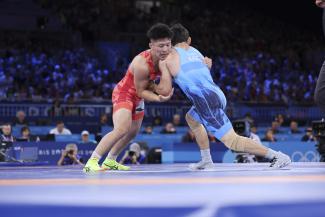
Share your thoughts.
Comments