

End of the year freestyle rankings
Friday, November 11, 2022 - 11:18 By Eric Olanowski & Vinay Siwach

CORSIER-SUR-VEVEY, Switzerland (November 11) -- The final set of rankings for the freestyle wrestlers is out. With more than six ranking events and two championships, wrestlers had the opportunity to finish in the top three and collect the prize money.
The wrestlers managed to claim the points from the four Ranking Series events, continental championships and the World Championships. Two Games were also included in the Rankings Series but a total of only four events were counted for awarding the points.
Here are the rankings after the 2022 season.
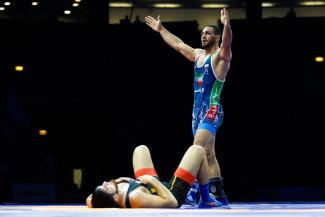
 Thomas GILMAN (USA) claimed the top spot at 57kg. (Photo: UWW / Kadir Caliskan)
57kg
1. Thomas GILMAN (USA) - $5000
2. Zelimkhan ABAKAROV (ALB) - $3000
3. Zanabazar ZANDANBUD (MGL) - $2000
Thomas GILMAN (USA) earned the top billing at 57kg after medaling in three point-earning events. He won the Pan-American Championships and the Zouhaier Sghaier Ranking Series event before closing the season with a runner-up finish at the World Championships. Altogether, the Tokyo Olympic bronze medalist was 10-1 on the season.
Zelimkhan ABAKAROV (ALB) grabbed gold in Belgrade and collected 45,000 Ranking Series points, which was good enough to catapult him to the No. 2 spot in the 57kg rankings. With his win over Gilman in the 57kg world finals, the 29-year-old Albanian made history for his country, becoming the first wrestler to win a world title.
Abakarov’s gold in Belgrade also earned a berth on the All-World team for the 2022 Freestyle World Cup, which will take place in Coralville, Iowa, USA, December 10-11.
Zanabazar ZANDANBUD (MGL) finished the season tied with Abakarov with 45,000, but due to the Albanian’s higher placement at the World Championships, the Mongolian ended up in the third position in the 57kg rankings. His 2022 body of work included fifth-place finishes at the Asian Championships and Yasar Dogu Ranking Series event, before finishing the season with a bronze medal at the 2022 World Championships.
 Rei HIGUCHI (JPN) won the world title and the top spot at 61kg. (Photo: UWW /Kadir Caliskan)
61kg
1. Rei HIGUCHI (JPN) - $5000
2. Arsen HARUTYUNYAN (ARM) - $3000
3. Suleyman ATLI (TUR) - $2000
Rei HIGUCHI (JPN) went 8-0 during his 2022 season and finished the year as the 61kg’s top guy. He won four matches in each of his outings and submitted to the podium at the Asian Championships and World Championships.
Armenian youngster Arsen HARUTYUNYAN (ARM) rounds out the year ranked second in the world at 61kg after collecting European gold and a world bronze.
Harutyunyan had his handed raised in 11 of the 12 bouts he competed in this season, and only fell to eventual world champion Higuchi in the world quarterfinals. Despite it not counting towards his senior-level point total, the 23-year-old native of Masis, Armenia, won his second consecutive U23 world title.
Suleyman ATLI (TUR) ended the year ranked third in the world at 61kg with 39,120 points. He was a runner-up at the European Championships and a bronze-medal finisher at the Zouhaier Sghaier Ranking Series. Although he didn’t win a medal, he did finish in the top ten of the World Championships and Yasar Dogu Ranking Series event.
 Rahman AMOUZAD (IRI) won the Asian and world titles to leapfrong his opponents for the number one rank at 65kg. (Photo: UWW / Kadir Caliskan)
65kg
1. Rahman AMOUZAD (IRI) - $5000
2. Bajrang BAJRANG (IND). - $3000
3. Iszmail MUSZUKAJEV (HUN) - $2000
Belgrade world champion Rahman AMOUZAD (IRI) topped the rankings at 65kg after snagging golds at the Continental and World Championships. During his 2022 campaign, the 20-year-old Iranian youngster beat Tokyo Olympic medalists Haji ALIYEV (AZE) and Bajrang BAJRANG (IND).
Amouzad took out Bajrang, a Tokyo bronze medal winner, to win the Asian title. Then, he cruised to a 9-2 win over three-time world champion and two-time Olympic medalist Aliyev in the world semifinals.
Bajrang edged Hungary’s Iszmail MUSZUKAJEV (HUN) by 200 points for the No. 2 spot at 65kg.
Bajrang earned a silver medal at the Asian Championships and bronze medals at the Bolt Turlykhanov Cup and World Championships and finished the season with 44,200 points.
Muszukajev won the European Championships and took home a bronze from the World Championships, completing the year with 44,000 points.
Sebastian RIVERIA (PUR) also had 44,000 points but he did not win a medal at the World Championships while Muszukajev did to finish ahead of Riveria.
 Zurabi IAKOBISHVILI (GEO) finished with 57720 points to claim the top rank at 70kg. (Photo: UWW / Kostadin Andonov)
70kg
1. Zurabi IAKOBISHVILI (GEO) - $5000
2. Ernazar AKMATALIEV (KGZ) - $3000
3. Taishi NARIKUNI (JPN) - $2000
At 70kg, 2,720 points were the difference between the first and third-ranked wrestlers.
Zurabi IAKOBISHVILI (GEO) edged Ernazar AKMATALIEV (KGZ) and Taishi NARIKUNI (JPN) for the top spot with three medals in point-based events. He won European gold in Hungary and finished with bronze medals at the World Championships and Yasar Dogu Ranking Series events.
Akmataliev laid it on the line at a pair of Ranking Series events, and the Asian and World Championships. He medaled in three of those events, finishing with gold, silver and bronze at the Bolat Turlykhanov Cup, Asian Championships and World Championships, respectively. He fell short of the top spot by 2,200 points – which could have happened with a mere 10th place or better finish at a Ranking Series event.
Despite winning Asian and world gold, Narikuni fell 2,720 points -- equivalent to a ninth-place finish at a Ranking Series event -- short of claiming the top spot at the weight.
 Tajmuraz SALKAZANOV (SVK) and Kyle DAKE (USA) finished 1-2 respectively at 74kg. (Photo: UWW / Kostadin Andonov)
74kg
1. Tajmuraz SALKAZANOV (SVK) - $5000
2. Kyle DAKE (USA) - $3000
3. Soner DEMIRTAS (TUR) - $2000
Tajmuraz SALKAZANOV (SVK) grabbed the No. 1 spot in the world rankings after winning 15 consecutive matches before falling in the world finals to No. 2 Kyle DAKE (USA).
Salkazanov won his second consecutive European title and grabbed Ranking Series titles at the Matteo Pellicone and the Bolat Turlykhanov Cup. He competed in two more competitions than his American foe and outscored him by 13,000 points.
This season, Dake competed at the World and Pan-American Championships and won gold at both events. It was his fourth consecutive gold-medal finish at the World Championships and second title-winning effort at the Pan-Am C’ships. He finished the season with 58,000 ranking points, which was 11,000 points ahead of the third-ranked wrestler.
Soner DEMIRTAS (TUR) rounded out the season ranked No. 3 in the world after a trio of top ten finished. He started the season with a gold-medal win at the Yasar Dogu, then finished in fifth and eighth place at the World and European Championships, respectively.
 Jordan BURROUGHS (USA) remained untouched at the top spot at 79kg. (Photo: UWW / Kadir Caliskan)
79kg
1. Jordan BURROUGHS (USA) - $5000
2. Arsalan BUDAZHAPOV (KGZ) - $3000
3. Mohammad NOKHODI (IRI) - $2000
There was no one challenging Jordan BURROUGHS (USA) for the top spot at 79kg and he never gave anyone a chance as well. In Belgrade, Burroughs won a record sixth world title. He finished at the top of the rankings with 63000 points with 45000 points coming from the gold in Belgrade. Apart from that, he won the Yasar Dogu event at the beginning of the year for 13000 points before the Pan-Am gold awarded him 5000 points.
The second spot sees a surprise as Arsalan BUDAZHAPOV (KGZ) jumped from 14th to second. He has 51700 points with 31000 points coming from the bronze medal at the World Championships. He was also a bronze medalist at the Yasar Dogu for 10200 points. Another bronze at the Asian Championships awarded him 6500 points. He decided to participate in the Bolat Turlykhanov Cup as well and finished fifth for 4000 points.
But his participation in various events helped him finish better than World Championships silver medalist Mohammad NOKHODI (IRI) who has 45000 points. The silver in Belgrade was worth 37000 points and the other 8000 points were won at the Zouhaier Sghaier event as he finished that with a gold medal.
 Boris MAKOEV (SVK) outclassed other acclaimed wrestlers at 86kg and won the top spot. (Photo: UWW / Martin Gabor)
86kg
1. Boris MAKOEV (SVK) - $5000
2. Azamat DAULETBEKOV (KAZ) - $3000
3. David TAYLOR (USA) - $2000
There was little separating the top two at 86kg but Boris MAKOEV (SVK) clinched the top spot with 100 points more than Azamat DAULETBEKOV (KAZ). Makoev finished with 49100 points thanks to his participation in four events. He began with a ninth-place finish at the European Championships for 6500 points before winning silver at Bolat Turlykhanov Cup and bronze at Matteo Pellicone. The two medals were worth a combined 11600 points. He finished the season with a bronze medal at the World Championships for 31000 points.
Dauletbekov also participated in four events with Asian Championships being his first. He won gold at 86kg for 10000 points before adding 4000 points for a fifth-place finish at the Bolat Turlykhanov Cup, perhaps the most crucial tournament in hindsight.
The Kazakhstan wrestler did win the Zouhaier Sghaier event but the gold was worth only 4000 points for him. He matched Makoev for the bronze at the World Championships but failed to overtake him for the top rank.
The third spot was claimed by world champion David TAYLOR (USA) who finished with 45000 points, all of which came from the gold he won in Belgrade.
Hassan YAZDANI (IRI) also finished with 45000 points but in fourth place as Taylor won gold in Belgrade while Yazdani won silver.
 Kamran GHASEMPOUR (IRI) finished with 53000 points in 2022. (Photo: UWW / Kadir Caliskan)
92kg
1. Kamran GHASEMPOUR (IRI) - $5000
2. Miriani MAISURADZE (GEO) - $3000
3. Osman NURMAGOMEDOV (AZE) - $2000
World champion Kamran GHASEMPOUR (IRI) was the clear favorite to finish at the first spot and he did that by winning the gold medal in Belgrade at 92kg. He got 45000 points for the win and 8000 points more from the gold he won at the Bolat Turlykhanov Cup for a total of 53000 points.
Miriani MAISURADZE (GEO) made a big jump from the 11th spot to the second by winning a bronze medal at the World Championships. With 49700 points, the made sure he was clear of the other bronze medalist Osman NURMAGOMEDOV (AZE). In the three events he participated in for points, Maisuradze won bronze at the European Championships for 6500 points, the same as Nurmagomedov who also won a bronze.
At the Matteo Pellicone, the two met in the final that was won by Nurmagomedov who got 8000 points while Maisuradze got 6400 points. Both then went on to win the bronze medals at the Worlds.
Maisuradze's 5800 points more than Nurmagomedov came from the Yasar Dogu event in which he finished ninth.
 Kyle SNYDER (USA) and Batyrbek TSAKULOV (SVK) were in the world finals and finished number one and two in the rankings. (Photo: UWW / Kostandin Andonov)
97kg
1. Kyle SNYDER (USA) - $5000
2. Batyrbek TSAKULOV (SVK) - $3000
3. Magomedkhan MAGOMEDOV (AZE) - $2000
The world finalists Kyle SNYDER (USA) and Batyrbek TSAKULOV (SVK) were in a close battle for the top spot and the former clinched it with 500 points more than Tsakulov.
Snyder won the Pan-Am gold medal for 10000 points before winning the Zouhaier Sghaier gold and World gold for 8000 points and 45000 points respectively to finish with 63000 points.
Tsakulov began with a bronze medal at the European Championships for 6500 points before winning two rankings series -- Bolat Turlykhanov and Matteo Pellicone -- for 8000 points and 11000 points respectively. His silver at World Championships was worth only 37000 points as he fell short of Snyder's tally.
Magomedkhan MAGOMEDOV (AZE) claimed the third spot with 47520 points which he accumulated by winning the European Championships for 10000 points, finishing seventh at Matteo Pellicone for 6520 points and winning bronze at World Championships for 31000 points.
 Taha AKGUL (TUR) claimed the world gold and the first rank at 125kg. (Photo: UWW / Kostandin Andonov)
125kg
1. Taha AKGUL (TUR) - $5000
2. Geno PETRIASHVILI (GEO) - $3000
3. Lkhagvagerel MUNKHTUR (MGL) - $2000
Taha AKGUL (TUR) and Geno PETRIASHVILI (GEO) exchanged the top two spots for a long time but the former raced ahead after winning the European and World Championships. The two gold medals were worth 55000 points and he also won the gold at Yasar Dogu for 13000 points, taking his total to 63000 points.
Petriashvili won silver at the European Championships for 8000 points but won the Matteo Pellicone and Zouhaier Sghaier rankings events, for 8000 points each. With 24000 points, gold at World Championships would have taken him to the top but he finished with bronze and 31000 points to settle for the second spot with 55000 points.
The third spot went to Lkhagvagerel MUNKHTUR (MGL) who stunned Petriashvili to reach the World Championships final at 125kg. He reach the final at Yasar Dogu and got 11400 points. A bronze medal at the Bolat Turlykhanov Cup added 5200 points more to his account. With 37000 points from the World Championships, he finished with 53600 points and the third spot.
Share your thoughts.
Comments