

Women's Day

Eight Years After Olympic Struggle, Women Look to Become Wrestling's Next Generation of Leaders

By United World Wrestling Press

CORSIER-SUR-VEVEY, Switzerland (March 8) — When Nenad Lalovic was appointed interim president of the international federation for wrestling in 2013 the sport faced an uphill battle for Olympic reinstatement and lacked wide-reaching respect among those in the global sports community.  

Behind the scenes, the federation was suffering from a number of issues, primary among them an ineffective outreach to female athletes and leaders. Few opportunities existed for women interested in taking the mats and even fewer were available for those interested in positions of leadership.  

On the mats women only had four Olympic weight categories while their male counterparts in freestyle enjoyed seven. There were few female bureau members, no commissions aimed at increasing diversity, and an overall dearth of experienced women in place to change the future.

“We knew that we needed to change,” said Lalovic. “Re-branding and changing the rules were important, but as a federation it was vital we make efforts to diversify and include more women. We wanted to find a way to promote their activities and give them opportunities to succeed and gain experience.”
 

The 2016 Games in Rio saw male and female freestyle wrestlers compete in the same number of weight categories for the first time ever.

The first change was increasing the number of competed Olympic opportunities to ensure that men’s and women’s freestyle were equal with six categories a piece. Having an equal playing field, meant having more gold medal opportunities. The media splash from that move was well-documented, but behind the scenes a larger – and arguably more important mission -- was made clear: equalize the opportunities for women to participate in the organization and to take leadership positions within their own NF’s.

Eight years later Lalovic and the worldwide wrestling family are witnessing an era of unparalleled opportunity for women. With an eye on total gender equality, wrestling implemented a vision where wrestling would be 50-50 male/female participation at the 2022 Youth Olympic Games in Dakar (now postponed to 2026). The sport of women’s wrestling has also garnered an incredible online following with the top social media moments in four of the last five years belonging to women.  

The most-watched match on the United World Wrestling YouTube page features female wrestlers Vinesh Phogat (IND) and Victoria Anthony (USA).
 

“I’m very pleased with the performance of our women,” said Lalovic. “When I look around an arena and see the crowds growing, I’m grateful but also not that surprised. We have the toughest women in the world, and they train as hard as anyone else. I’m happy for their continued success.”

But the triumph of wrestling’s eight years promoting women’s wrestling isn’t contained to the mats. Scroll past the action posts and you’ll find that women are also being provided opportunities to take leadership opportunities off-the-mat – a powerful option to create a sport that is stronger and more diverse than previous to 2013.  

“We aren’t reinventing the wheel,” said United World Wrestling development director Deqa Niamkey. “We have fantastic existing programs with room to accommodate our gender and diversity goals. Our national federations have responded well and have been using quotas for men and women.”  

The programming works, and with more attention to quotas and educating the national federations on the benefits of sending female leaders on educational and professional development programs, the opportunities for women have flourished. Niamkey herself was named as a member of ASOIF’s Gender Equality and Diversity Committee. 

Participants at one of the very succesful Women's Global Wrestling Forums.

“Professional opportunities equal to that of men are important because it allows the women to be promoted on merit throughout their national federations and to take leaderships positions within our commissions and committees,” said Niamkey. “They now can attain the same qualifications and that’s the key.” 

In addition to the existing programming, there has been an effort to create conversation and collaboration via initiatives like the Women's Global Wrestling Forum, which began three years ago in Mexico. The second conference included female wrestling leaders from each continent and more than 20 nations across five days of unique programming, networking, and educational seminars in Istanbul. The forum was last hosted in 2019 and will be held again this November at a location to be determined. 

Aline Silva was the 2018 winner of the Women's Prize Award.

Since 2015 wrestling has also recognize powerful leaders in the women’s wrestling community through the “Women’s Prize Award” a certificate noting the individual's unique work in the space and a generous $10,000 award to support their initiatives to promote women's wrestling from the grassroots level to the elite.  

The development department has also added women referee’s educational courses, coaching courses, and created women’s wrestling training camps to respond to the needs of the national federations. 

“We are on a path to long term success,” said Niamkey. “These opportunities will help create a new, diverse class of leaders which will be the backbone for the next generation of wrestling.”
#WrestleUlaanbaatar

Oh Beats Kiyooka in Battle of World Champs in Ulaanbaatar

By Vinay Siwach

ULAANBAATAR, Mongolia (June 5) -- Soon after winning the 53kg gold medal the Meiji Cup two weeks ago, Moe KIYOOKA (JPN) said that she will be travelling to Ulaanbaatar for the third Ranking Series.

It's rare for a Japanese wrestler to compete in Ranking Series especially close to the Meiji Cup. Kiyooka explained her participation in the Ulaanbaatar Open as more of a necessity to gain more experience competing against international wrestlers as she continues to find a firm footing at 53kg.

After all, the 22-year-old had secured her spot on the Japan team for the World Championships and Asian Games by winning the gold medal at the Meiji Cup.

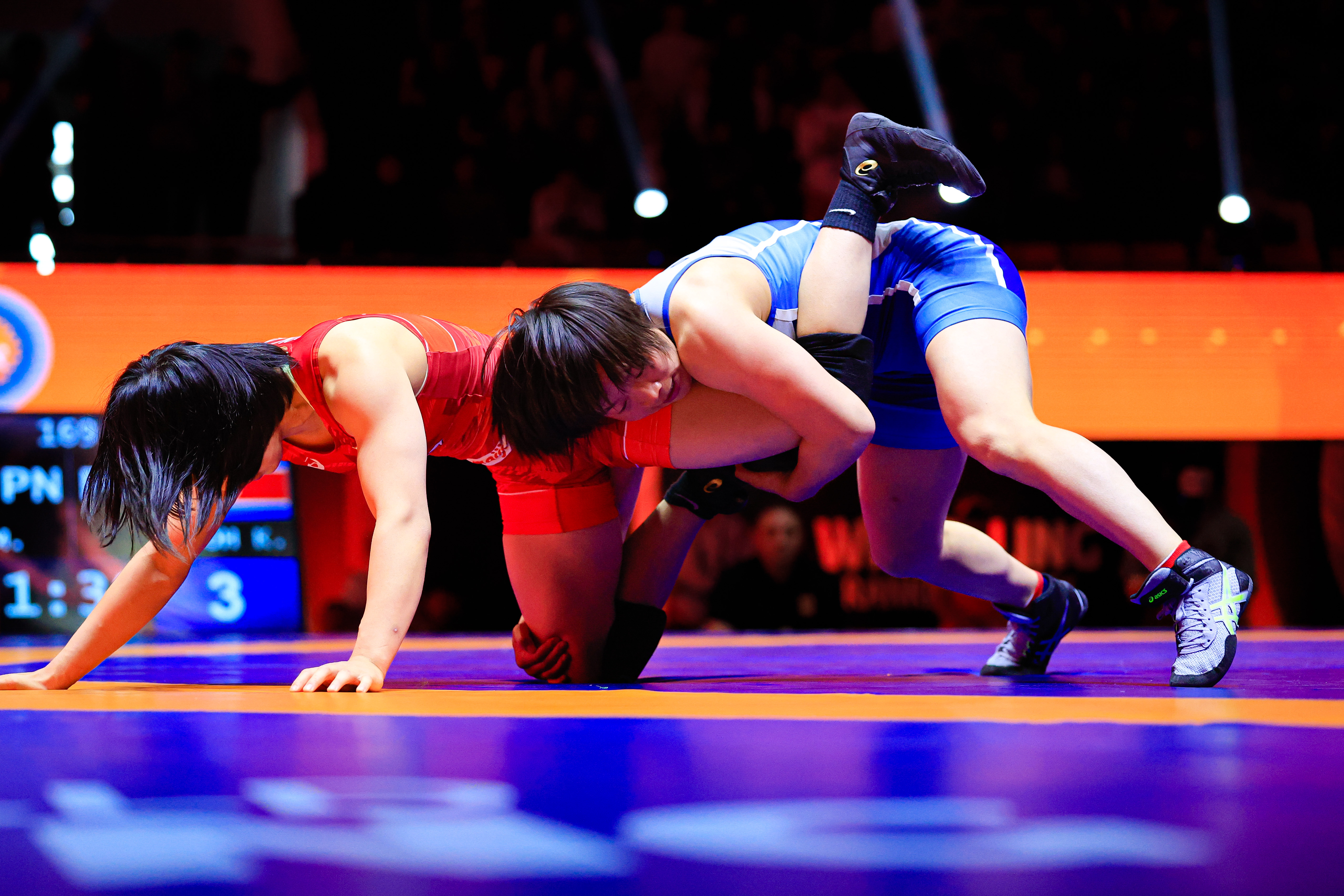
The experience came in the form of a showdown with reigning 55kg world champion Kyong Ryong OH (PRK), who rallied from a four-point deficit to defeat Kiyooka, 10-6, and win the 53kg gold medal on Friday at the third Ranking Series.

The final pitted two world champions against each other, with Kiyooka, a former 55kg world champion, also moving down to 53kg. Despite leading by four points midway through the second period, Kiyooka was unable to hold off Oh's comeback.

Oh's gold medal was the second of the night for the DPR Korea. India also won two gold medals while Poland took home the fifth gold medal.

Greco-Roman also concluded in Ulaabaatar with three weight classes with Iran, Kyrgyzstan and South Korea winning gold medal each.

Kyong Ryong OH (PRK)Kyong Ryong OH (PRK) turns Moe KIYOOKA (JPN) using the leg lace in the 53kg final. (Photo: United World Wrestling / Kostadin Andonov)
In the marquee match-up of the night between Kiyooka and Oh, the former struck first with a single-leg takedown that Oh failed to defend, opening a 2-0 lead. She maintained control for the remainder of the first period. Oh, who was warned for passivity in the first period, showed little urgency at the start of the second.

Kiyooka capitalized again with a single-leg attack and stepped over for two points, but surrendered a reversal in the same sequence. Oh immediately took advantage, scoring a gut wrench and a lace turn to move ahead 5-4 with 1:26 remaining.

Twenty seconds later, Oh added a stepout to extend her lead to 6-4. Kiyooka responded in the next exchange, regrouping after an initial attack was defended and finishing a takedown to regain the lead on criteria at 6-6 with 53 seconds left.

A heavy snap from Oh squared Kiyooka, and the DPR Korea wrestler quickly converted a takedown before adding a lace turn to surge ahead 10-6. Kiyooka had 18 seconds remaining to find four points but was unable to break through as Oh closed out the victory.

Asian silver medalist Son Hyang KIM (PRK) secured DPR Korea's second gold medal of the evening, needing just 1 minute and 35 seconds to defeat Anqi BAO (CHN), 10-0, in the 50kg final. Kim scored an early takedown and followed with four gut-wrench turns to complete the technical superiority victory.

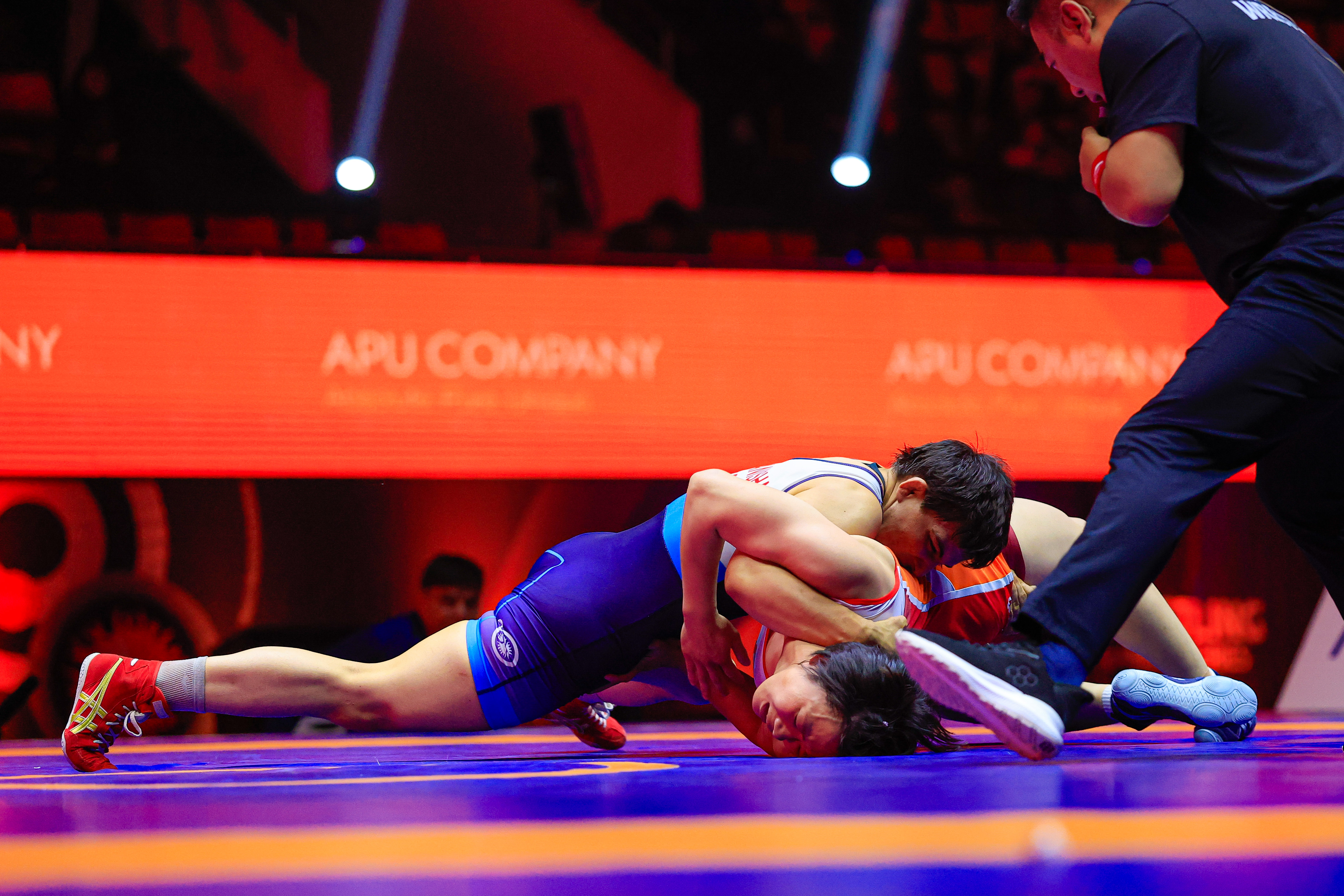
MANISHA (IND)MANISHA (IND) pins Il Sim SON (PRK) in the 57kg final at the Ulaanbaatar Open. (Photo: United World Wrestling / Kostadin Andonov)
Despite claiming two gold medals, DPR Korea suffered defeats in two other finals, both against Indian wrestlers.

At 57kg, world silver medalist Il Sim SON (PRK) was stunned by former Asian champion MANISHA (IND) in the final as the Indian secured a fall to claim the gold medal.

As has often been the case for Manisha, she was called passive in the first period and Son led 1-0 at the break after Manisha failed to score any points in the 30-second activity clock.

Manisha began the second period with a stepout to lead 1-1 on criteria which forced Son to attack again. She attempted a throw, but Manisha rotated through the action and avoided conceding points.

Son, still holding onto Manisha during the scramble, lost her balance and rolled onto her back. Manisha was quick to return on top and pushed Son's shoulders on the mat to get the pin with 2:02 left in the final.

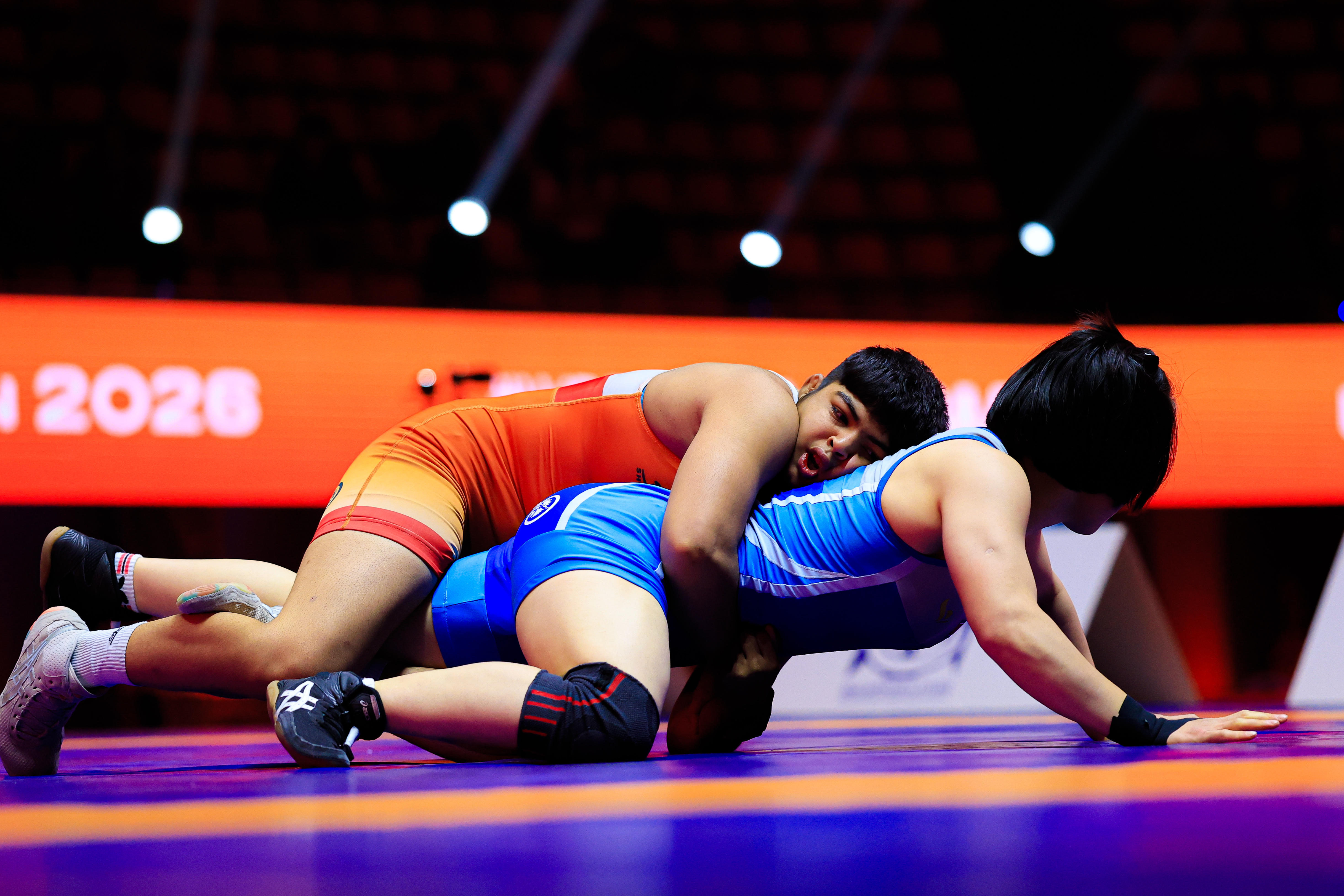
NEHA (IND)NEHA (IND) scores a takedown on Pyol HONG (PRK) during the 59kg final. (Photo: United World Wrestling / Kostadin Andonov)
NEHA (IND) also defeated a DPR Korea wrestler in the 59kg final to capture the second gold medal for India in Ulaanbaatar. Taking on Pyol HONG (PRK) for the gold medal, Neha opened the scoring with a stepout and then added two takedowns to lead 5-0 at the break.

Hong opened the second period with a stepout to get on board before adding a takedown to cut Neha's lead to 5-3. However, Neha controlled the remaining bout to clinch the gold medal.

The two-point victory of Neha contrasted her earlier meeting with Hong in the Nordic bracket, when Neha dominated and won 10-2 in Round 2.

The fifth gold medal on offer on Friday in Women's Wrestling went to European silver medalist Wiktoria CHOLUJ (POL) who ran through Bolortungalag ZORIGT (MGL) for a 12-2 technical superiority win.

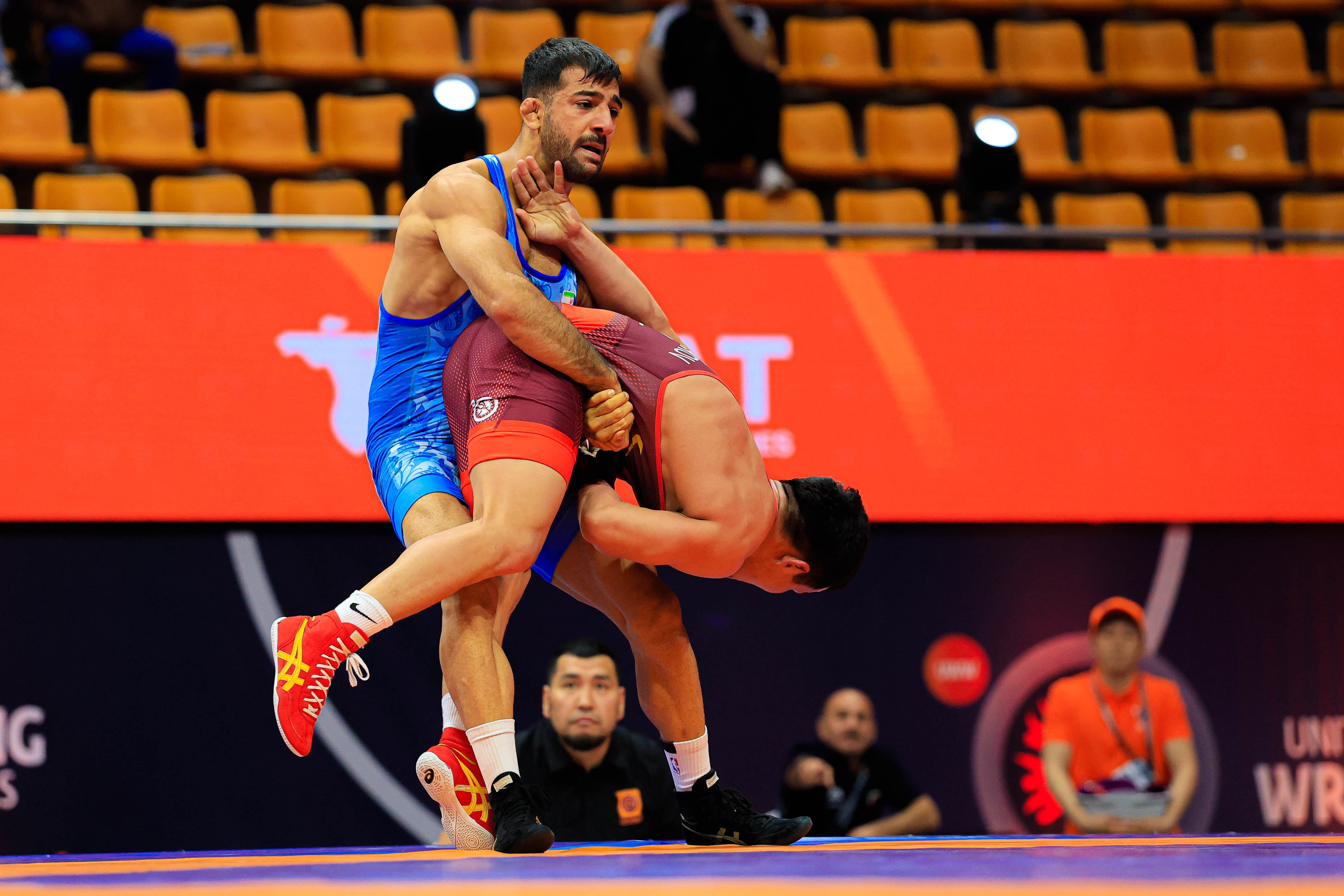
Mohammad KESHTKAR (IRI)Mohammad KESHTKAR (IRI), blue, loads for a throw even as Zholaman SHARSHENBEKOV (KGZ) commits a leg foul during the 63kg final. (Photo: United World Wrestling / Kostadin Andonov)

Keshtkar Beats Sharshenbekov

In Greco-Roman action, Mohammad KESHTKAR (IRI) spoiled the return of former world champion and Paris 2024 bronze medalist Zholaman SHARSHENBEKOV (KGZ) at 63kg.

Sharshenbekov was return to international wrestling after a gap of almost two years. He began with two strong victories, first over Erfan JARKANI (IRI) and then over Sunny KUMAR (IND).

In Round 3 of his Nordic bracket, Sharshenbekov faced Keshtkar having already made his place in the semifinals. Keshtkar was put in par terre first but Sharshenbekov failed to score any points from the position and led 1-0 at the break.

Keshtkar was given the par terre in the second period and he scored two points for exposure. As Keshtkar tried to pin Sharshenbekov, the latter committed defensive foul and was docked two points.

As the bout restarted in par terre, Keshtkar lifted Sharshenbekov and threw him for two points. Sharshenbekov again committed a foul, this time using his legs, and was docked another two points, essentially finishing the bout 9-1.

Kyrgyzstan challenged for no foul but the review confirmed leg foul from Sharshenbekov whose lost challenge added one more point to Keshtkar's score.

Both wrestlers advanced from Group A and won their respective semifinals to set up a clash in the final. However, Keshtkar defaulted the final, giving Sharshenbekov the gold medal.

Iran won gold as 60kg as well as Ali AHMADI VAFA (IRI) humbled Yu Chol RO (PRK), 10-0, in the final. Ro, who was moving up from 55kg to 60kg, had no chance against Ahmadi Vafa who threw Ro for two four-point throws from par terre to accumulate nine points. A lost challenge from Ro added the last point.

The 130kg gold medal was won by Minseok KIM (KOR) who defeated Nambardagva BATBAYAR (MGL), 8-0, in the final. Kim's gold medal was the first for Korea internationally in Greco-Roman since 2021 when Hansu RYU (KOR) won the Asian Championships gold medal at 72kg in Almaty.

Photo

RESULTS

Greco-Roman

60kg
GOLD: Ali AHMADI VAFA (IRI) df. Yu Chol RO (PRK), 10-0

BRONZE: Akyl SULAIMANOV (KGZ) df. Seunghak KIM (KOR), 9-0
BRONZE: SAHIL (IND) df. SUMIT (IND), via inj. def.

63kg
GOLD: Zholaman SHARSHENBEKOV (KGZ) df. Mohammad KESHTKAR (IRI), via inj. def.

BRONZE: Yerkebulan ARDAKOV (KAZ) df. Hyunwoong CHOI (KOR), 7-4

130kg
GOLD: Minseok KIM (KOR) df. Nambardagva BATBAYAR (MGL), 8-0

BRONZE: Olzhas SYRLYBAY (KAZ) df. Joginder RATHEE (IND), 10-0

Women's Wrestling

50kg
GOLD: Son hyang KIM (PRK) df. Anqi BAO (CHN), 10-0

BRONZE: Miyu NAKAMURA (JPN) df. Evin DEMIRHAN (TUR), 4-0
BRONZE: NEELAM (IND) df. Maral TANGIRBERGENOVA (KAZ), 10-0

53kg
GOLD: Kyong Ryong OH (PRK) df. Moe KIYOOKA (JPN), 10-6

BRONZE: Christianah OGUNSANYA (NGR) df. Otgontuya BAYANMUNKH (MGL) , 6-6
BRONZE: Andreea ANA (ROU) df. Namuuntsetseg TSOGT OCHIR (MGL), via fall (11-0)

57kg
GOLD: MANISHA (IND) df.  Il Sim SON (PRK), via fall (3-1)

BRONZE: Nilufar RAIMOVA (KAZ) df. Danielle LIM (SGP), 10-0
BRONZE: Elvira SULEYMAN (TUR) df. Khulan BATKHUYAG (MGL), via forfeit

59kg
GOLD: NEHA (IND) df. Pyol HONG (PRK), 5-3

BRONZE: Bolortuya KHURELKHUU (MGL) df. Bediha GUN (TUR), via fall (4-1)

72kg
GOLD: Wiktoria CHOLUJ (POL) df. Bolortungalag ZORIGT (MGL), 12-2

BRONZE: Odgerel ERDENE OCHIR (MGL) df. Zhamila BAKBERGENOVA (KAZ), via inj. def.