

#UnitedWorldWrestling

A decade since wrestling’s grapple back into Olympics

By United World Wrestling Press

From left to right: Jim SCHERR (USA), Daniel IGALI (CAN), Lise LEGRAND (FRA), Carol HUYNH (CAN) and UWW President Nenad LALOVIC at the press conference during the 125th IOC Session in Buenos Aires in 2013. (Photo: IMAGO/AFLOSPORT)

CORSIER-SUR-VEVEY, Switzerland (September 8) -- Wrestling's World Championships enters the 102nd year next week and next year will mark another Olympic Games that will feature wrestling. But 10 years ago, wrestling was removed from the Olympic Programme.

In February 2013, the International Olympic Committee voted to remove wrestling from the 2020 Olympics. It took wrestlers from different nations coming together, led by Serbia's Nenad LALOVIC, to reverse an unthinkable result and to 'Save Olympic Wrestling'.

On September 8, 2013, in Buenos Aires, Argentina, the full IOC membership welcomed the sport back to the programme with a first-round vote that left no doubt that wrestling belonged in the Olympic Games.

Wrestling's journey of finding itself back in the Olympics was marked by twists and turns, and, fittingly, resiliency.


The Decision

One of the original sports in the ancient Olympic Games, wrestling faced the critical assessment of the IOC which had expressed concerns about the growing size of the Summer Games and aimed to cap the number of athletes at approximately 10,500. The IOC also wanted to attract younger viewers to broaden the international television audience. There was also discontent over the lack of gender equality, having only introduced women's freestyle competitions in 2004.

When the decision of wrestling being dropped from the Olympic Gamesheadlined, United World Wrestling, then FILA, put in all efforts to revamp the sport. In a FILA Bureau meetingin Phuket, Thailand, Raphael Martinetti resigned as president and after a vote of the Bureau members. The Bureau nominated Lalovic as acting President.

"The world of wrestling is understandably disappointed by the IOC Executive Board’s recommendation to remove wrestling from the 2020 Olympic Games Programme," Lalovic said. "We see this as an opportunity which could be a positive turning point for our sport. One thing is for certain: it is our responsibility alone to address the issues that led to this situation. We are listening to the IOC’s concerns and learning from their guidance. We must strive to improve our sport’s Olympic offering in order to retain our position on the Olympic Programme and evolve with the times.

The Fight

What followed was an immediate and impassioned campaign that stretched from the United States and Russia to Iran and Japan. 

Armen NAZARYAN (ARM) and Sagid MURTAZALIEV returned their gold medals in protest, with Nazaryan also engaging in a hunger strike. London gold-medallist Jordan BURROUGHS (USA) used numerous public speaking appearances, countless interviews, and his Twitter account to promote the cause.

To address the concerns, UWW removed two men's weight classes and introduced two new classes for women starting from the 2016 Rio Olympics. This adjustment led to six weight classes each for Freestyle and Women's Wrestling while maintaining six in Greco-Roman.

Rule changes were also implemented to make the sport more engaging and dynamic. Instead of the previous format of three two-minute rounds, matches now consist of two three-minute rounds. This new structure aims to reward aggressive wrestling; takedowns, for example, are now worth two points instead of one. Additionally, matches are decided based on accumulated points, further encouraging active competition.

Campaigns were held in Russia, Iran, the United States and Japan. The first three countries came to New York City, united and determined to prove to the world that Wrestling belongs in the Olympics. The three competed in the “Rumble on the Rails” in the world-famous Grand Central Station.

While in New York, Lalovic attended a press conference at the United Nations. “We are dedicated to reforming our sport and making FILA a more proactive and responsible organization. We will do everything we can to address the IOC’s concerns and ensure that wrestling remains a part of the Olympic Games," he said.

Wrestlers from around the world also took a trip to – Olympia, Greece – the birthplace of the Olympic movement. Wrestlers from Albania, Brazil, Germany, Great Britain, Greece, Iran, Russia and the United States, competed in the international tournament, which was run under the new rules passed by FILA.

IOC took notice and in its session in Buenos Aires, Argentina, it confirmed wrestling's spot in the Olympics.

"I want to offer my sincere gratitude to each member of the International Olympic Committee that voted to save Olympic wrestling today," Lalovic said. "With this vote, you have shown that the steps we have taken to improve our sport have made a difference. I assure each of you that our modernization will not stop now. We will continue to strive to be the best partner to the Olympic Movement that we can be."

In Ten Years

In the decade since wrestling's reinstatement to the Olympic Games, the sport has seen remarkable progress in its structure and reach. The governance of the sport underwent significant changes, with rule amendments aimed at making matches even more dynamic and engaging.

In 2016, there were ten weight classes for women in wrestling, up from four in 2004. This was a major step forward for the sport and has helped increase the visibility and popularity of Women's Wrestling. Who can forget Kaori ICHO’s (JPN) historic accomplishment of being the first ever wrestler, women or men, to obtain four Olympic gold medals!

Over the years, many countries have emerged as the best performers in Women's Wrestling including Japan, Kyrgyzstan, China, Moldova, India, Estonia, Kazakhstan, Turkiye and even Pan-Am countries.

The focus on gender equality has extended beyond merely adding women’s weight classes, as witnessed by UWW's projects and programs, such as special funding for female coaches and wrestlers and quotas for female referees and women working in key administrative positions.

Off the mat, there has been a concerted effort to globalize wrestling, and marketing and social media campaigns have effectively changed the sport's image and engaged younger fans. High-profile wrestlers have taken on ambassadorial roles, visiting schools, appearing on talk shows, and participating in public events to promote the sport. Online platforms are being utilized for live-streaming events and tutorials, making the sport more accessible.

Wrestling's growth is further marked by the acceptance of Beach Wrestling and more than 100 countries participating in the World Championships.

The athlete-focused approach aligned with the IOC's vision of the Olympic movement has allowed fans to be more connected to the sport. Wrestling has established itself as a leader in terms of engagement and continues to be ranked within the top ten in social media amongst all other International Federations.

The 10-year journey from near-elimination to triumphant return is a microcosm of the sport: a physical and metaphorical tussle where resilience is the key to victory. As a wrestler grapples, twists, and turns to win, the sport has shown its mettle by overcoming near defeat, reforming, and returning stronger.

Here’s to wrestling — a sport as ancient as it is contemporary, as diverse as it is specialized, and, most importantly, as resilient as the athletes who partake in it. Wrestling knows how to fight back and fight back it did.

Wrestling’s reinstatement to the Olympic Programme was a collective effort of the wrestling family all across the world. The dedication and tremendous work of key individuals that went into this result will never be forgotten by the wrestling community and will forever live on in wrestling folklore as some of the greatest stewards the sport has ever seen. Thank you.

#JapanWrestling

Tanabe moves halfway to historic double victory with Greco 63kg gold

By Ken Marantz

TOKYO (December 18) -- Kaisei TANABE didn't have to deal with one Olympic champion in moving halfway to his goal of achieving a historic double of national titles in both Greco-Roman and Freestyle. He likely won't be able to avoid another to complete the mission.

Tanabe powered his way to his first national crown in Greco with a victory at 63kg at the Emperor's Cup All-Japan Championships on Thursday, the opening day of the four-day tournament at Tokyo's Komazawa Gym.

"While I feel relieved, I have my 'real job' of freestyle 65kg the day after tomorrow, so I have to get my mind ready and do the best I can," said Tanabe, the defending champion at freestyle 65kg who will face a potential major hurdle this year in Paris Olympic champion Kotaro KIYOOKA.

In other action, another potential future star with Iranian roots emerged on the scene after Waseda University's Keyvan GHAREHDAGHI captured the freestyle 79kg gold, while a clash of reigning world champions between Ami ISHII and Miwa MORIKAWA was set up for the women's 68kg title.

The Emperor's Cup is also serving as the domestic qualifier for next year's Asian Championships, and the first of two qualifiers for the World Championships and Asian Games.

Olympic weight classes are being contested over two days, while non-Olympic divisions are completed in a single day.

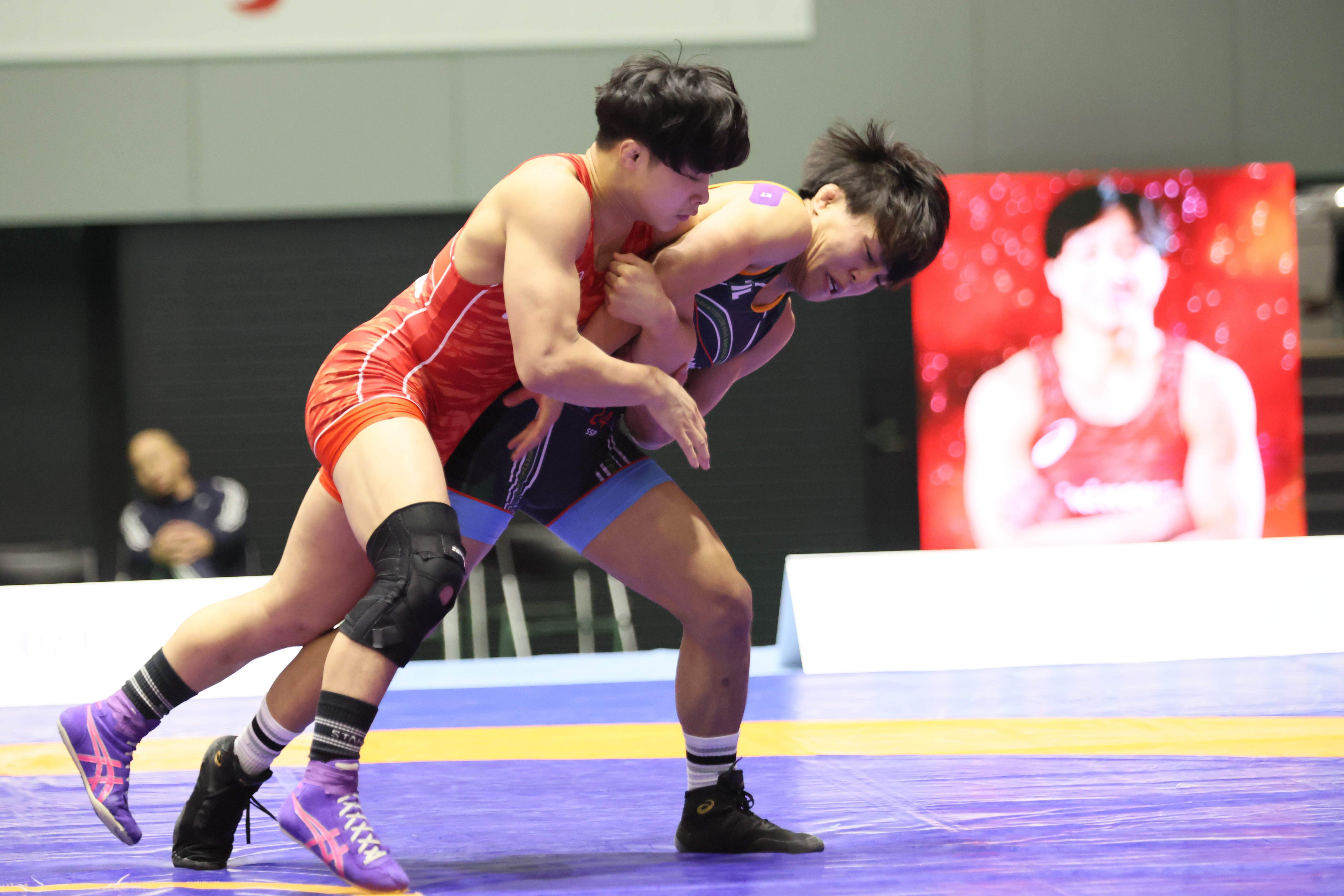
Kaisei TANABEKaisei TANABE, left, works to get behind Ryota KOSHIBA in the Greco 63kg final. (Photo: Takeo Yabuki / wrestling-spirits.jp)
Tanabe acknowledged that he dodged a bullet when Paris 60kg gold medalist Kenichiro FUMITA withdrew on the eve of the tournament due to injury. Fumita was entered at 63kg in what would have been his first competition since his triumph in Paris.

As both are Nippon Sports Science University alumni and still train at the campus, Tanabe said he has spent some time sparring with Fumita.

"Part of me wanted to face him [today]. But in practice, I've never scored a point," he admitted. "It was a crummy feeling. But if we faced each other in an actual match, I would never give up and try my best to win. Without him here, this became my tournament and I felt I had to take the title."

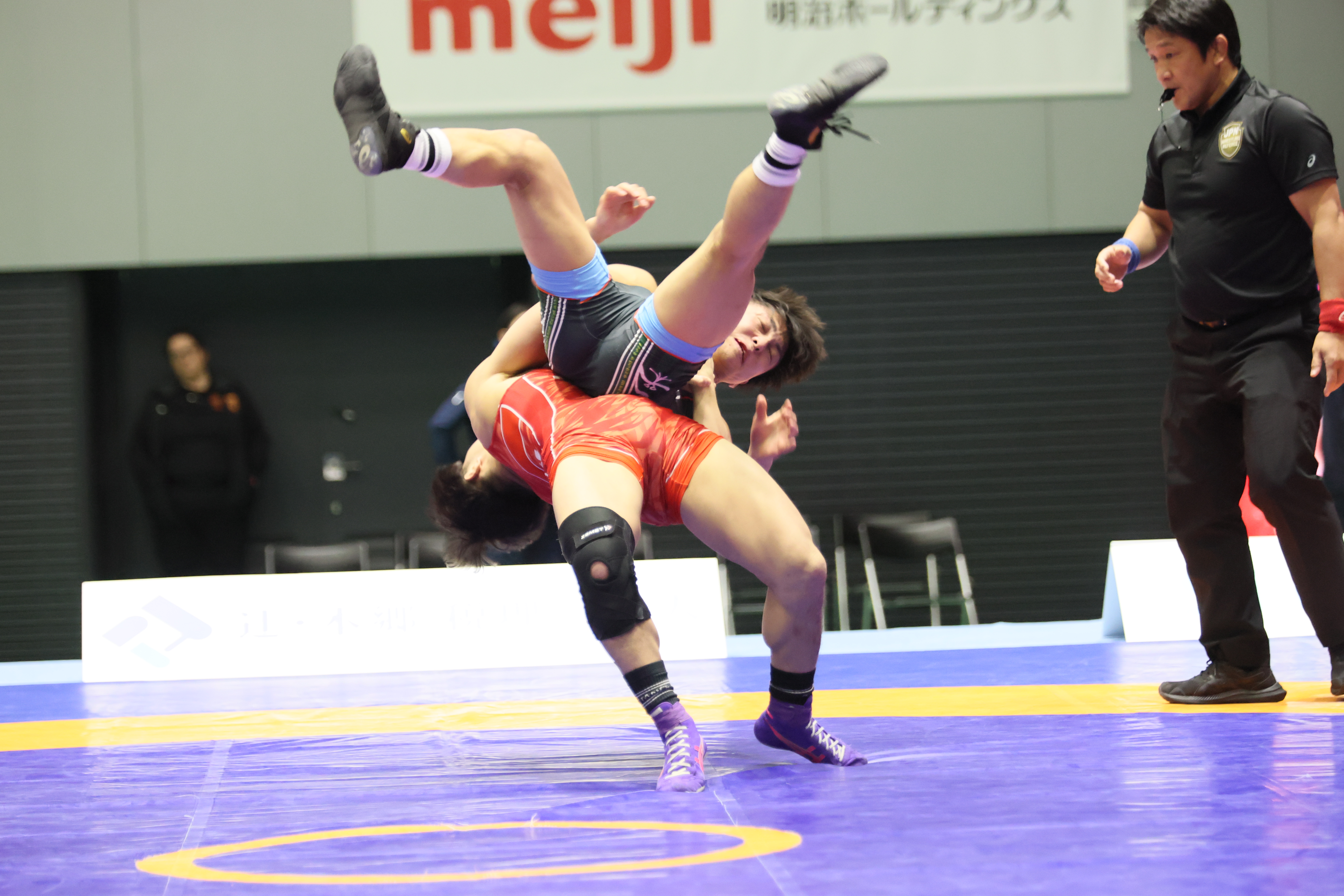
On Thursday, Tanabe showed he was clearly the best of the rest, sailing through the field with three straight technical falls. He capped his day with 4-point throw that finished off an 8-0 victory in the final in just under two minutes over Ryota KOSHIBA, another NSSU alum who happens to also dabble in freestyle.

Tanabe, whose father Chikara TANABE was a freestyle 55kg bronze medalist at the 2004 Athens Olympics and is a current NSSU coach, said he likes to integrate techniques from the two styles into each other.

"To put it as simply as I can, Greco is mostly about throws and often has big 4-point moves, while freestyle is mainly precise techniques," Tanabe said. "Amid that, I want to add the fine, small moves to Greco and, amid the small moves in freestyle, aim for the big move that gives me a point spread."

Kaisei TANABEKaisei TANABE finishes up his victory over Ryota KOSHIBA with a four-point throw in the Greco 63kg final. (Photo: Takeo Yabuki / wrestling-spirits.jp)
This fall, Tanabe was among a number of Japanese wrestlers who participated in the German Bundesliga, where he said he sometimes worked on Greco with his teammates. And at times for fun, the Greco wrestlers and him would do freestyle.

Tanabe won his first national title at freestyle 61kg in 2024, then moved up to 65kg last year and won the gold in the absence of Kiyooka, who like other Olympic medalists was on an extended post-Olympics hiatus. He just missed out on the two-style double that year when he lost in the Greco 67kg final to Katsuaki ENDO.

Tanabe won the freestyle 65kg gold at the Asian Championships in March, then finally clashed with Kiyooka -- also an NSSU alum -- two months later at the Meiji Cup All-Japan Invitational Championships, which is the second of the two domestic qualifiers for major international tournaments.

Tanabe held his own in a close 4-3 loss in the final, but Kiyooka dominated a playoff for the team to the World Championships with a one-sided 13-2 victory. Kiyooka went on to take the silver medal in Zagreb.

Should Tanabe manage to capture the gold on Sunday, it would make him the first wrestler to complete the Greco-freestyle double at the same tournament since Mitsuo YOSHIDA did it back in 1973 with victories in the 100kg weight classes.

As it is, Tanabe's victory on Thursday made him the first to achieve a career double since Atsushi MATSUMOTO switched to Greco and won at 85kg in 2016 after winning the first three of four national freestyle titles at 84/86kg between 2011 and 2014. He returned to freestyle and won again at 92kg in 2018.

Ironically, another wrestler could beat Tanabe to the punch. Taishi NARIKUNI, the 2022 world champion at freestyle 70kg, is entered in that weight class as well as Greco 72kg. Both divisions will be completed before Sunday, when the freestyle 65kg final will be held.

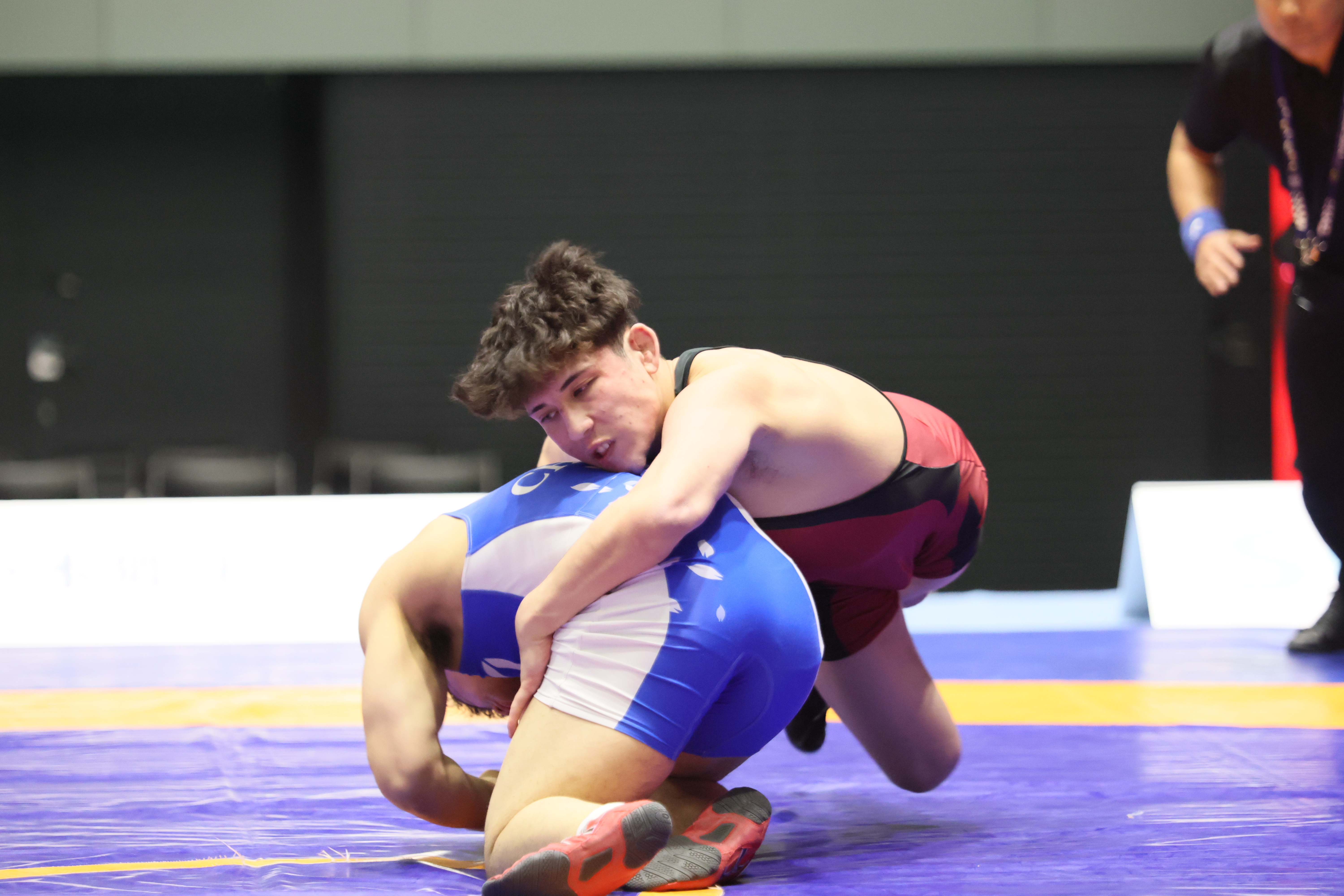
Keyvan GHAREHDAGHIKeyvan GHAREHDAGHI, right, spins behind Kanata YAMAGUCHI in the freestyle 79kg final. (Photo: Takeo Yabuki / wrestling-spirits.jp)
At freestyle 79kg, Gharehdaghi used effective counters to score an 8-0 victory in the final over Kanata YAMAGUCHI, a world U20 bronze medalist at 74kg who had beaten him in two previous encounters.

That followed up on Gharehdaghi's victory at the Meiji Cup in May, which was tempered by a loss in the world team playoff to last year's Emperor's Cup champion Ryonosuke KAMIYA, who has moved up to 86kg.

"Losing the playoff was devastating, and I was determined to work hard so that I wouldn't lose again," said the 19-year-old Gharehdaghi, a product of the JOC Elite Academy.

Gharehdaghi was born and raised in Japan to an Iranian father and Japanese mother. Through the influence of his father, who works in the automobile industry, he started wrestling at age 3.

Although he shares a compassion for the sport with his ancestral homeland, he has only been there on visits and cannot speak Persian.

His background is similar to that of one of Japan's top rising stars, world 97kg bronze medalist Arash YOSHIDA, one of six siblings in the sport who use their mother's family name. They all started the sport at a kids wrestling club outside of Tokyo run by their father.

"I'm well aware of them," Gharehdaghi said. "I really respect them. Every one of them is strong. Their father was here today and gave me some advice."

In other finals on the opening day, Asian bronze medalist Takashi ISHIGURO went on the offensive in the second period to notch a 6-3 victory at freestyle 92kg over Daisuke MASUDA to defend his crown and claim a fifth career national title.

Kenta OGUSU won the Greco 55kg gold by completing a 9-1 technical fall with one second left over Mizuki ARAKI, who had knocked off Asian champion Kohei YAMAGIWA in the semifinals.

At women's 65kg, 2024 world U20 champion Nana IKEHATA defeated Haruka KOBARA 6-0 for her first national title, while Mahiro YOSHITAKE defeated Chisato YOSHIDA 7-2 for her third national crown and first at 72kg.

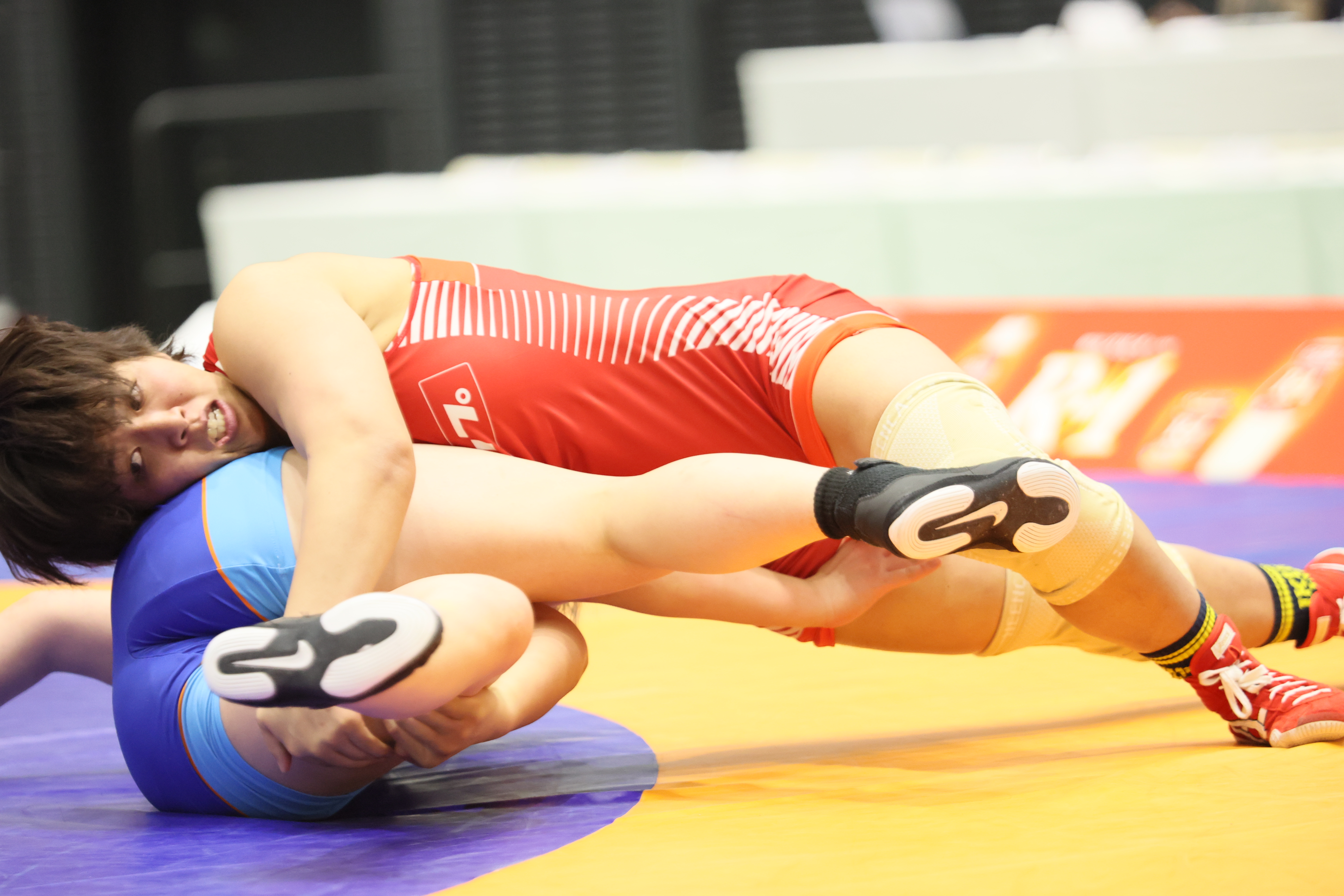
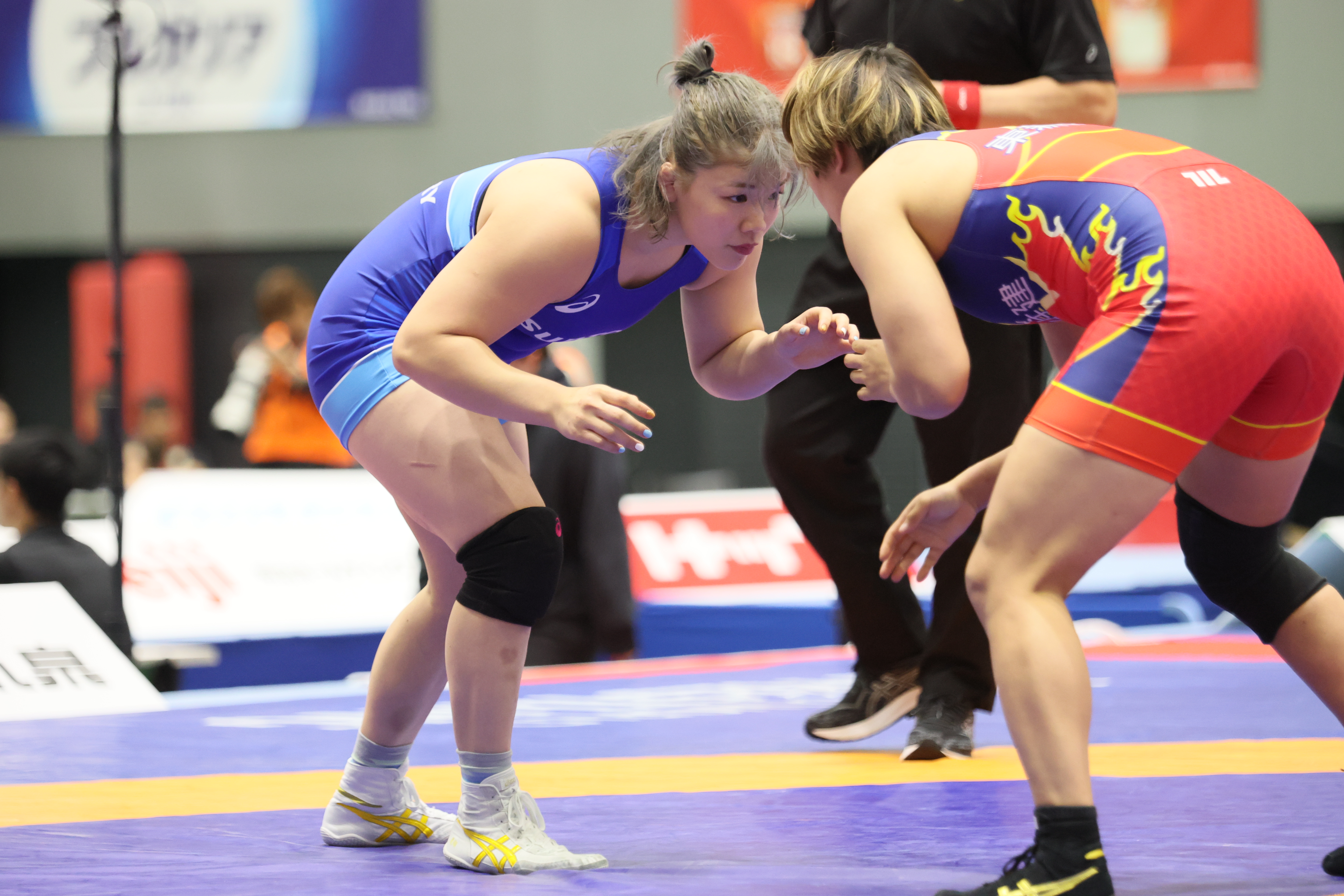
Ami ISHIIWorld champion Ami ISHII scores a takedown in the women's 68kg semifinal against Kaede MATSUYAMA. (Photo: Takeo Yabuki / wrestling-spirits.jp)
Ishii, Morikawa set up clash; Kagami sharp in return

In Olympic weight classes that were competed through the semifinals, a blockbuster final was set up at women's 68kg when Ishii, the reigning world champion, advanced to a showdown with Morikawa, the winner at 65kg in Zagreb.

Ishii won both of her matches by one-sided technical falls -- giving up a lone takedown in her opening match when she lost her balance.

"I didn't think my matches went very well," Ishii said. "Especially in the first match, I rushed it too much. I want to be the aggressor and have crushing victories."

Morikawa met some stiff resistance in her semifinal with world U20 champion Ray HOSHINO, scoring two first-period takedowns before holding on for a 6-2 victory. Hoshino had knocked off three-time world medalist Masako FURUICHI 8-6 in the quarterfinals.

Ishii and Morikawa have met three times, with Ishii holding a 2-1 advantage. She won their first meeting 5-2 in the 2022 Emperor's Cup final. They clashed again in the semifinals at the 2023 Meiji Cup, with Morikawa winning 8-5. That set up a world team playoff between the two, which Ishii won 2-1.

Yuka KAGAMIOlympic champion Yuka KAGAMI, left, competes for the first time since her victory in Paris. (Photo: Takeo Yabuki / wrestling-spirits.jp)

Meanwhile, Olympic 76kg champion Yuka KAGAMI looked sharp in her first competition since her victory in Paris, scoring a technical fall before beating defending champion and Asian bronze medalist Nodoka YAMAMOTO 13-4 to advance to the final.

Kagami, who was limited to an activity point in the first period by Yamamoto, was being pressured at the edge early in the second when she neatly reversed the tide and dumped her opponent for a 4-point takedown.

Kagami padded the lead and, despite giving up a takedown and roll, she was never in danger. In Friday's final, she will face veteran Yasuha MATSUYUKI.

At Greco 87kg, rising teen star Taizo YOSHIDA, a world senior and U20 bronze medalist at 82kg, posted two technical falls, each inside of two minutes, to advance to the final. Two-time defending champion So SAKABE was a late withdrawal.

Day 1 Results

Freestyle

57kg (18 entries)
SF 1: Yamato OGAWA df. Kento YUMIYA, 6-4
SF 2: Fuga SASAKI df. Yamato FURUSAWA, 3-1

79kg (19 entries)
GOLD: Keyvan GHAREHDAGHI df. Kanata YAMAGUCHI, 8-0
BRONZE: Kaiyo IMAI df. Hirotaka ABE, 7-0
BRONZE: Subaru TAKAHARA df. Kojiro SHIGA, 5-2

SF 1: Keyvan GHAREHDAGHI df. Hirotaka ABE by TF, 10-0, 2:06
SF 2: Kanata YAMAGUCHI df. Subaru TAKAHARA by TF, 12-2, 3:45

92kg (25 entries)
GOLD: Takashi ISHIGURO df. Daisuke MASUDA, 6-3
BRONZE: Satoshi MIURA df. Sorato KANAZAWA,6-2
BRONZE: Ryogo ASANO df. Takato UCHIDA by Inj. Def.

SF 1: Takashi ISHIGURO df. Sorato KANAZAWA, 7-5
SF 2: Daisuke MASUDA df. Takato UCHIDA, 4-1

125kg (10 entries)
SF 1: Taiki YAMAMOTO df. Akinari ORIYAMA by TF, 10-0, :50
SF 2: Taira SONODA df. Hibiki ITO, 3-2

Greco-Roman

55kg (17 entries)
GOLD: Kenta OGUSU df. Mizuki ARAKI by TF, 9-1, 5:59
BRONZE: Kohei YAMAGIWA df. Daisuke MORISHITA, 5-0
BRONZE: Sanshiro TAKAHASHI vs Taketo NINOMIYA by TF, 9-0, 2:00

SF 1: Mizuki ARAKI df. Kohei YAMAGIWA, 6-5
SF 2: Kenta OGUSU df. Sanshiro TAKAHASHI by TF, 9-1, 4:04

63kg (19 entries)
GOLD: Kaisei TANABE df. Ryota KOSHIBA by TF, 8-0, 1:54
BRONZE: Kazuki YABE df. Shoya ITO, 7-0
BRONZE: Toya MINAMI df. Miruto TOKUHIGA, 7-5

SF 1: Kaisei TANABE df. Kazuki YABE by TF, 8-0, 1:12
SF 2: Ryota KOSHIBA df. Miruto TOKUHIGA by TF, 9-0, 3:56

87kg (9 entries)
SF 1: Taizo YOSHIDA df. Genki YAHAGI by TF, 9-0, 1:59
SF 2: Daisei ISOE df. Chihiro MOTOHASHI, 10-5

97kg (16 entries)
SF 1: Yuri NAKAZATO df. Koki MATSUMOTO by TF, 9-0, 4:12
SF 2: Takahiro TSURUTA df. Kanta SHIOKAWA, 5-0

Women's Wrestling

65kg (9 entries)
GOLD: Nana IKEHATA df. Haruka KOBARA, 6-0
BRONZE: Suzu SASAKI df. Chika AKASHI by TF, 14-4, 2:59
BRONZE: Nanoha YASHIMA df. Rin MIYAJI, by Inj. Def.

SF 1: Nana IKEHATA df. Suzu SASAKI, 10-2
SF 2: Haruka KOBARA df. Nanoha YASHIMA, 6-4

68kg (8 entries)
SF 1: Ami ISHII df. Kaede MATSUYAMA by TF, 10-0, 3:41
SF 2: Miwa MORIKAWA df. Ray HOSHINO, 6-2

72kg (9 entries)
GOLD: Mahiro YOSHITAKE df. Chisato YOSHIDA, 7-2
BRONZE: Ai SAKAI df. Miyu TAKAYAMA, 5-5
BRONZE: Yuka FUJIKURA df. Asahi NAKAMURA, 8-0

SF 1: Chisato YOSHIDA df. Miyu TAKAYAMA by TF, 10-0, 4:56
SF 2: Mahiro YOSHITAKE df. Yuka FUJIKURA, 4-0

76kg (8 entries)
SF 1: Yuka KAGAMI df. Nodoka YAMAMOTO, 13-4
SF 2: Yasuha MATSUYUKI df. Makoto KOMADA, 7-0