

#UnitedWorldWrestling

A decade since wrestling’s grapple back into Olympics

By United World Wrestling Press

From left to right: Jim SCHERR (USA), Daniel IGALI (CAN), Lise LEGRAND (FRA), Carol HUYNH (CAN) and UWW President Nenad LALOVIC at the press conference during the 125th IOC Session in Buenos Aires in 2013. (Photo: IMAGO/AFLOSPORT)

CORSIER-SUR-VEVEY, Switzerland (September 8) -- Wrestling's World Championships enters the 102nd year next week and next year will mark another Olympic Games that will feature wrestling. But 10 years ago, wrestling was removed from the Olympic Programme.

In February 2013, the International Olympic Committee voted to remove wrestling from the 2020 Olympics. It took wrestlers from different nations coming together, led by Serbia's Nenad LALOVIC, to reverse an unthinkable result and to 'Save Olympic Wrestling'.

On September 8, 2013, in Buenos Aires, Argentina, the full IOC membership welcomed the sport back to the programme with a first-round vote that left no doubt that wrestling belonged in the Olympic Games.

Wrestling's journey of finding itself back in the Olympics was marked by twists and turns, and, fittingly, resiliency.


The Decision

One of the original sports in the ancient Olympic Games, wrestling faced the critical assessment of the IOC which had expressed concerns about the growing size of the Summer Games and aimed to cap the number of athletes at approximately 10,500. The IOC also wanted to attract younger viewers to broaden the international television audience. There was also discontent over the lack of gender equality, having only introduced women's freestyle competitions in 2004.

When the decision of wrestling being dropped from the Olympic Gamesheadlined, United World Wrestling, then FILA, put in all efforts to revamp the sport. In a FILA Bureau meetingin Phuket, Thailand, Raphael Martinetti resigned as president and after a vote of the Bureau members. The Bureau nominated Lalovic as acting President.

"The world of wrestling is understandably disappointed by the IOC Executive Board’s recommendation to remove wrestling from the 2020 Olympic Games Programme," Lalovic said. "We see this as an opportunity which could be a positive turning point for our sport. One thing is for certain: it is our responsibility alone to address the issues that led to this situation. We are listening to the IOC’s concerns and learning from their guidance. We must strive to improve our sport’s Olympic offering in order to retain our position on the Olympic Programme and evolve with the times.

The Fight

What followed was an immediate and impassioned campaign that stretched from the United States and Russia to Iran and Japan. 

Armen NAZARYAN (ARM) and Sagid MURTAZALIEV returned their gold medals in protest, with Nazaryan also engaging in a hunger strike. London gold-medallist Jordan BURROUGHS (USA) used numerous public speaking appearances, countless interviews, and his Twitter account to promote the cause.

To address the concerns, UWW removed two men's weight classes and introduced two new classes for women starting from the 2016 Rio Olympics. This adjustment led to six weight classes each for Freestyle and Women's Wrestling while maintaining six in Greco-Roman.

Rule changes were also implemented to make the sport more engaging and dynamic. Instead of the previous format of three two-minute rounds, matches now consist of two three-minute rounds. This new structure aims to reward aggressive wrestling; takedowns, for example, are now worth two points instead of one. Additionally, matches are decided based on accumulated points, further encouraging active competition.

Campaigns were held in Russia, Iran, the United States and Japan. The first three countries came to New York City, united and determined to prove to the world that Wrestling belongs in the Olympics. The three competed in the “Rumble on the Rails” in the world-famous Grand Central Station.

While in New York, Lalovic attended a press conference at the United Nations. “We are dedicated to reforming our sport and making FILA a more proactive and responsible organization. We will do everything we can to address the IOC’s concerns and ensure that wrestling remains a part of the Olympic Games," he said.

Wrestlers from around the world also took a trip to – Olympia, Greece – the birthplace of the Olympic movement. Wrestlers from Albania, Brazil, Germany, Great Britain, Greece, Iran, Russia and the United States, competed in the international tournament, which was run under the new rules passed by FILA.

IOC took notice and in its session in Buenos Aires, Argentina, it confirmed wrestling's spot in the Olympics.

"I want to offer my sincere gratitude to each member of the International Olympic Committee that voted to save Olympic wrestling today," Lalovic said. "With this vote, you have shown that the steps we have taken to improve our sport have made a difference. I assure each of you that our modernization will not stop now. We will continue to strive to be the best partner to the Olympic Movement that we can be."

In Ten Years

In the decade since wrestling's reinstatement to the Olympic Games, the sport has seen remarkable progress in its structure and reach. The governance of the sport underwent significant changes, with rule amendments aimed at making matches even more dynamic and engaging.

In 2016, there were ten weight classes for women in wrestling, up from four in 2004. This was a major step forward for the sport and has helped increase the visibility and popularity of Women's Wrestling. Who can forget Kaori ICHO’s (JPN) historic accomplishment of being the first ever wrestler, women or men, to obtain four Olympic gold medals!

Over the years, many countries have emerged as the best performers in Women's Wrestling including Japan, Kyrgyzstan, China, Moldova, India, Estonia, Kazakhstan, Turkiye and even Pan-Am countries.

The focus on gender equality has extended beyond merely adding women’s weight classes, as witnessed by UWW's projects and programs, such as special funding for female coaches and wrestlers and quotas for female referees and women working in key administrative positions.

Off the mat, there has been a concerted effort to globalize wrestling, and marketing and social media campaigns have effectively changed the sport's image and engaged younger fans. High-profile wrestlers have taken on ambassadorial roles, visiting schools, appearing on talk shows, and participating in public events to promote the sport. Online platforms are being utilized for live-streaming events and tutorials, making the sport more accessible.

Wrestling's growth is further marked by the acceptance of Beach Wrestling and more than 100 countries participating in the World Championships.

The athlete-focused approach aligned with the IOC's vision of the Olympic movement has allowed fans to be more connected to the sport. Wrestling has established itself as a leader in terms of engagement and continues to be ranked within the top ten in social media amongst all other International Federations.

The 10-year journey from near-elimination to triumphant return is a microcosm of the sport: a physical and metaphorical tussle where resilience is the key to victory. As a wrestler grapples, twists, and turns to win, the sport has shown its mettle by overcoming near defeat, reforming, and returning stronger.

Here’s to wrestling — a sport as ancient as it is contemporary, as diverse as it is specialized, and, most importantly, as resilient as the athletes who partake in it. Wrestling knows how to fight back and fight back it did.

Wrestling’s reinstatement to the Olympic Programme was a collective effort of the wrestling family all across the world. The dedication and tremendous work of key individuals that went into this result will never be forgotten by the wrestling community and will forever live on in wrestling folklore as some of the greatest stewards the sport has ever seen. Thank you.
#WrestleZagreb

Motoki works her magic to snatch elusive world gold

By Ken Marantz

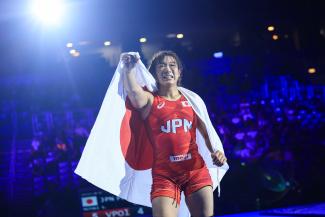
ZAGREB, Croatia (September 17) -- Sakura MOTOKI (JPN) finally has a world gold to go with the one she won at the Paris Olympics. And she did it with another
dramatic victory, this time in the final.

As is becoming her forte, Motoki snatched a victory in the dying seconds of a match, beating Asian silver medalist Ok Ju KIM (PRK) 5-4 in the 62kg final at the World Championships on Thursday, as the women's competition concluded with a banner day for Japan.

"Just like at the Olympics, I went from a point where I thought I would lose, then the outcome suddenly changed and I was able to win," Motoki said. "It's the same feeling of happiness and feeling of relief, and brought me to tears."

Japan won two of the three other golds at stake, with Haruna MURAYAMA (JPN) winning at 53kg for her fourth career world gold, and Ami ISHII (JPN) triumphing
at 68kg to become a two-time world champion.

The fourth and final gold of the night went to Alla BELINSKA (UKR), who repeated her victory over Nesrin BAS (TUR) from the final of the European Championships -- right down to winning by fall.

The three golds padded Japan's total in the team race, as the Asian powerhouse had clinched the title before the night began. Japan, which won five of the 10 golds, finished on top with 162 points, followed by the DPR Korea with 115 points. China edged the United States for third, 87-83.

Motoki made a name for herself around the world at the Paris Olympics, where her hopes of a gold seemed to be over in the semifinals, when she was trailing Grace BULLEN (NOR) 7-2 and was being tripped backwards for what might end the match.

But Motoki suddenly locked Bullen's arms and bridged, then turned her over and recorded a stunning fall to the shock of those in the Champ de Mars Arena and around the world. The next day she defeated Irina KOLIADENKO (UKR) for the gold.

Motoki had to survive a grueling qualifying process just to get to Paris. A world bronze medalist at 59kg, she moved up to the Olympic weight and had to win out among a domestic field that included Tokyo Olympic champion Yukako KAWAI (JPN) and world champion Nonoka OZAKI (JPN).

And she basically had to repeat the process to get to Zagreb. As she did in Paris, Motoki pulled a rabbit out of the hat and defeated Ozaki by scoring a takedown literally in the final second of a playoff for Japan's team.

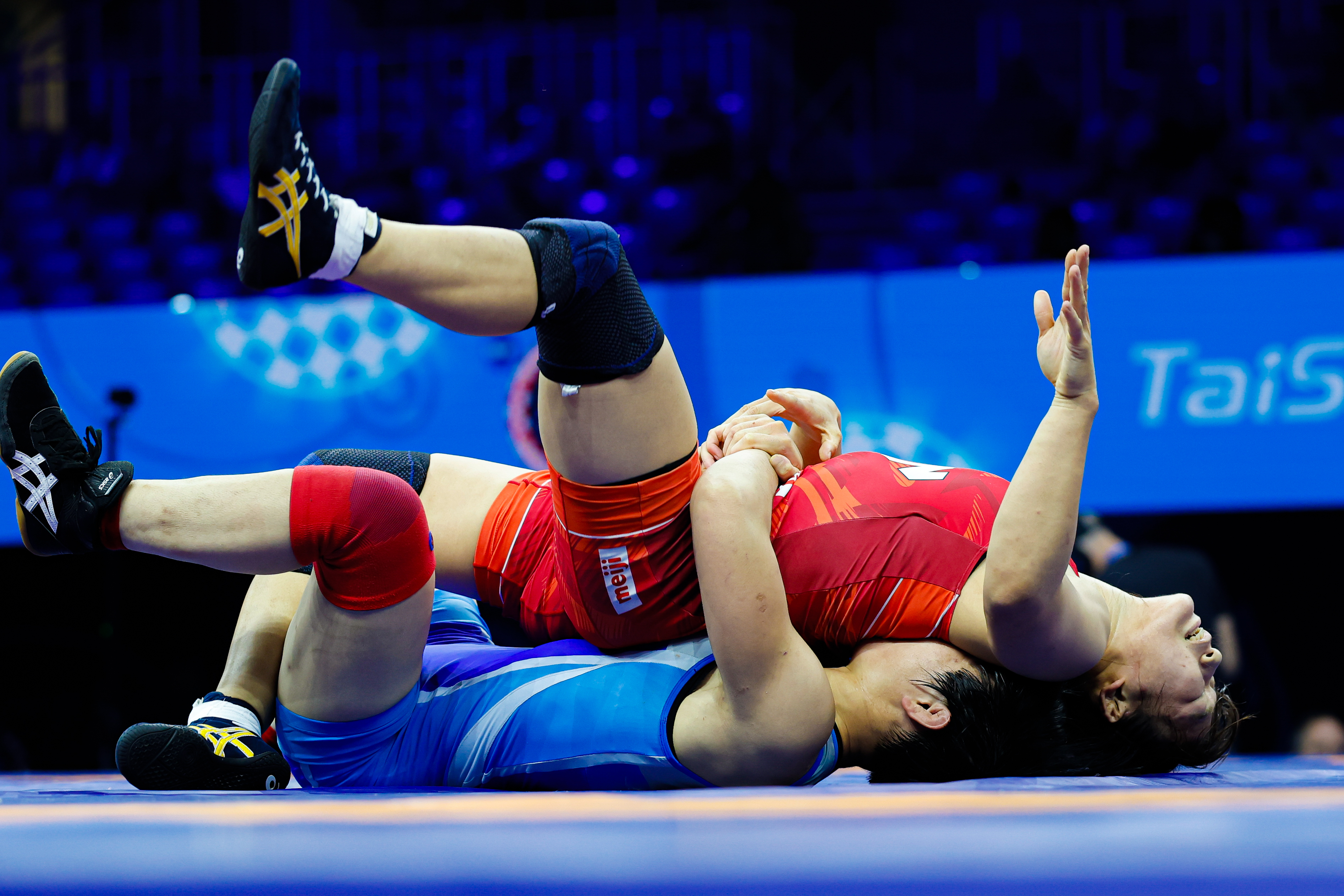
On Thursday, Kim became the latest to fall victim to the Motoki magic. The Japanese took a 3-0 lead in the first period on an activity point and a sweeping single-leg takedown.

Trying to defend in the second period, Motoki gave up a single-leg takedown to Kim, which the Japanese was willing to concede. But she wasn't prepared for being
gut-wrenched over to suddenly fall behind 4-3 with :35 left.

"I had a three-point lead and when she got in on a single leg, I thought it would be alright to give up two [points]," Motoki said. "But then when I was rolled, I thought, 'This is bad. Once again I'm going to get this far and not win?'"

Ok Ju KIM (PRK)Ok Ju KIM (PRK) turns Sakura MOTOKI (JPN) to take a 4-3 lead in the 62kg final. (Photo: United World Wrestling / Kostadin Andonov)
In her two previous trips to the World Championships, Motoki fell short of the gold, taking the bronze in 2022 and the silver in 2023, losing to Aisuluu TYNYBEKOVA (KGZ) in the final. Would she miss out on the gold again?

With 12 seconds left, she launched her attack, transitioning from one thing to another in a desperate attempt. First a low single, then an arm throw, then back to
a single. All were defended. Then she tried a headlock throw, and that sent Kim sideway to the mat as time ran out.

The referee gave no points, but on challenge, it was determined that Kim's shoulders broke the 90-degree plane -- with :00.3 seconds on the clock.

"In the last 12 seconds, I launched an attack, and when the tackles failed, I thought, 'Oh no, that's the end,'" Motoki said. "When I looked back, she was on my back. I thought if I threw her, I could make it. I just put everything into the throw, but I didn't know if I turned her. Really, it was lucky."

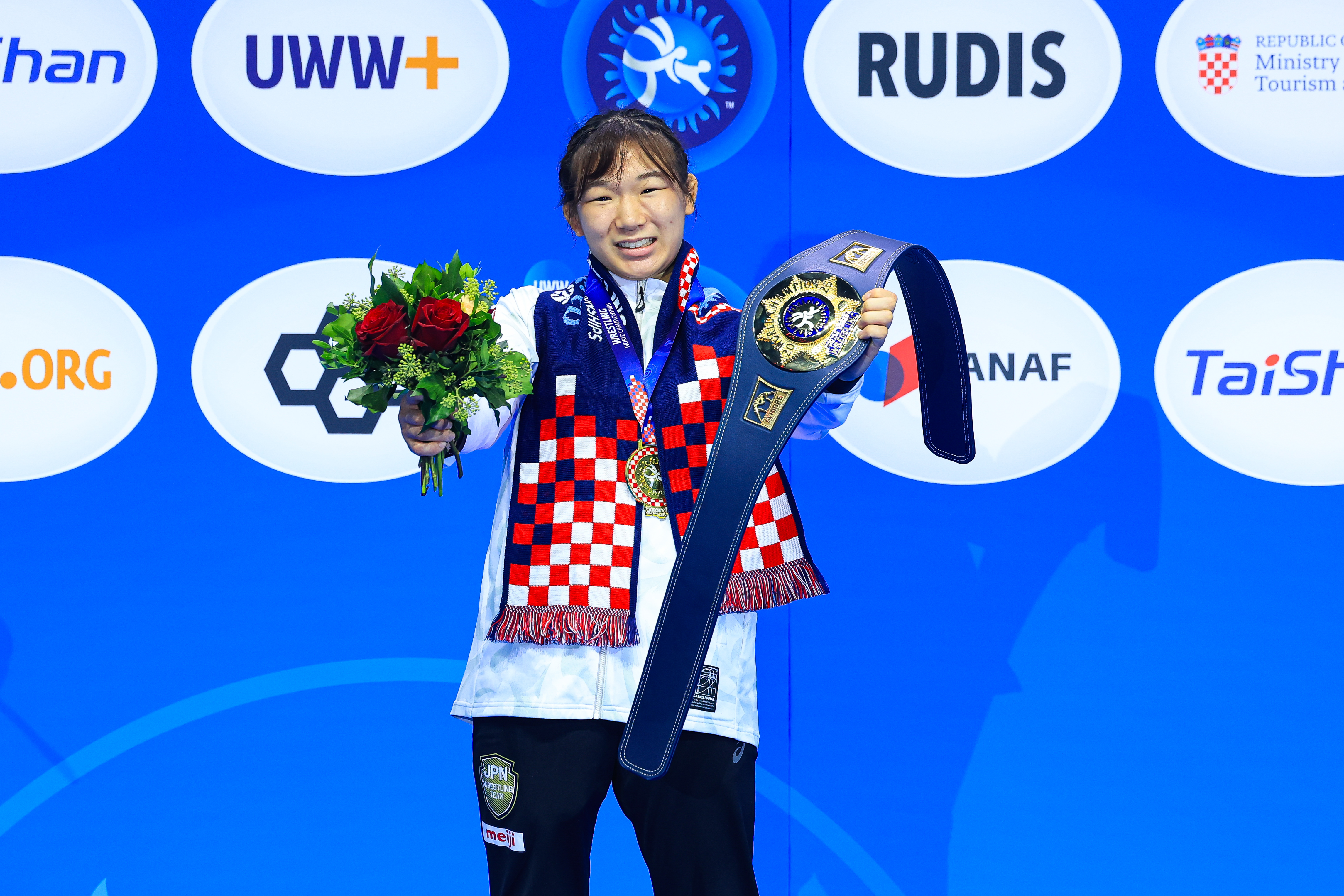
Sakura MOTOKI (JPN)Sakura MOTOKI (JPN) won her first world gold medal in Zagreb. (Photo: United World Wrestling / Kadir Caliskan)
Motoki said her earlier losses at the worlds served as incentive to work harder and always give everything up to the final whistle. She told the Japanese press earlier this year that she uses the UWW music played during the medal ceremony as her morning alarm -- a constant reminder of the agony she never wanted to experience again.

"Three years ago and two years ago, I lost on this stage, and the feeling of disappointment and of being inferior, even after winning at the Olympics, did not go away," Motoki said. "But by losing, it made me stronger and made me what I am now. To win here makes me so happy."

Motoki will embark on another quest in a month's time when she competes at the World U23 Championships on October 20-27. Already a world U17 and U20 champion, a victory in Novi Sad, Serbia, will make her just the third member -- along with Yui SUSAKI (JPN) and Amit ELOR (USA) -- of the elite "Golden Grand Slam" club, those who have won on the senior and all three age-group levels as well as at the Olympics.

"One might think that winning on the age-group level would put you at the forefront, but that's not the case," Motoki said. "After I won the U17, I had an injury and became weaker. I lost in the first round at the Inter High. Then I went to college and thought I had progressed, only to have a major injury.

"To achieve the Grand Slam would be due to overcoming the hard times with the support of many others."

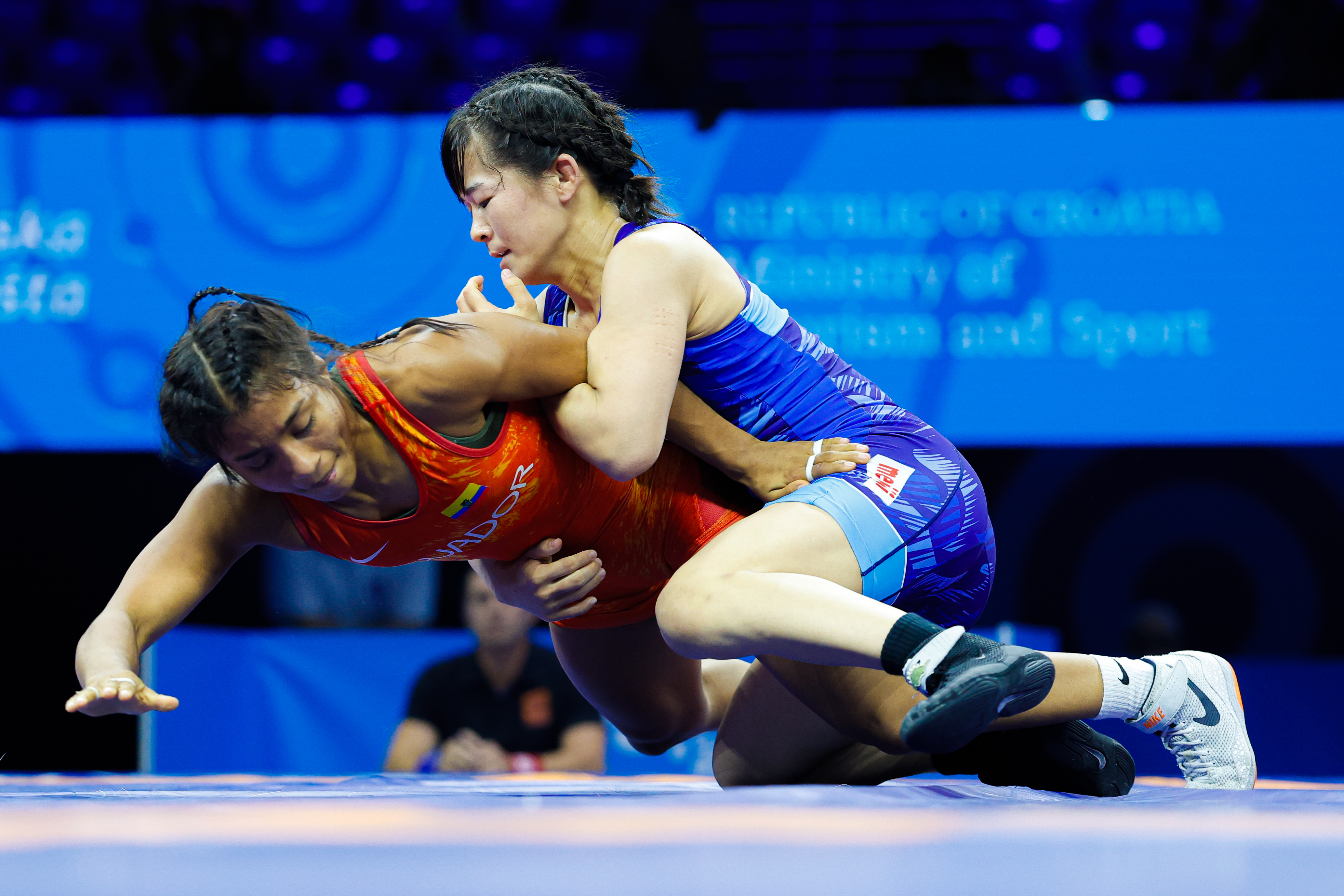
Haruna MURAYAMA (JPN)Haruna MURAYAMA (JPN) controls Lucia YEPEZ (ECU) during the 53kg final at the World Championships. (Photo: United World Wrestling / Kostadin Andonov)
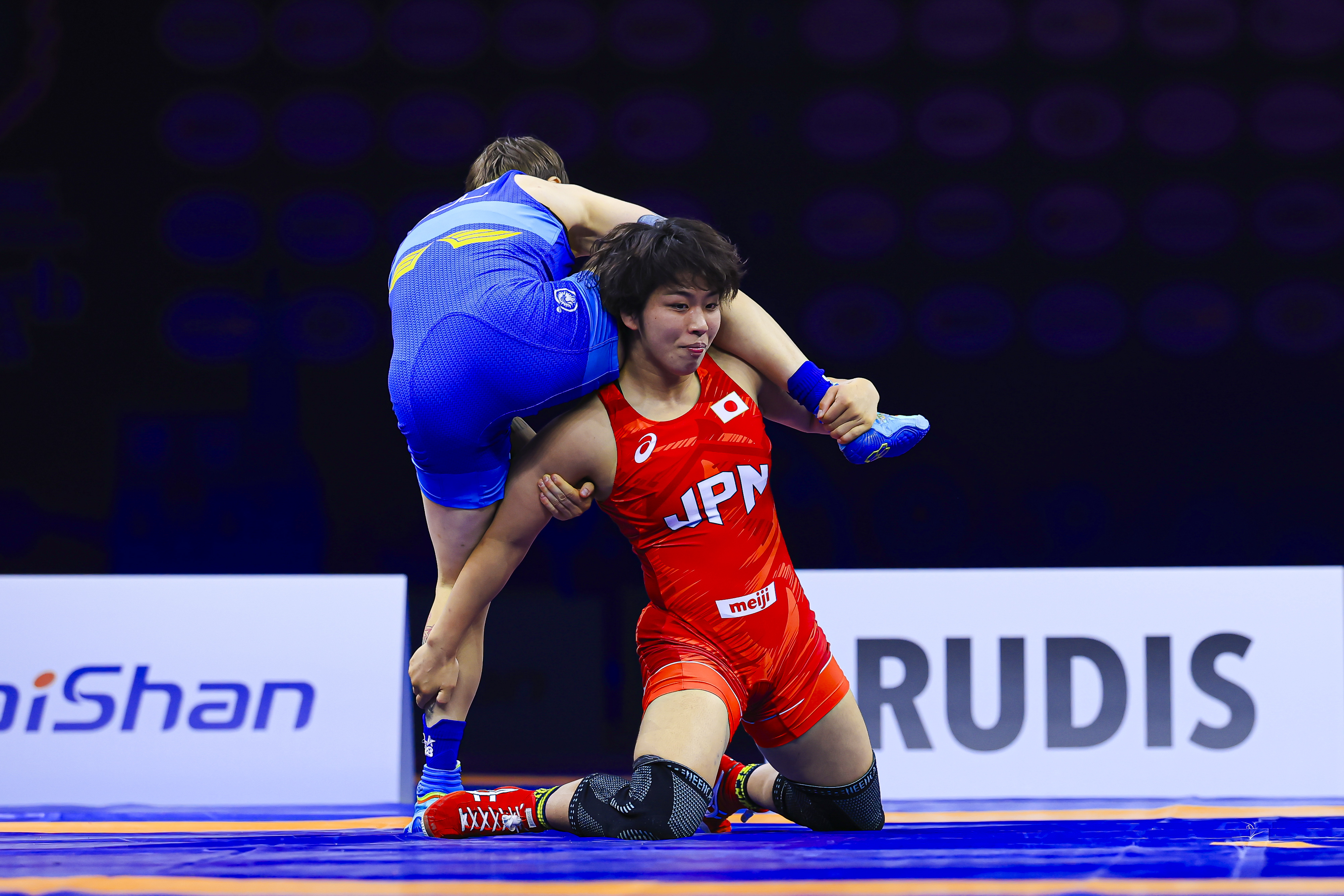
At 53kg, Murayama established herself as the frontrunner in the weight class in the runup to the 2028 Los Angeles, following the decision by Paris gold medalist Akari FUJINAMI (JPN) to move up to 57kg.

Murayama scored takedowns in each period to defeat Paris silver medalist Lucia YEPEZ (ECU) 5-0 and add to her world golds from 2017, 2018 and 2023, all won under her maiden name of OKUNO.

It marks the continuation of a remarkable turnaround for Murayama, who sank into the depths of despair after losing out on the berth for the Tokyo Olympics to collegiate teammate and eventual gold medalist Mayu MUKAIDA (JPN).

"I had half given up on the idea of competing at events like the World Championships in an Olympic weight class," Murayama said. "So just being able to stand on this stage and leave this kind of result behind -- it’s something that two or three years ago, I couldn’t even have imagined."

It was Yepez who famously scored seven points off Fujinami in the quarterfinals at the 2023 World Championships, albeit the Japanese came back and scored 16 of
her own before winning by fall. But the Ecuadorean, her country's first-ever world and Olympic medalist, established herself as a dangerous foe.

In the final, Murayama wrestled cautiously but methodically, using a front headlock to spin behind for a takedown just as she was receiving an activity point in the first period. She added a second takedown by getting behind again in the second period.

Murayama and Yepez had met once before, with the Japanese winning 10-0 in the final of the U23 World Championships in October 2022.

Ami ISHII (JPN)Ami ISHII (JPN) tries to score on Yuliana YANEVA (BUL) in the 68kg final. (Photo: United World Wrestling / Kadir Caliskan)
At 68kg, Ishii had plowed through the field to make the final, where she met stiff resistance from four-time European medalist Yuliana YANEVA (BUL) and needed a second-period takedown to secure a 4-2 victory.

It was Yaneva who struck first when she adroitly used a counter lift for a two-point lead. Ishii came back with a stepout, but an apparent takedown was wiped out on challenge as having been completed after the buzzer.

Down by a point, Ishii warily avoided the counter and went with an arm drag to get behind for a takedown to go ahead 3-2. A short time later, Yaneva shot in for a single, but Ishii slipped under and grabbed Yaneva's leg, then clung on to force a stalemate. An unsuccessful challenge at the end gave Ishii her final point.

"I thought I might get countered again," Ishii said of her strategy for the second period. "Still, I had to get points. It would be the end if I lost my nerve. Even if I couldn't get in [on a tackle], I had to find a way to get points."

Ishii has been a workhorse since missing out on the Paris Olympics when she suffered a heartbreaking, last-second loss for the 68kg spot to Ozaki. She won the 72kg gold at last year's Non-Olympic World Championships as a sort of consolation, so winning at 68kg holds more significance.

"Without a doubt, it's getting to a place closer to the Olympics," Ishii said, adding that her mission now will be staying at the top of the division in Japan. "It's tough to be at this level, and I can't just keep going as I am now. I need to raise my level, so I have to train even harder."

In the last match of the night, two-time European champion Belinska, who had received an activity point in the first period, came out in the second and caught Bas in a headlock before securing the fall in 4:25.

"The final was tense, but I had prepared my throw, and I’m very happy that I managed to execute it," Belinska said. "In the first period, I couldn’t make that move, and the tension started to build -- but even in a stressful situation, I was still able to pull it off."

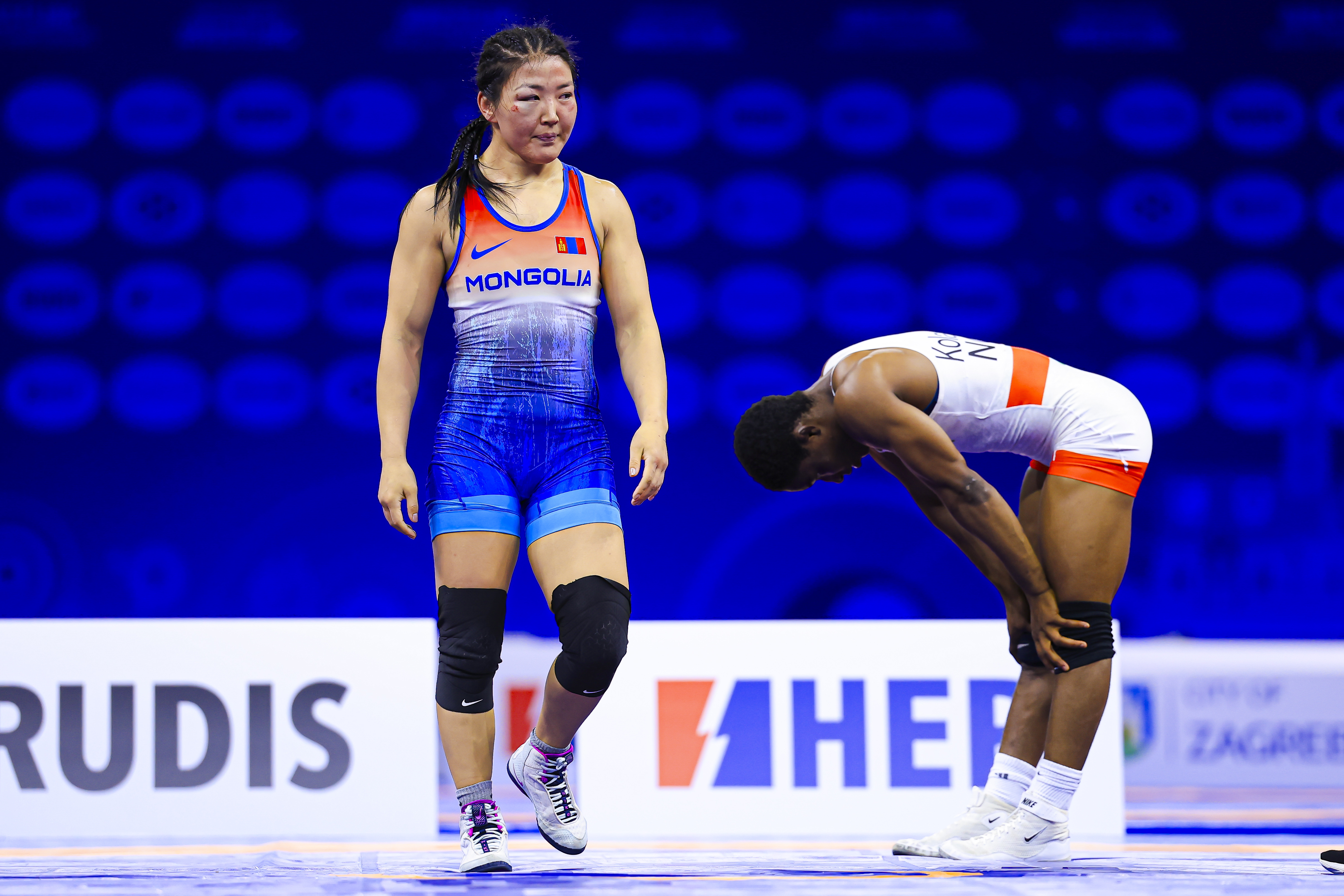
Orkhon PUREVDORJ (MGL)Orkhon PUREVDORJ (MGL) defeated Esther KOLAWOLE (NGR) to win bronze at 62kg. (Photo: United World Wrestling / Kadir Caliskan)

Purevdorj captures bronze 8 years after striking gold

Eight years after winning a world gold, Orkhon PUREVDORJ (MGL) finally picked up her another medal, taking a 62kg bronze by rallying to a nail-biting 6-5 victory over Esther KOLAWOLE (NGR).

After Purevdorj received an activity point in the first period, she fell into a large hole by giving up a 4-point takedown at the edge to open the second period. Purevdorj picked up a 2-point exposure on a scramble, which, after a scramble, revealed a foul by Kolawole. That gave Purevdorj a point and, significantly, put her on top in par terre.

She took advantage by executing a gut wrench and, even though Kolawole reversed, it left the Mongolian with a 6-5 advantage that she maintained through the end.

Amina TANDELOVA (UWW) earned her first world medal when she scored a duck under takedown in the final minute to defeat Bilyana DUDOVA (BUL) 4-2 for the other 62kg bronze.

Asian champion Hyongyong CHOE (PRK) added the senior world bronze to her Olympic bronze from Paris with a victory at 53kg by second-period fall over Shokhida AKHMEDOVA (UZB) after building up an 8-0 lead.

Choe went for the kill at all times, scoring two exposures off a head lock, then ending the match when she scored a takedown and immediately applied a half-nelson to turn Akhmedova over.

Two-time Asian bronze medalist ANTIM (IND) gave India its first medal through six days in Zagreb, capping a 9-1 victory over Jonna MALMGREN (SWE) with a 4-point takedown for the other 53kg bronze.

Kennedy BLADES (USA), the Paris silver medalist at 76kg who made the drop all the way down to 68kg but couldn't get past Ishii, assured she wouldn't leave empty-handed when she routed Buse TOSUN (TUR) 12-1 for the bronze medal.

Jia LONG (CHN), last year's champion at 65kg at the Non-Olympic Worlds, defeated Sol Gum PAK (PRK) 6-1 for the other 68kg bronze. Long scored all of her points in the first period, with a takedown-roll combo followed by a go-behind takedown.

China also picked up a bronze at 72kg, when Zelu LI (CHN) fought off her back after a 4-point headlock by Alexandra ANGHEL (ROU) to start the match, gradually chipping away until she came away with a 7-4 victory with three takedowns.

Nurzat NURTAEVA (KGZ) scored a takedown in each period to top Pauline LECARPENTIER (FRA) 5-0 for the other 72kg bronze.

Day 6 Results

Women's Wrestling

53kg (23 entries)
GOLD: Haruna MURAYAMA (JPN) df. Lucia YEPEZ (ECU), 5-0

BRONZE: ANTIM (IND) df. Jonna MALMGREN (SWE), 9-1
BRONZE: Hyongyong CHOE (PRK) df. Shokhida AKHMEDOVA (UZB) by Fall, 4:00 (8-0)

62kg (22 entries)
GOLD: Sakura MOTOKI (JPN) df. Ok Ju KIM (PRK), 5-4

BRONZE: Orkhon PUREVDORJ (MGL) df. Esther KOLAWOLE (NGR), 6-5
BRONZE: Amina TANDELOVA (UWW) df. Bilyana DUDOVA (BUL), 4-2

68kg (24 entries)
GOLD: Ami ISHII (JPN) df. Yuliana YANEVA (BUL), 4-2

BRONZE: Kennedy BLADES (USA) df. Buse TOSUN (TUR) by TF, 12-1, 5:22
BRONZE: Jia LONG (CHN) df. Sol Gum PAK (PRK), 6-1

72kg (17 entries)
GOLD: Alla BELINSKA (UKR) df. Nesrin BAS (TUR) by Fall, 4:25 (5-0)

BRONZE: Nurzat NURTAEVA (KGZ) df. Pauline LECARPENTIER (FRA), 5-0
BRONZE: Zelu LI (CHN) df. Alexandra ANGHEL (ROU), 7-4

Greco-Roman

55kg (18 entries)
SEMIFINAL: Vakhtang LOLUA (GEO) df. Emin CAKIR (TUR) 2-2
SEMIFINAL: Payam AHMADI (IRI) df. Eldaniz AZIZLI (AZE) 3-1

77kg (33 entries)
SEMIFINAL: Malkhas AMOYAN (ARM) df. Alireza ABDEVALI (IRI), 5-1
SEMIFINAL: Nao KUSAKA (JPN) df. Robert FRITSCH (HUN), 3-1

82kg (26 entries)
SEMIFINAL: Gela BOLKVADZE (GEO) df. Taizo YOSHIDA (JPN), 8-5
SEMIFINAL: Gholamreza FAROKHI (IRI) df. Karlo KODRIC (CRO), 7-1

130kg (27 entries)
SF 1: Darius VITEK (HUN) df. Pavel HLINCHUK (UWW), 3-1
SF 2: Amin MIRZAZADEH (IRI) df. Wenhao JIANG (CHN), 3-1