ALEXANDRIA, Egypt (May 1) -- Till the first four weight classes, Algeria thought it was in with a chance to upset Egypt and win the Greco-Roman team title in Alexandria, Egypt. (Also Read: Nigeria Dominates Women's Wrestling With 4 Golds)
Both countries were tied at 45 points in the team title race at the African Championships on Friday. However, after the initial thrill, Egypt made the race its own, winning five of the remaining six gold medals to claim the team title with 235 points, 40 more than Algeria which finished with 195 points.
Led by world bronze medalist Abdellatif MOHAMED (EGY), who became a nine-time African champion on Friday, Egypt won seven gold and three silver medals to give the local crowd a festive feeling at the Borg Elarb Sport Hall.

Mohamed, who won his first African gold in 2016, defeated Wissam KOUAINSO (MAR), 9-0, in Round 2. While four wrestlers were entered in the bracket, only Mohamed and Kouainso wrestled while Issah FUSEINI (GHA) and Maurice ABATAM (CHA) did not show up.
That made the match between Mohamed and Kouainso the only bout at 130kg which the Egyptian won using four turns from par terre.
U23 world champion Mohamed ABDELREHIM (EGY) spent only seven minutes on the mat to win three round-robin bouts at 67kg. In Round 5, he faced Fayssal BENFREDJ (ALG) who made him work hard for his 6-0 victory in which no par terre positions was awarded to Benfredj. However, Abdelrehim was up to the task and defended his gold medal.
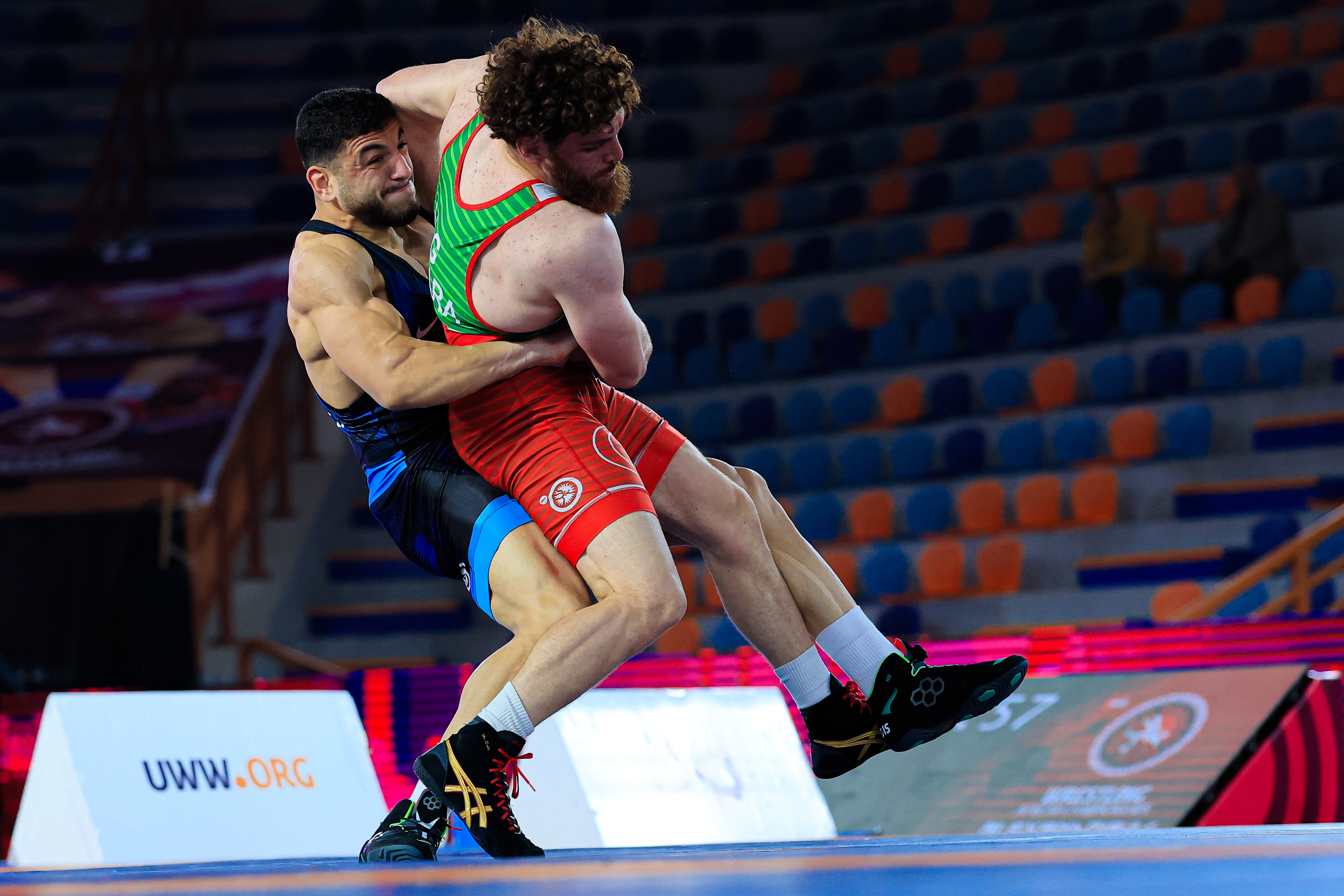 Mohamed DYAB (EGY), red, throws Bachir SID AZARA (ALG) during the 87kg final. (Photo: United World Wrestling / Kostadin Andonov)
At 87kg, six-time African champion Bachir SID AZARA (ALG) was handed a 7-1 loss by Mohamed DYAB (EGY) in the final. Dyab showed early signs of causing the upset when he defeated Sid Azara in the Nelson bracket 8-0.
Though Sid Azara managed to close the gap, he failed to stop Dyab from claiming the gold medal. Dyab got the par terre position in first period and as he was trying to score, Sid Azara committed a defensive leg-foul and was docked two points. As Dyab restarted in par terre, he used two turns to lead 7-0.
Sid Azara got par terre in the second period but he failed to score any points despite using a seatbelt technique. Dyab defended his six-point lead to win the gold medal for Egypt.
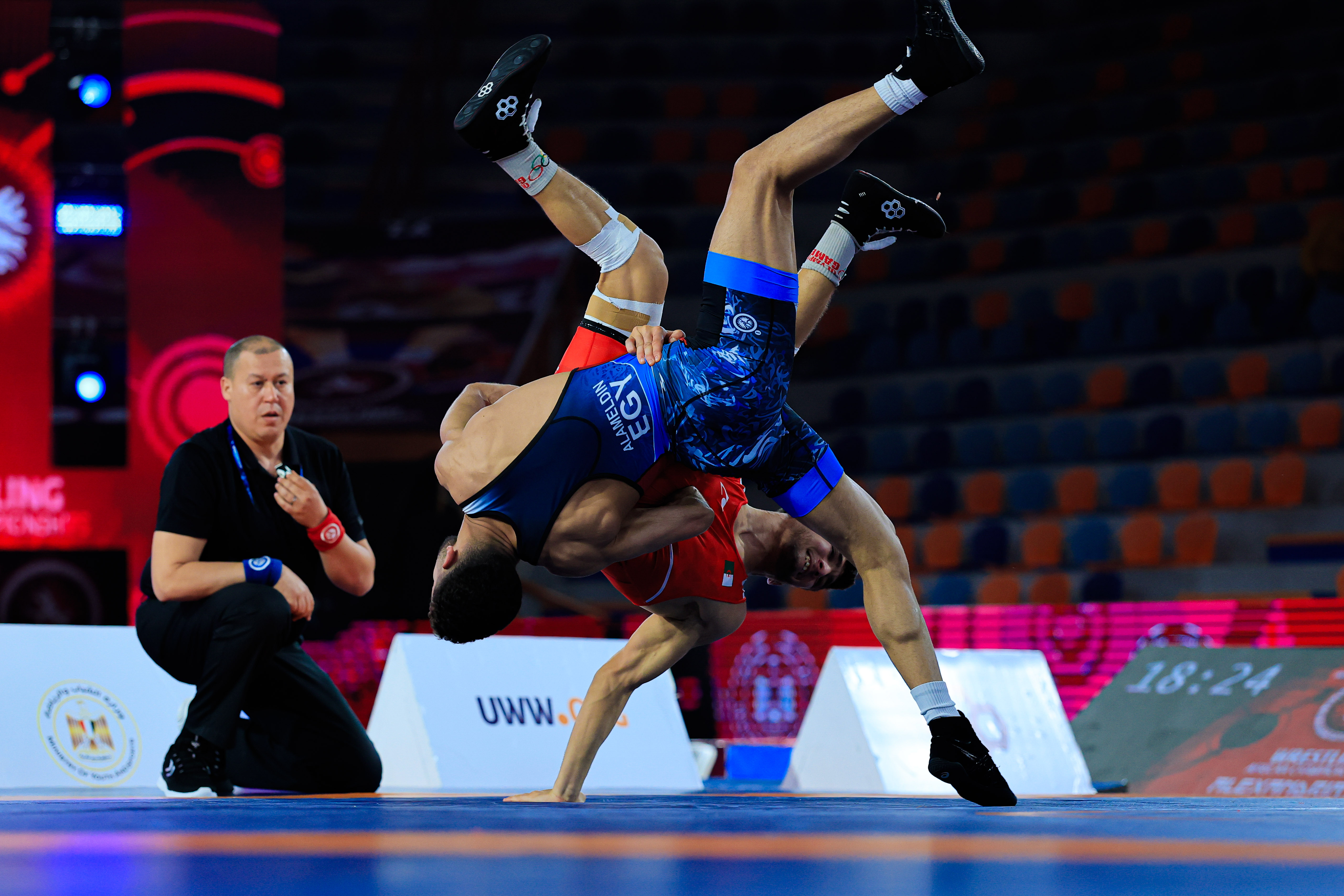 Moustafa ALAMELDIN (EGY) throws Abdelmalek MERABET (ALG) during the 72kg final. (Photo: United World Wrestling / Kostadin Andonov)
Former U20 world champion Moustafa ALAMELDIN (EGY) also defeated Abdelmalek MERABET (ALG) two times to claim the gold medal at 72kg. He defeated Merabet 8-0 in the morning and as the two reached the final, Alameldin once again won via technical superiority, 10-2.
Merabet led 2-2 on criteria but Alameldin dragged him for takedown to lead 4-2, before extending it to 8-2 using a four-pointer. Merabet tried a few moves in the second period to cut the lead but Alameldin held firm and scored the match-winning takedown.
This is the second gold medal of the season for Alameldin as he began the year with a gold medal at the Zagreb Open Ranking Series in February.
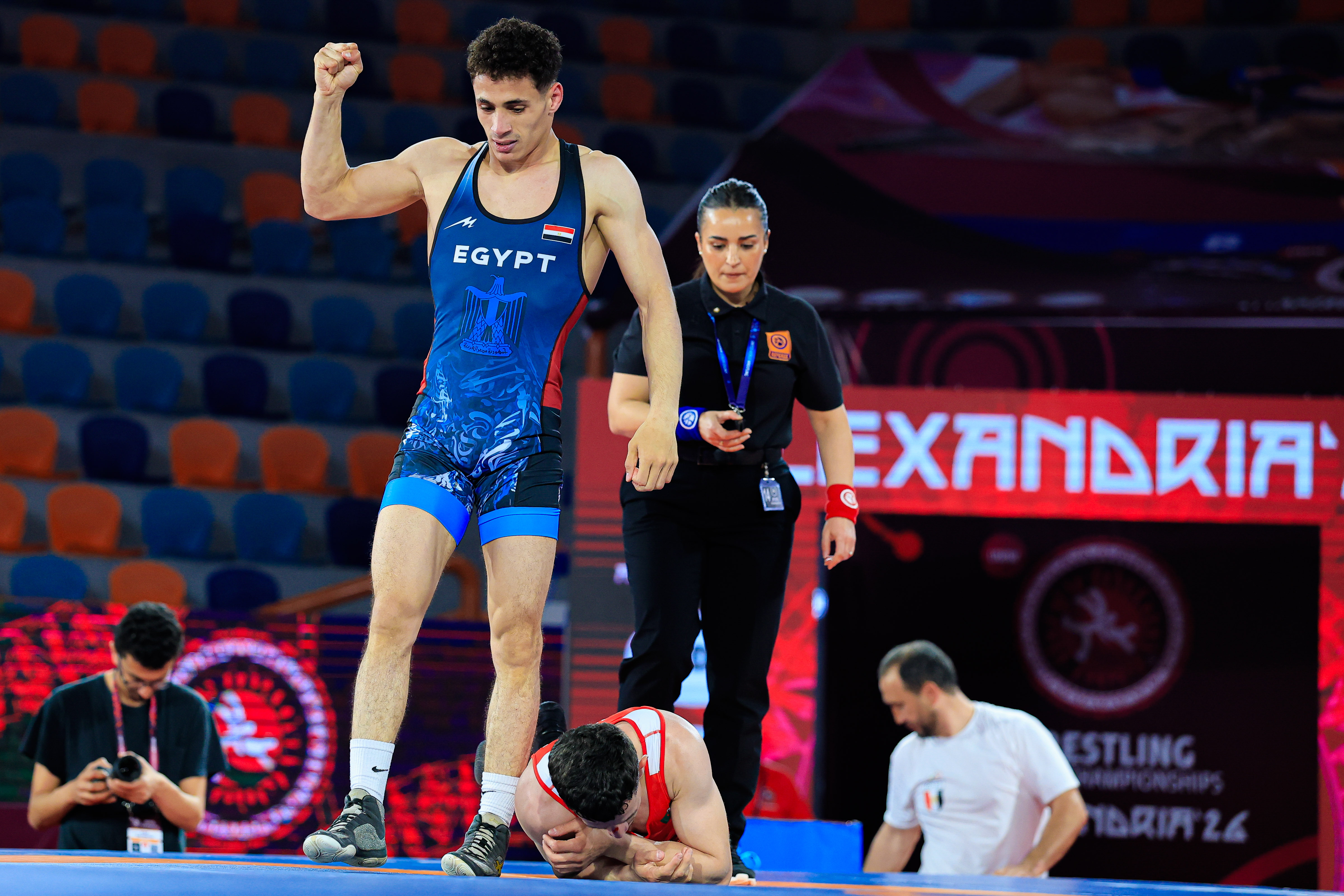 Mahmoud SAAD (EGY) celebrates after beating Abdelkarim FERGAT (ALG), 9-1, at 60kg. (Photo: United World Wrestling / Kostadin Andonov)
Egypt's three other gold medals came at 60kg, 77kg, and 82kg. Mahmoud SAAD (EGY) began his day with a fall in Round 1 before beating Abdelkarim FERGAT (ALG), 9-1, scoring all his points from par terre in the second period.
Once Fergat was beaten, Saad had no trouble in defeating Latuf MADI (COM), 9-0, in 1:55 and Virinao NGUATJITI (NAM), 8-0, in 4:05 in the next rounds.
At 77kg, Mohamed KHALIL (EGY) turned Chawki DOULACHE (ALG) from par terre while defending his own position to craft a 3-1 victory over the Algerian and claim his fourth-ever African title.
There was little to differentiate between Emad ABOUELATTA (EGY) and Haithem ISSAAD (ALG) at 82kg as both dominated their other two matches. But when the two clashed, Abouelatta scored four more points than Issaad to win the Round 1 bout 7-3.
As Abouelatta won all three of his bouts, he won gold while Issaad finished with a silver medal.
While Egypt ruled, the evening began with Algeria winning gold through Badr MAHDAOUI (ALG) at 55kg. He defeated Ahmed ALY (EGY), 15-6, a technical superiority in the final. The 18-year-old thus became a senior African champion.
Three-time African champion Abdeldjebar DJEBBARI (ALG) returned to the tournament after three years and defeated Omar IBRAHIM (EGY), 5-2, in the 63kg final to win gold, his fourth.
The big shock came at 97kg as defending champion and Olympian Mohamed GABR (EGY) failed to defend his title. Former U17 and U20 African champion Fadi ROUABAH (ALG) stopped Gabr in Round 2 with a 2-1 victory.

RESULTS
55kg
GOLD: Badr MAHDAOUI (ALG) df. Ahmed ALY (EGY), 15-6
BRONZE: Bofenda KALUWEKO (ANG) df. Dunia SIBOMANA (COD), via forfeit
60kg
GOLD: Mahmoud SAAD (EGY)
SILVER: Abdelkarim FERGAT (ALG)
BRONZE: Latuf MADI (COM)
63kg
GOLD: Abdeldjebar DJEBBARI (ALG) df. Omar IBRAHIM (EGY), 5-2
BRONZE: Lazarus HAIMBODI (NAM) df. Solomon ADDICO (GHA), via forfeit
67kg
GOLD: Mohamed ABDELREHIM (EGY)
SILVER: Fayssal BENFREDJ (ALG)
BRONZE: Miguel ANTONIO (ANG)
72kg
GOLD: Moustafa ALAMELDIN (EGY) df. Abdelmalek MERABET (ALG), 10-2
BRONZE: Radhwen TARHOUNI (TUN) df. Yamine ATCHIBA (BEN), 8-3
77kg
GOLD: Mohamed KHALIL (EGY) df. Chawki DOULACHE (ALG), 3-1
BRONZE: Sami SLAMA (TUN) df. Yassine CHEKLY (MAR), 8-6
82kg
GOLD: Emad ABOUELATTA (EGY)
SILVER: Haithem ISSAAD (ALG)
BRONZE: Belhasan AZAOUZI (TUN)
87kg
GOLD: Mohamed DYAB (EGY) df. Bachir SID AZARA (ALG), 7-1
BRONZE: Lamjed MAAFI (TUN) df. Persy BAMONA (COD), 8-0
97kg
GOLD: Fadi ROUABAH (ALG)
SILVER: Mohamed GABR (EGY)
BRONZE: Hamza BOUMADIENE (MAR)
130kg
GOLD: Abdellatif MOHAMED (EGY)
SILVER: Wissam KOUAINSO (MAR)



 Participants of the 'Learn, Wrestle, Use' camp work on technique with the Croatian coastline in the background. (Photo: United World Wrestling)
Share your thoughts.
Comments