

#WrestleTokyo

China Grabs 2 of 3 Golds at Tokyo 2020 Test Event

By Ken Marantz

CHIBA, Japan (Oct.4) --- A pair of Chinese world medalists came away with two of the three golds on the second day of the Tokyo 2020 Olympics test event as organizers continued to work out the operational kinks at the Makuhari Messe venue.

WANG Xiaoqian (CHN) held on for a 2-1 victory over teenager Naruha MATSUYUKI (JPN) to take the 68kg title, while China was destined to win the 76kg gold, which went to Paliha PALIHA (CHN) when compatriot ZHOU Qian (CHN) defaulted the final. 

Rui SAKANO (JPN) took the other gold at stake on the second day of the three-day tournament by edging Atena KODAMA (JPN) 2-1 at 62kg, avenging a loss to her compatriot at last year’s All-Japan Championships.

The women’s tournament in the six Olympic weight classes is part of the “Ready Steady Tokyo” series of test events for all sports on the Tokyo 2020. Wrestling is one of four sports that will be held at Makuhari Messe, an international convention center located on the Tokyo Bay coast in neighboring Chiba city.

The event, which had drawn a limited number of entries coming so close to the World Championships in Kazakhstan, was open to the media for the first and only time on Friday. No spectators, other than invited guests, have been allowed, and the only sounds outside of the mat echoing in the cavernous hall are shouts from coaches and teammates.

In line with the first day of finals, medal ceremonies were held for the three weight classes on one of the three mats. The medalists stepped up to a single-level medal stand placed on a red carpet and bearing the “Ready Steady Tokyo” logo. Volunteers brought out the medals on cafeteria trays, and a wrestling dignitary placed them around the winners’ necks. No national anthems were played. 
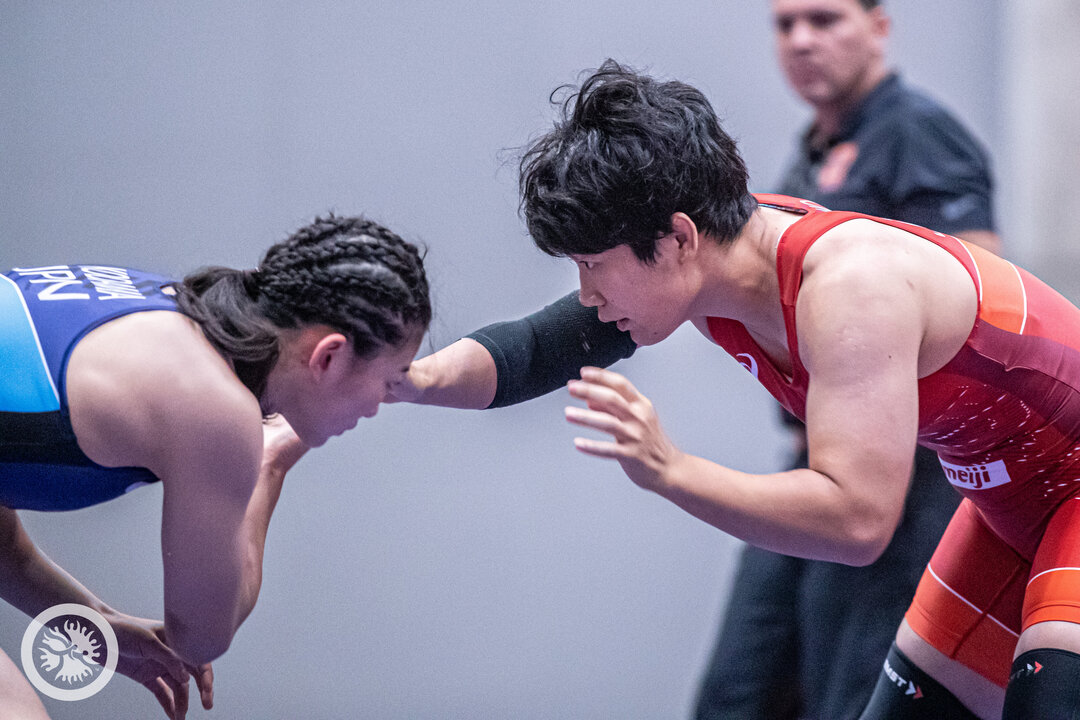
Rui SAKANO (JPN) edged Atena KODAMA (JPN), 2-1, in the 62kg finals. (Photo: Sachiko Hotaka)

Sakano, a 2017 world U23 champion, became the first gold recipient after her victory over 2018 world junior champion Kodama, in which she scored both of her points with Kodama on the activity clock. Kodama earned a point for fleeing in the final seconds.

“It’s possible I’ll face her again in a national competition this year,” said Sakano, who defeated world 59kg bronze medalist PEI Xingru (CHN) in the semifinals on Thursday. “I’m just trying to put out on the mat what I work on practice.”

With world bronze medalist Yukako KAWAI (JPN) having clinched a spot at Tokyo 2020 and almost surely planning to skip the Emperor’s Cup All-Japan Championships in December, Sakano knows the door is open to reach her most immediate goal.

“I still haven’t become the national champion at 62kg,” said Sakano, who also won a gold at the Rio 2016 test event. “What I most regret [in the final] is that I wasn’t aggressive. I’ll work on fixing that heading toward the Bill Farrell [Memorial International] in New York and the Emperor’s Cup in December, and hopefully that will bring me a national title.” 

The bronze medals went to LUO Xiaojuan (CHN), who received a victory by default over Pei, and European U23 champion Ilona PROKOPEVNIUK (UKR), who stormed to a 10-0 technical fall over Anna SHCHERBAKOVA (RUS).

Wang, a bronze medalist in Nur-Sultan at 65kg, had eased into the 68kg final with victories by technical fall and fall, but was hampered by the onset of stomach cramps against world junior champion Matsuyuki and had to make a first-period takedown stand up for a 2-1 win.

“I was thinking to attack more and get more points,” Wang said. “But because of [my condition] I couldn’t really do that.”

Wang said she felt fine about competing so soon after the World Championships. 

“There’s no problem because it was so close, because I am ready for all competitions,” she said. 

Taking home the bronzes were Alina RUDNYTSKA (UKR), who rode a 4-point first-period cradle to a 4-3 win over Alexandra GLAUDE (USA), and Rin MIYAJI (JPN), who rallied to defeat Alena STARODUBTSEVA (RUS), 9-6

While there was no match to decide the gold at 76kg, one bronze-medal playoff was an intriguing match-up of generations.
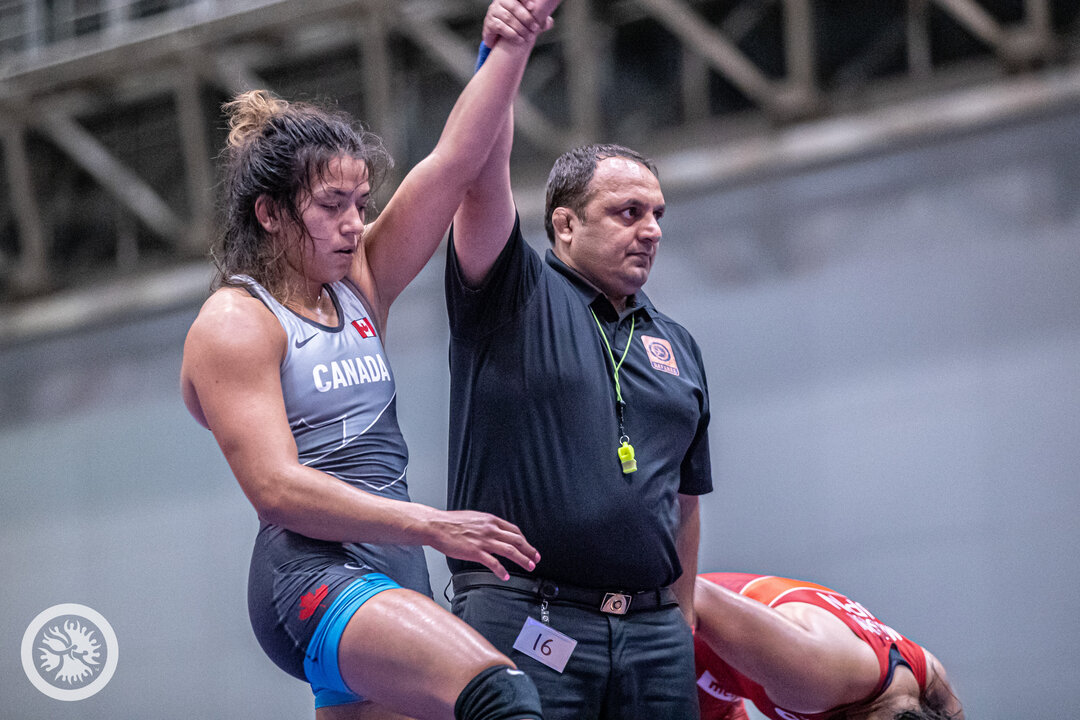
Justina DI STASIO (CAN), a 2018 world champion, defeated Yasuha MATSUYUKI (JPN) in one of the 76kg bronze-medal matches. (Photo: Sachiko Hotaka)

Justina DI STASIO (CAN), the 2018 world champion at 72kg, had her hands full with teenager and world junior bronze medalist Yasuha MATSUYUKI (JPN) before coming away with a 3-0 win.

Di Stasio gained a first-period point with Matsuyuki---Naruha’s twin sister---on the activity clock, then scored a single-leg takedown in the second.

“I didn’t know she was so young and then the match starts and you hear, ‘a 26-year-old versus a 19-year-old’ and I was like, ‘Man, I hope I do good against the 19-year-old,’” Di Stasio said. “She’s long, super long, so it was like trying to stay patient and not take bad, bad shots--which I did once--but I came out of it.”

Di Stasio, who gave up a last-second takedown to lose 2-2 to Zhou in the semifinals, had missed out on a place at the World Championships to Rio 2016 Olympic champion Erica WIEBE (CAN). 

With two months to prepare to challenge Wiebe for the Tokyo 2020 spot at the Canadian trials in December, she sees making the trip to compete at the Olympic venue as invaluable. 

“It just makes it so real,” Di Stasio said. “You come here and you see it all and you’re competing in the place [for the Olympics]. It was pretty real before I came here, but to be here and know what it’s like. You can very much visualize what you’re training for.

“It is a long trip, and it’s a quick trip. But it was important. I didn’t go the World Championships….Watching all that stuff was a lot of emotions, too. Just trying to focus through stuff, which is something I don’t get at practice all the time. The tournament environment is totally different so it was completely worth coming out here.”

Winning the other 76kg bronze was Romana VOVCHAK (UKR), who defeated Mizuki NAGASHIMA (JPN) by fall in 3:19.

In the morning session, the qualification rounds (actually mainly quarterfinals as all weight classes have only eight or nine entries) were held for the remaining three divisions, which were more notable for who did not wrestle than who did. 

Two world medalists in Olympic weight classes in Nur-Sultan, RONG Ningning (CHN) and PANG Qianyu (CHN), as well former Olympic medalist SUN Yanan (CHN), all were entered in the tournament, but without the intention of actually taking part. As such, their opponents were awarded victories by default. 

“They were very tired and had some injuries,” said a team spokesperson. “We didn’t suppose they would participate.”  

Venue manager Yasukazu Fujimori was sympathetic of the Chinese wrestlers.

“This is a test event, it’s not a championship, it’s not a ranking event,” Fujimori said. “The Chinese athletes who were at the World Championships in Kazakhstan have fatigue, and this tournament doesn’t really mean anything, so I understand their feelings about canceling.” 

Still, there were enough good matches to go around, resulting in two Japan-China finals and one all-Japan clash to be held on the final day Saturday.
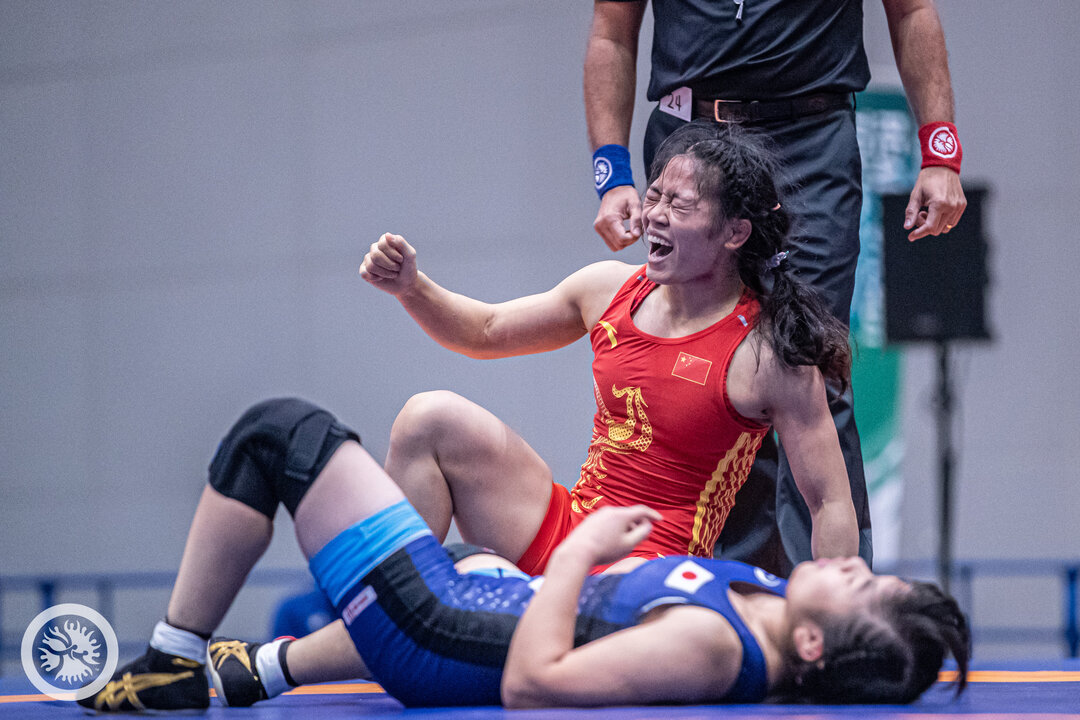
LEI Chun (CHN) secured her spot in the 50kg finals with a pair of technical superiority wins. She'll wrestle Miu SHIMIZU (JPN) in the gold-medal bout. (Photo: Sachiko Hotaka)

At 50kg, 2018 Asian champion LEI Chun (CHN) advanced to the gold-medal match with a pair of technical falls, beating Daria LEKSINA (RUS) 13-2 and Remina YOSHIMOTO (JPN) 14-4, the latter by scoring a takedown and six consecutive ankle-lock rolls. 

Lei will face Miu SHIMIZU (JPN), who won by fall over world junior bronze medalist Mariia VYNNYK (UKR) and 12-2 technical fall over Chihiro SAWADA (JPN). Sawada had received the default from Sun.

The 53kg final will pit LUO Lannuan (CHN) against Umi IMAI (JPN). Luo, a 2018 Asian bronze medalist, won by default over Pang, then ousted 2018 world U23 and junior champion Saki IGARASHI (JPN) 7-1. Imai, a 2018 world junior champion, topped Katherine SHAI (USA) 10-2 before edging Ibuki TAMURA (JPN) 5-4.

Compatriots Sena NAGAMOTO (JPN) and Yumeka TANABE (JPN) will duel for the 57kg title. Nagamoto, recipient of the default from Rong, knocked off Asian 59kg bronze medalist ZHANG Qi (CHN) 2-0 in the semifinals. Tanabe chalked up victories over Khadizhat MURTUZALIEVA (RUS) and 2018 world junior champion Hanako SAWA (JPN). 

Day 2 results

Women’s Wrestling
50kg (8 entries)
Semifinal – LEI Chun (CHN) df. Remina YOSHIMOTO (JPN) by TF, 14-4, 4:16
Semifinal – Miu SHIMIZU (JPN) df. Chihiro SAWADA (JPN) by TF, 12-2, 5:24 

53kg (9 entries)
Semifinal – LUO Lannuan (CHN) df. Saki IGARASHI (JPN), 7-1
Semifinal – Umi IMAI (JPN) df. Ibuki TAMURA (JPN), 5-4 

57kg (8 entries)
Semifinal – Sena NAGAMOTO (JPN) df. ZHANG Qi (China), 2-0
Semifinal – Yumeka TANABE (JPN) df. Hanako SAWA (JPN) by TF, 14-4, 5:36 

62kg (8 entries)
Gold – Yui SAKANO (JPN) df. Atena KODAMA (JPN), 2-1
Bronze – LUO Xiaojuan (CHN) df. PEI Xingru (CHN) by Def.
Bronze – Ilona PROKOPEVNIUK (UKR) df. Anna SHCHERBAKOVA (RUS) by TF, 10-0, 4:04 

68kg (8 entries)
Gold – WANG Xiaoqian (CHN) df. Naruha MATSUYUKI (JPN), 2-1 
Bronze – Alina RUDNYTSKA (UKR) df. Alexandra GLAUDE (USA), 4-3
Bronze –Rin MIYAJI (JPN) df. Alena STARODUBTSEVA (RUS), 9-6

76kg (9 entries)
Gold – Paliha PALIHA (CHN) df. ZHOU Qian (CHN) by Def.
Bronze – Romana VOVCHAK (UKR) df. Mizuki NAGASHIMA (JPN) by Fall, 3:19 (3-0)
Bronze – Justina DI STASIO (CAN) df. Yasuha MATSUYUKI (JPN), 3-0

#JapanWrestling

Kinjo earns shot at 4th world title, but it won't be part of sister act

By Ken Marantz

TOKYO, Japan (May 26) -- It may not be Paris, but given what it took for Risako KINJO to get there, the Albanian capital of Tirana will do just fine.

Already denied a chance at winning a third Olympic gold medal, Kinjo created her own chance for some consolation by earning a shot at a fourth career world title by qualifying for Japan's team to this fall's Non-Olympic Weight Class World Championships.

The only downside for Kinjo is that younger sister Yukako TSUNEMURA won't be accompanying her as a competitor, meaning there would be no repeat of their sibling double at the 2021 Tokyo Olympics where they won golds together under their maiden name of KAWAI.

Kinjo needed a dramatic, last-second victory in a playoff over 18-year-old Sakura ONISHI to secure a ticket at women's 59kg to the non-Olympic worlds to be held October 28-31 in Tirana.

jpnRisako KINJO celebrates her victory in the 59kg playoff over teenager Sakura ONISHI. (Takeo Yabuki / Japan Wrestling Federation)

That win avenged a loss earlier in the day to 2023 world U17 champion Onishi during the Meiji Cup All-Japan Championships -- the second of two domestic qualifiers for Tirana held May 23-26 in Tokyo -- to set up the playoff.

"My desire to go to the World Championships was so strong," Kinjo said. "If I didn't do it, I would be regretting it for the next year. It was a desperate situation."

Tsunemura, whose marriage on New Year's Day got off to an ominous start when a devastating earthquake struck her home prefecture hours later, saw her bid at 65kg end with a quarterfinal loss to Miwa MORIKAWA, who went on to win the title and a playoff to get the chance to regain the world gold she won in 2022.

Japan will also have strong representation in the two other women's weight classes, with newly crowned Asian champion Moe KIYOOKA at 55kg and 2022 world 68kg silver medalist Ami ISHII at 72kg -- teammates at Ikuei University -- also making it through the playoff route.

The former Kawai sisters have been through hard times since their dual triumph in Tokyo, where Risako captured the 57kg gold and Yukako triumphed at 62kg.

Both took time off after the Olympics, with Risako getting married, then giving birth to a daughter in May 2022. By the time both returned to the mat, formidable newcomers had emerged in the race to the Paris Olympics.

Both fell in the qualifying process -- Kinjo to world 57kg champion Tsugumi SAKURAI and Tsunemura to world 62kg bronze medalist Sakura MOTOKI (notably also Ikuei wrestlers). Tsunemura also made a long-shot attempt at 68kg, but came up short there as well.

"After the Tokyo Olympics, I couldn't win for awhile," Kinjo said. "It made me realize just what a big deal it is to win at the Olympics."

After giving birth, Kinjo returned to the mat in late 2022 at 59kg in preparation for a run to Paris at 57kg. She won the title at the Emperor's Cup All-Japan Championships that year, but her bid for Paris ended at the 2023 Meiji Cup. She also lost a playoff at 59kg for the 2023 World Championships.

In December last year, Kinjo retained her 59kg title at the Emperor's Cup, which earned her a ticket to the Asian Championships last April in Bishkek. She would take home a bronze after being dealt a tough 1-1 loss by world champion Qi ZHANG (CHN) in a quarterfinal limited to activity points.

As Emperor's Cup champion, Kinjo would have automatically clinched a place on the team to the non-Olympic worlds with a victory at the Meiji Cup. But Kinjo was dealt an 8-4 loss in the semifinals by Onishi, in which she gave up a 4-point front body lock throw. When Onishi won the title, it set up a rematch in the playoff.

Kinjo was emboldened by recalling the grueling qualifying process that she went through to get to the Tokyo Olympics when she had to endure classic battles with four-time Olympic champion Kaori ICHO to earn the spot.

"Before the playoff, I thought, 'The qualifying for the Tokyo Olympics was a hundred times tougher. To have gone through that, nothing seems difficult."

jpn2Risako KINJO fights off a takedown attempt by Sakura ONISHI in the 59kg playoff. (Takeo Yabuki / Japan Wrestling Federation)

Onishi, currently a freshman at Nippon Sports Science University where Icho is among her coaches, made it as hard as she could, jumping out to a 5-0 lead in the first period with a pair of takedowns, the second off a nice ankle pick, and a penalty point for an illegal knee hold.

Onishi added a stepout to start the second period before Kinjo finally made her presence known, going behind for a takedown and adding a 2-point exposure to cut the lead to 6-4. From there, experience kicked in for the 29-year-old who captured back-to-back golds at the 2016 Rio and 2021 Tokyo Olympics.

"With a minute left, I thought that even if I was the aggressor, it would be to my disadvantage against an opponent who is a student and very lively," Kinjo said. "When 30 seconds, 20 seconds left, I put it all on the line for going to the World Championships."

With :15 on the clock, Kinjo got in on a single and managed to lift up the leg and expose Onishi's back with 8 seconds left, putting her ahead 6-6 on criteria. But Onishi squirmed back to her feet and with a mighty charge, went for a double-leg takedown that forced Kinjo out just as time expired. The referee gave her 1 for a stepout, but after an agonizing wait for the challenge review, it was nullified as Kinjo's foot was just centimeters from the edge when the clock hit all zeroes.

"I didn't have a strategy," Kinjo said. "Having wrestled for over 20 years, at my age, more than what move should I use, or how should I attack, the most important thing is being mentally ready."

jpn3Miwa MORIKAWA, right, keeps the pressure on Yukako TSUNEMURA in the 65kg playoff. (Takeo Yabuki / Japan Wrestling Federation)

Two days earlier, her sister pulled off a similar miracle to start her bid at 65kg, but couldn't make the magic last.

Tsunemura avenged a loss at the Emperor's Cup to Miyu YOSHIKAWA when, like Kinjo, she scored an exposure off a single leg in the final seconds for a 5-4 victory, after having given up a go-ahead takedown with :45 remaining.

But Tsumemura said she heard her knee pop in the match, and the subsequent pain hampered her in a 5-1 quarterfinal loss to Morikawa, who scored three stepouts in the first period and stopped a late front headlock roll attempt for a 2-point exposure. Morikawa went on to win the title, then defeated Emperor's Cup and Asian champion Mahiro YOSHITAKE 8-0 in the world playoff.

"Of course I wanted to go the World Championships, but this tournament was more about erasing the disappointing memories from the last year," Tsunemura said.

New Year of celebration, calamity

Like families throughout Japan, the Kawai clan had gathered for the New Year's holidays at the family home in Kanazawa, Ishikawa Prefecture, on the snowy northern coast of Japan.

On January 1, Yukako and mixed martial arts fighter Toshinori TSUNEMURA went to the municipal office in the nearby city of Tsubata and registered their marriage.

Four hours later, the ground began to shake violently.

The major earthquake that measured 7 on the Japanese intensity scale left over 200 dead and caused massive damage to homes, buildings and infrastructure, exacerbated by a tsunami and fires. Even now, thousands remain in temporary shelters.

"I'm not going to be so flippant as to say to people, 'I'm fighting hard, so please keep fighting,'" Kinjo said. "Their hardship is completely different. Many homes were destroyed and they can't go back. Someone near us had just finished construction of their house and it was damaged.

"But if [my winning] can give them some good news and it warms their hearts even a little, that would be good."

Tsunemura also was hoping to boost the spirits of her hometown.

"The big earthquake hit in January, but there are many people who suffered much more than me," she said. "Even if I lose, I think there are people who are heartened by seeing me give my best."

The sisters, who both went to then-powerhouse Shigakkan University in central Japan, currently reside in Tokyo. They train at Nihon University, where they are taking online graduate school classes.

Tsunemura said that in her studies of sports psychology, she uses her own notes on her mindset that she kept up to and during the Tokyo Olympics. She also said the program is giving her a broader outlook on life.

"Of course, I credit Shigakkan for making me strong in wrestling," she said. "But the daily schedule at Nihon University allows me to grow as a person. It has widened my view of the world.

"Wrestling is only something you can do when you're young, and the day is going to come when you call it quits. Your life after retirement will be longer. With that in mind, it makes me think that little by little I have to start looking ahead."

For now, the question of when -- or if  -- she will return to competition remains unanswered.

"I don't know when I will enter a tournament," Tsunemura said. "After the Olympics, I had come to despise wrestling, but I really like it. I don't intend to stop any time soon. I will let the injury heal and get back to practice, and if I want to compete again, I'll do it. I don't know whether I will have a match again, but I still like wrestling."

Kinjo, of course, has her dance card filled for October, when she will attempt to win her first world title since winning three straight from 2017 to 2019. (She also has a silver from 2015.)

Her appearance at the Asian Championships in April marked her first international match since the Tokyo Olympics, and as fate would have it, she was paired with China's Zhang right off the bat. The closeness of the loss reassured her that she could still be competitive.

"In the first round, I met the world champion from last year," Kinjo said. "Even though I lost, it was my first international tournament in three years since the Olympics, and it may be rude to say it, but I think it went better than expected. It made me think that I can still do it."

In hindsight, the defeat may have been a blessing in disguise, which was reinforced by her mother Hatsue, a member of Japan's team at the 1989 World Championships.

"Truthfully, if I had won the Asian title, it would have been a good way to go out. But I lost. I talked it over with my mother, and she said, 'You're going to keep going, right?' I felt that way, too."

Japan Wrestling Federation President Hideaki TOMIYAMA, a gold medalist at the 1984 Los Angeles Olympics, surmises that while motherhood may be an added burden for Kinjo, it is indirectly keeping her in the sport.

"It's likely that she wants her child to be able to see her mother during her career," Tomiyama said. "The Olympics was before she was born. Probably she wants to give the child something to remember. She can see with her own eyes and remember 'Mama was strong.' I think that's what keeps her going."

From the federation's perspective, having a past Olympic champion remain active is always a positive thing.

"Of course, her [making the national team] draws the attention for wrestling from the mass media," Tomiyama said. "Wrestling doesn't usually make the news. Becoming a topic of conversation is important. We're really happy to see her fighting on, and it will help in the spread of wrestling."

jpn4Moe KIYOOKA, right, works for a takedown in the 55kg playoff against world champion Haruna MURAYAMA. (Takeo Yabuki / Japan Wrestling Federation)

Kiyooka inspired by Paris-bound brother

Like Kinjo, Kiyooka went into the tournament as the Emperor's Cup champion, only to lose her opening match -- also to a high schooler -- and have her fate decided in a playoff. One big difference was the level of her opponent.

Having bounced back from an 11-9 loss to 17-year-old Sowaka UCHIDA, Kiyooka proceeded to defeat reigning world champion Haruna MURAYAMA (nee OKUNO) 3-2 in the playoff, thanks to a second-period takedown.

Kiyooka's win over Murayama was a repeat of the Emperor's Cup final in December and allowed her to join Ikuei teammate Ishii on the plane to Tirana.

In Albania, Kiyooka will get a chance to join the small group of wrestlers who have won world titles on all four age levels. She won the U17 gold in 2019, and then captured both the U20 and U23 titles in 2022.

Kiyooka, a winner at the Zagreb Open in 2023, made her major senior debut at the Asian Championships, where her gold-medal performance came a week before brother Kotaro won the Asian Olympic qualifier at freestyle 65kg at the same venue in Bishkek.

"Recently, my brother's accomplishments have been a source of inspiration for me," Kiyooka said. "I believe that if I keep fighting to the end, I know I can definitely win."

Ishii was coming off a heartbreaking, last-second playoff loss in January to Nonoka OZAKI for the 68kg spot in Paris -- which she herself had won for Japan by placing fifth at the 2023 World Championships.

Ishii swept to the Meiji Cup gold at 72kg with a 10-0 victory in the final over former world champion Masako FURUICHI. That gave her the ticket to Tirana as there was no playoff because Emperor's Cup champion Ayano MORO did not enter.

jon4High schooler Taizo YOSHIDA, top, tries to turn Yuji OKAJIMA in the Greco 82kg final of the Meiji Cup. (Takeo Yabuki / Japan Wrestling Federation)

Most noteworthy in the men's styles was the victory at Greco 82kg by 18-year-old Taizo YOSHIDA, who followed up his historic gold-medal run at the Asian Championships by becoming just the third male high school champion in Meiji Cup history.

One year removed from winning the world U17 gold, Yoshida defeated three-time former champion Yuji OKAJIMA 8-0 in the final, then earned the place at the non-Olympic worlds when Hayato TAKAOKA -- who beat Yoshida in the Emperor's Cup final -- defaulted the playoff.

Yoshida will be 18 years and 10 months old when the non-Olympic worlds starts, making it possible for him to eclipse Tokyo Olympic gold medalist Takuto OTOGURO as Japan's youngest-ever male world champion. Otoguro was 19 years and 10 months old when he won the freestyle 65kg gold in 2018.

"At the World Championships, I will give everything I have and aim for a medal," said Yoshida, who will precede that by also appearing at the world U20 in September. "I will be a senior in college at the time of the Los Angeles Olympics. I feel like the fight has just begun."

Three Asian medalists in freestyle also made the cut -- Masanosuke ONO, a bronze medalist at 65kg, earned the spot at 61kg; Yoshinosuke AOYAGI will go at 70kg, where he was the silver medalist in Bishkek; and 74kg champion Kota TAKAHASHI will aim to strike gold at 79kg.

Takahashi will be heading to Tirana early, as he will also compete at 74kg at the world U23 to be held there the previous week.