

#WrestleTokyo

China Grabs 2 of 3 Golds at Tokyo 2020 Test Event

By Ken Marantz

CHIBA, Japan (Oct.4) --- A pair of Chinese world medalists came away with two of the three golds on the second day of the Tokyo 2020 Olympics test event as organizers continued to work out the operational kinks at the Makuhari Messe venue.

WANG Xiaoqian (CHN) held on for a 2-1 victory over teenager Naruha MATSUYUKI (JPN) to take the 68kg title, while China was destined to win the 76kg gold, which went to Paliha PALIHA (CHN) when compatriot ZHOU Qian (CHN) defaulted the final. 

Rui SAKANO (JPN) took the other gold at stake on the second day of the three-day tournament by edging Atena KODAMA (JPN) 2-1 at 62kg, avenging a loss to her compatriot at last year’s All-Japan Championships.

The women’s tournament in the six Olympic weight classes is part of the “Ready Steady Tokyo” series of test events for all sports on the Tokyo 2020. Wrestling is one of four sports that will be held at Makuhari Messe, an international convention center located on the Tokyo Bay coast in neighboring Chiba city.

The event, which had drawn a limited number of entries coming so close to the World Championships in Kazakhstan, was open to the media for the first and only time on Friday. No spectators, other than invited guests, have been allowed, and the only sounds outside of the mat echoing in the cavernous hall are shouts from coaches and teammates.

In line with the first day of finals, medal ceremonies were held for the three weight classes on one of the three mats. The medalists stepped up to a single-level medal stand placed on a red carpet and bearing the “Ready Steady Tokyo” logo. Volunteers brought out the medals on cafeteria trays, and a wrestling dignitary placed them around the winners’ necks. No national anthems were played. 
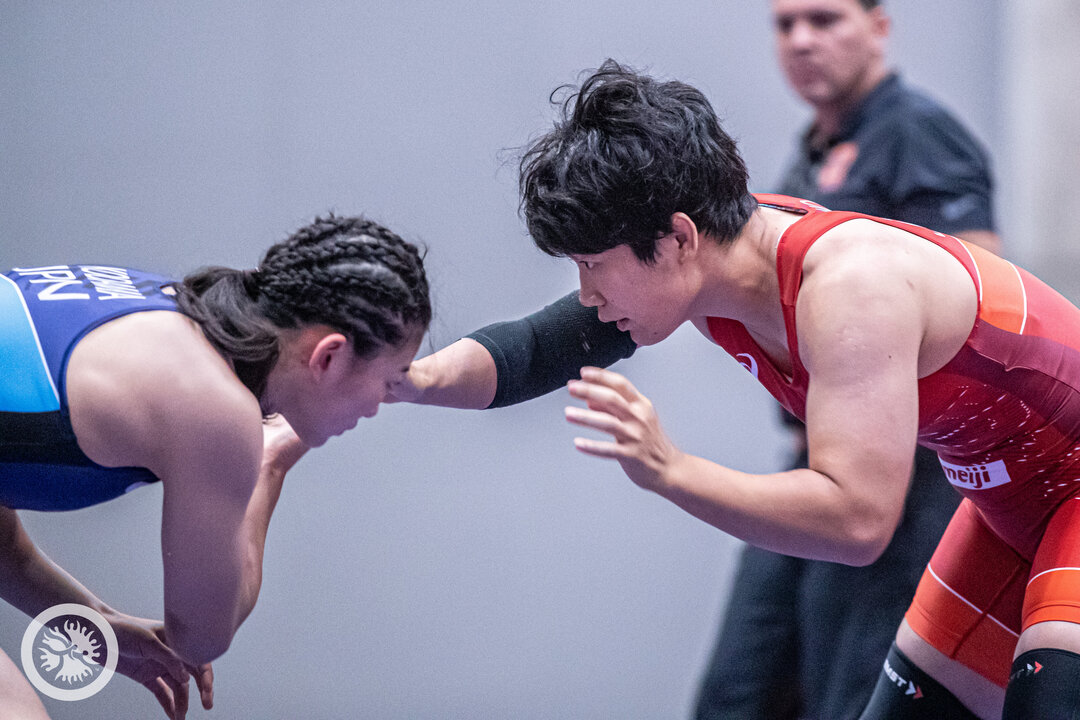
Rui SAKANO (JPN) edged Atena KODAMA (JPN), 2-1, in the 62kg finals. (Photo: Sachiko Hotaka)

Sakano, a 2017 world U23 champion, became the first gold recipient after her victory over 2018 world junior champion Kodama, in which she scored both of her points with Kodama on the activity clock. Kodama earned a point for fleeing in the final seconds.

“It’s possible I’ll face her again in a national competition this year,” said Sakano, who defeated world 59kg bronze medalist PEI Xingru (CHN) in the semifinals on Thursday. “I’m just trying to put out on the mat what I work on practice.”

With world bronze medalist Yukako KAWAI (JPN) having clinched a spot at Tokyo 2020 and almost surely planning to skip the Emperor’s Cup All-Japan Championships in December, Sakano knows the door is open to reach her most immediate goal.

“I still haven’t become the national champion at 62kg,” said Sakano, who also won a gold at the Rio 2016 test event. “What I most regret [in the final] is that I wasn’t aggressive. I’ll work on fixing that heading toward the Bill Farrell [Memorial International] in New York and the Emperor’s Cup in December, and hopefully that will bring me a national title.” 

The bronze medals went to LUO Xiaojuan (CHN), who received a victory by default over Pei, and European U23 champion Ilona PROKOPEVNIUK (UKR), who stormed to a 10-0 technical fall over Anna SHCHERBAKOVA (RUS).

Wang, a bronze medalist in Nur-Sultan at 65kg, had eased into the 68kg final with victories by technical fall and fall, but was hampered by the onset of stomach cramps against world junior champion Matsuyuki and had to make a first-period takedown stand up for a 2-1 win.

“I was thinking to attack more and get more points,” Wang said. “But because of [my condition] I couldn’t really do that.”

Wang said she felt fine about competing so soon after the World Championships. 

“There’s no problem because it was so close, because I am ready for all competitions,” she said. 

Taking home the bronzes were Alina RUDNYTSKA (UKR), who rode a 4-point first-period cradle to a 4-3 win over Alexandra GLAUDE (USA), and Rin MIYAJI (JPN), who rallied to defeat Alena STARODUBTSEVA (RUS), 9-6

While there was no match to decide the gold at 76kg, one bronze-medal playoff was an intriguing match-up of generations.
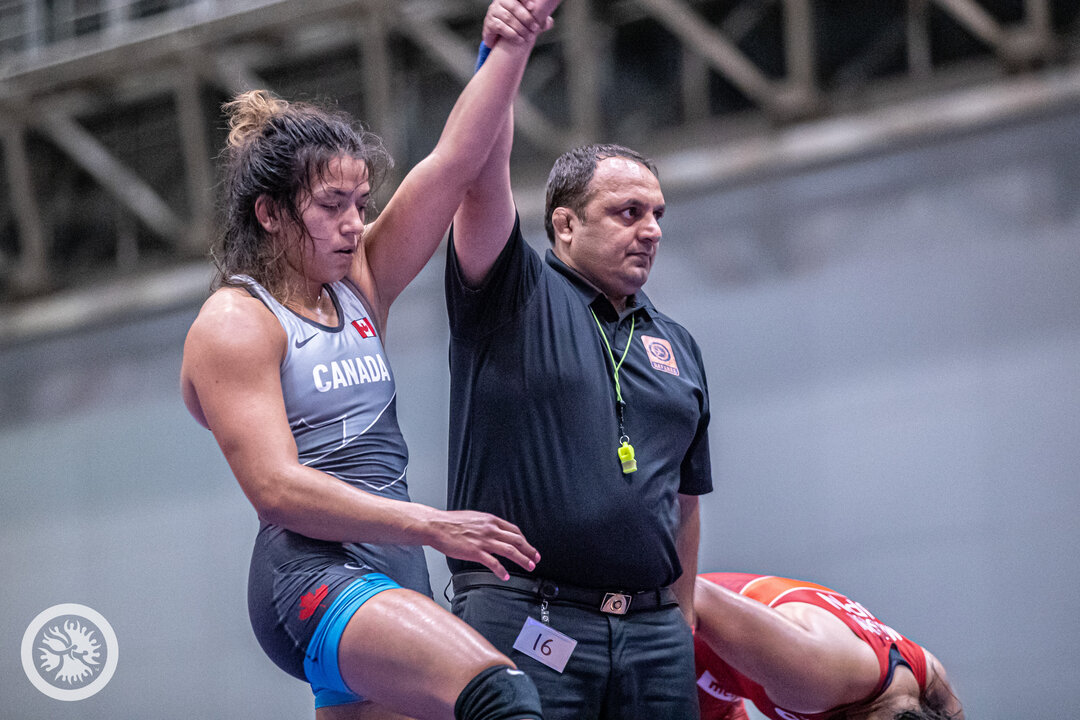
Justina DI STASIO (CAN), a 2018 world champion, defeated Yasuha MATSUYUKI (JPN) in one of the 76kg bronze-medal matches. (Photo: Sachiko Hotaka)

Justina DI STASIO (CAN), the 2018 world champion at 72kg, had her hands full with teenager and world junior bronze medalist Yasuha MATSUYUKI (JPN) before coming away with a 3-0 win.

Di Stasio gained a first-period point with Matsuyuki---Naruha’s twin sister---on the activity clock, then scored a single-leg takedown in the second.

“I didn’t know she was so young and then the match starts and you hear, ‘a 26-year-old versus a 19-year-old’ and I was like, ‘Man, I hope I do good against the 19-year-old,’” Di Stasio said. “She’s long, super long, so it was like trying to stay patient and not take bad, bad shots--which I did once--but I came out of it.”

Di Stasio, who gave up a last-second takedown to lose 2-2 to Zhou in the semifinals, had missed out on a place at the World Championships to Rio 2016 Olympic champion Erica WIEBE (CAN). 

With two months to prepare to challenge Wiebe for the Tokyo 2020 spot at the Canadian trials in December, she sees making the trip to compete at the Olympic venue as invaluable. 

“It just makes it so real,” Di Stasio said. “You come here and you see it all and you’re competing in the place [for the Olympics]. It was pretty real before I came here, but to be here and know what it’s like. You can very much visualize what you’re training for.

“It is a long trip, and it’s a quick trip. But it was important. I didn’t go the World Championships….Watching all that stuff was a lot of emotions, too. Just trying to focus through stuff, which is something I don’t get at practice all the time. The tournament environment is totally different so it was completely worth coming out here.”

Winning the other 76kg bronze was Romana VOVCHAK (UKR), who defeated Mizuki NAGASHIMA (JPN) by fall in 3:19.

In the morning session, the qualification rounds (actually mainly quarterfinals as all weight classes have only eight or nine entries) were held for the remaining three divisions, which were more notable for who did not wrestle than who did. 

Two world medalists in Olympic weight classes in Nur-Sultan, RONG Ningning (CHN) and PANG Qianyu (CHN), as well former Olympic medalist SUN Yanan (CHN), all were entered in the tournament, but without the intention of actually taking part. As such, their opponents were awarded victories by default. 

“They were very tired and had some injuries,” said a team spokesperson. “We didn’t suppose they would participate.”  

Venue manager Yasukazu Fujimori was sympathetic of the Chinese wrestlers.

“This is a test event, it’s not a championship, it’s not a ranking event,” Fujimori said. “The Chinese athletes who were at the World Championships in Kazakhstan have fatigue, and this tournament doesn’t really mean anything, so I understand their feelings about canceling.” 

Still, there were enough good matches to go around, resulting in two Japan-China finals and one all-Japan clash to be held on the final day Saturday.
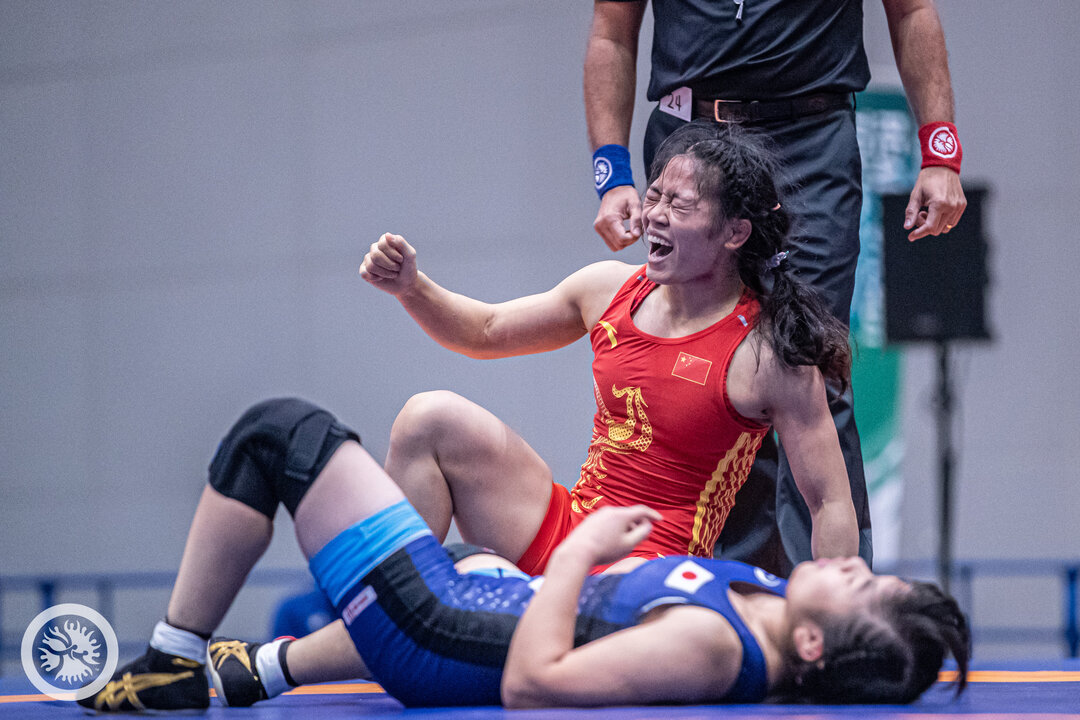
LEI Chun (CHN) secured her spot in the 50kg finals with a pair of technical superiority wins. She'll wrestle Miu SHIMIZU (JPN) in the gold-medal bout. (Photo: Sachiko Hotaka)

At 50kg, 2018 Asian champion LEI Chun (CHN) advanced to the gold-medal match with a pair of technical falls, beating Daria LEKSINA (RUS) 13-2 and Remina YOSHIMOTO (JPN) 14-4, the latter by scoring a takedown and six consecutive ankle-lock rolls. 

Lei will face Miu SHIMIZU (JPN), who won by fall over world junior bronze medalist Mariia VYNNYK (UKR) and 12-2 technical fall over Chihiro SAWADA (JPN). Sawada had received the default from Sun.

The 53kg final will pit LUO Lannuan (CHN) against Umi IMAI (JPN). Luo, a 2018 Asian bronze medalist, won by default over Pang, then ousted 2018 world U23 and junior champion Saki IGARASHI (JPN) 7-1. Imai, a 2018 world junior champion, topped Katherine SHAI (USA) 10-2 before edging Ibuki TAMURA (JPN) 5-4.

Compatriots Sena NAGAMOTO (JPN) and Yumeka TANABE (JPN) will duel for the 57kg title. Nagamoto, recipient of the default from Rong, knocked off Asian 59kg bronze medalist ZHANG Qi (CHN) 2-0 in the semifinals. Tanabe chalked up victories over Khadizhat MURTUZALIEVA (RUS) and 2018 world junior champion Hanako SAWA (JPN). 

Day 2 results

Women’s Wrestling
50kg (8 entries)
Semifinal – LEI Chun (CHN) df. Remina YOSHIMOTO (JPN) by TF, 14-4, 4:16
Semifinal – Miu SHIMIZU (JPN) df. Chihiro SAWADA (JPN) by TF, 12-2, 5:24 

53kg (9 entries)
Semifinal – LUO Lannuan (CHN) df. Saki IGARASHI (JPN), 7-1
Semifinal – Umi IMAI (JPN) df. Ibuki TAMURA (JPN), 5-4 

57kg (8 entries)
Semifinal – Sena NAGAMOTO (JPN) df. ZHANG Qi (China), 2-0
Semifinal – Yumeka TANABE (JPN) df. Hanako SAWA (JPN) by TF, 14-4, 5:36 

62kg (8 entries)
Gold – Yui SAKANO (JPN) df. Atena KODAMA (JPN), 2-1
Bronze – LUO Xiaojuan (CHN) df. PEI Xingru (CHN) by Def.
Bronze – Ilona PROKOPEVNIUK (UKR) df. Anna SHCHERBAKOVA (RUS) by TF, 10-0, 4:04 

68kg (8 entries)
Gold – WANG Xiaoqian (CHN) df. Naruha MATSUYUKI (JPN), 2-1 
Bronze – Alina RUDNYTSKA (UKR) df. Alexandra GLAUDE (USA), 4-3
Bronze –Rin MIYAJI (JPN) df. Alena STARODUBTSEVA (RUS), 9-6

76kg (9 entries)
Gold – Paliha PALIHA (CHN) df. ZHOU Qian (CHN) by Def.
Bronze – Romana VOVCHAK (UKR) df. Mizuki NAGASHIMA (JPN) by Fall, 3:19 (3-0)
Bronze – Justina DI STASIO (CAN) df. Yasuha MATSUYUKI (JPN), 3-0

#JapanWrestling

Olympic champ Higuchi on fact-finding mission to get grasp on American folkstyle

By Ken Marantz

TOKYO (March 6) -- The conventional wisdom is that domestic folkstyle hampers American wrestlers trying to make the transition to the international stage. Paris Olympic champion Rei HIGUCHI (JPN), however, finds the opposite to be true, saying his toughest matches have come against opponents with such a background.

And the Japanese star has been on a fact-finding mission to find out why. Higuchi has been spending the winter learning American folkstyle while training at Lehigh University in the eastern U.S. in an attempt to find out what makes that version of the sport tick, and how he might be able to integrate its techniques into his own reportoire.

"When I face opponents who had done American style, I always have a hard time," Higuchi said in an interview last year prior to departing on his journey.

Higuchi, the freestyle 57kg gold medalist in Paris, cites the difficulty he had in the final with Spencer LEE (USA), the American sparkplug whom he defeated 4-2 with a late takedown off a scramble -- the aspect of the sport that Higuchi notes Americans are particularly adept at.

"It was the same with Seth GROSS [USA]," he added, referring to his opponent in a wild 15-7 semifinal victory en route to the 61kg world title in 2022. "It's a different culture, isn't it? The difference in styles, what makes them strong, that's something I haven't yet figured out. By not knowing, I feel I still have room for growth and that's exciting."

Rei HIGUCHI (JPN)Rei HIGUCHI (JPN) wrestling at the Lehigh University. (Photo: Courtesy of Lehigh University)

The biggest difference between American folkstyle and the freestyle used around the globe is the emphasis on control in the former. Takedowns are generally the same, but what comes after that is how the two styles greatly differ.

In a loose equivalent of par terre, there is no returning the wrestlers to their feet after an allotted time for gaining exposure points, and the bottom wrestler is obligated to be on the move and try to escape or reverse. And there are no points for just exposing the back; the opponent must be held down on the mat for a certain count for points to be given.

"In college style, on the ground, they don't use the body lock, so their forearms are incredibly strong," Higuchi noted. "Maybe it was just Spencer Lee, but I feel like I have to train harder to get that strength in my forearms.

"Instead of a body lock, I think I can raise my level by learning how to maintain control [on top], how to get takedowns and how to use my body. I want to practice a lot."

Regarding his first impression of the differences, Higuchi said in a message earlier this winter, "I feel that in folkstyle, there are a lot of scramble situations. In freestyle, you wrestle trying to keep your legs from getting touched. But these guys don't seem to care if someone gets in on a tackle.

"From the time the leg is touched, they are thinking about how to get control of the opponent. In that way, the American wrestlers are far superior in scrambles then those from other countries."

Lehigh UniversityLehigh University wrestling training room.

Lehigh comes calling

While it was Higuchi who would go off in search of enlightenment, it was actually Lehigh that came to him and proferred an invitation to practice with the team in the middle of the U.S. collegiate wrestling season.

The 29-year-old Higuchi, who defeated Lehigh alumnus Darian CRUZ (PUR) in the quarterfinals in Paris, said he was approached in September after the Olympics. He needed little persuasion.

"For them to think so highly of me, I was really happy," said Higuchi, who was allowed to bring his wife and baby daughter. "I want to help them produce NCAA champions."

The final arrangements were made by Sanshiro ABE (JPN), a former NCAA champ at Penn State currently living in Pennsylvania where Lehigh is located, via Shingo MATSUMOTO (JPN), the head coach at Nippon Sports Science University, Higuchi's alma mater where he continues to train.

From the start, Lehigh coach Pat SANTORO (USA), along with Kerry MCCOY (USA), the head coach of the Lehigh Valley Wrestling Club, were on board with Higuchi's coming.

"When Kerry McCoy and I were approached we were obviously very excited," Santoro said in an interview by email. "Kerry spent some time in Japan last year with Darian Cruz and learned so much. I have been a huge fan of Rei's for many years, so it was an easy decision."

Lehigh's timing was just right, because soon after other teams came calling for Higuchi. But he said he had already made a commitment and would stick to it.

"Actually, from [Tadaaki] HATTA I heard that Oklahoma [State] definitely wanted me to come," Higuchi said. "But I had already decided to accept Lehigh's offer, so I thought maybe I could go after that had finished. Oklahoma [State], Penn State, Iowa. Well, Iowa, I'm not sure, with the connection with Spencer Lee," he said with a grin.

Lehigh, which has a traditionally strong wrestling program, is an academically select private university with an enrollment of 5,800 located in the town of Bethlehem, about 90 kilometers north of Philadelphia and 130 kilometers west of New York City.

Higuchi is one of a number of top Japanese who have taken "sabbaticals" at U.S. universities this winter, after the country's wrestlers suddenly became hot commodities when they came away from Paris with a stunning haul of eight gold medals, a silver and two bronzes.

Reigning world 61kg champion Masanosuke ONO has been training at No. 1-ranked Penn State, while Paris 74kg silver medalist Daichi TAKATANI and Tokyo Olympic 65kg champion Takuto OTOGURO mixed it up at Ohio State.

But unlike Higuchi, the others went for exposure to American training methods, not to learn folkstyle. "I think it can be applied to freestyle," Higuchi said. "When we tied up, Seth was really strong in that position. His ability to be in control is higher than in freestyle now. I want to be able to do that part of it."

Higuchi said he knew going into the venture that, while his aim was to learn the American style, his hosts were not going to let the opportunity to pick the brain of an Olympic champion go to waste. As such, it natually evolved into a mutually beneficial arrangement for both sides, one in which Higuchi has already participated in a clinic for local wrestlers.

"I want to share the techniques I have with the Lehigh students, and conversely, I want to learn and absorb much from the Lehigh students that I can take back with me," Higuchi said. "I want it to be a fruitful three months."

Said coach Santoro: "Our staff and team ask a lot of questions about his training, learning new techniques and his mindset.

"I believe that freestyle and folkstyle are very similar and making a few minor adjustments will allow you to adapt to each style. At the end of the day, wrestling is wrestling and fundamentals are what wins at the highest level."

Higuchi said one thing he has he noticed is that American training sessions feature more live wrestling, while Japan's lean toward a more drill-oriented approach. "It's not a matter of which way is better, but the difference in culture seems to come out in the wrestling styles."

Rei HIGUCHI (JPN)Rei HIGUCHI (JPN) with wife Yuki and daughter Nagi at the airport before flying to the United States. (Photo: Rei Higuchi / X)

Longest stay abroad

Aside from international tournaments and overseas training camps, it marks the longest time Higuchi has spent overseas. "The longest up to now has been about three weeks," he said.

"I've been on extended practice tours to Russia, Mongolia and other places. But the max has been three weeks."

Ever since he attended the 2017 NCAA Championships in the midwestern city of St. Louis in 2017 ("They had massive crowds. Everyone eats popcorn as they watch," he recalls), Higuchi has been enamored with the fervor that Americans show for the sport.

He plans to stay through this year's NCAA Championships, to be held in nearby Philadelphia on March 20-22, and might consider a future stay in the States if the opportunity arises.

Rei HIGUCHI (JPN)Posing with Jordan BURROUGHS (USA) and others at the 2017 NCAA Championships in St. Louis. (Photo courtesy of Rei Higuchi)

"I've always wanted to go [to America]," Higuchi said. "But it was dependent on my putting up good results...In the future, I may be a coach in Japan, or perhaps a coach of a wrestler in America. I don't know how many years I will continue as an athlete.

"But I want to find a future work place that values the skills I have acquired, the passion I have for wrestling and my way of thinking."

In Japan, Higuchi has earned a reputation for being professional, polite and, for a Japanese athlete, outgoing in his own way. Coach Santoro said that that description fits the wrestler who has shown up in the wrestling room.

"Rei is extremely polite and friendly, what I noticed right away is how much he really enjoys wrestling," Santoro said. "He works extremely hard, but he often is smiling or laughing after a great scramble.

"His technique is some of the best I've seen in the world, he is fundamentally sound in so many positions. He is also very good at explaining his thought process of positional wrestling and technique."

Rei HIGUCHI (JPN)Playing the role of the typical tourist at the Statue of Liberty in New York in February. (Photo courtesy of Rei Higuchi)

Higuchi preceded his Lehigh adventure with a short stay at Cornell University, the alma mater of four-time world champion and two-time Olympic bronze medalist Kyle DAKE (USA) in upstate New York.

He arrived at Lehigh in December, but returned to Japan in early January to attend the wedding ceremony of fellow Olympic gold medalist and Nippon Sports Science alumnus Kenichiro FUMITA (JPN). When he returned to Lehigh, he was accompanied by his wife Yuki and daughter Nagi, who turned 1 in February.

The family, which took a sightseeing trip to New York City last month, has been staying at the home of Lehigh junior Ryan CROOKHAM (USA), who finished third at last year's NCAAs at 133lbs (60.3kg). Crookham is a local star from Hellertown, a neighboring town of Bethlehem.

"Our team loves having Rei around, they understand how elite he is and all of his accomplishments," Santoro said. "Seeing how well he prepares and how his mind works is very valuable for our guys. Some of the wrestlers on our team aspire to be World and Olympic champions, too."

Overcoming setbacks

Higuchi's determination enabled him to bounce back stronger from several devastating setbacks and ascend to the apex of the sport, the Olympic gold.

A native of Osaka in central Japan, Higuchi was pushed into the sport at age 3 by his mother, who was concerned he would be bullied because of his small size. His own stubbornness soured him on team sports, but was a good fit for an individual sport like wrestling.

"I was the type who would say, 'We lost because that guy stinks,'" Higuchi said in a 2019 interview with The Japan News. "In that way, wrestling is great. Everything depends on you. If you lose, it's you own fault. I think that is way it suits me."

His first setback came as an elementary school first-grader in 2002, when he lost in the final of that age group at the national championships. It's a loss that left a lifetime impression on him and solidified a distaste for losing that continued throughout his career. He went on to win his age group for the next five years.

He won his first senior national title in 2015 and qualified for the 2016 Rio Olympics, where he was dealt his second big disappointment. In the 57kg final, he suffered a heart-breaking and frustrating 3-3 criteria loss to Vladimir KHINCHEGASHVILI (GEO) in a match he had led 3-0.

Higuchi's bid to make amends for that loss led to perhaps the most devastating calamity of his career. After an unsuccessful bid to qualify for the 2020 Tokyo Olympics at 65kg, he moved back down to 57kg, only to infamously fail to make weight at the Asian Qualifying Tournament. He then lost a playoff for the Japan team spot to Yuki TAKAHASHI (JPN).

Getting married -- his wife was a former national high school champion, and they had a long-distance relationship starting as high schoolers -- helped add structure to his life, and enabled him to better manage his nutrition and weight control. From there, there was no stopping him as he stormed to the gold in Paris.

The path ahead

So, what lies ahead for Higuchi? Like the vast majority of Japan's Paris medalists, he has not seen action since the Olympics, spending the time recovering and taking advantage of invitations to take part in TV variety shows and other frivolities.

Higuchi had toyed with the idea of entering the Meiji Cup All-Japan Invitational Championships in June, which will serve as the second of two qualifiers for this year's World Championships, but has indicated he will give that a pass.

His more immediate aim is to make the team to the 2026 Asian Games, a tournament that he has yet to compete in and which Japan will host in the fall of that year. He would likely have to begin the qualifying process for that at the Emperor's Cup All-Japan Championships in December.

"The next objective is to win a tournament that I haven't won before, which is the Asian Games," Higuchi said. "That's what I'm shooting for."

Beyond that, including defending his Olympic title, remains undecided. "As an athlete, I think I'll want to keep going up to Los Angeles," he said. "I still don't know about that."