

Burroughs Rides Classic Takedown to 5th World Title, 1st at 79kg
Monday, October 4, 2021 - 19:12 By Ken Marantz

OSLO, Norway (October 4) -- The tiger-like leap forward. The vice-like grip behind the knees. The head to the chest. The opponent tumbling helplessly backwards.
With the same classic takedown that has kept him at the pinnacle of the sport for a decade, Jordan BURROUGHS (USA) added to his self-proclaimed legend by capturing a fifth world title and first in the freestyle 79kg division.
Burroughs scored twice with his trademark double-leg takedown in the second period to outclass world junior champion Mohammad NOKHODILARIMI (IRI) 5-1 in one of the four finals on tap Monday night at the World Championships in Oslo.
"I've been waiting a long time to get back here," Burroughs said. "It's been four years since I won a world championship. It's been so much that I've gone through this last year. It's been a really difficult year for me."
Tokyo Olympic bronze medalist Thomas GILMAN (USA) also gave the U.S. a gold with a victory at 57kg, as Iran came away with only one title on the night despite having a presence in all four finals.
The Russian federation and Iran split the other two golds at stake, with European champion Zagir SHAKHIEV (RWF) capturing the 65kg gold and Kamran GHASEMPOUR (IRI) coming through at 92kg to give Iran its third gold overall of the tournament at Jordal Amfi arena.
 Jordan BURROUGHS (USA) won the 79kg title after beating Mohammad NOKHODILARIMI (IRI) 5-1 in the final. (Photo: UWW / Tony Rotundo)
Burroughs, by adding to the world titles he won in 2011, 2013, 2015 and 2017 (all at 74kg), is now the first American male to become a five-time world champion. Combined with his Olympic gold in 2012, he tied John Smith for the U.S. record of six world and Olympic crowns.
"I knew that this was going to be a big moment for me, and it was only six minutes of wrestling to solidify myself in history," Burroughs said. "I just wanted to be in the moment. My coaches told me to be thankful, show heart and gratitude, let the light inside you shine brighter than the lights on you."
The 33-year-old Burroughs revealed that he suffered a severe calf injury at the U.S. team trials three weeks ago that nearly derailed his trip to Oslo. He also had to deal with mental strain of his wife having fourth child two days before his departure. That was on top of missing out on the Tokyo Olympics when he was beaten for the 74kg spot by Kyle DAKE (USA).
"I was able to persevere through strong faith and a great encouraging team around me," he said. "I'm just super-blessed to be in this position. I really don't take any of this for granted....Even if I never wrestle another match in my life, I feel like I'm certified, I'm a legend in this sport and no one can take that away from me."
Burroughs joked that the epic story of how he won the 2013 world title despite a severe ankle injury might have cost him credibility had he pulled out of Oslo.
"Nobody listens to me now," he said with a smile. "They're like, you did it in 2013, you can do it again."
Burroughs said that making the victory sweeter was the fact that he faced an Iranian in the final, as he and that country share a long-held mutual respect.
"I knew coming into this match-up tonight that it was really cool that I get to wrestle an Iranian in the final, since I hadn't done that since 2013," said Burroughs, who also joked about facing such a younger opponent. "He was junior world champion, but that's all they had to tell me, that he was junior world champion, in 2021! I'm like, nope, I can't lose to this guy."
Still, Burroughs knows never to underestimate anyone, so he did his homework and found the chink in Nokholdilarimi's armor. From earlier matches, Burroughs saw how the Iranian liked to square up and work for an underhook, which he countered by circling and deflecting the arm.
Nokholdilarimi never launched an attack, and in the first period, Burroughs scored the only point off the activity clock. In the second period, it was Classic Burroughs and his driving takedown.
"If you leave your legs in a square position, half of the work is done for me," Burroughs said. "I don't have to have a set-up. Now all I have to do is just lower my stance and shoot a hard one. Fortunately, I was able to get my hands behind his knees and get through him a few times."
So will Burroughs head off into the sunset in triumph? Not on your life, he says. He's not only going to continue, but has aims of eventually dropping back down to 74kg and making it to the 2024 Paris Olympics.
"I'm sore. I'm getting old, man. I feel it, but I also feel good," he said. "I feel strong at this weight class and I'm going to stay here at 79 kilos for the foreseeable future, then work my way back down to 74 for the Olympic Games in Paris in 2024.
"I'm not done. I still feel like I have a lot to give."
 Thomas GILMAN (USA) won his first world title in Oslo, Norway. (Photo: UWW / Martin Gabor)
At 57kg, Gilman, who won a bronze medal at the Tokyo Olympics, had a takedown in each period to build up a five-point cushion that he rode to a 5-3 victory over 2019 world U23 bronze medalist Alireza SARLAK (IRI).
"I am glad that we finally did it," Gilman said. "It has been four, five years in the making. Checked that one off the list. We have three years and hopefully I can do this again in Paris. But we are here. It's sinking a little bit."
Gilman, the 2017 world silver medalist who finished fifth in 2018, said the key to victory was the single-leg takedown he scored early in the second period, in which he got Sarlak's leg in the air and twisted him down for a 5-0 lead.
"I was looking for maybe 4, maybe lift him and step through," Gilman said. "But I was getting to the edge, and he was strong there, so I dumped him. If I don't get that takedown, maybe I lose. It was important, looking back.
"I can win with five points. With three points, I'm not confident I can win that match and stay in there. That's something I have to continue to work on."
Sarlak, this year's Asian silver medalist, despearately tried to rally, but his takedown with 30 seconds left and stepout with :06 on the clock proved too little, too late.
 Zagir SHAKHIEV (RWF) made short work of Amirmohammad YAZDANI (IRI) to win 65kg gold. (Photo: UWW / Kadir Caliskan)
In one of the strangest matches of the day, Shakhiev notched a 14-4 technical fall in the first period over Amir YAZDANI (IRI) in the 65kg final that took some time to sort out all of the points.
"I was well prepared for the final match," Shakhiev said. "I could concentrate really well. I was planning to wrestle for six minutes. I knew the Iranian wrestler was definitely not a bad one. It was expected to be an interesting match for the fans. I could finish it ahead of time. I believed I could make it. And I’ve made it."
The fireworks started when Shakhiev got in on a single and Yazdani went to his backside for a counter lift. Shakhiev kept an inside grip on Yazdani's arm as well as the leg, and the two then flip-flopped over several times, with Shakhiev getting credit for four exposures and Yazdani two.
Leading 8-4, Shakhiev came out behind, then secured a standing lace lock, from which he rolled three times to end the match at 1:25 to add the senior title to his 2016 world cadet gold.
"I am glad I could win this," Shakhiev said. "It’s my first time and I could make it, thank God. Thanks a lot to all those people who supported me....I am glad I could make so many people happy. My parents back home worry about me, I can imagine."
 Kamran GHASEMPOUR (IRI) won the 92kg World title in Oslo. (Photo: UWW / Kadir Caliskan)
Ghasempour salvaged Iranian pride in the final bout of the night when he forged an 8-4 victory in the 92kg final over Magomed KURBANOV (RWF) in a battle between reigning continental champions.
Ghasempour, the 2018 and 2019 world U23 champion who won his second Asian title this year, scored a takedown at the first-period buzzer to take a 3-2 lead into the second period.
A takedown and penalty point increased the lead to 6-2, but Kurbanov had a chance to turn the match around when he scored a takedown with 30 seconds left. As the Russian worked for a gut wrench that would give him the win on criteria, Ghasempour stopped the move by stepping over, adding the final 2 points to his tally to clinch the win.
"I am so happy to finally win the world championship gold and I hope I can continue this and win more," Ghasempour said. "It's great for me, for the team and everyone and I hope now we can be team champions as well."
Meanwhile in the bronze-medal matches, Horst LEHR (GER) gave Germany its first world freestyle medal since 1999 with consecutive takedowns in the second period that gave him a well-earned 6-4 victory over Abubakar MUTALIEV (RWF).
 Horst LEHR (GER) defeated Abubakr MUTALIEV (RWF) to claim the bronze medal at 57kg. (Photo: UWW / Kadir Caliskan)
Lehr, the 2020 European bronze medalist, had never placed higher than seventh in several trips to World Championships at different age-group levels.
"I was not sure if I would be able to come here for the tournament because I had a lot of injuries and I was recovering," Lehr said. "But to come here and win, I am glad and I think I will be the guy for Paris 2024."
Russian-born Aryan TSIUTRYN (BLR), making his debut on the international stage after stagnating in his native country, denied European champion Suleyman ATLI (TUR) a third world medal with a 3-1 victory that had no technical points.
Tsuitryn, who was fifth at this year's world championships, scored two activity points, then got his final point on an unsuccessful match-ending challenge as Atli failed to add to his 2019 world silver and 2018 bronze.
At 65kg, 2019 Asian U23 champion Tulga TUMUR OCHIR (MGL) had a pair of 4-point moves against ROHIT (IND), the second coming from a pancake that he finished off with a fall at 5:47.
Tumur Ochir, who lost to eventual gold medalist Takuto OTOGURO (JPN) in the first round of the Tokyo Olympics, used a spinning arm throw right off the opening whistle for 4 points. He led 10-4 before securing the fall.
Alibek OSMONOV (KGZ) won the 0ther 65kg bronze when he scored two first-period takedowns and held on for a 4-1 win over European silver medalist Krzysztof BIENKOWSKI (POL), who made a medal match for the first time in five trips to the World Championships.
At 79kg, 2019 world U23 bronze medalist Radik VALIEV (RWF) picked up a senior bronze by overwhelming Ryuki YOSHIDA (JPN) by 11-0 technical fall. After bulling his way to three takedowns, he slammed the Japanese down for 4 to end the match in 2:25.
Nika KENTCHADZE (GEO) followed with a near-identical win for the other 79kg bronze, putting away Arman AVAGYAN (ARM) 10-0 in 2:07. Using an arm drag for an opening takedown, he locked up the ankles and whipped off four lace rolls.
At 92kg, dethroned two-time champion J'den COX (USA) made sure he would not leave Oslo empty-handed after surging late to an 11-0 technical fall of Andriy VLASOV (UKR).
Leading 3-0, Cox slammed Vlasov to the mat off a single-leg for 4 points, then added a takedown and gut wrench to end the match at 5:20 for his fourth career world medal.
European bronze medalist Osman NURMAGODMEDOV (AZE) defeated Amarhajy MAHAMEDAU (BLR) 2-0 for the other 92kg bronze, with both points coming off the activity clock.
With the final two weight classes to finish on Tuesday, Iran had a one-point lead over the United States in the team standings with 141. The Russian federation is third with 133.
Day 3 Results
Freestyle
57kg (22 entries)
GOLD: Thomas GILMAN (USA) df. Alireza SARLAK (IRI), 5-3
BRONZE: Horst LEHR (GER) df. Abubakar MUTALIEV (RWF), 6-4
BRONZE: Aryan TSIUTRYN (BLR) df. Suleyman ATLI (TUR), 3-1
65kg (27 entries)
GOLD: Zagir SHAKHIEV (RWF) df. Amir YAZDANI (IRI) by TF, 14-4, 1:25
BRONZE: Alibek OSMONOV (KGZ) df. Krzysztof BIENKOWSKI (POL), 4-1
BRONZE: Tulga TUMUR OCHIR (MGL) df. Rohit ROHIT (IND) by Fall, 5:47 (10-4)
70kg (26 entries)
Semifinal: Ernazar AKMATALIEV (KGZ) df. Evgenii ZHERBAEV (RWF), 9-5
Semifinal: Magomedmurad GADZHIEV (POL) df. Turan BAYRAMOV (AZE), 4-2
79kg (25 entries)
GOLD: Jordan BURROUGHS (USA) df. Mohammad NOKHODILARIMI (IRI), 5-1
BRONZE: Radik VALIEV (RWF) df. Ryuki YOSHIDA (JPN) by TF, 10-0, 2:25
BRONZE: Nika KENTCHADZE (GEO) df. Arman AVAGYAN (ARM) by TF, 10-0, 2:07
92kg (20 entries)
GOLD: Kamran GHASEMPOUR (IRI) df. Magomed KURBANOV (RWF), 8-4
BRONZE: Osman NURMAGODMEDOV (AZE) df. Amarhajy MAHAMEDAU (BLR), 2-0
BRONZE: J'den COX (USA) df. Andriy VLASOV (UKR) by TF, 11-0, 5:20
97kg (22 entries)
Semifinal: Abdulrashid SADULAEV (RWF) df. Mahamed ZAKARIIEV (UKR) by TF, 11-0, 5:29
Semifinal: Kyle SNYDER (USA) df. Mojtaba GOLEIJ (IRI), 3-2
Women's Wrestling
55kg (14 entries)
Semifinal: Tsugumi SAKURAI (JPN) df. Olga KHOROSHAVTSEVA (RWF), 6-2
Semifinal: Nina HEMMER (GER) df. Pinki PINKI (IND), 8-6
62kg (17 entries)
Semifinal: Aisuluu TYNYBEKOVA (KGZ) df. Ilona PROKOPEVNIUK (UKR), 5-2
Semifinal: Kayla MIRACLE (USA) df. Lais NUNES DE OLIVEIRA (BRA), 2-0
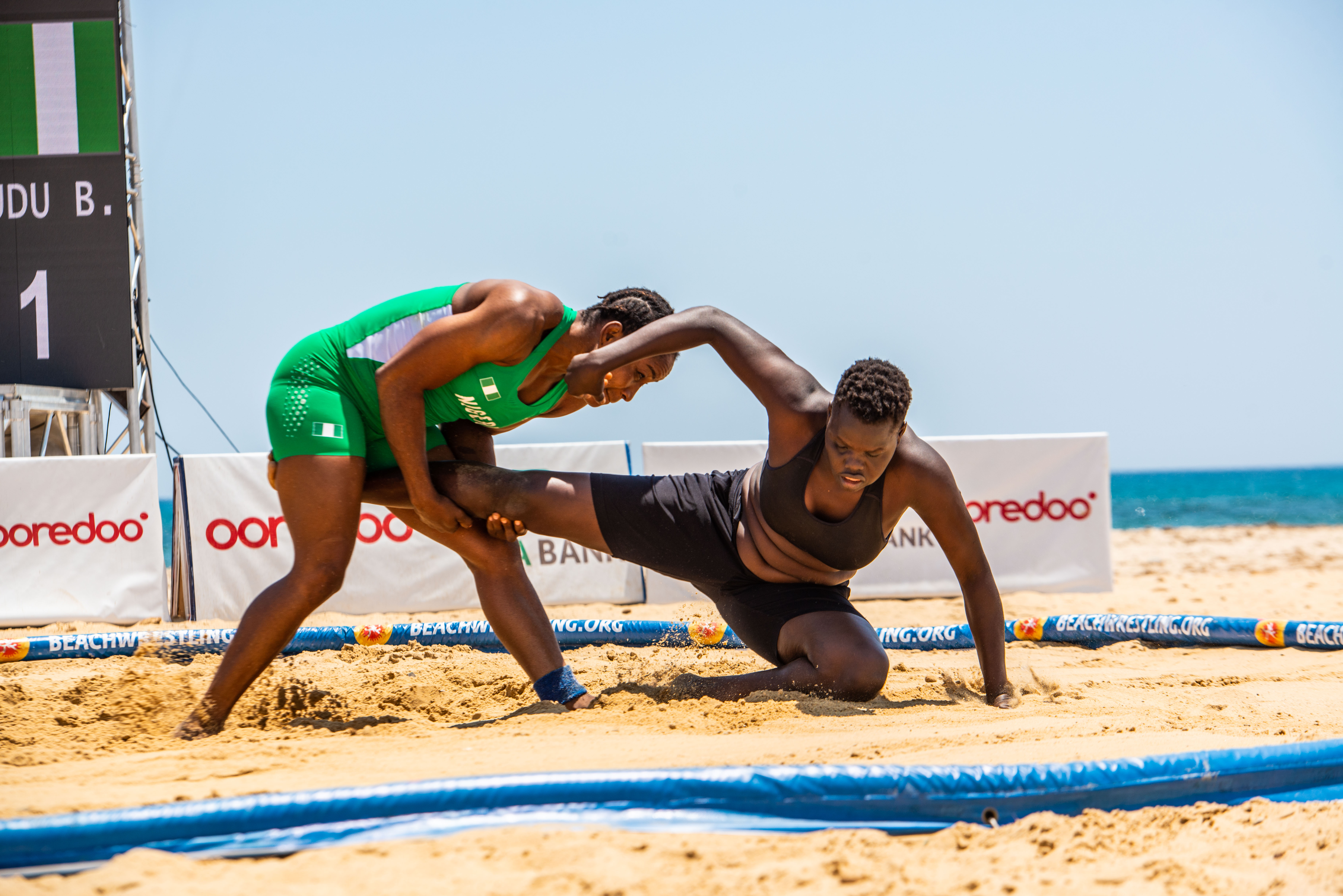
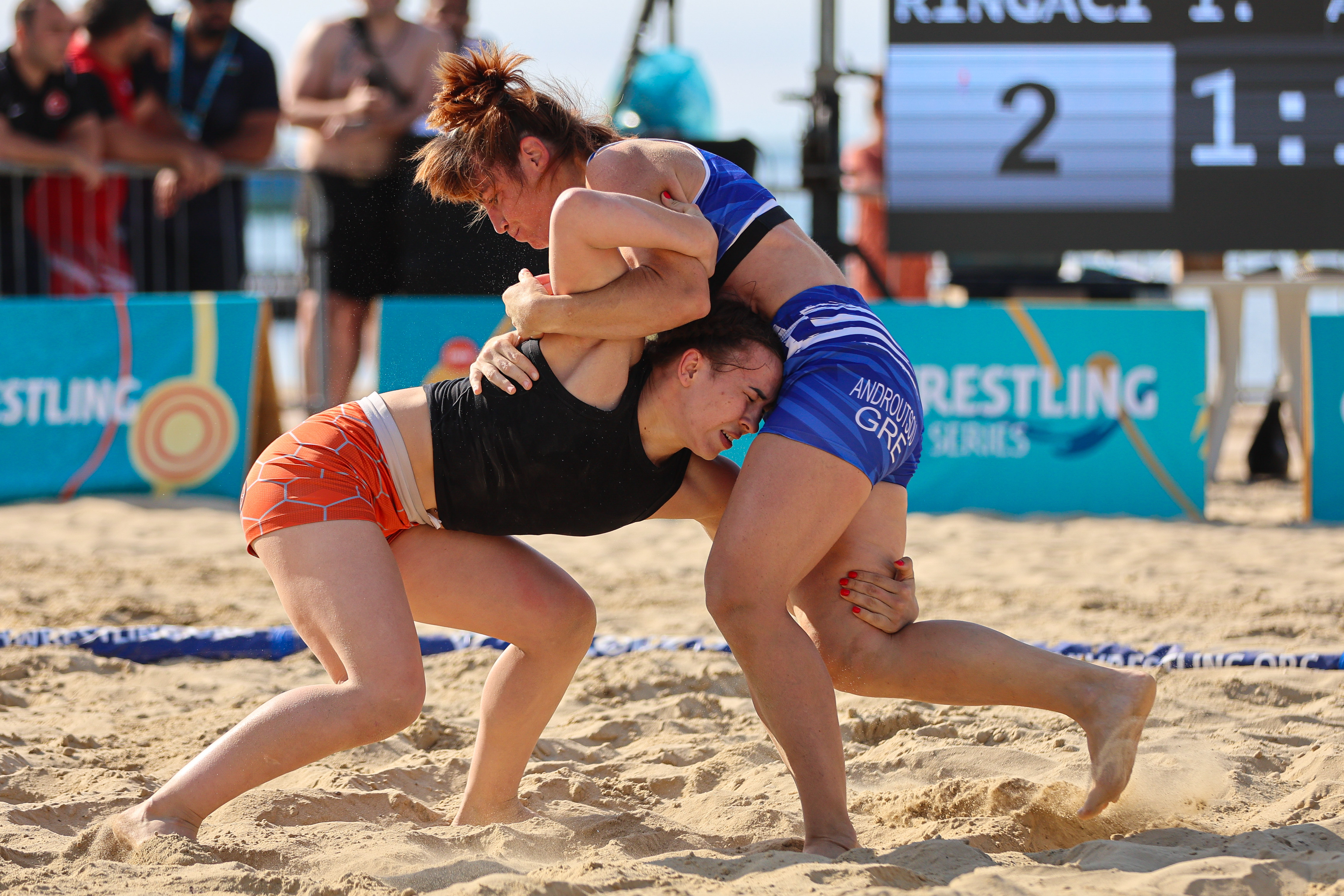 World champion Irina RINGACI (MDA) competes in Beach Wrestling in Porec, Croatia. (Photo: United World Wrestling / Kostadin Andonov)
Share your thoughts.
Comments