

Bullen brims with confidence after third European gold
Saturday, February 17, 2024 - 00:48 By Vinay Siwach

BUCHAREST, Romania (February 17) -- "Desperation."
Grace BULLEN (NOR) doesn't mince her words when asked about what forced her to switch training base from Norway to Georgia. For the past two years, Bullen has been training in Georgia and former world champion Zurabi IAKOBASHVILI (GEO) has been training her.
"I wanted to be great in wrestling," Bullen said. "I wanted to do good and not quit without knowing that I've done my full potential. And knowing that, it was not hard for me to pack my bag and move to another country."
Since that move, Bullen has changed weight classes, won two World Championships medals and now a European gold medal after four years.
In Bucharest for the European Championships, Bullen claimed her third European Championships gold medal and first since 2020 to continue her impressive return to the mat. Bullen had failed to qualify for the Tokyo Olympics, lost in the first round in the Oslo World Championships and was slowly fading away.
"I needed to be surrounded by people who love what I do as much as I do and see the potential in me as well that I know that I have. Today was the place that you can see that I can do good even though I am not at my 100 [percent]," she said.
 Grace BULLEN (NOR) takes down Luisa NIEMESCH (GER) in the 62kg final. (Photo: UWW / Kadir Caliskan)
On Thursday, Bullen destroyed her opponents with three falls in as many matches. Though there was no fall in the final on Wednesday, she held on to a 5-4 win over Luisa NIEMESCH (GER).
"Luisa is a tough opponent. She wrestled good," she said. "I see how she wrestled in her bracket with good wrestlers. Everyone knows that I love to attack and love my double legs. So she was very low. It was just for me to be patient with my attacks and just take the easy point instead of doing the risky and big one. Because those can be easy for her to counter and just being on my offense but still not being too passive with my wrestling."
The 62kg final was sort of similar to how Bullen had planned it. She kept her attacks going and even got a stepout. She used her double-leg attacks to score a takedown. It was only towards the end of the match that Neimesch caught her off guard and scored a takedown, exposure and tried a pin. However, it was too little too late.
"All worth it at the end," Bullen said. "It's good to get this type of competition, especially in this important year that we have ahead of us. This is my first competition back after the World Championship last year. So just getting the feeling of being back on the mat and especially in a big competition like this."
Bullen decided to wrestle at the Olympic weight class of 62kg at the World Championships and won a bronze medal which also gave her the Olympic quota for Paris. Now, she has a European title in the same weight class. She now hopes to become an Olympic medalist for Norway in Paris.
"It will be some tough six months," she said. "It's already been tough four years for me just getting to the spot of having a ticket to the Olympics. I'm looking forward to enjoying every moment that I have on the training mat. Then I want to work on the small stuff because I just changed weight class. It's been one year and I've done great things in a new place with new athletes that I haven't wrestled when I'm in this weight class. Just getting the opportunity to feel myself and being the Grace that I know I can be and my coaches have the confidence in me to be. Having that in mind, I think we will do good stuff this year just wrestling-wise."
 Vanesa KALADZINSKAYA (AIN) denied Jonna MALMGREN (SWE) her third Euro title by winning the 53kg final. (Photo: UWW / Kostadin Andonov)
World silver medalist Vanesa KALADZINSKAYA (AIN) earned her third European title as she won the gold medal at 53kg, denying Jonna MALMGREN (SWE) her third straight European title.
Kaladzinskaya defeated Malmgren 9-6 at the World Championships but was more dominant in Bucharest, beating her 10-2. Malmgren attempted her big throws and caught Kaladzinskaya in an arm spin twice but failed to score any points.
As soon as Kaladzinskaya was put on the activity clock in the first period, she scored a stepout and scored a takedown to lead 3-0 at the break. Malmgren tried hitting an arm spin but Kaladzinskaya blocked it and went behind to get two points. She hit a double-leg takedown to finally score and cut the lead to 5-2.
With 19 seconds left in the bout, Malmgren tried going deep on Kaladzinskaya's leg but she blocked Malmgren middle of the attack and flung Malmgren to her back for four points. While the pin was not secured as the time ran out, Kaladzinskaya won 10-2, securing her third European title.
 Iryna KURACHKINA (AIN) celebrates after beating Evelina NIKOLOVA (BUL) for the 57kg gold medal. (Photo: UWW / Kadir Caliskan)
In a battle of two Tokyo Olympic medalists, Iryna KURACHKINA (AIN) defeated Evelina NIKOLOVA (BUL) 7-2 to claim her third European title as well.
The final was off to a slow start to the final, there was only an activity point awarded to Kurachkina who scored a takedown in the second period. Her powerful snaps would trouble Nikolova as she scored her second takedown, and added a third with an ankle pick to lead 7-0. Kurachkina went a little inactive in the final minute of the final which cost her a stepout and a point for fleeing. But it was not enough to stop her from winning the gold medal at 57kg.
 Iryna KOLIADENKO (UKR) won her second straight European title and third overall. (Photo: UWW / Kostadin Andonov)
At 65kg, Iryna KOLIADENKO (UKR), who was wrestling a weight class up than last year, also won her third European Championships after she defeated Kateryna ZELENYKH (ROU), a former Ukrainian wrestler in the final.
After a few scrambles in the opening minute, Zelenykh was put on the activity clock and as she tried to a big move on Koliadenko, the Ukrainian blocked the move and scored exposure, getting two points. As the activity period expired, her lead extended to 3-0.
Koliadenko added another takedown to make it 5-0 at the break and a stepout in the second period gave her another point. No more points were scored as Koliadenko won 6-0.
 Nesrin BAS (TUR) stepped up and won the 72kg gold medal for Turkiye. (Photo: UWW / Kostadin Andonov)
Nesrin BAS (TUR) earned her first senior European gold medal, defeating defending champion and home favorite Alexandra ANGHEL (ROU) in a dramatic 72kg final.
Bas blocked Anghel when the Romanian was trying a front roll and then put her back on the mat. The fall was confirmed but Romania challenged as it appeared that the time had expired. A pin can be challenged only for technical reasons such as expiration of time or a foul. The jury confirmed that the fall was called after the time expired. But that delayed the final result as Bas would go on to beat Anghel 5-1.

RESULTS
53kg
GOLD: Vanesa KALADZINSKAYA (AIN) df. Jonna MALMGREN (SWE), 10-2
BRONZE: Zeynep YETGIL (TUR) df. Sztalvira ORSUS (HUN), 3-1
BRONZE: Maria PREVOLARAKI (GRE) df. Natalia MALYSHEVA (AIN), via fall (6-11)
57kg
GOLD: Iryna KURACHKINA (AIN) df. Evelina NIKOLOVA (BUL), 7-2
BRONZE: Solomiia VYNNYK (UKR) df. Elvira KAMALOGLU (TUR), 10-6
BRONZE: Anhelina LYSAK (POL) df. Mihaela SAMOIL (MDA), via fall
62kg
GOLD: Grace BULLEN (NOR) df. Luisa NIEMESCH (GER), 5-4
BRONZE: Yuliia TKACH (UKR) df. Johanna LINDBORG (SWE), 8-6
BRONZE: Veranika IVANOVA (AIN) df. Birgul SOLTANOVA (AZE), 9-6
65kg
GOLD: Iryna KOLIADENKO (UKR) df. Kateryna ZELENYKH (ROU), 6-0
BRONZE: Elis MANOLOVA (AZE) df. Anne NUERNBERGER (GER), 2-1
BRONZE: Irina RINGACI (MDA) df. Kadriye AKSOY (TUR), 10-4
72kg
GOLD: Nesrin BAS (TUR) df. Alexandra ANGHEL (ROU), 5-1
BRONZE: Yuliana YANEVA (BUL) df. Anastasiya ALPYEYEVA (UKR), via inj. def.
BRONZE: Wiktoria CHOLUJ (POL) df. Viktoryia RADZKOVA (AIN), 6-2
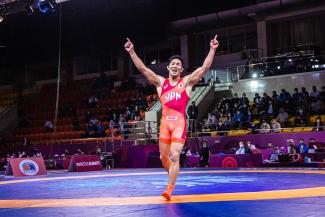
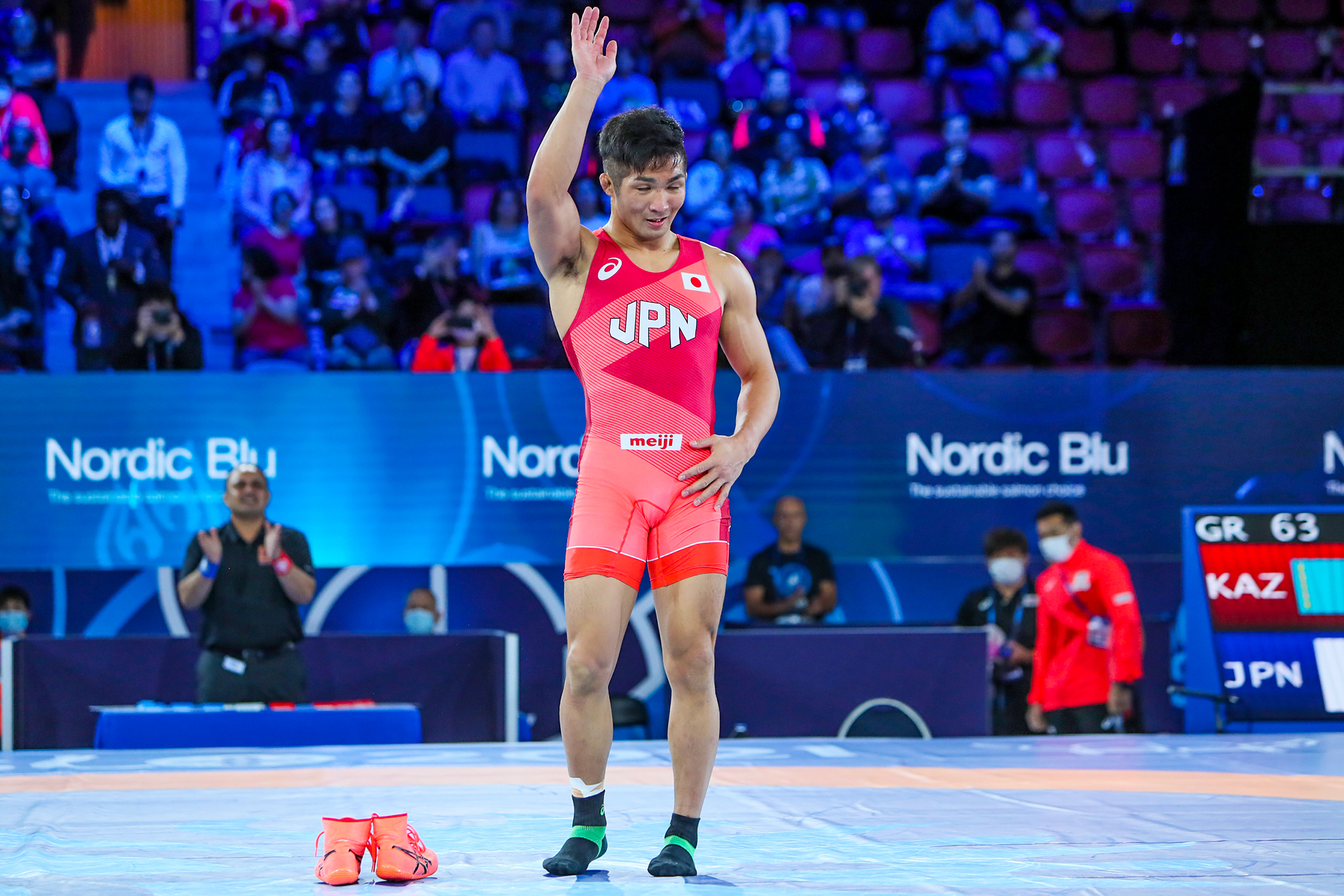 Tsuchika SHIMOYAMADA (AUS) had left his shoes on the mat during the 2021 World Championships to mark his retirement. (Photo: United World Wrestling / Martin Gabor)
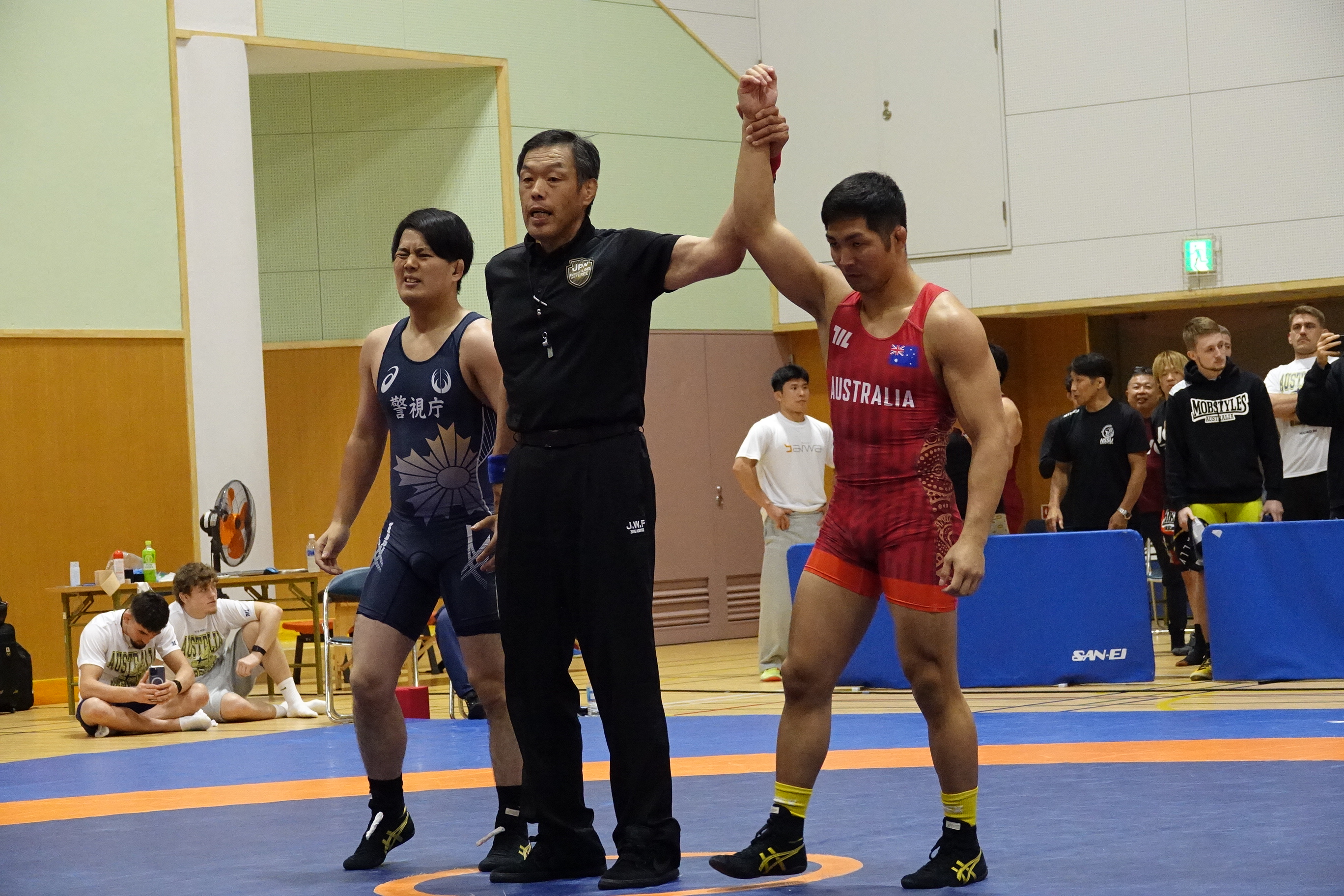 Tsuchika SHIMOYAMADA advances to the semifinals at the All-Japan Non-Student Championships in July with a 52-second win over Kokoro GOTO. (Photo: Koji Fuse / wrestling-spirits.jp)
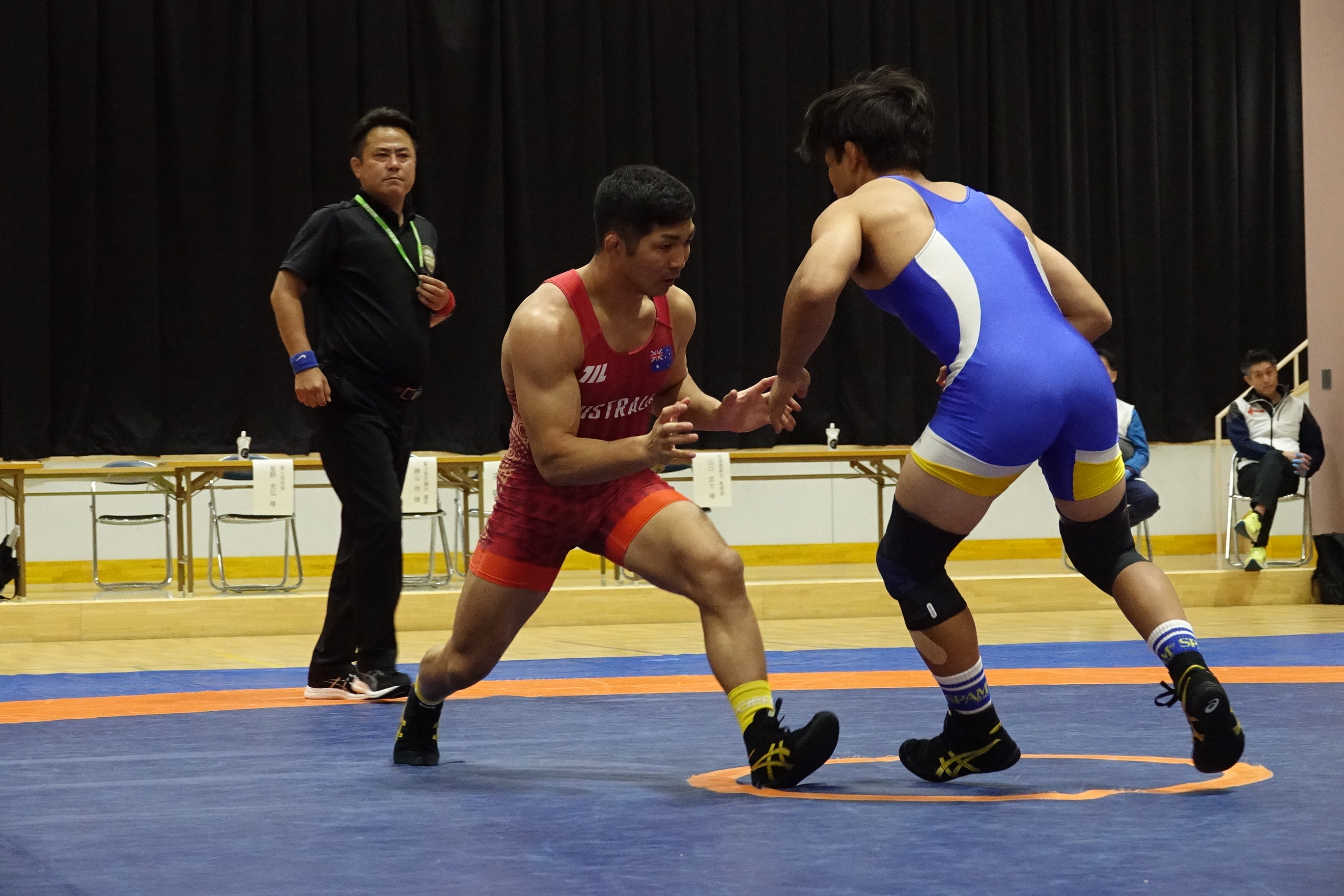 Tsuchika SHIMOYAMA faces Keitaro ONO in his opening match at the All-Japan Non-Student Championships in July. (Photo: Koji Fuse / wrestling-spirits.jp)
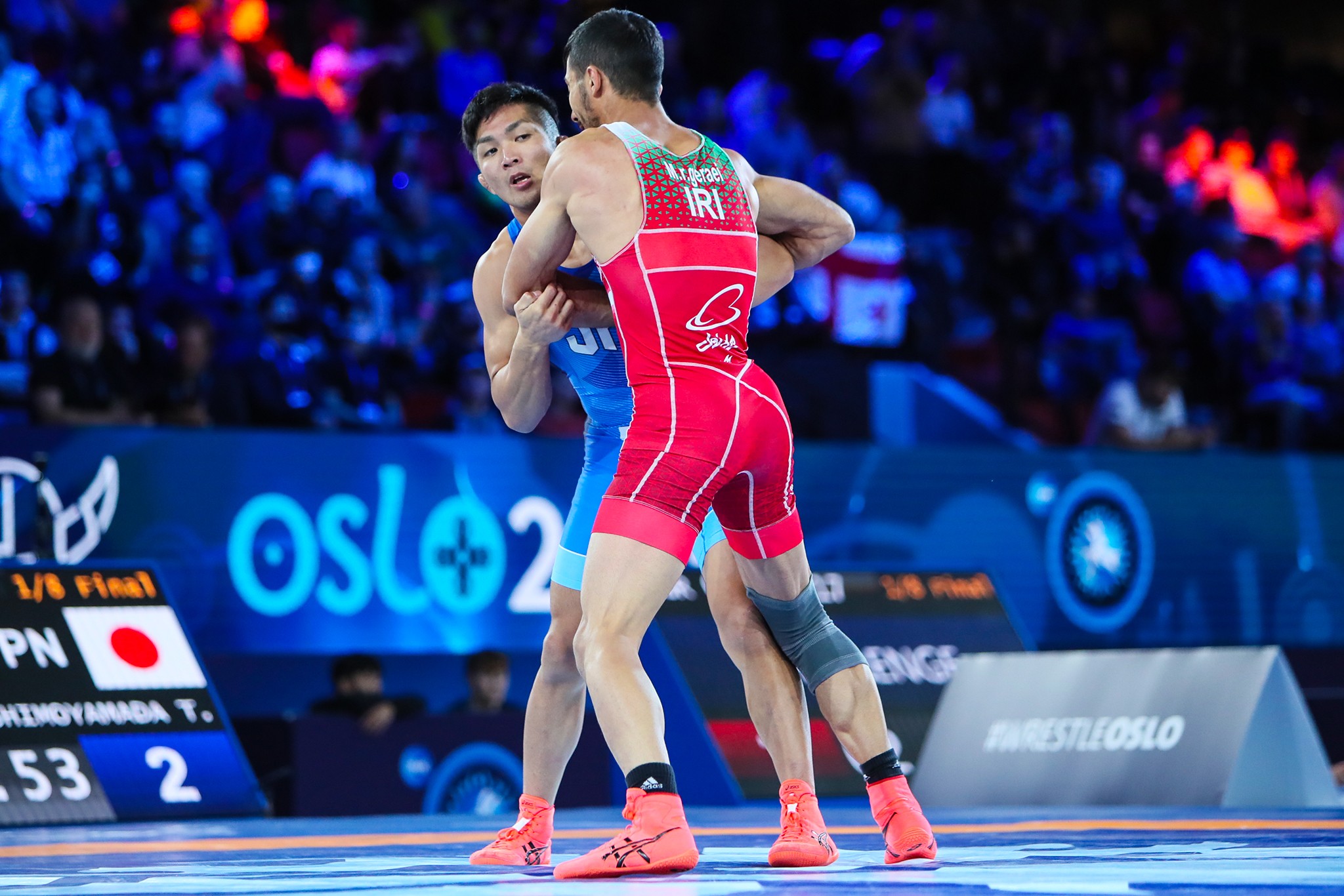 Tsuchika SHIMOYAMADA (AUS) was dominating Mohammadreza GERAEI (IRI) in their match at the 2021 World Championships before being pinned. (Photo: United World Wrestling / Martin Gabor)
Share your thoughts.
Comments