

#Trnava2018

Bey Likes Odds to Repeat as World Champion

By Eric Olanowski

TRNAVA, Slovakia (September 16) – For reigning world champion Kamal BEY (USA) to replicate his 2017 run to Junior World gold, he’ll have to navigate a bracket that returns every medalist from the 74kg Tampere World Championships. 

Bey, along with runner-up Akzhol MAKHMUDOV (KGZ) and bronze medalist Nasir HASANOV (AZE) drew into the bottom half of the bracket, while Sajan SAJAN (IND), the other bronze medalist, drew into the top half of the bracket. 

The way the draw played out, a potential Tampere World finals rematch between Bey and Makhmudov could happen as early as Monday night (18:00 local time). 
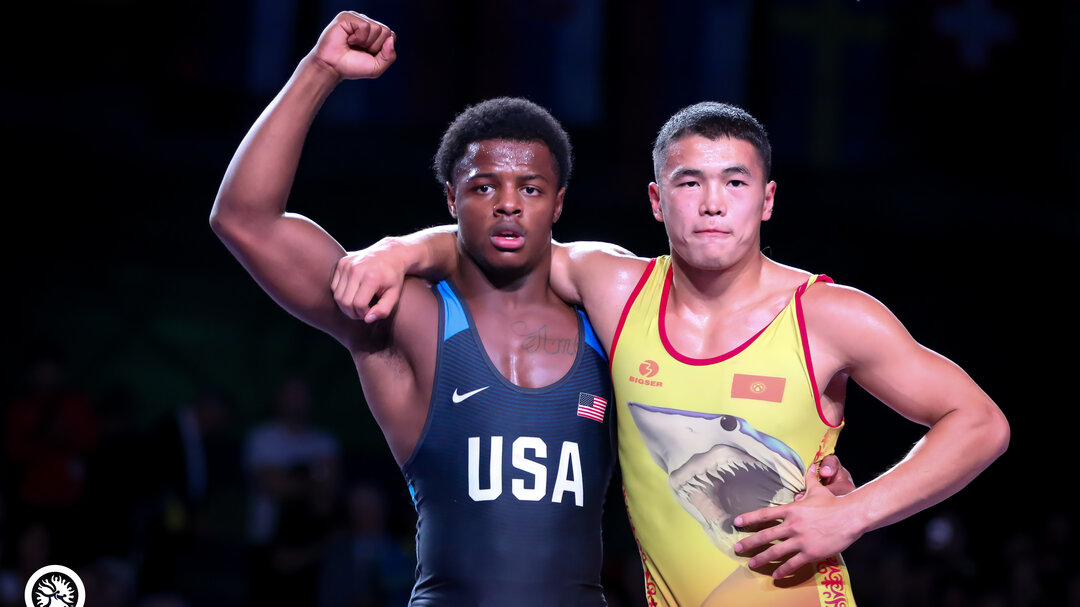

Kamal BEY (USA) and Akzhol MAKHMUDOV (KGZ) after the 2017 74kg gold-medal bout at the Tampere World Championships. (Photo by Marion Stein) 

When Bey was asked about the potential semifinal challenge of facing Makhmudov again, he said “It’s not that much of a challenge. People always want to challenge me, and I accept that challenge. He’s only bumping up for this tournament; then he’s going back down to 72kg for the Senior World Championships. …I’m in this for the long haul, and he’s just in this for one match.” 

He added, “This year, it’ll be about keeping the same pace and mentality, while not giving up as many points.” 

Whether it’s Makhudov, Hasanov, Sajan or the field, Bey feels that the improvements he's made over the last year have put himself in position to beat anyone on his way to repeating as Junior World champion. 

“Being a World champion is never given. Whoever stands in your way, you have to beat them regardless. It just about me going out there and taking care of my business.” 

Bey, along with the other returning medalists kick off the opening round of the 2018 Junior World Championships on Monday morning at 10:30 AM (local time). 
#development

Bulgaria hosts OLYMP to increase media literacy

By United World Wrestling Press

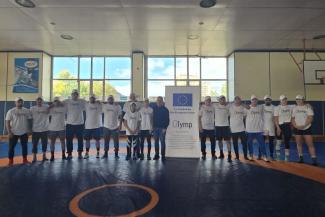
BULGARIA (October 15) -- Bulgaria hosted a seminar on the OLYMP project, funded by the European Union's Citizens, Equality, Rights and Values (CERV) Programme, at Diana National Wrestling Hall on October 9. The project aims to improve the media literacy of athletes, coaches, and sports managers.

The seminar was led by Georgi BANOV, one of the doyens of Bulgarian sports journalism, who has covered 14 Olympic Games in winter and summer sports, as well as a number of world and European Championships in wrestling, weightlifting, athletics, biathlon, and more.

The seminar was organized for the athletes of the national wrestling teams. The event was hosted by Belcho GORANOV, Chairman of the Ethics and Legal Commission of the United World Wrestling (UWW) and project manager on behalf of the Bulgarian Olympic Committee (BOC).


A post shared by bgolympic (@bgolympic)

The team emphasized that the seminar is part of a six-month cycle of informal training under the OLYMP project, which covers a total of 110 young athletes. The program includes weekly sessions in small groups focusing on media and information literacy, critical thinking and analytical skills, as well as developing the participants' confidence and ability to defend their positions with reasoned arguments.

The weekly classes will include readings and discussions on biographies, novels, sports magazines, as well as topics related to sports management and economics. Additional informal activities -- meetings with prominent athletes and film screenings -- will be held twice a month, with each event featuring moderated debates and practical challenges for “fact checking” and ethical behavior on social media.

Banov drew the athletes' attention to how to verify the information they receive through social media and other sources, how to recognize fake news, how to search for reliable information, and how to use social networks correctly, avoiding hate speech.

At the end of the media literacy program, a combined (formal and informal) assessment is planned – short tests and case studies, observation of group work, participant portfolios, and satisfaction surveys—to report on the specific results of the training and its impact on the engagement of young athletes in public life.

Read more on BOC website