

Berber adds to growing reputation with U23 Euro gold
Thursday, March 13, 2025 - 20:16 By United World Wrestling Press

TIRANA, Albania (March 13) -- Alperen BERBER (TUR) came jogging on the mat, gave the umpire a high-five and shook hands with his opponent Vladimeri KARCHAIDZE (FRA). Once the niceties were out of the way, he put his mean game face on, completely transforming himself.
As the reigning senior European champion and a world U23 medalist, Berber’s reputation of being a serial winner precedes him. And perhaps that also plays a role in the minds of his opponents. Karchaidze, at times, looked like giving too much respect to his opposite number. And so, when the moment presented itself, he couldn’t show the killer instinct.
Threatening to go off script, after a minute and 27 seconds, Berber – the odds-on favorite to win the 87kg gold medal bout – was put in a par terre position. But the young Frenchman, only in his second year of international wrestling, could not make the most of it as Berber returned to his feet without conceding a point from that position, except for the one penalty point for passivity.
Immediately after restart, he put Karchaidze under pressure. As Karchaidze tried a bear-hug throw, he fell back-first on the mat. Berber reacted fast as he got on top of his opponent and pinned him. In a blink of the eye – 20 seconds in the second period – the 19-year-old pocketed his first U23 European title.
 Evgenii BAIDUSOV (UWW) won the gold medal in the 77kg weight class. (Photo: United World Wrestling / Kadir Caliskan)
He wasn’t the only wrestler to win this crown for the first time.
For four years after winning the U20 World Championship gold medal, in 2021, Evgenii BAIDUSOV (UWW) may have been away from action. But on his comeback, he hasn’t shown any signs of rustiness.
The 23-year-old dropped just one point en route to the 77kg final, showing he was the one to beat. And if Aaron BELLSCHEIDT (GER) harbored any hopes of scripting an upset, he was dealt a harsh reality check only 20 seconds into the match.
Starting aggressively, Baidusov got a firm grip on his opponent in the first big move of the gold medal bout and used an underhook throw for a takedown. He gripped Bellscheidt's elbow to turn and race to a 4-0 lead. Bellscheidt challenged for a stepout before the action but it was deemed continuous action and the lost challenge made it 5-0.
It set the tone for the rest of the bout and with 45 seconds still left in the first period, Bellscheidt lost his balance while defending. Baidusov leapt on his opponent’s mistake and closed the tie with a simple takeover, winning by technical superiority.
 Mykhailo VYSHNYVETSKYI (UKR) won his third U23 European gold medal. (Photo: United World Wrestling / Kadir Caliskan)
At 130kg, Mykhailo VYSHNYVETSKYI (UKR) won his third U23 European Championship gold medal, beating Magomed ALICHUEV (UWW) on technical superiority.
The semifinal against Saba CHILASHVILI (GEO) was the only major hurdle on his way to a dominant gold medal. Vyshnyvetskyi executed a big four-point throw using double-arm locks inside the opening 90 seconds. From that moment onwards, it was always going to be a daunting task for Alichuev. So much so that he did not even get time to regroup.
Within seconds of his first big move, Vyshnyvetskyi launched another locked-arm throw send Alichuev over his head and slamming him on his back for four more points, which settled the gold medal bout in just two minutes and six seconds.
 U23 world champion Vitalie ERIOMENCO (MDA) won U23 European gold after silver and two bronzes in previous attempts. (Photo: United World Wrestling / Kadir Caliskan)
For three years, Vitalie ERIOMENCO (MDA) has been striving to step on to the top of the podium at the U23 European Championships. In 2022 and 2023, the 22-year-old won bronze medals. Last year, he upgraded to silver, faltering at the final hurdle but the U23 World Championship title softened that blow.
On Thursday, as he returned to the arena where he won his only international title -- the U23 Worlds last year -- Eriomenco looked like a man on a mission. Having reached the final largely trouble free, the Moldovan wrestler didn’t allow Ziya BABASHOV (AZE) a sniff of the gold in the 63kg final as he won his first-ever U23 European title at fourth attempt.
During the first period, Babashov was put in par terre and Eriomenco managed to get a turn for a 3-0 lead. In the second round, Eriomenco was handed passivity but he defended from par terre position to escape Babashov’s tight grip and emerge unscathed from the position of disadvantage. He controlled the remainder of the bout masterfully to be crowned the champion.
He, thus, avenged his 3-2 loss against Babashov in the final of the U23 Europeans last year.
 Alibek AMIROV (UWW) celebrates after winning the 55kg final in Tirana. (Photo: United World Wrestling / Kadir Caliskan)
At 55kg, Alibek AMIROV (UWW) ended his gold medal bout via technical superiority at the start of the finals session, beating Koba KARUMIDZE (GEO) 8-0 to win the U23 European title.
Amirov led 2-0 at the break but he scored arm throw for four which stunned Karumidze and Amirov finished the bout with two stepouts and win 8-0.
Historic final day
On the final day of the competition, Ukraine could add more gold medals to its tally when 19-year-old Yehor YAKUSHENKO (UKR) takes on Richard KARELSON (EST) in the 97 kg final. Yakushenko won the U20 World Championships last year and is competing in this age category for the first time. A win for Karelson will make him the first winner from Estonia in Greco at U23 European Championships.
Melkamu FETENE (ISR), too, will be eyeing his first gold medal at U23 Europeans when he faces Dimitri KHACHIDZE (GEO) in the 60kg final. A win for Fetene will make him only second Israel wrestler to win an European Championships title in Greco at any level.

RESULTS
55kg
GOLD: Alibek AMIROV (UWW) df. Koba KARUMIDZE (GEO), 8-0
BRONZE: Elmir ALIYEV (AZE) df. Filip BARTOSIK (CZE), 8-0
BRONZE: Arayik TOPALYAN (ARM) df. Hanifi SARP (TUR), 10-1
63kg
GOLD: Vitalie ERIOMENCO (MDA) df. Ziya BABASHOV (AZE), 3-1
BRONZE: Alexander VAFAI (SWE) df. Miroslav EMILOV (BUL), 5-2
BRONZE: Romeo BERIDZE (GEO) df. Davit JOTYAN (ARM), 8-2
77kg
GOLD: Evgenii BAIDUSOV (UWW) df. Aaron BELLSCHEIDT (GER), 8-0
BRONZE: Alexandrin GUTU (MDA) df. Karl BAFF (SWE), 5-1
BRONZE: Khasay HASANLI (AZE) df. Michal ZELENKA (CZE), 9-1
87kg
GOLD: Alperen BERBER (TUR) df. Vladimeri KARCHAIDZE (FRA), via fall (3-1)
BRONZE: Vigen NAZARYAN (ARM) df. Hamza SERTCANLI (SWE), via inj. def.
BRONZE: Baskhan SAIDOV (UWW) df. Ivan CHMYR (UKR), 3-1
130kg
GOLD: Mykhailo VYSHNYVETSKYI (UKR) df. Magomed ALICHUEV (UWW), 8-0
BRONZE: Cemal BAKIR (TUR) df. Artur SARKISJAN (CZE), 8-3
BRONZE: Saba CHILASHVILI (GEO) df. Razmik KURDYAN (ARM), 1-1
Semifinals
60kg
GOLD: Melkamu FETENE (ISR) vs. Dimitri KHACHIDZE (GEO)
BRONZE: Dimitri KHACHIDZE (GEO) df. Bohdan HRYSHYN (UKR), 10-0
BRONZE: Melkamu FETENE (ISR) df. Suren AGHAJANYAN (ARM), 7-5
67kg
GOLD: Hleb MAKARANKA (UWW) vs. Anri KHOZREVANIDZE (GEO)
SF 1: Anri KHOZREVANIDZE (GEO) df. Azat SARIYAR (TUR), 6-5
SF 2: Hleb MAKARANKA (UWW) df. Daniial AGAEV (UWW), 5-5
72kg
GOLD: Ruslan NURULLAYEV (AZE) vs. Danil GRIGOREV (UWW)
SF 1: Danil GRIGOREV (UWW) df. Vasile ZABICA (MDA), 8-7
SF 2: Ruslan NURULLAYEV (AZE) df. Oleh KHALILOV (UKR), 4-2
82kg
GOLD: Alexandru SOLOVEI (MDA) vs. Gamzat GADZHIEV (UWW)
SF 1: Gamzat GADZHIEV (UWW) df. Frederik MATHIESEN (DEN), 7-1
SF 2: Alexandru SOLOVEI (MDA) df. Elmin ALIYEV (AZE), 8-0
97kg
GOLD: Yehor YAKUSHENKO (UKR) vs. Richard KARELSON (EST)
SF 1: Richard KARELSON (EST) df. Luka GABISONIA (GEO), 9-0
SF 2: Yehor YAKUSHENKO (UKR) df. Muhittin HELVACI (TUR), 5-2
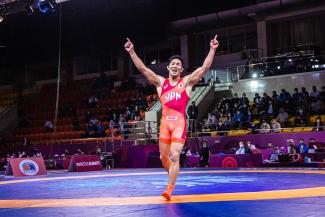
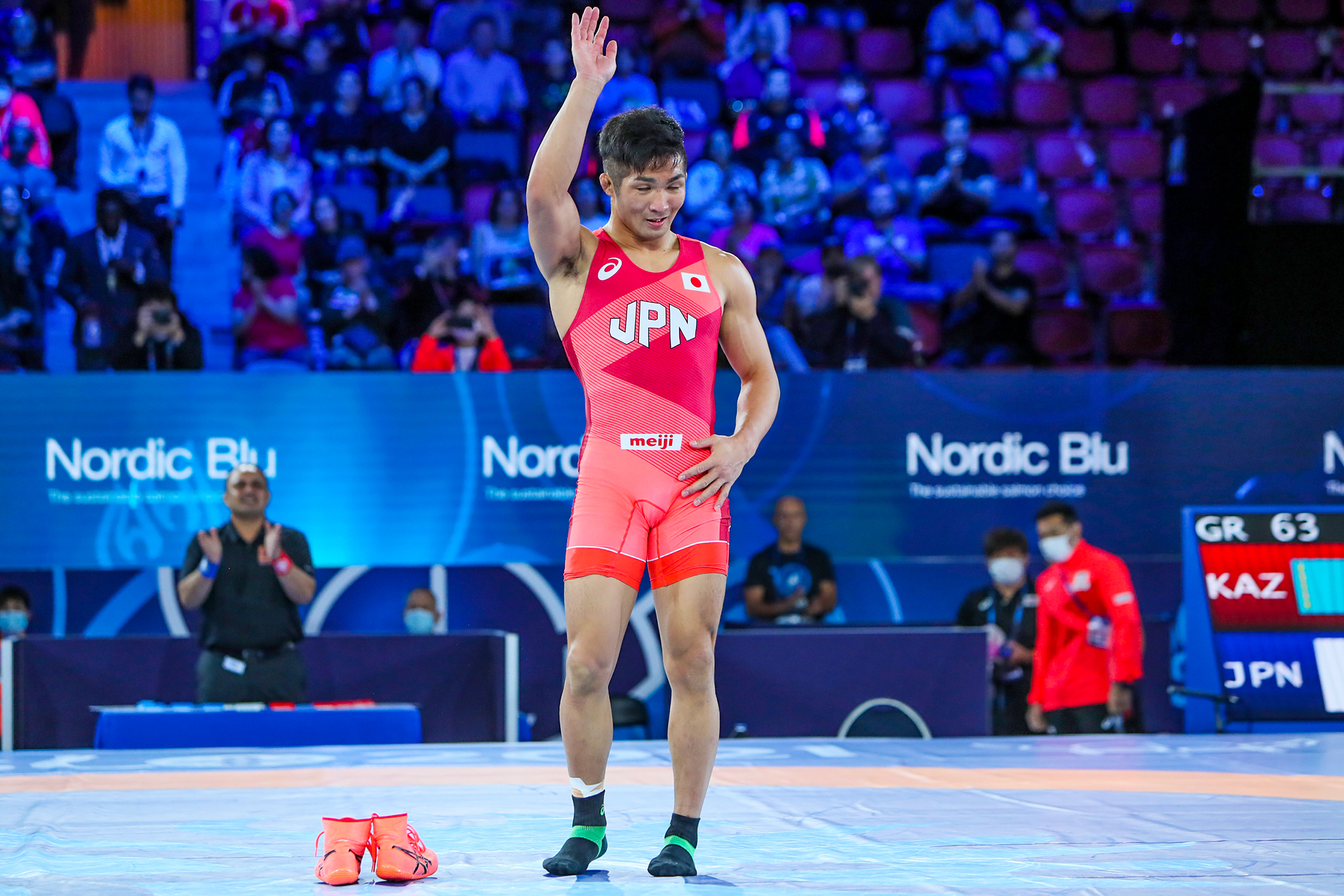 Tsuchika SHIMOYAMADA (AUS) had left his shoes on the mat during the 2021 World Championships to mark his retirement. (Photo: United World Wrestling / Martin Gabor)
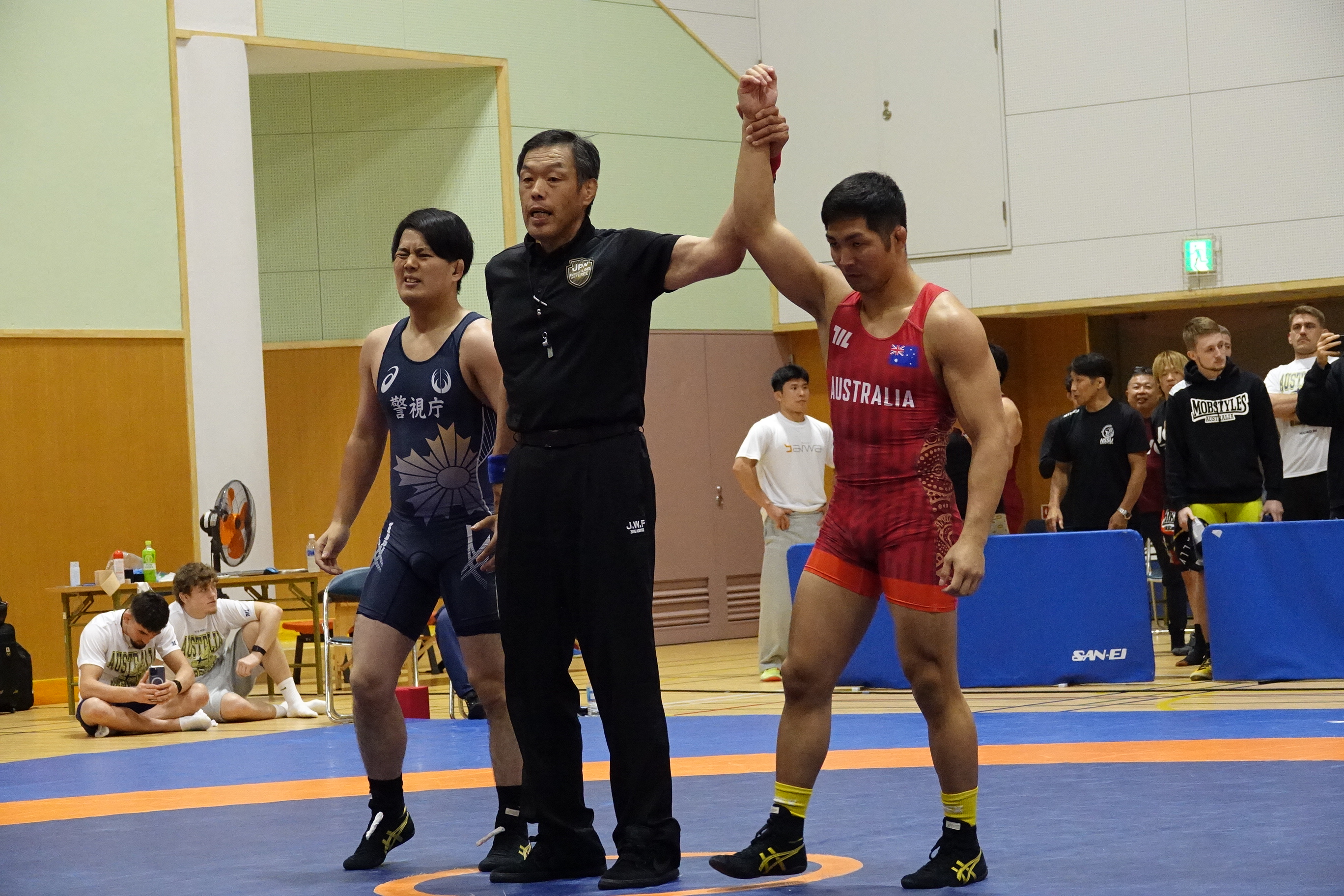 Tsuchika SHIMOYAMADA advances to the semifinals at the All-Japan Non-Student Championships in July with a 52-second win over Kokoro GOTO. (Photo: Koji Fuse / wrestling-spirits.jp)
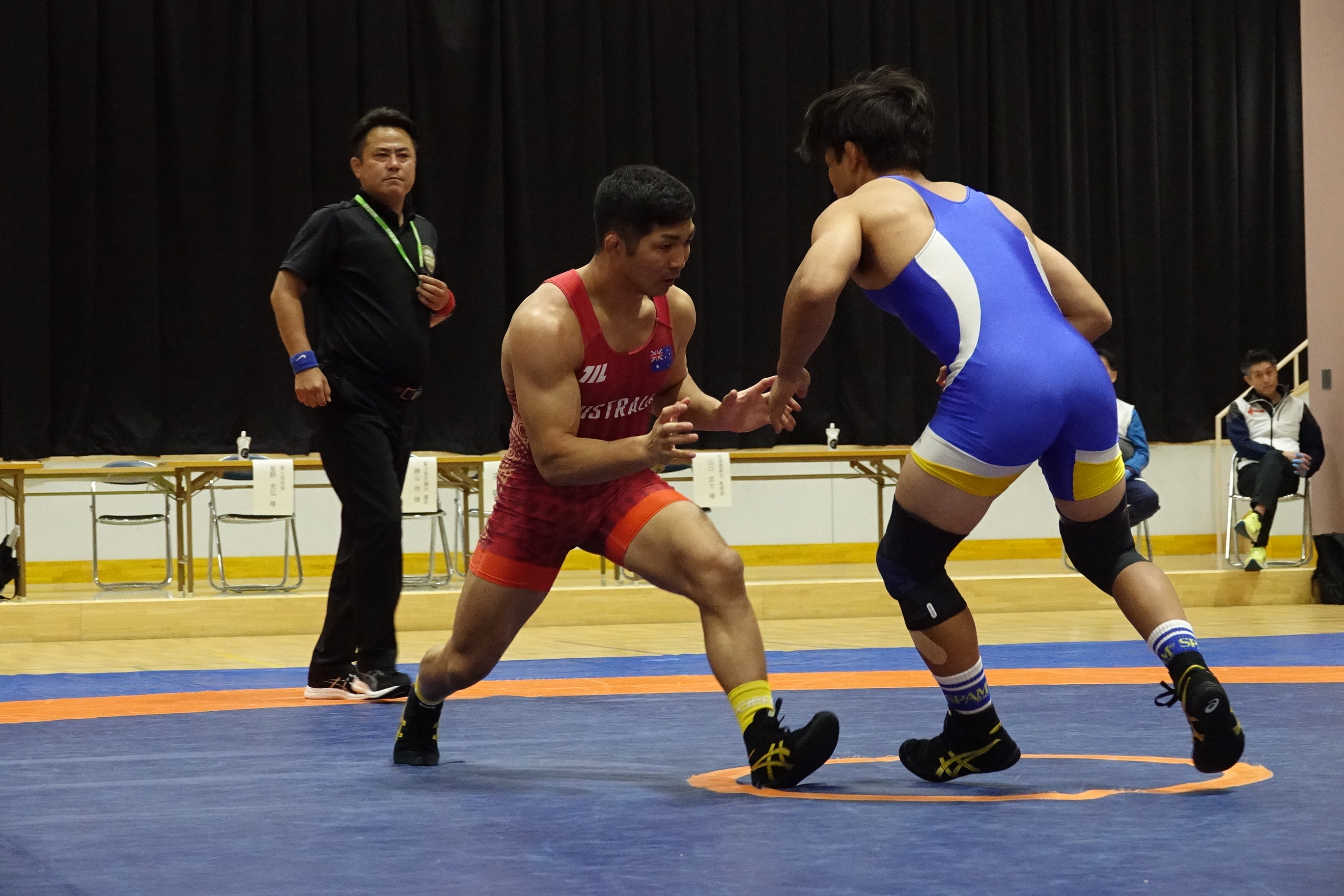 Tsuchika SHIMOYAMA faces Keitaro ONO in his opening match at the All-Japan Non-Student Championships in July. (Photo: Koji Fuse / wrestling-spirits.jp)
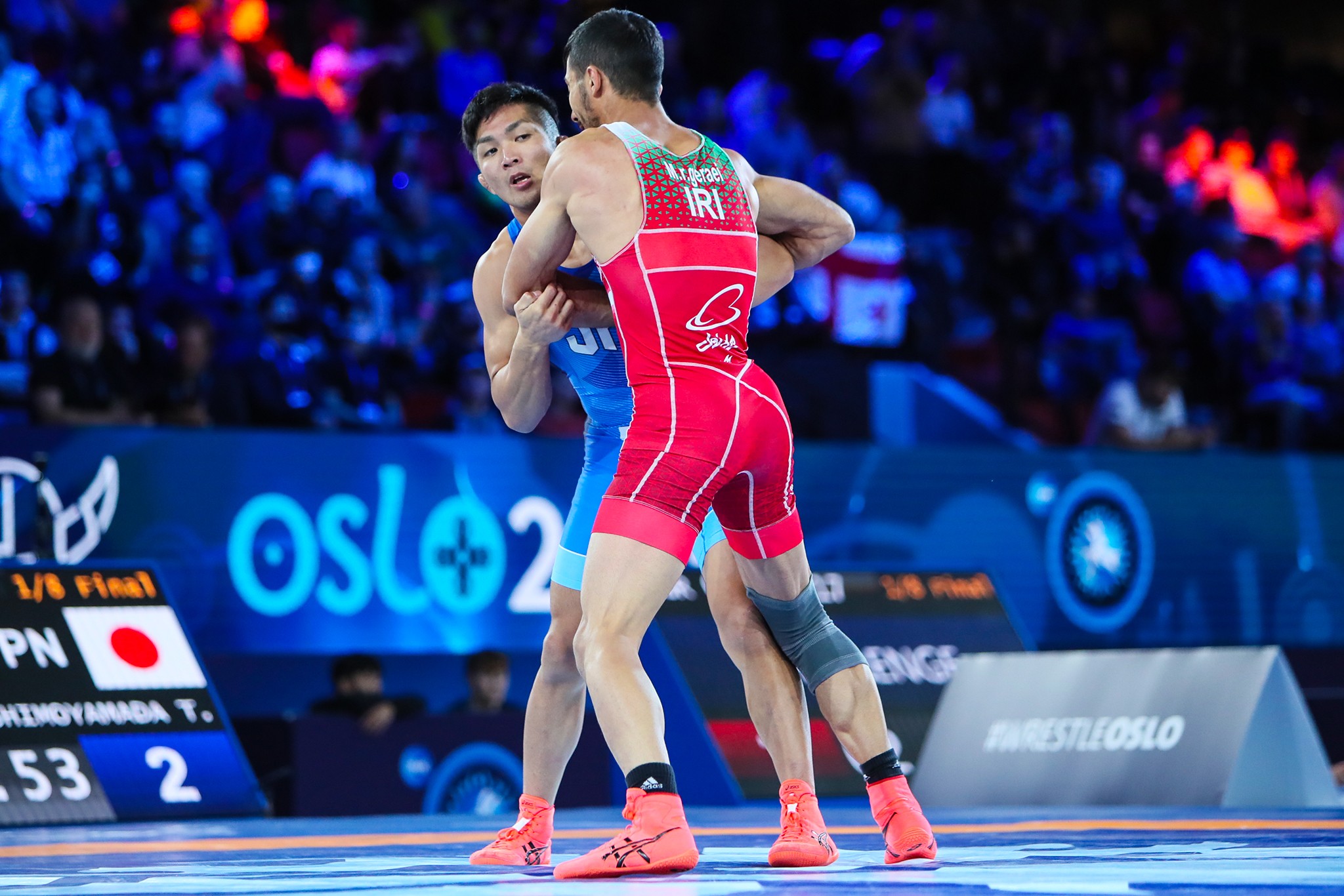 Tsuchika SHIMOYAMADA (AUS) was dominating Mohammadreza GERAEI (IRI) in their match at the 2021 World Championships before being pinned. (Photo: United World Wrestling / Martin Gabor)
Share your thoughts.
Comments