

Amouzad avenges Paris loss to Kiyooka, claims 65kg gold
Tuesday, September 16, 2025 - 22:02 By Ken Marantz
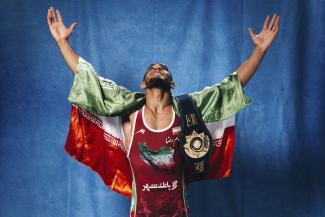
ZAGREB, Croatia (September 16) -- Revenge was the theme of the night on Tuesday at the Zagreb World Championships, with Rahman AMOUZAD (IRI) playing the starring role.
Amouzad not only avenged his loss to Kotaro KIYOOKA (JPN) from the Paris Olympics, he did it in overwhelming fashion, blitzing his way to a 10-0 victory in the 65kg final on the final day of the freestyle competition at Arena Zagreb.
"I worked really hard and had been waiting for this moment for almost a year, and I’m happy this championship is mine," Amouzad said. "I put in a lot of effort physically, mentally, and with analysis."
The other freestyle gold at stake went to Kyle SNYDER (USA), who likewise avenged a loss in Paris -- albeit for the bronze -- with a nail-biting 4-2 win at 97kg over Amirali AZARPIRA (IRI) to capture his fourth world title.
Iran, which was already assured of winning the team title for the first time since 2013 before the night began, finished with 145 points, 11 ahead of the United States in second place. Japan placed third with 111 points.
"I’m also really happy that Iran’s team became the champion," Amouzad said. "This title was well deserved. For the past 12 years we couldn’t win but now, with seven medals, it finally happened. I’m glad the people of Iran are happy, and that makes me even happier."
It was just over a year ago that Kiyooka came seemingly out of nowhere and snatched the 65kg gold in Paris with an inspired 10-3 victory over Amouzad.
But on Tuesday, the outcome could not have been more different. From the outset, it was all Amouzad, the 2022 world champion who won three straight Asian titles from 2022 to 2024.
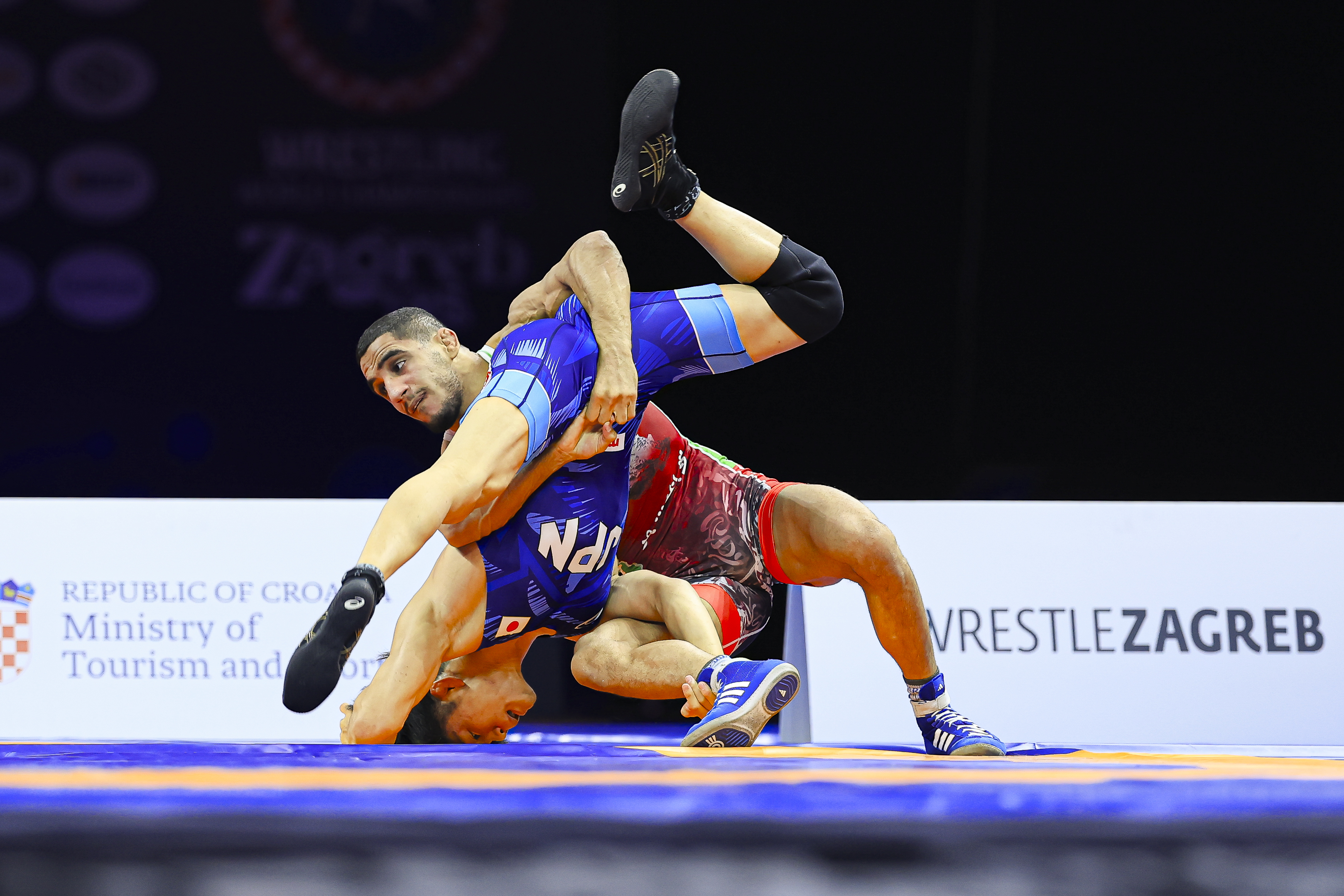 Rahman AMOUZAD (IRI) counters Kotaro KIYOOKA (JPN) in the 65kg final. (Photo: United World Wrestling / Kadir Caliskan)
The Iranian deftly countered a single-leg attack from Kiyooka with a back lift for two, then added a two-point exposure. And he wasn't finished with the sequence, transitioning to a cradle at the edge and wedging Kiyooka over for two more and a 6-0 lead.
Amouzad kept the pressure on a shell-shocked Kiyooka, scoring a stepout that had a fleeing point tacked on. A final takedown and the match was over with eight seconds to spare in the first period.
"I have more plans and bigger goals ahead," Amouzad said. "This is just the beginning for me, and my work isn’t finished yet. In two months, I’ll compete in the Islamic Games and I’ll participate in any tournament the coaching staff believe I should."
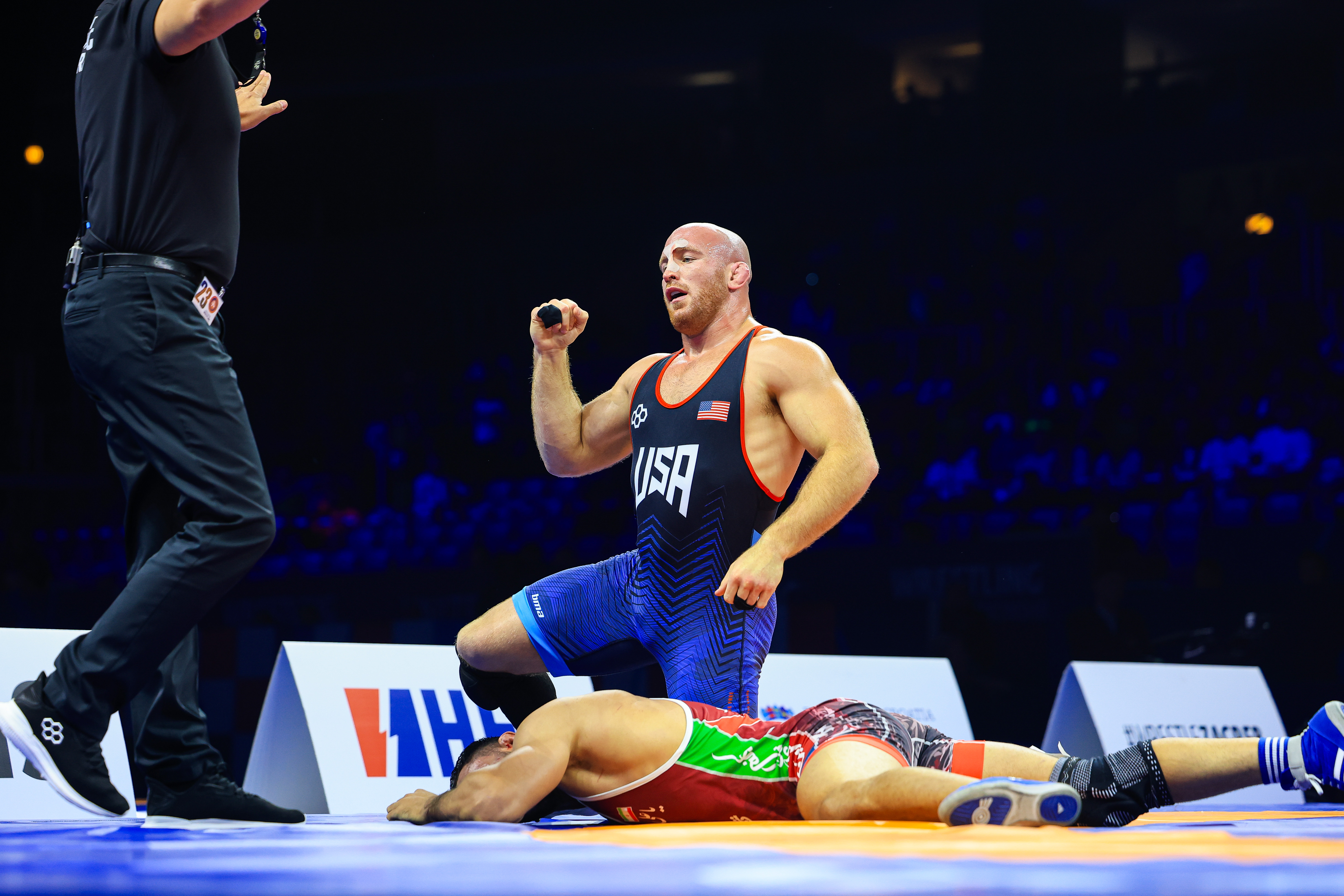 Kyle SNYDER (USA) celebrates after beating Amirali AZARPIRA (IRI) in the 97kg final. (Photo: United World Wrestling / Kadir Caliskan)
The 97kg final was a much closer but no less dramatic affair, as Snyder picked up his eighth medal in eight trips to the World Championships to go along with an Olympic gold from Rio 2016 and a silver at Tokyo 2021.
The 29-year-old Snyder received an activity point in a tenuous first period, but Azarpira broke the logjam by getting behind for a takedown early in the second. A penalty point against Azarpira for finger-grabbing tied the score at 2-2, but with the Iranian holding the criteria advantage.
With the atmosphere growing intense, Snyder put the pressure on and scored a stepout with 8.5 seconds left, then held on as the match ended with him defending against a single-leg attack. As has become ritual, Iran made a futile challenge at the end, which did nothing but change the final score.
"We just had a little bit of a game plan for him, making sure the match is tight because in a match like that, I can always get things going near the end and find a way to score," Snyder said. "I thought I was close and I felt like he was kind of stumbling. I over-pursued a little bit and he's pretty savvy on the edge and I gave him a takedown. But honestly, that was good because it made me bring my pace even more.
"I think the timing of that was perfect, just made the match a matter of the heart, like I wasn't as much about technique as it was about the heart."
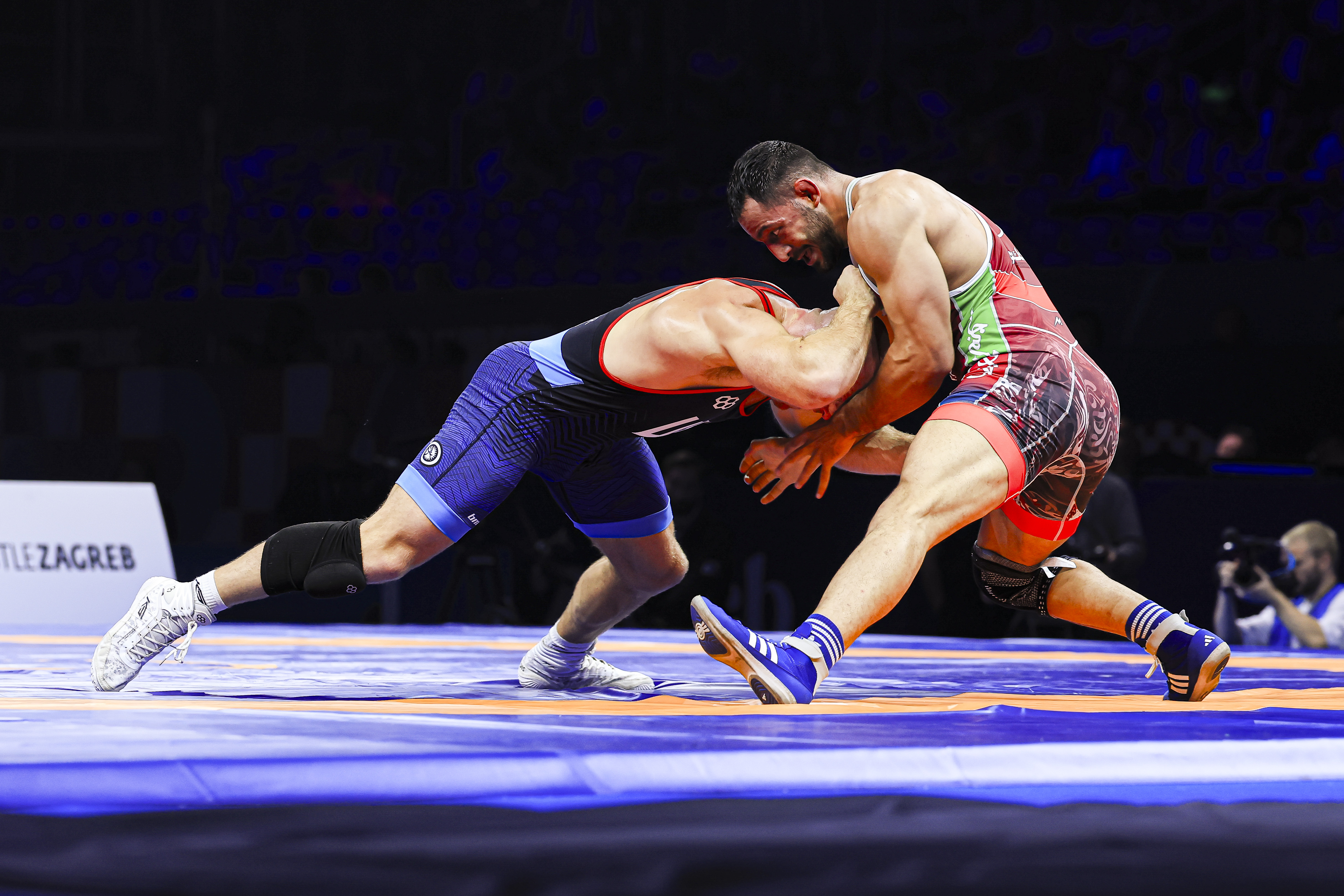 Kyle SNYDER (USA) scores the match-winning stepouts against Amirali AZARPIRA (IRI) during the 97kg final. (Photo: United World Wrestling / Kadir Caliskan)
It was in Zagreb back in February 2023 that Snyder and Azarpira first met on the mat, with the American winning 3-0 in the final of the Zagreb Open. But a year later in the final of the same tournament, Azarpira came out a 6-3 winner, then defeated Snyder 4-1 eight months later in a bronze-medal match at the Paris Olympics.
"He's a tough and good hand fighter," Snyder said. "At the Olympics, I felt like I got him tired, but there were a lot of stops because of the blood. I felt that broke up the match a little bit. It came down to the last couple of seconds in this one, too. Just keeping inside a little bit better and faking and snapping and finding a way to win."
Snyder credits his dedication to consistently hard training for his continued success. "I know every time I come in, it's going to be hard. Even making the team in America is hard. So I think the most important quality for consistency over time is just humility and being willing to keep learning and keep working.
"You got to keep working hard. I think I trained harder this year than I ever have in my entire life. You got to be willing to keep doing that year after year after year."
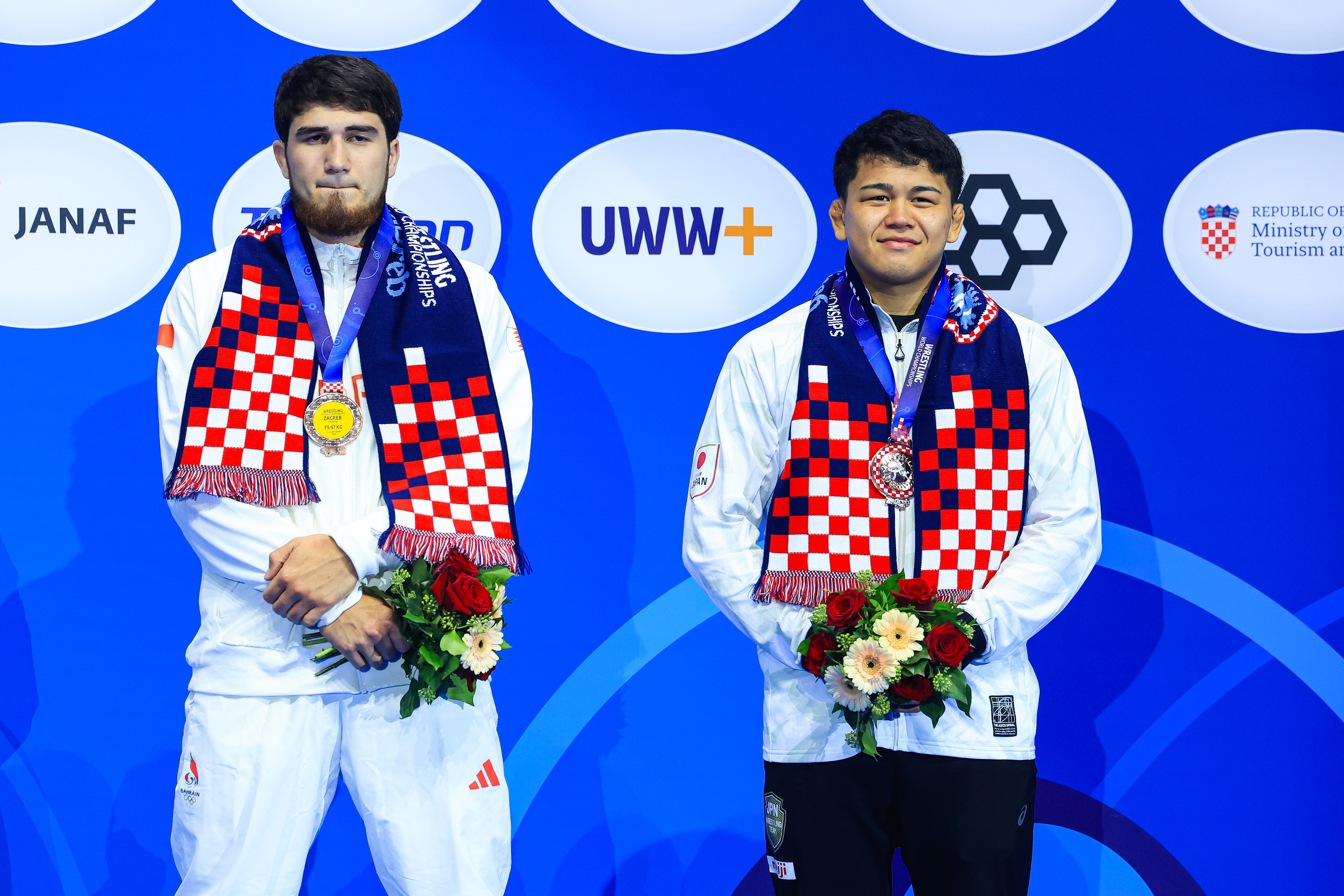 Akhmed TAZHUDINOV (BRN), left, and Arash YOSHIDA (JPN), the two bronze medalists at 97kg. (Photo: United World Wrestling / Kadir Caliskan)
Tazhudinov cuts it close, but leaves Zagreb with bronze
Paris Olympic champion Akhmed TAZHUDINOV (BRN), whose reign as world champion ended with a loss in the semifinals by Azarpira, assured he won't be leaving Zagreb empty-handed, but he had to work hard to earn his consolation bronze medal.
Tazhudinov, who has looked out of sorts all tournament, had to survive a late scramble that, when the video was studied and the points sorted out, gave him a 13-10 come-from-behind victory over Akhmed MAGAMAEV (BUL).
It didn't look good for Tazhudinov when he was thrown for four at the outset of the match, but he managed to come back with a pair of takedowns. The two traded two-point exposures when Tazhudinov secured a cradle, but was stopped on his own back, leaving him trailing 6-6 on criteria.
Tazhudinov finally went ahead with a takedown with 1:23 left, but a wild scramble from Magamaev's counter-lift ended up with Tazhudinov being awarded five points and Magamaev four on challenge, giving the Bahrain wrestler the win.
Meanwhile, two-time Asian champion Arash YOSHIDA (JPN) made Japanese history when he became the country's heaviest world medalist ever by outmuscling Zbigniew BARANOWSKI (POL) 6-0 for the other 97kg bronze.
Yoshida, whose father is Iranian and runs the kids club where he and his siblings started the sport, combined two stepouts, two activity points and a takedown to earn the historic bronze.
"I am thankful to Japan," Yoshida said. "But inside, I'm not completely satisfied. From now, I will work hard with the aim of becoming the champion."
Japan's previous heaviest medal winner was Atsushi MATSUMOTO (JPN), who won a bronze at 92kg in Budapest in 2018. In fact, Matsumoto is one of only two Japanese who had won a medal in a weight classes 90kg or above.
As a footnote, Akira OTA (JPN) won silver medals at 90kg at both the 1984 Los Angeles and 1988 Seoul Olympics.
At 65kg, Umidjon JALOLOV (UZB) earned his first world medal with a solid 7-1 victory over European champion Ibragim IBRAGIMOV (UWW), scoring a takedown in the first period and two in the second along with a stepout.
The victory avenged a loss from two years ago from the semifinals at the World U23 Championships, which Ibragimov won 3-0 en route to a second straight gold in the age group.
Real WOODS (USA) added the other 65kg bronze medal to the U.S. tally with a 3-1 win over Peiman BIABANI (CAN) that saw no technical points.
In making his first world podium, Woods received two activity points to Biabani's one, with a point for an unsuccessful challenge at match end padding the final score.
Day 4 Results
Freestyle
65kg (34 entries)
GOLD: Rahman AMOUZAD (IRI) df. Kotaro KIYOOKA (JPN) by TF, 10-0, 2:52
BRONZE: Real WOODS (USA) df. Peiman BIABANI (CAN), 3-1
BRONZE: Umidjon JALOLOV (UZB) df. Ibragim IBRAGIMOV (UWW), 7-3
97kg (29 entries)
GOLD: Kyle SNYDER (USA) df. Amirali AZARPIRA (IRI), 4-2
BRONZE: Akhmed TAZHUDINOV (BRN) df. Akhmed MAGAMAEV (BUL), 13-10
BRONZE: Arash YOSHIDA (JPN) df. Zbigniew BARANOWSKI (POL), 6-0

 Women's Wrestling at the 2004 Athens Olympic Games. (Photo: United World Wrestling / Martin Gabor)
 Tayla FORD (NZL) is the first wrestler from New Zealand who will compete at the Olympics. (Photo: United World Wrestling / Amirreza Aliasgari)
Share your thoughts.
Comments