

Akgul Bests Geno and Salkazanov Shocks 74kg Field in Warsaw
Tuesday, April 20, 2021 - 19:15 By Eric Olanowski

WARSAW, Poland (April 20) – In a colossal battle of titans, Taha AKGUL (TUR) avenged his ’19 world finals loss to Geno PETRIASHVILI (GEO) and kept his hopes of winning an eighth continental title alive.
The two superstars who have won every continental gold medal since the ’12 European Championships met early Tuesday morning in the opening round at European Championships in Poland’s Hala Widowiskowo-Sportowa COS Torwar.
“My last match before surgery was against Geno, and my first match back was against Geno,” said the Rio Olympic champion who returned from a 15-month layoff after undergoing shoulder surgery last January. He continued, saying, “It’s been well over a year since I wrestled, but I felt good. I think it’s a good point to move forward to the Olympics and I’ll continue to train and hopefully get better before Tokyo.”
Akgul put on a near-flawless performance and controlled the match from whistle to whistle. He scored a trio of takedowns against the reigning three-time world champ – two of which came from go behinds off Petriashvili’s shot attempts – and won the match 6-1.
“For me, I don’t care too much about when Geno and I wrestle. I knew we were going to wrestle at some point during the competition, so It didn’t change much whether it was in the qualification round, semifinals or finals.”
Akgul continued to roll throughout the day and picked up wins against Kamil Tomasz KOSCIOLEK (POL) and Dzianis KHRAMIANKOU (BLR) en route to the 125kg finals where he’ll wrestle Russia’s Sergei KOZYREV (RUS).
Meanwhile, underdog Tajmuraz SALKAZANOV (SVK) scored three shocking wins on Tuesday and punched his ticket to the 74kg finals. The former Russian-turned-Slovakian picked up wins over a two-time world champion, U23 world champion and world silver medalist.
After running through Switzerland’s Marc DIETSCHE, Salkazanov threw two-time world champion Frank CHAMIZO (ITA) to his back with less than 10 seconds left and won, 6-2. That set up a quarterfinals match against ’18 world silver medalist Avtandil KENTCHADZE (GEO).
Salkazanov trailed Kentchadze, 5-0, but scored six unanswered points in the second period and upset the Georgian Tokyo Olympian, 6-5. Then, in the semifinals, he erased a five-point deficit for a second consecutive match and moved into the finals with a surprising 6-5 win over tournament-favorite and Individual World Cup champion Razambek ZHAMALOV (RUS).
Salkazanov will square off with Miroslav Stefanov KIROV (BUL) on Wednesday night for 74kg gold.
On the finals side of the day, Zagir SHAKHIEV (61kg), Israil KASUMOV (70kg) and Alikhan ZHABRAILOV (97kg) finished atop the podium for the Russian Federation, while Nachyn MONGUSH (57kg) finished in second place.
Shakhiev slashed the title hopes of Poland’s battle-tested 30-year-old veteran Krzysztof BIENKOWSKI. After the heavy-footed Russian surrendered a takedown from a snatch single, he scored 13 unanswered points from two takedowns and four leg laces to win the 61kg title, 13-2.
The second Russian to hoist his nation’s flag was Israil Kasumov. The reigning Russian National champion had a slender 1-0 disadvantage after the first period but struck early in the second period with a stepout and a takedown. Despite leading by two points, Kasumov was never threatened offensively by Turan BAYRAMOV (AZE). Last year’s 12th-place European finisher played defense for the final two minutes and walked away with the 3-1 win.
Alikhan ZHABRAILOV (RUS) grabbed Russia’s third gold of the night. He stopped Suleyman KARADENIZ (TUR) from winning back-to-back European titles with a 6-4 victory.
In the opening period, Zhabrailov got to a low-level attack and chased down the ankles of Karadeniz. The pair went out of bounds and the Russian thought he had a takedown near the edge, but the refs had differing opinions. Zharailov’s corner threw the brick but lost the challenge and headed into the second period with the 2-1 advantage.
In the closing frame, Zhabrailov fired off an attack and transitioned to a gut wrench. He extended his lead to 6-2 before conceding a takedown but hung on to win 97kg gold, 6-4.
The other two golds on the night went to Suleyman ATLI (TUR) and Akhsarbek GULAEV (SVK).
At 57kg, Atli wrestled until exhaustion and claimed his second European title in the last three years with a 6-5 win over Russia’s Nachyn Mongush.
“This gold medal shows me that I'm on the right track,” said Atli. “For me, it's one of the main stages before the Olympics. Now, I have a gold medal to win, and I'll be training more to win it.”
This is an improvement from his silver medal from a year ago, but the goal for Atli is to remain on top. “It is not important to become a champion, but to remain the champion.” He’ll have the opportunity to stay on top as he’s set to compete in three upcoming competitions before Tokyo. “I want to wrestle in as many tournaments as possible before the Olympic Games. I’d like to take part in the Polish Ranking Series event, the Ivan Yariguin and Yasar Dogu.”
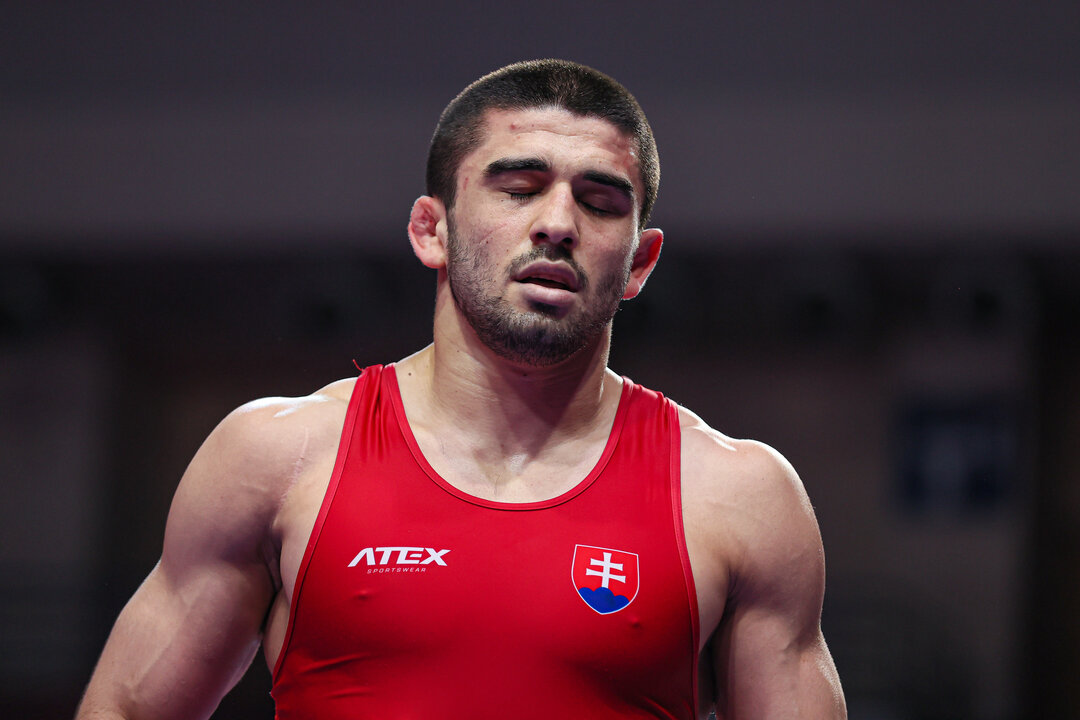 Akhsarbek GULAEV (SVK) defeated Saifedine ALEKMA (FRA), 2-1, in the 79kg finals and became Slovakia's second-ever freestyle European champion. (Photo: Kadir Caliskan)
The final gold of the night went to Slovakia's Akhsarbek Gulaev. He planted Saifedine ALEKMA (FRA) on his back and had the French wrestler dead to rights but the clock expired and the Slovakian led, 2-1, heading into the final period. After a scoreless second period, Gulaev hung on to improve on his ninth-place finish from a year ago and became Slovakia's second-ever freestyle European champion.
Wrestling resumes tomorrow at 11:30 (local time) with women’s wrestling action. The freestyle medal matches are set to begin at 18:00.
Semifinal Results
61kg
GOLD - Andrii DZHELEP (UKR) vs. Abasgadzhi MAGOMEDOV (RUS)
SEMIFINAL - Abasgadzhi MAGOMEDOV (RUS) df. Eduard GRIGOREV (POL), 4-2
SEMIFINAL - Andrii DZHELEP (UKR) df. Beka LOMTADZE (GEO), 5-3
74kg
GOLD - Tajmuraz SALKAZANOV (SVK) vs. Miroslav Stefanov KIROV (BUL)
SEMIFINAL - Tajmuraz SALKAZANOV (SVK) df. Razambek ZHAMALOV (RUS, 6-5
SEMIFINAL - Miroslav Stefanov KIROV (BUL) df. Valentin BORZIN (MDA), 5-0
86kg
GOLD - Artur NAIFONOV (RUS) vs. Sandro AMINASHVILI (GEO)
SEMIFINAL - Artur NAIFONOV (RUS) df. Boris MAKOEV (SVK), 9-0
SEMIFINAL - Sandro AMINASHVILI (GEO) df. Ali SHABANAU (BLR), 3-2
92kg
GOLD - Magomed KURBANOV (RUS) vs. Samuel SCHERRER (SUI)
SEMIFINAL - Magomed KURBANOV (RUS) df. Osman NURMAGOMEDOV (AZE), 6-2
SEMIFINAL - Samuel SCHERRER (SUI) df. Hajy RAJABAU (BLR), 5-4
125kg
GOLD - Taha AKGUL (TUR) vs. Sergei KOZYREV (RUS)
SEMIFINAL - Taha AKGUL (TUR) df. Dzianis KHRAMIANKOU (BLR), 4-0
SEMIFINAL - Sergei KOZYREV (RUS) df . Daniel LIGETI (HUN), 10-0
Final Results
57kg
GOLD - Suleyman ATLI (TUR) vdf Nachyn MONGUSH (RUS), 6-5
BRONZE - Afgan KHASHALOV (AZE) df. Aryan TSIUTRYN (BLR), 2-2
BRONZE - Kamil KERYMOV (UKR) df. Mikyay Salim NAIM (BUL), 9-4
65kg
GOLD - Zagir SHAKHIEV (RUS) df. Krzysztof BIENKOWSKI (POL), 13-2
BRONZE – Maxim SACULTAN (MDA) df. Andrei BEKRENEU (BLR), 5 - 2
BRONZE - Ali RAHIMZADE (AZE) df. Andrii SVYRYD (UKR), 3-2
70kg
GOLD - Israil KASUMOV (RUS) df. Turan BAYRAMOV (AZE), 3-1
BRONZE - Arman ANDREASYAN (ARM) df. Mihail SAVA (MDA), 4-3
BRONZE - Ihor NYKYFORUK (UKR) df. Nicolae COJOCARU (GBR), via inj. def.
79kg
GOLD - Akhsarbek GULAEV (SVK) vs. Saifedine ALEKMA (FRA), 2-1
BRONZE - Alans AMIROVS (LAT) vs. Rashad YUSIFLI (AZE), 4-3
BRONZE - Nika KENTCHADZE (GEO) df. Arman AVAGYAN (ARM), 10-0
97kg
GOLD - Alikhan ZHABRAILOV (RUS) df. Suleyman KARADENIZ (TUR), 6-4
BRONZE - Elizbar ODIKADZE (GEO) df. Shamil ZUBAIROV (AZE), via fall
BRONZE - Radoslaw BARAN (POL) df. Murazi MCHEDLIDZE (UKR), 8-1

Share your thoughts.
Comments