TOKYO (June 20) -- Taishi NARIKUNI was never ready to abandon his quest of completing the extremely unique double of world titles in both freestyle and Greco. But after his latest setback six months ago, he began to wonder if it was beyond his limits.
Narikuni, the world freestyle 70kg champion in 2022, put the dream within reach again when he secured a place on Japan's team to this year's World Championships at Greco 72kg.
Also Read: Tokyo champ Shidochi dealt setback in return from two-year layoff
Narikuni captured the title at the Meiji Cup All-Japan Championships on Friday at Tokyo Metropolitan Gym, then returned to the mat a short time later to win a playoff for the ticket to the senior worlds to be held September 13-22 in Zagreb.
"I finally did it," Narikuni said. "Of course, I'm happy, but there's also a feeling of relief."
The Meiji Cup is the second of two domestic qualifiers for the Zagreb worlds, following the Emperor's Cup All-Japan Championships last December. Winners at both earned places outright on the world team, while a playoff determined spots in which the champions differed.
Joining Narikuni on the plane to Zagreb will be his long-time friends and brothers Hayato and Takashi ISHIGURO, who started the sport in the same Gold Kids club run by Narikuni's mother -- a former two-time world champion herself.
 Taishi NARIKUNI works to turn Ryoma HOJO in the Greco 72kg final. (Photo: Takeo Yabuki / wrestling-spirits.jp)
It was Mom's two world titles that inspired Narikuni to launch a quest to not only match her in number of golds, but top her in uniqueness by going for one each in the two men's styles.
But since winning the freestyle title in Belgrade, he endured a tough road in switching full-time to Greco. Hampered at times by injury, he failed to even make the final of any of the domestic qualifiers.
One obstacle was that he tried to make it at 67kg, which is one of Japan's most stacked weight classes. He dropped down to 63kg for the Emperor's Cup in December, but the strain of cutting so much weight took its toll and he was ousted in the semifinals.
"When I cut down to 63kg in December, that was really, really tough," Narikuni said. "It took three months and I barely made it. But I thought if I want to win the world title, 63kg was the only path.
"To put everything on the line and then lose, it was depressing and made me feel that I had reached my limit. I was close to giving up. But I thought of the people who had long been supporting me, who put up with my selfishly going into Greco after becoming a freestyle champion, and I couldn't give up."
Narikuni then made the bold step of moving up two weight classes. With a natural weight of about 74kg and a proclivity for weight training, 72kg became a good fit.
"I think [this] weight class is just right for me," said Narikuni, who never looked inferior in terms of power, using a high chest wrap to lethal effect to get his turns. "I was never the type who cut a lot of weight, and it was really tough getting down to 63kg."
On Friday, Narikuni won the Meiji Cup title -- the first in his career in either style -- with a solid 9-0 victory in the final over Ryoma HOJO.
He then clinched the world team spot with a 9-0 demolition of Emperor's Cup champion Issei HONNA that took just 1:47 and included a 5-point throw. He had defeated Honna 6-0 in the semifinals on Friday.
 Hayato ISHIGURO makes short work of Tatsuya SHIRAI in the world team playoff at freestyle 86kg. (Photo: Takeo Yabuki / wrestling-spirits.jp)
In the only other playoff on the day, Paris Olympian Hayato Ishiguro clinched the world team spot at freestyle 86kg with a lightning-quick 10-0 win over Emperor's Cup and former world U23 champion Tatsuya SHIRAI.
Ishiguro, who beat Shirai 3-0 earlier in their final round-robin match to top the standings and set up the playoff, scored a takedown, then reeled off a tilt, roll, exposure and roll to end the match in 54 seconds.
Ishiguro's older brother, Asian bronze medalist Takashi, completed the Emperor's Cup-Meiji Cup double at freestyle 92kg with an 8-2 victory over Takato UCHIDA.
It will be the third time for the brothers to appear at the same World Championships, after 2021 and 2023.
 Sakura ONISHI and older brother Taiga celebrate making Japan's team to the World Championships together. (Photo: Takeo Yabuki / wrestling-spirits.jp)
Onishi makes world team, with a brotherly bonus
World U20 champion Sakura ONISHI had little trouble cruising to victory at women's 59kg to earn her first trip to the senior worlds. Then she got an added bonus when older brother Taiga secured a ticket to Zagreb as well at Greco 55kg.
The 19-year-old Sakura scored a takedown in each period and was never in danger as she rolled to a 5-0 victory over Sena NAGAMOTO in the final, repeating her win in the gold-medal match at the Emperor's Cup but in much smoother fashion.
The victory erases the lingering sting from last year, when she defeated two-time Olympic champion Risako KINJO en route to the title, only to suffer a heartbreaking last-second loss in the world team playoff.
"Last year, I was left with a tough memory after losing in the playoff, but I think this makes up for it and I'm really happy," Onishi said.
Onishi was clearly the favorite this time, and said she was energized by the combination of the pressure, the support of those around her, and the victory by her brother.
"There was a lot of pressure and things to think about, but I received a lot of messages of support from many people that really gave me strength. And three was my older brother winning. Instead of being pressure, I turned it all to energy. I'm really satisfied."
Onishi, who won the senior Asian title in March, has established herself of one of Japan's fastest rising stars. She has suffered just one loss in seven international tournaments, falling to Maria YEFREMOVA (UKR) in the final at the 2022 World U17 Championships in Rome.
Prior to Zagreb, she will defend her world U20 title in August in Bulgaria. Looking farther ahead, her aim is to make it to the 2028 Los Angeles Olympics along with senior Nippon Sport Science University teammate Akari FUJINAMI, the Paris Olympic champion at 53kg who has moved up to 57kg. That would entail a move up to 62kg, an issue she said she will address when the time comes.
Meanwhile, 2022 world U20 bronze medalist Taiga, a student at Waseda University, will be heading to his second senior worlds after defeating Sanshiro TAKAHASHI 7-1 in the Greco 55kg final.
Takahashi had defeated Emperor's Cup and Asian champion Kohei YAMAGIWA in the semifinals, but Yamagiwa was injured in the match and unable to take part in the playoff, handing Onishi the world team spot by default.
 Arash YOSHIDA secures a fall in the freestyle 97kg final against high schooler Noah LEIBOWITZ. (Photo: Takeo Yabuki / wrestling-spirits.jp)
Japan national team gets double helping of Yoshida
Two of Japan's rising young male stars, who happen to share a last name, clinched their tickets to Zagreb by adding the Meiji Cup title to their Emperor's Cup triumph.
Arash YOSHIDA overwhelmed high schooler Noah LEIBOWITZ in the freestyle 97kg final, muscling him over and scoring a victory by fall in 2:31.
Three matches later, Taizo YOSHIDA rallied from a 6-3 deficit, scoring the go-ahead points in the last 20 seconds to defeat Reon KAKEGAWA 11-6 for the Greco 82kg gold.
Arash Yoshida has occasionally sparred with the 17-year-old Leibowitz, who, through his coaches' connection, has been invited to practices at Nihon University. The son of an American father and Japanese mother who came to Japan when he was 4, Leibowitz still has a way to go to catch up to Yoshida, a two-time Asian champion.
"At times, Leibowitz comes to our practices, so I think there were things about me that he knew," Yoshida said. "Even so, it was good that I was able to stop him and get the fall."
Also proficient in judo, Leibowitz has set a lofty goal of winning a wrestling gold at the Los Angeles Olympics, then striking gold in judo at a future Olympics.
In other action, four-time world medalist Miwa MORIKAWA cut it close in capturing the women's 65kg title, then former world champion Masako FURUICHI cut it even closer to triumph at women's 72kg.
Morikawa needed a victory in the final round of matches in the five-women round-robin, and she barely held on to secure a 4-3 win over Nana IKEHATA.
Morikawa went ahead 3-1 with a stepout and takedown in the second period. In the last 10 seconds, Ikehata put the pressure on but had to settle for two stepouts. An unsuccessful challenge after the second one gave Morikawa her final point.
 Masako FURUICHI turns over Ayano MORO to pull out a last-second victory in the women's 72kg final. (Photo: Takeo Yabuki / wrestling-spirits.jp)
At 72kg, Emperor's Cup champion Furuichi was trailing 2-1 against 2022 world U20 champion Ayano MORO, with all of the points coming on the activity clock, when she launched a last-ditch shot at a single leg. Moro's sprawl seemed to be enough to fend off the attack as the seconds ticked down.
But suddenly, Furuichi got enough leverage to dump Moro onto her back, where she lay stunned to make it a victory by fall at 5:58 and miss out on forcing a playoff. A distraught Moro later wept loudly, her wailing audible throughout the arena.
Day 2 Results
Freestyle
61kg (12 entries)
SF 1: Toshihiro HASEGAWA df. Aiki KAWAI, 10-2
SF 2: Akito MUKAIDA df. Takuto OSETO by Fall, 4:04 (14-4)
70kg (12 entries)
SF 1: Ryoya YAMASHITA df. Yoshinosuke AOYAGI, 4-2
SF 2: Shoya MIURA df. Makoto HOSOKAWA, 7-4
79kg (9 entries)
SF 1: Keyvan GHAREHDAGHI df. Ryunosuke KAMIYA, 4-4
SF 2: Subaru TAKAHARA df. Natsura OKAZAWA, 5-1
86kg (5 entries)
GOLD: Hayato ISHIGURO (4-0)
SILVER: Yudai TAKAHASHI (3-1)
BRONZE: Tatsuya SHIRAI (2-2)
Key match: Ishiguro df. Takahashi 5-4 in Round 3
World Team Playoff: Ishiguro df. Shirai by TF, 10-0, :54.
92kg (10 entries)
GOLD: Takashi ISHIGURO df. Takato UCHIDA, 8-2
BRONZE: Masanobu MITSUI df. Shuichiro SATO, 4-3
BRONZE: Sorato KANAZAWA df. Rintaro MOTOHASHI, 9-5
97kg (7 entries)
GOLD: Arash YOSHIDA df. Noah LEIBOWITZ by Fall, 2:31 (6-0)
BRONZE: Yuta SASAKI df. Takuma TATEOKA by Def.
125kg (10 entries)
GOLD: Taiki YAMAMOTO df. Hibiki ITO, 2-1
BRONZE: Ryusei FUJITA df. Hosei FUJITA by Fall, 1:33 (5-4)
Greco-Roman
55kg (11 entries)
GOLD: Taiga ONISHI df. Sanshiro TAKAHASHI, 7-1
BRONZE: Kohei YAMAGIWA (no match)
BRONZE: Taketo NINOMIYA df. Ryuma KAWANO by TF, 9-0, 1:49
World Team Playoff: Onishi df. Kohei YAMAGIWA by Def.
63kg (11 entries)
GOLD: Manato NAKAMURA df. Ayata SUZUKI by TF, 12-2, 1:53
BRONZE: Yuto NAGASAWA df. Kazuki YABE by Def.
BRONZE: Shoya ITO df. Sota SUGIMOTO, 8-3
72kg (11 entries)
GOLD: Taishi NARIKUNI df. Ryoma HOJO by TF, 9-0, 2:15
BRONZE: Rei NAGAMATSU df. Issei HONNA by Def.
BRONZE: Daigo KOBAYASHI df. Kento NOMURA, 6-2
World Team Playoff: Narikuni df. Honna by TF, 9-0, 1:47
82kg (9 entries)
GOLD: Taizo YOSHIDA df. Reon KAKEGAWA, 11-6
BRONZE: Tesshin HIGUCHI df. Daichi AKIHO by Fall, 1:39 (7-0)
BRONZE: Yudai KOBORI df. Yoshimitsu MATSUZAKI by Fall, 1:29 (4-0)
87kg (7 entries)
SF 1: Tatsuya FUJII df. Genki YAHAGI, Inj. Def.
SF 2: So SAKABE df. Isshin ONITSUKA by TF, 8-0, 1:57
97kg (11 entries)
SF 1: Yuri NAKAZATO df. Ryosei KATAMATSU by TF, 9-0, 3:30
SF 2: Takahiro TSURUDA df. Sorato KANAZAWA by Fall, 5:06 (10-2)
130kg (7 entries)
SF 1: Yuta NARA df. Shion OBATA, 3-1
SF 2: Sota OKUMURA vs Ayumu IWASAWA by TF, 9-0, 3:15
Women's Wrestling
53kg (11 entries)
SF 1: Moe KIYOOKA df. Haruna MORIKAWA, 2-1
SF 2: Haruna MURAYAMA df. Saki YUMIYA, 5-0
55kg (7 entries)
GOLD: Sowaka UCHIDA df. Umi IMAI, 2-0
BRONZE: Karina HONDA df. Narumi NAKAMURA by Fall, 5:50 (5-1)
59kg (9 entries)
GOLD: Sakura ONISHI df. Sena NAGAMOTO, 5-0
BRONZE: Sae NOGUCHI df. Sayaka OTA, 3-0
BRONZE: Miuna KIMURA df. Misaki YOSHIBA, 3-0
65kg (5 entries)
GOLD: Miwa MORIKAWA (4-0)
SILVER: Nana IKEHATA (3-1)
BRONZE: Akari ASAI (2-2)
Key match: Morikawa df. Ikehata 4-3 in Round 5
68kg (4 entries)
Standings through 2 rounds: 1. Ami ISHII (2-0); 2. Seia MOCHINAGA (2-0); 3. Kaede MATSUYAMA (0-2); 4. Rin MIYAJI (0-2).
72kg (7 entries)
GOLD: Masako FURUICHI df. Ayano MORO by Fall, 5:58 (3-2)
BRONZE: Mahiro YOSHITAKE df. Chisato YOSHIDA by TF, 10-0, 3:16
76kg (4 entries)
Standings through 2 rounds: 1. Nodoka YAMAMOTO (2-0); 2. Yasuha MATSUYUKI (2-0); 3. Mizuki NAGASHIMA (0-2); 4. Sakura NAKANO (0-2).



 Yanan SUN (CHN) is a bronze medalist from the Rio Olympics as well. (Photo: (Xinhua)
 Yanan SUND (CHN) and Yui SUSAKI (JPN) compete during the 50kg final at Tokyo 2020 Olympic Games. (Photo: Xinhua / Xu Zijian)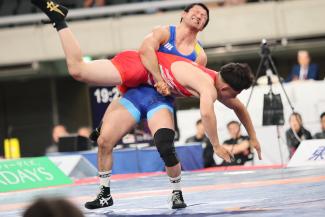
Share your thoughts.
Comments