

Abuladze Upgrades Oslo Silver to #WrestleBelgrade Gold
Tuesday, November 2, 2021 - 21:52 By Vinay Siwach

BELGRADE, Serbia (November 2) -- In the last 24 days, Leri ABULADZE (GEO) captured a silver medal at the Senior World Championships and a gold at the U23 Worlds.
Recovering from a heartbreaking 5-4 loss in the Oslo finals to Meysam DALKHANI (IRI), Abuladze dug deep for the 3-1 win over Ahmet OYUR (TUR) in the 63kg final in Belgrade and won his first-ever world title.
Abuladze was one of the five wrestlers that won gold on Tuesday at the Belexpocentar in the Serbian capital. Russia won two gold while Iran and Hungary each won one.
Abuladze's wrestling was the highlight of the tournament over the two days. He scored from disadvantageous positions and defended as if his life depended on it to rally to the title. And though he holds the silver in Oslo higher, he said he was proud of his effort in Belgrade.
"It's not possible to describe the feeling I had when the Georgian anthem was playing," Abuladze said.
In the final, the Georgian controlled Uyar for the first period, and after following up an inactivity point with a left-sided gut wrench, carried a three-point lead into the second period.
But in the second period, Abuladze had to dig deep after giving up an inactivity point himself. He furiously fought off a Turkish lift attempt and won his first world title with a 3-1 victory.
Despite a testing final, he picks the semifinal against Tokyo Olympian Alireza NEJATI (IRI) as his toughest bout of the tournament.
"The one with the Iran wrestler [was the toughest bout]," he said. "That is because he is a senior world medalist [2019], he was in Tokyo Olympics.
"He is a good wrestler and a tough opponent, but the stronger one won."
Abuladze is Georgia's fifth-ever U23 Greco-Roman world champion. He joined Shmagi BOLKVADZE, Nugzari TSURTSUMIA, Zviadi PATARIDZE and Gela BOLKVADZE.
 Tamas LEVAI (HUN) won the 77kg gold medal at the U23 World Championships. (Photo: UWW / Mohammed Yahia)
At 77kg, Tamas LEVAI (HUN) joined Erik SZILVASSY as Hungary's only U23 GR world titleholder with a tactical 5-1 performance over Amin KAVIYANINEJAD (IRI). The Hungarian lit up the scoreboard with all five of his points in the first period of the 77kg finals. The refs awarded Levai the one point for inactivity before throwing Kaviyaninejad's feet over his head with a four-point lift.
The inactivity was returned in the second period, but Levai escaped while only giving up the one point. Nevertheless, he hung on and stopped the Iranian from adding a fourth world title to his resume.
"I wanted this so bad," Levai said. "My family is of wrestlers, but we did not have a medal at the World Championships. But I have broken the ice."
Levai has been a constant performer at the continental level but made a name for himself when he defeated two-time Olympic champion Roman VLASOV (RUS) at the Poland Open. But Vlasov avenged that loss in Oslo.
With Vlasov watching from the stands, Levai was motivated to impress the Greco-Roman legend from Russia.
"Before coming here, I imagined myself as a world champion," he said. "I was very focused and thinking that if I can beat Vlasov, then I can beat anyone. So I was motivated and wanted to show him that I am a really good wrestler."
 Mavlud RIZMANOV (RUS), red, won the first gold of the U23 Worlds. (Photo: UWW / Kadir Caliskan)
Russia had two finalists Tuesday and both came away with gold. Mavlud RIZMANOV (RUS) was up first. He stopped Iran's Poya DAD MARZ from winning a second age-group world title with a two-point come-from-behind win at 55kg.
The '21 U23 European bronze medalist surrendered an inactivity point and trailed 1-0 heading into the final frame. However, with less than two minutes to go in the bout, the Russian failed to capitalize on a lift attempt but seamlessly transitioned into a right-sided gut wrench and gained a 3-1 lead.
Rizmanov, who was introduced to the sport by his brothers and as he got better, got admitted to the Rostov Olympic College, fought off a late flurry of attacks from Dad Marz and picked up Russia's first 25-point gold medal win over of the night.
"I knew it wasn't going to be easy as Iranians are always tough to wrestle," Rizmanov said. "I was prepared for a six-minute bout."
 Aleksandr KOMAROV (RUS) won his fifth age-group world title Tuesday. (Photo: UWW / Kadir Caliskan)
The second gold came at 87kg, as Aleksandr KOMAROV (RUS) ascended to the top of the fifth time in his career with a blistering 9-0 win over David LOSONCZI (HUN).
The young-up-and-coming Russian started the match on the slow foot but found his arm drag late in the first period and blew the doors off the bout. He led 3-0 but scored a pair of takedowns and two step-outs with that arm drag and closed the match out with a nine-point win.
Komarov last won one of five gold medals in age-group Worlds in 2018 and was relieved that he could do the same again.
"It's been a long time since I last won," Kamorov said. "But it would be definitely better to win the senior world than any age-group title."
The Russian had a tough road to the final and was tested at every stage, especially the semifinal against Temuri TCHKUASELIDZE (GEO), which he won 7-7.
"All my opponents were the leaders of our weight category," he said. "Wrestlers from Iran, India and even the semifinal was difficult. It's the first time when I had so difficult bouts one after another."
The 23-year-old wants to carry forward the age-group success into the senior category and win medals.
"Now it's important to get ready for the Russian nationals; I really want the gold medals on the senior level," he said.
 Amin MIRZAZADEH (IRI) is now a three-time age-group world champion. (Photo: UWW / Kadir Caliskan)
Iran capped the day with the gold medal after failing twice earlier in the evening as Tokyo Olympian Amin MIRZAZADEH (IRI) used a quick second-period takedown to move past David OVASAPYAN (ARM), 2-1, and won the 130kg titile. The final was a rematch from the 2018 Junior World Championships final which the Iranian won as well.
Mirzazadeh expressed his relief at winning the gold in a tough year which saw him finish fifth at the Olympics and battle with the COVID-19 virus.
"This year was a tough year for me, and I am happy that I could get this medal at the end," Mirzazadeh said. "In the second match against Russia, my ankle got injured, but I am happy that I could finish that match."
Though he wanted to be a world champion in Oslo, he still was motivated for the U23 Worlds and became a champion in Belgrade.
"I kept myself hopeful [despite missing the Oslo tournament] and continued my training," he said. "Although victory in Seniors is sweet but being champion at U23 level is also valuable. It is a good step and will motivate me to continue."
RESULTS
55kg
GOLD: Mavlud RIZMANOV (RUS) df Poya DAD MARZ (IRI), 3-1
BRONZE: Adem UZUN (TUR) df Arslan ABDURAKHMANOV (KAZ), via fall
BRONZE: Nihad GULUZADE (AZE) df Taylor LA MONT (USA), 9-0
60kg
GOLD: Mehdi MOHSEN NEJAD (IRI) vs Anvar ALLAKHIAROV (RUS)
SF 1: Anvar ALLAKHIAROV (RUS) df Kerem KAMAL (TUR), 9-0
SF 2: Mehdi MOHSEN NEJAD (IRI) df Pridon ABULADZE (GEO), 5-3
63kg
GOLD: Leri ABULADZE (GEO) df Ahmet UYAR (TUR), 3-1
BRONZE: Ali NEJATI (IRI) df Georgii TIBILOV (RUS), 9-0
BRONZE: Hrachya POGHOSYAN (ARM) df Corneliu RUSU (MDA), 9-0
67kg
GOLD: Mohammad REZAEI (IRI) vs Hasrat JAFAROV (AZE)
SF 1: Hasrat JAFAROV (AZE) df Kadir KAMAL (TUR), 3-1
SF 2: Mohammad REZAEI (IRI) df Joni KHETSURIANI (GEO), 5-1
72kg
GOLD - Sergei KUTUZOV (RUS) vs Idris IBAEV (GER)
SF 1: Idris IBAEV (GER) df Shant KHACHATRYAN (ARM), 9-0
SF 2: Sergei KUTUZOV (RUS) df Ulvi GANIZADE (AZE), 3-2
77kg
GOLD: Tamas LEVAI (HUN) df Amin KAVIYANINEJAD (IRI), 5-1
BRONZE: Sergei STEPANOV (RUS) df Nikoloz TCHIKAIDZE (GEO), 9-0
BRONZE: Per Albin OLOFSSON (SWE) df Dmytro VASETSKYI (UKR), 2-1
82kg
GOLD: Aivengo RIKADZE (GEO) vs Ramon BETSCHART (SUI)
SF 1: Ramon BETSCHART (SUI) df Moric KISMONI (HUN), 6-1
SF 2: Aivengo RIKADZE (GEO) df Mohammad NAGHOUSI (IRI), 5-2
87kg
GOLD: Aleksandr KOMAROV (RUS) df David LOSONCZI (HUN), 9-0
BRONZE: Naser ALIZADEH (IRI) df Temuri TCHKUASELIDZE (GEO), 15-7
BRONZE: Szymon SZYMONOWICZ (POL) df Markus SIHTOLA (FIN), 5-2
97kg
GOLD: Pavel HLINCHUK (BLR) vs Artur SARGSIAN (RUS)
SF 1: Artur SARGSIAN (RUS) df Markus RAGGINGER (AUT), 3-1
SF 2: Pavel HLINCHUK (BLR) df Robert ERSEK (HUN), via fall
130kg
GOLD: Amin MIRZAZADEH (IRI) df David OVASAPYAN (ARM), 2-1
BRONZE: Mikhail LAPTEV (RUS) df Fatih BOZKURT (TUR), 6-0
BRONZE: Dariusz VITEK (HUN) df Delian ALISHAHI (SUI), 3-0
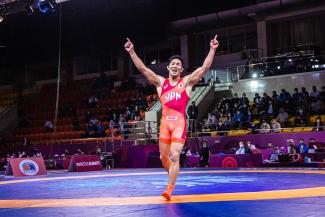
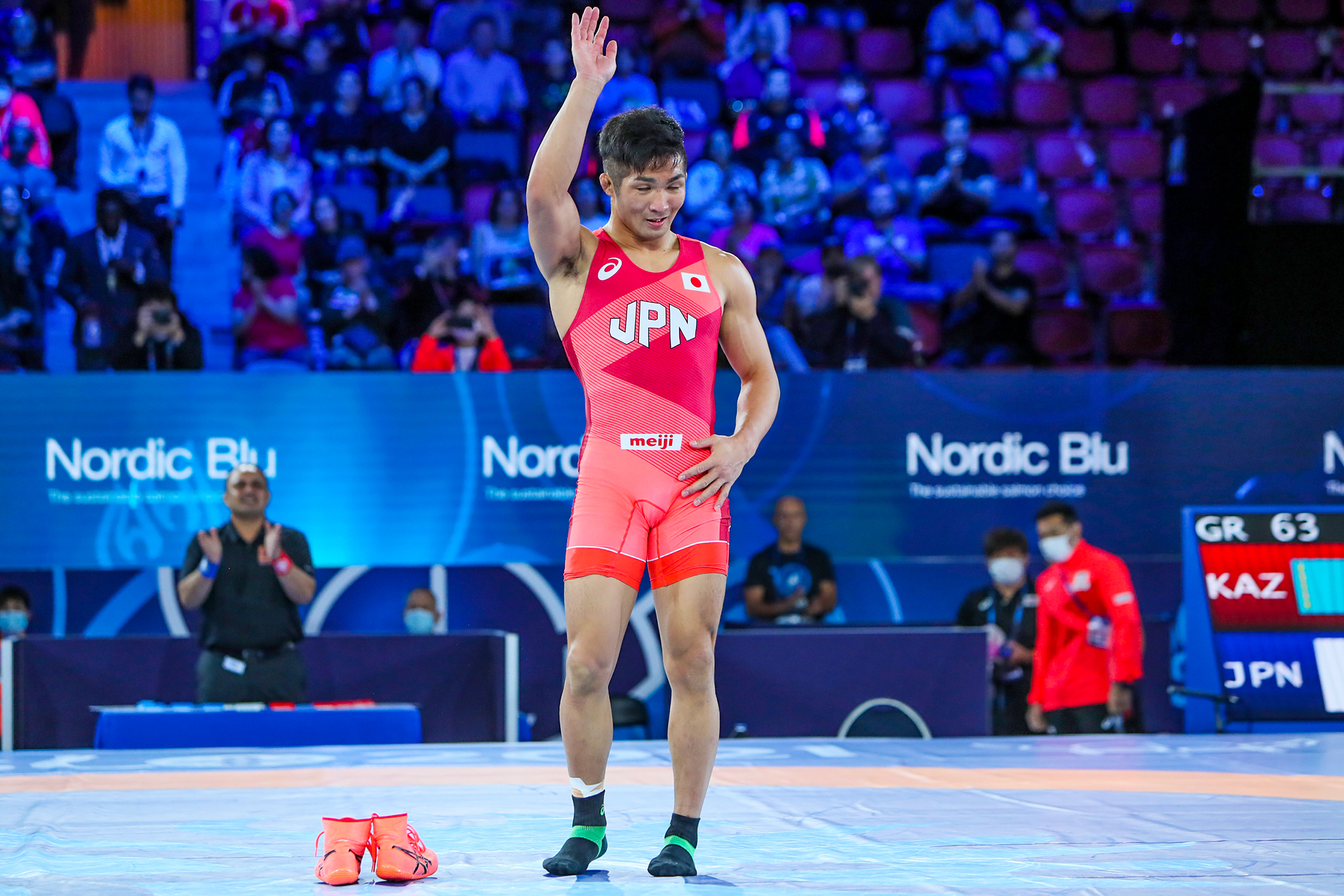 Tsuchika SHIMOYAMADA (AUS) had left his shoes on the mat during the 2021 World Championships to mark his retirement. (Photo: United World Wrestling / Martin Gabor)
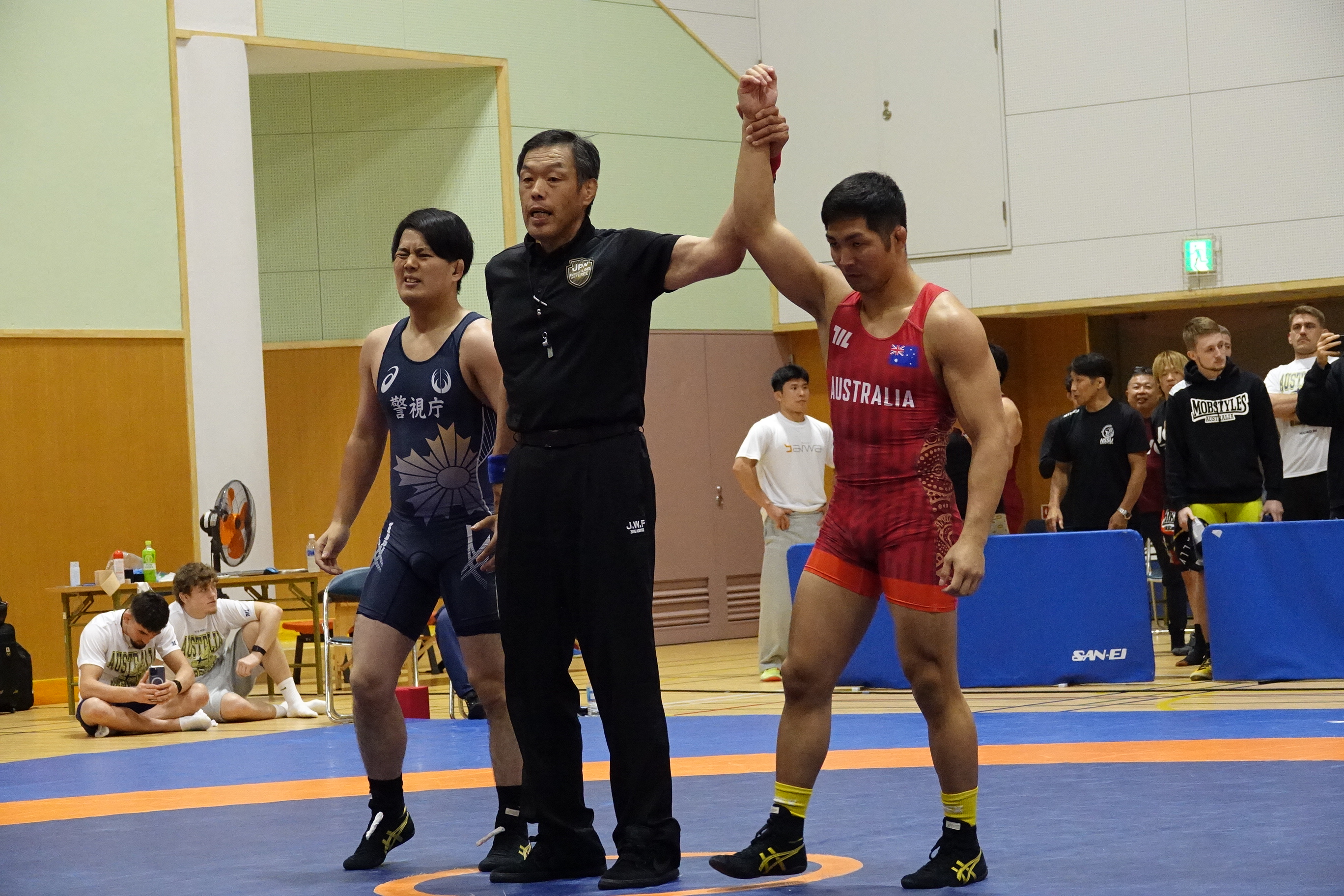 Tsuchika SHIMOYAMADA advances to the semifinals at the All-Japan Non-Student Championships in July with a 52-second win over Kokoro GOTO. (Photo: Koji Fuse / wrestling-spirits.jp)
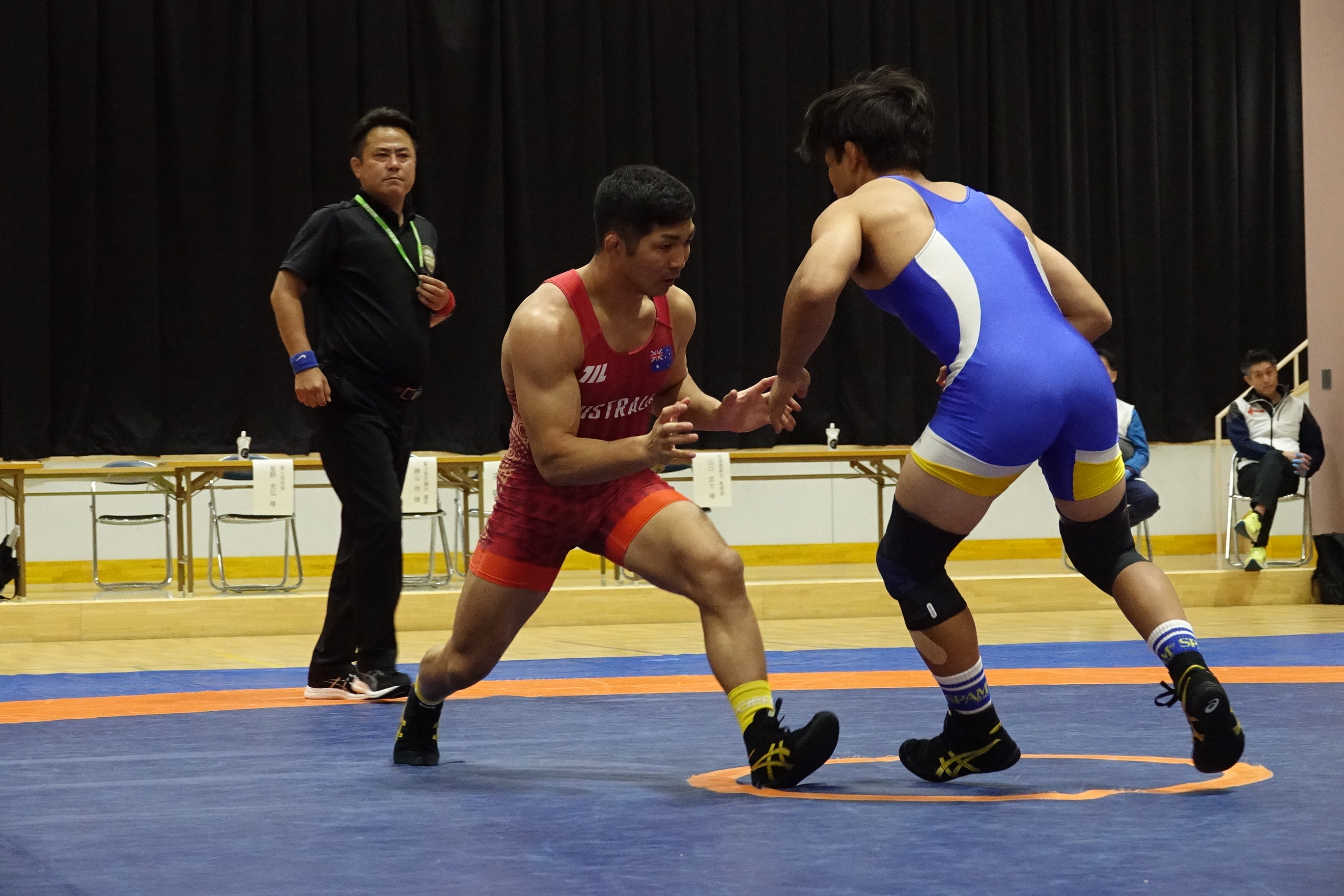 Tsuchika SHIMOYAMA faces Keitaro ONO in his opening match at the All-Japan Non-Student Championships in July. (Photo: Koji Fuse / wrestling-spirits.jp)
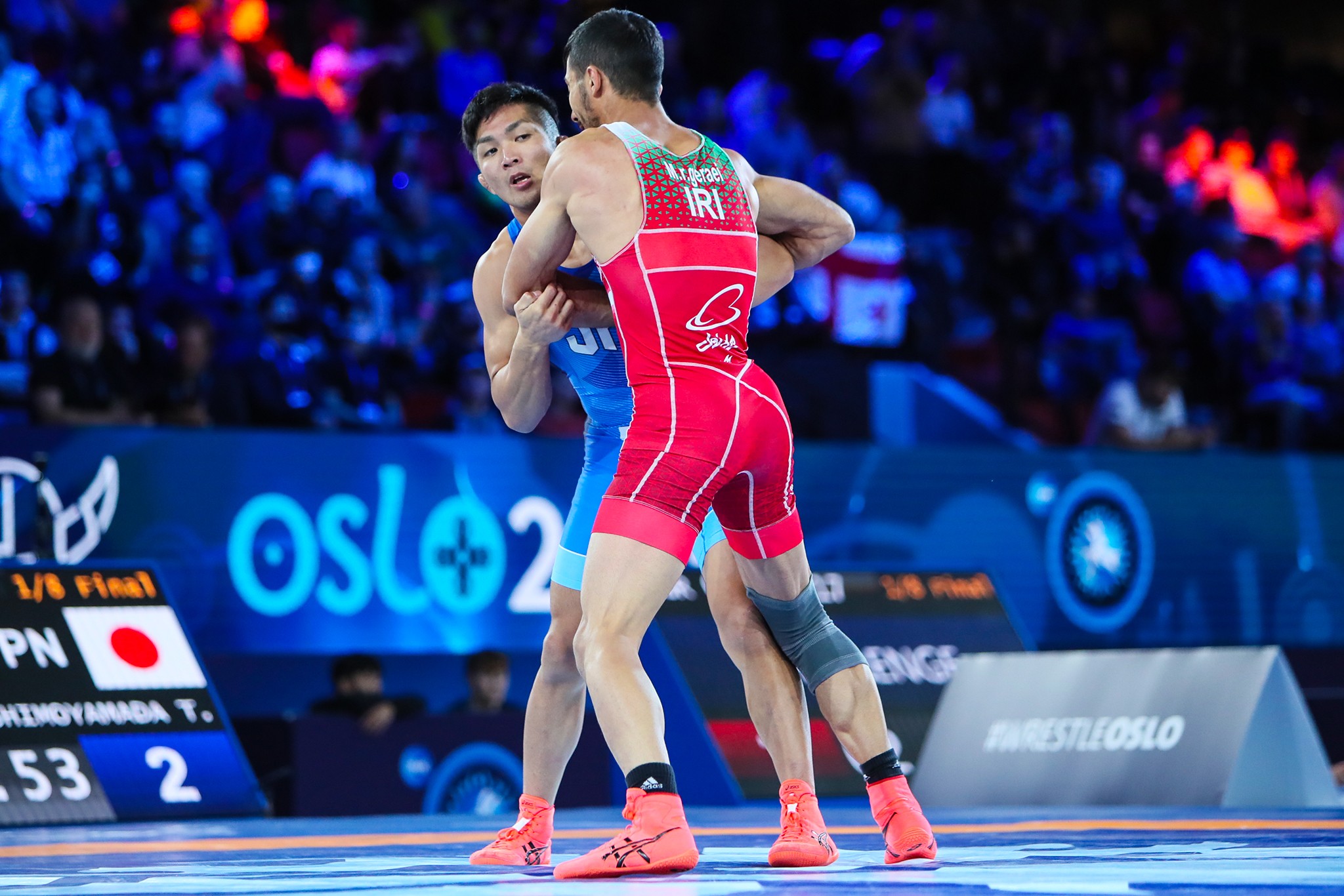 Tsuchika SHIMOYAMADA (AUS) was dominating Mohammadreza GERAEI (IRI) in their match at the 2021 World Championships before being pinned. (Photo: United World Wrestling / Martin Gabor)
Share your thoughts.
Comments