

Susaki Returns from Elbow Injury with Victory as Junior, but Laments Struggles
Wednesday, April 3, 2019 - 22:56 By Ken Marantz

TOKYO---Two-time senior world champion Yui SUSAKI went into the Japan Junior Queens Cup with the objective of winning a title in her comeback from a serious elbow injury in December, and going home with a smile.
She got half of what she wanted.
Susaki had to fight back tears after struggling to defeat relatively unheralded Remina YOSHIMOTO, 2-1, in the 50kg final of the junior division of the two-day tournament for Japan's young females at Tokyo's Komazawa Gym.
While a junior tournament, even on the national level, may seem below Susaki's pay grade, she saw it as a chance to get back on the mat following her injury, and, as she turns 20 in June, have one last fling as a junior. What she did not foresee was the immense pressure that she would put on herself to perform.
"In this final, I really felt the pressure," Susaki said. "Having that fear going into the match, it was the first time I wrestled feeling such pressure. Only a person who has become a champion can experience this. I will get over this and work hard to become a dominant, true champion."
Susaki, who won her second straight senior world title last October in Budapest, suffered a dislocated elbow just prior to the Emperor's Cup All-Japan Championships in December. That tournament was the first of two qualifiers for Japan's team to this year's world championships in Astana---where winning a medal will automatically clinch a spot on the squad for the Tokyo 2020 Olympics.
"Where I am at this point, I can't achieve my goal," Susaki said. "I will urgently pick up the pace to overcome my shortcomings, and renew my determination to make it to the Tokyo Olympics. Compared to myself at the world championships, I am still far behind my ideal level."

(Yui SUSAKI holds off Remina YOSHIMOTO in the junior 50kg final. Photo: Takeo Yabuki, JWF)
To get back to the worlds---and have a shot at the coveted ticket to Tokyo 2020---Susuki will next have to enter a qualifying tournament for the Meiji Cup All-Japan Invitational Championships in June, the second national team qualifier. She would then have to win the Meiji Cup, then defeat Emperor's Cup champion Yuki IRIE in a playoff.
Not impossible, as she did it last year to get to Budapest. But that time, she wasn't coming off a serious injury that has seemed to sap some of her confidence.
"She's only just returned and her elbow has healed, now she needs to increase the amount of practice," said Shoko YOSHIMURA, Susaki's coach during her days at the JOC Elite Academy who was in her corner on Wednesday. "She had a tough time in the final, but up to then, she had very good matches. We saw a lot of good things. She just needs to have confidence going into matches."
Susaki, her elbow taped, completely outclassed her first three opponents, winning by first-period 10-0 technical falls in her first two matches on Tuesday, then routing Ayaka HIRATA by the same score in their semifinal Wednesday morning.
But Yoshimoto, who just entered her freshman year at powerhouse Shigakkan University, proved to be formidable opponent, one who might crash the three-women 50kg party of Susaki, Irie and Rio 2016 champion Eri TOSAKA. Like Susaki, Yoshimoto needs to qualify for the Meiji Cup.
In the final, all three points came with the opponent on the activity clock, with Susaki scoring the go-ahead point with :40 left in the match. Yoshimoto had the best chance to score, as she got in on a deep single-leg early in the first period, but Susaki reached over and locked a leg and the move ended in a stalemate.
"In the final, I wasn't able to wrestle my way, and it became a tough match," Susaki said.
Yoshimoto, the 2017 world cadet champion at 46kg, sensed Susaki's anxiety, and regretted she could not take advantage to score a major upset over one of world wrestling's most popular stars.
"I think that she was under a lot of pressure this time, as this was her comeback from an injury," Yoshimoto said. "Psychologically, I was the challenger, which was an advantage for me. That I wasn't able to come away with a win was due to my weakness. She was under many times more pressure than me, and by winning, it shows how strong Yui is. That's something that I'm still lacking."

(Yui SUSAKI fights off a takedown attempt by Remina YOSHIMOTO in the junior 50kg final. Photo: Takeo Yabuki, JWF)
Yoshimoto made an impression as a high schooler at the Emperor's Cup last December, when she lost 8-4 to Irie in the quarterfinals, then pushed Tosaka in the third-place match before falling 7-3. She followed that up with a strong showing at this year's Klippan Lady Open, where she lost 4-4 to Chinese veteran SUN Yanan.
"She's a very good wrestler," Yoshimura said. "She uses the typical Japanese low stance. She had a great tournament."
Yoshimura added that Susaki's tough final proved only further how loaded Japanese women's wrestling is in the lower weight classes, and will only get stronger as the stakes rise.
"From now, they will raise each other's level, and the strongest wrestler will represent Japan at the world championships and Olympics," she said. "Looking at that, Japan has incredible depth, with many strong wrestlers. To win this fight is very difficult. If you beat them, you're very close to being a world champion."
Following Tuesday's session, Susaki spoke more in depth about her current condition and the recovery process. She also said the experience of being away from the sport only served to renew her devotion for it.
"My left elbow has pretty much healed, it's about at 90 percent," she said. "When I was injured before the Emperor's Cup and couldn't compete, it was really tough to take. It was the first time to have such a serious injury, and experience such hard times.
"It made me happy that I was able to wrestle again, and it made me realize how much I really like wrestling. Before I had to watch from the stands and bear the frustration, but to be able to now wrestle in a match, it's fun and I really know how happy it makes me. It makes me feel deep inside how important wrestling is to me."
Susaki said she was so desperate to get back into action, during rehab she even practiced one-handed. Unfortunately, she said, she ended up developing some bad habits which she had since amended.
As for entering the junior tournament, she replied, "Conversely, I didn't feel I had the choice not to enter. When I was unable to compete at the Emperor's Cup, I decided I would get back to full health and win the Queens Cup."

(Haruna OKUNO puts the pressure on Umi IMAI in the junior 53kg final. Photo: Takeo Yabuki, JWF)
Okuno also makes victorious comeback
Like Susaki, fellow world champion Haruna OKUNO missed out on the Emperor's Cup---in her case due to a stomach virus---and entered the Junior Queens Cup as part of her comeback.
Okuno was a rock of stability in winning the 53kg title, notching four without conceding a point, including a solid 6-0 win in the final over world junior and Klippan champion Umi IMAI.
That was Okuno's second 6-0 victory of the tournament, which also included a 10-0 technical fall and a victory by fall in which she had built a 12-0 lead.

(Haruna OKUNO defends against a takedown attempt by Umi IMAI in the junior 53kg final. Photo: Takeo Yabuki, JWF)
"More than a technical fall, I wanted to solidly score points," Okuno said. "Even when [Imai] got my legs, I was able to break free. Up to now, most times when the opponent got in my legs, they were able to lock it up. But I worked on breaking the hold."
Okuno is a product of the same wrestling club that produced legendary Saori YOSHIDA, and although the club stressed aggressiveness, her forte became defense, which she showed in the Junior Queens.
"I come from the same place as Saori [Yoshida], so attacking, going for tackles is the image that we have. But when I was in kids wrestling, I wasn't strong on tackling. I was the type of wrestler that had low scores, or come-from-behind wins or losses. To not give up points has been my strong point."
Okuno, who bounced back from finishing third at the Asian Games last summer by winning the gold in Budapest, has her work cut out for her to get onto the team for Astana. Mayu MUKAIDA, the world champion at 55kg, has dropped down to the Olympic weight of 53kg, and moved halfway to Astana by winning the weight class at the Emperor's Cup. Head-to-head, Mukaida has won all eight of their encounters.

(Yuka KAGAMI works for a takedown against Kanon KOBAYASHI during their round-robin match in the junior 72kg class. Photo: Takeo Yabuki, JWF)
In other action, two-time world cadet champion Yuka KAGAMI moved up to the junior division and made mincemeat of that group, posting four 10-0 technical falls and one fall to win the 72kg gold.
Kagami, who was named the UWW cadet wrestler of the year in 2018, said she has been inspired by JOC Elite Academy alum Susaki to take shots at the older divisions, and this year she finished second at the Ivan Yarygin Grand Prix and third at the Klippan.
"I didn't really think about that, but I watched Yui and other older teammates win on the senior level," she said. "I thought if I worked hard, I could do it, too."
The 17-year-old Kagami revealed that she will make her most bold challenge to date in June, when she moves up to 76kg for the Meiji Cup in a bid for Tokyo 2020 that few thought was in her range.
Kagami won the 72kg title at the Emperor's Cup in a field of four as the top wrestlers went either up or down to the Olympic divisions of 68kg or 76kg. But she wants to fulfill her Olympic dream sooner than later, which will put her on a collision course with two-time world medalist and defending champion Hiroe MINAGAWA.
"Right now, I'm in a non-Olympic weight, but it's my plan to enter the Meiji Cup at 76kg, win that and then the playoff, then go to the world championships," Kagami said. "Everyone's saying to me 'Paris [2024]', but for myself, I'm aiming for Tokyo."
In the 55kg class, world U23 and junior champion Saki IGARASHI scraped out a 3-0 win over high schooler Tsugumi SAKURAI in the final.
Two of Japan's reigning world junior champions came up short of national titles, as Atena KODAMA fell 5-2 in the 62kg final to Yuzuka INAGAKI, and Akie HANAI decked Hanako SAWA with two seconds left in the 57kg final.
Twin sisters Naruha and Yasuha MATSUYUKI won the 68kg and 76kg titles, respectively.
The tournament also decided the nation's best females in the schoolgirl, junior high school and cadet age groups.

(Akari FUJINAMI works to turn over Mako ONO in the cadet 53kg final. Photo: Takeo Yabuki, JWF)
Among the future stars, Akari FUJINAMI remains untouchable at the cadet level as the younger sister of 2017 world freestyle bronze medalist Yuhi FUJINAMI put together three technical falls and a fall to take the 53kg crown.
"I was satisfied that I was able to be the aggressor," said Fujinami, who will compete in her first high school tournament in August. "I want to continue to raise my level, and work hard to be able to challenge those at the next level."
In a battle between Asian U15 champions and Klippan cadet medalists, Moe KIYOOKA edged Yu SAKAMOTO 2-1 in a nail-biting 49kg final.
World cadet champions Nonoka OZAKI (61kg) and Honoka NAKAI (69kg) both stormed to gold medals in their respective divisions.
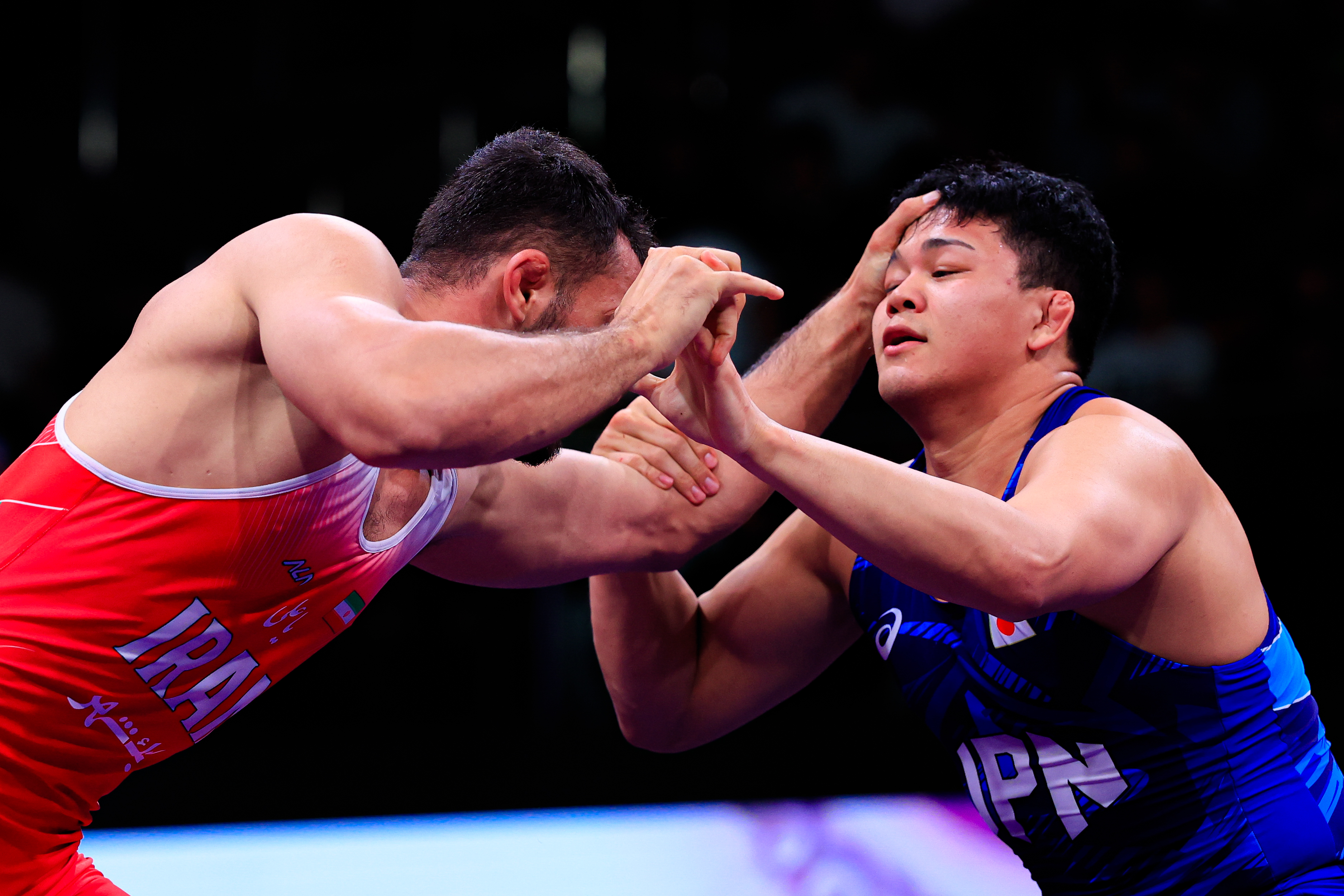 Arash YOSHIDA (JPN), blue, and Amirali AZARPIRA (IRI) battle it out in the 97kg final at the Asian Championships. (Photo: United World Wrestling / Kostadin Andonov)
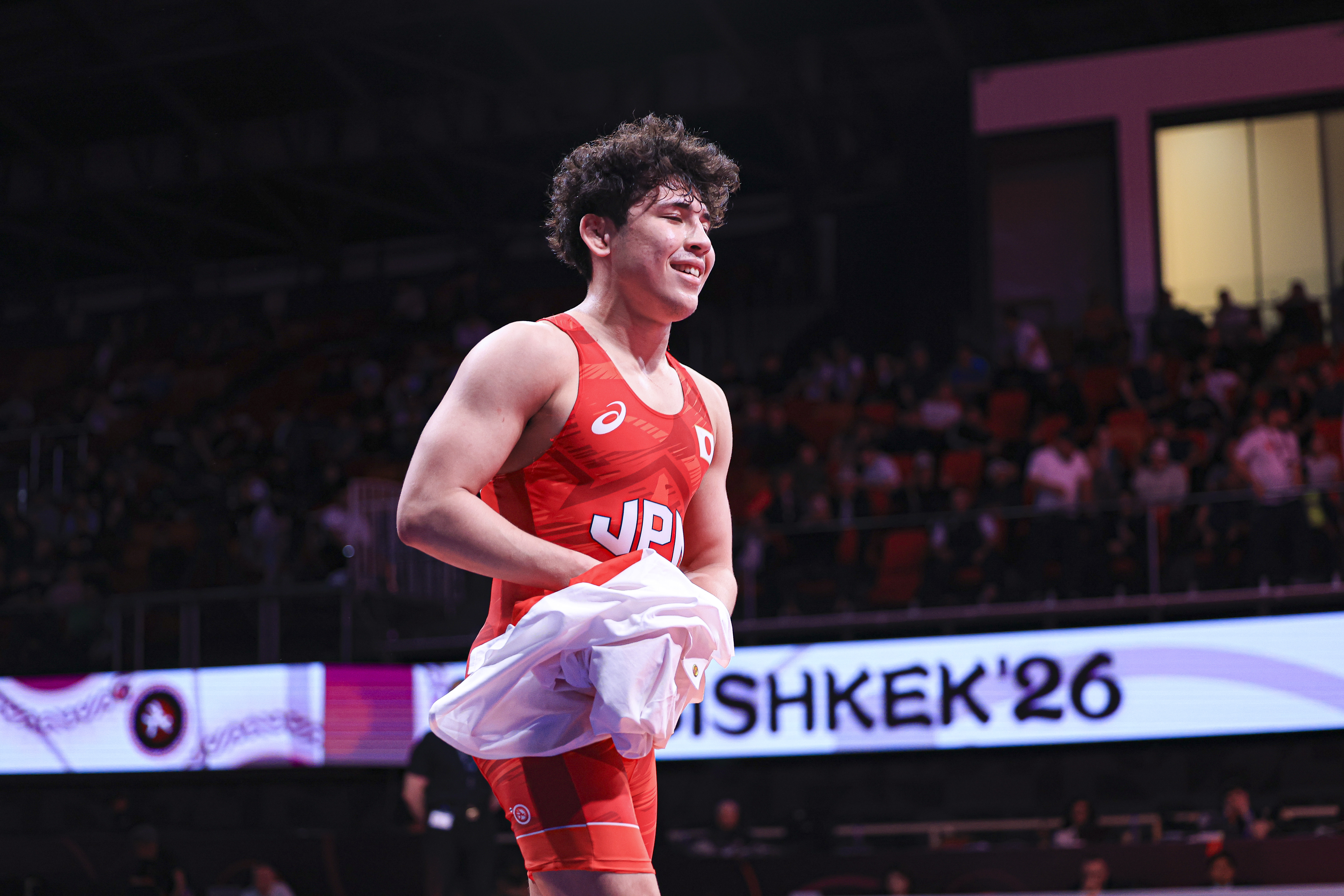 Keyvan GHAREHDAGHI (JPN) celebrates after winning the 79kg gold medal at the Asian Championships. (Photo: United World Wrestling / Kadir Caliskan)
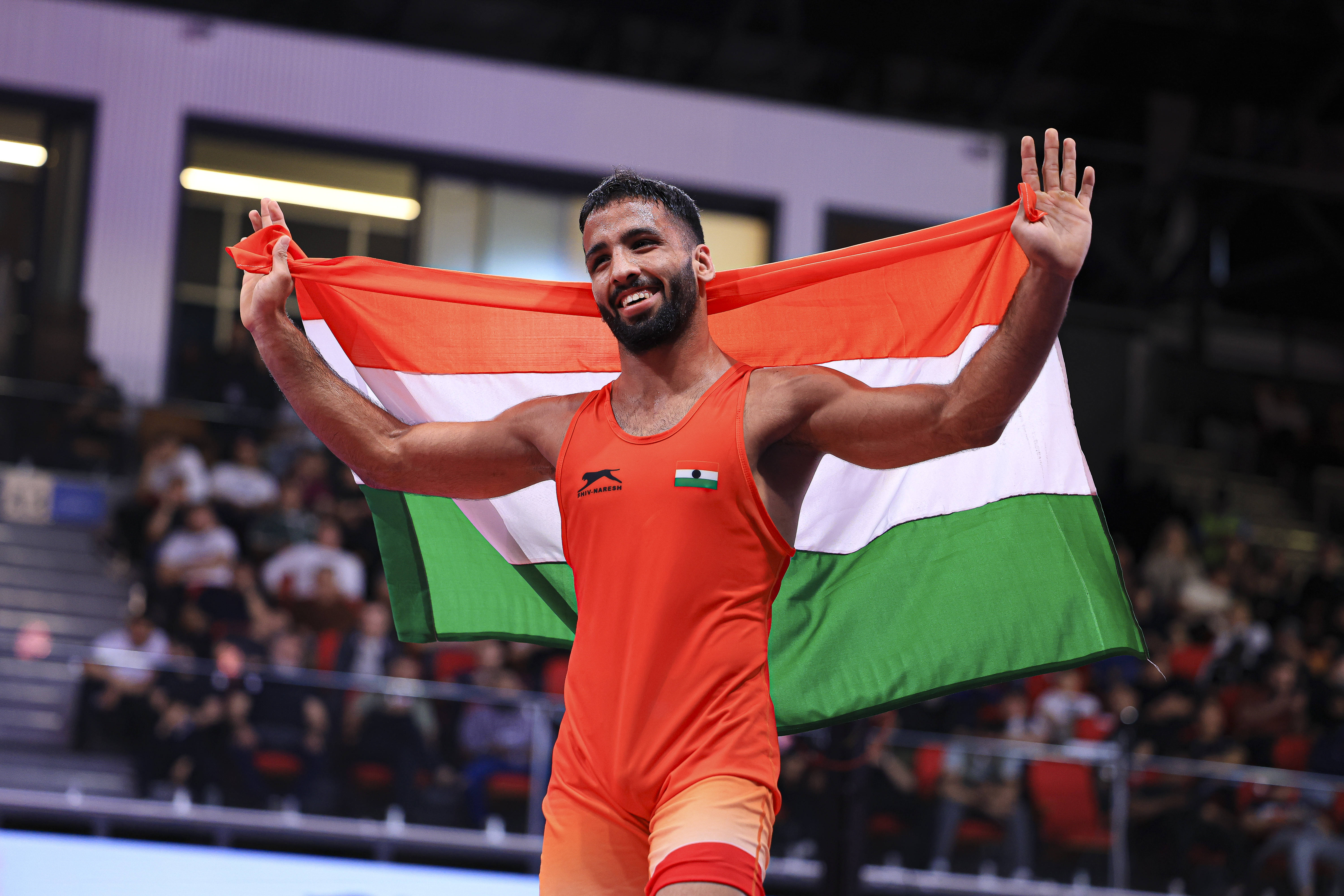 SUJEET (IND) claimed the 65kg gold medal in Bishkek after an 8-1 victory over Umidjon JALOLOV (UZB). (Photo: United World Wrestling / Amirreza Aliasgari)
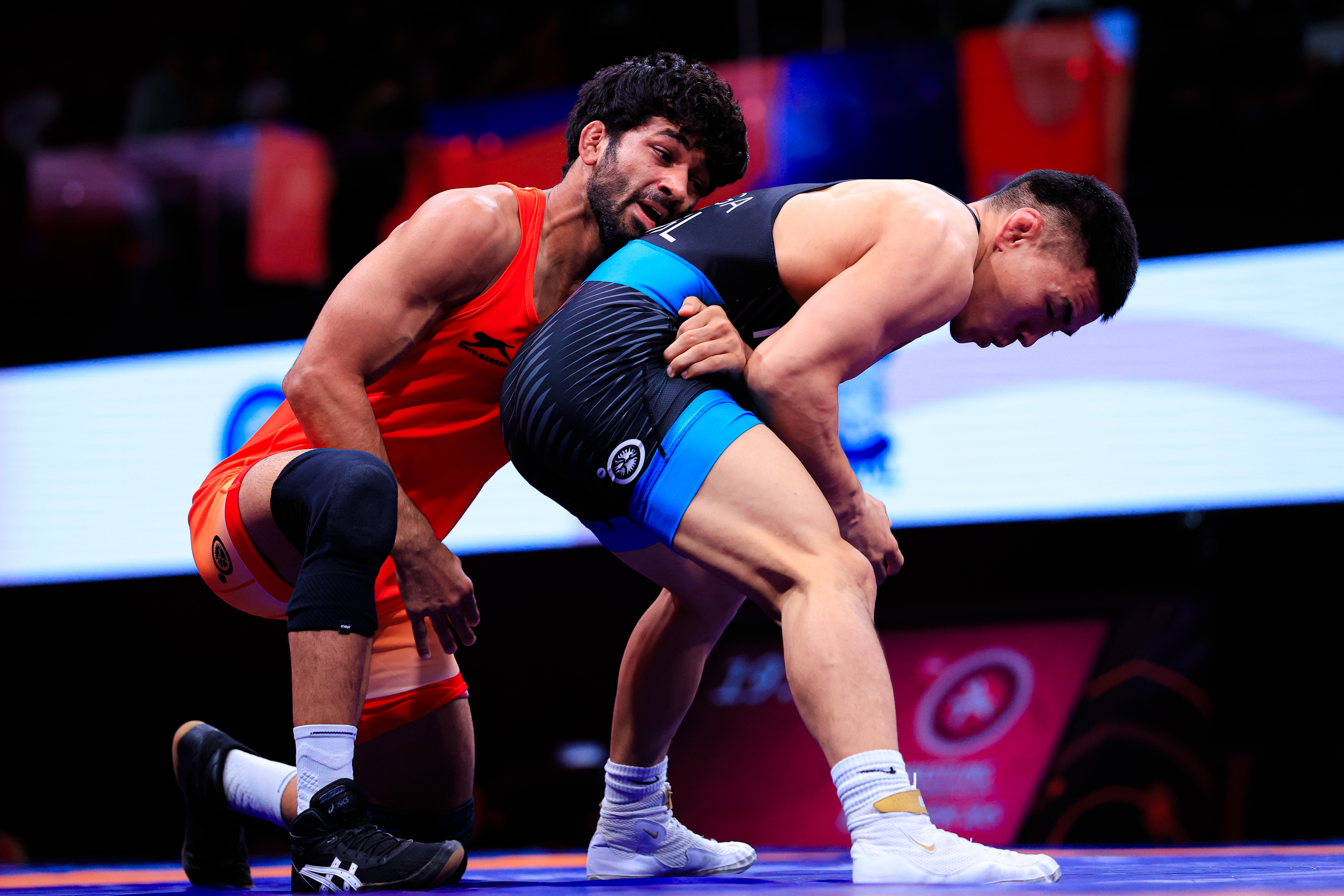 ABHIMANYOU (IND) scores a takedown on Tulga TUMUR OCHIR (MGL) in the 70kg final. (Photo: United World Wrestling / Kostadin Andonov)
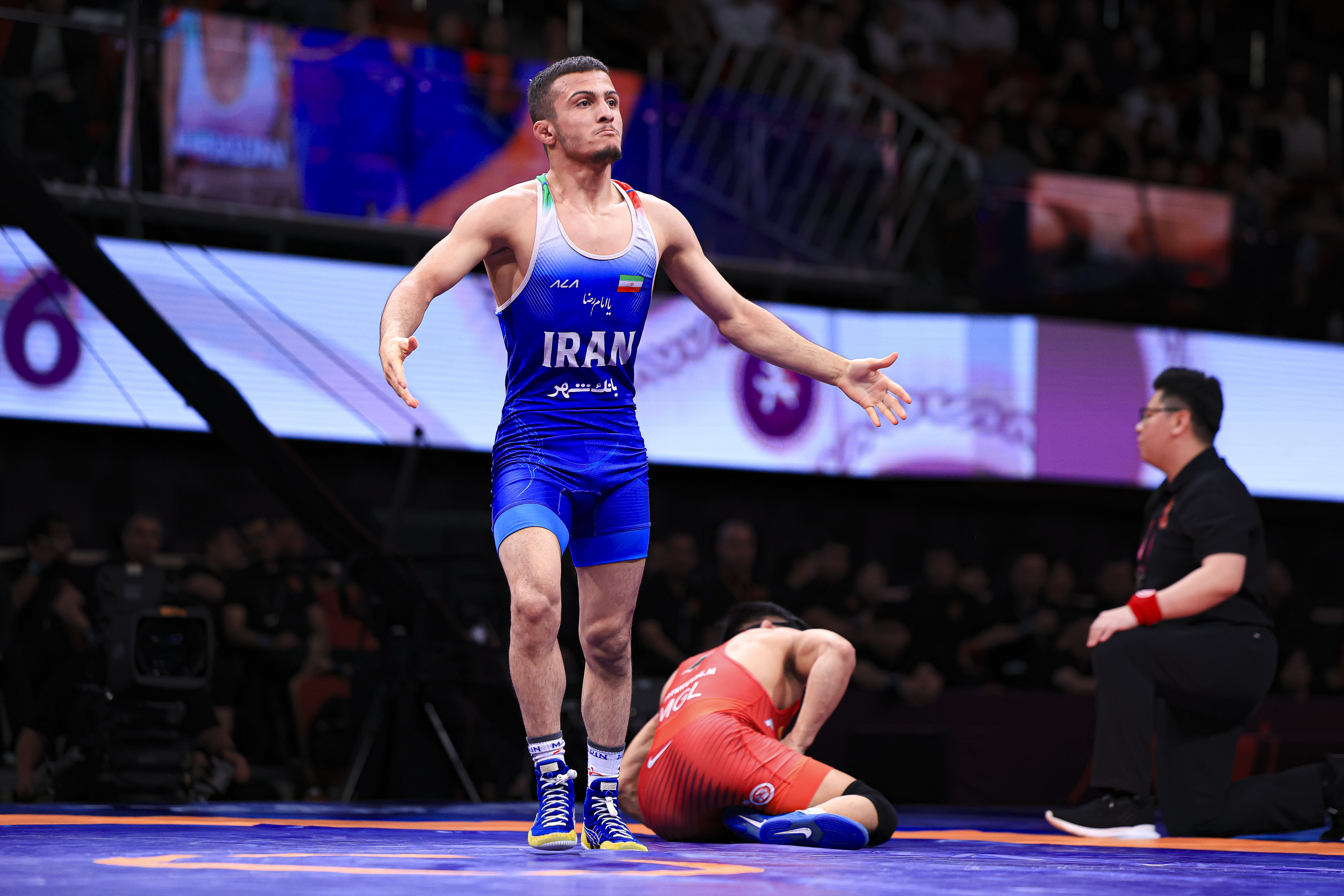 Milad VALIZADEH (IRI) won the 57kg gold, the only champion for Iran on Saturday. (Photo: United World Wrestling / Amirreza Aliasgari)
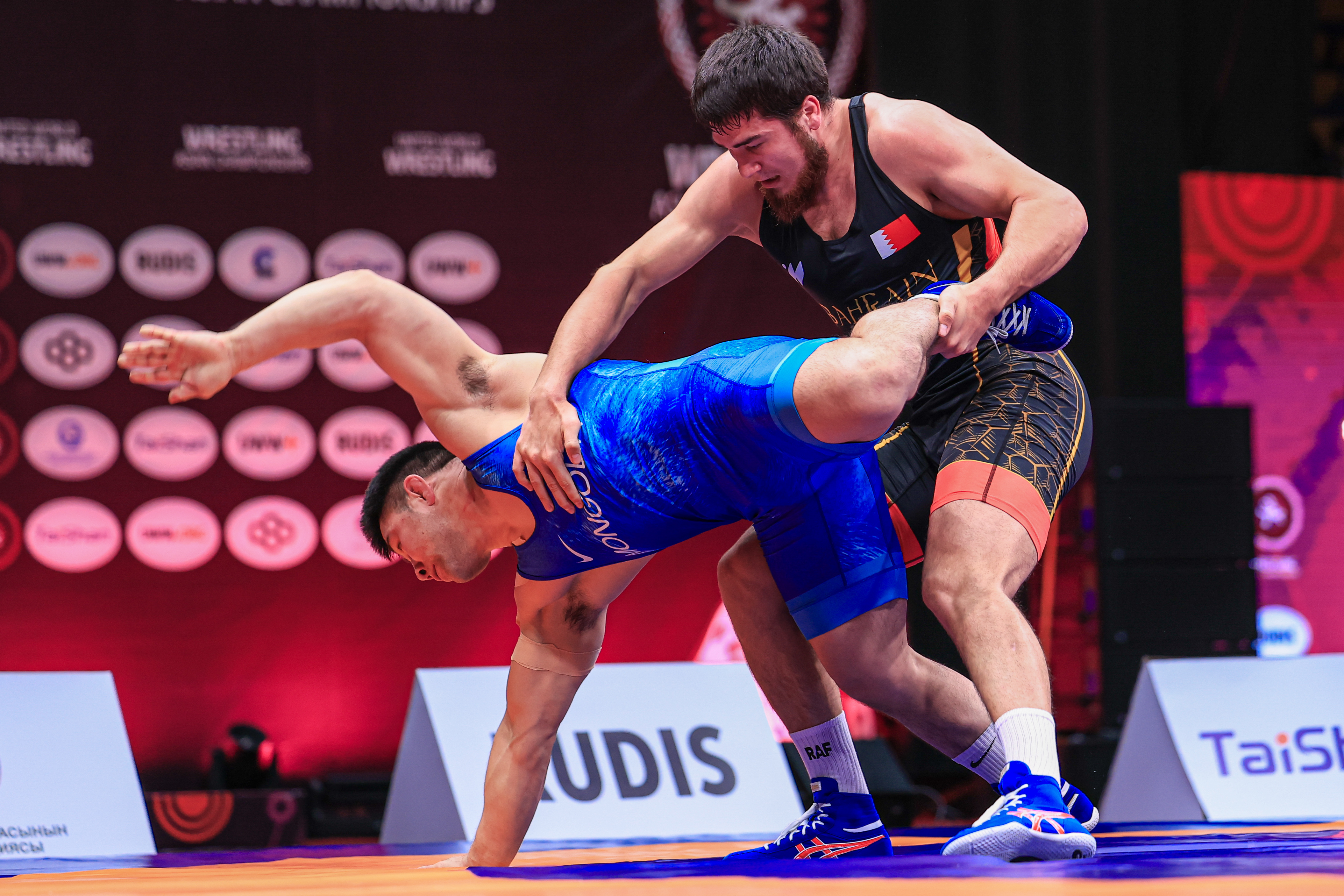 Akhmed TAZHUDINOV (BRN) returned with a bronze medal at 97kg. (Photo: United World Wrestling / Amirreza Aliasgari)
Share your thoughts.
Comments