

Shock as Rio 2016 Silver-Medal Duo Fail to Make Japan Squad for Paris
Monday, June 19, 2017 - 01:22 By Ken Marantz

TOKYO (June 18) - Having an Olympic silver medal to one’s name is a remarkable accomplishment certainly worth being proud of. But as both Rei HIGUCHI and Shinobu OTA found out, it counts for little when the 2017 world team is being selected.
Both Higuchi and Ota, who won silver medals at the Rio 2016 Olympic Games, failed to make Japan's team to this summer's World Championships in Paris after going down to defeat on the final day of the three-day Japan National Invitational Championships in Tokyo.
Higuchi, the freestyle runner-up at 57kg in Rio de Janeiro, lost in the 61kg final to longtime collegiate rival Rinya NAKAMURA, 14-5, and then blew an early lead and dropped a 9-5 decision in a special world team wrestle-off as Nakamura snatched the berth to Paris.
Asian champion Kenichiro FUMITA, having defeated Ota for the Greco-Roman 59kg crown at the National Championships in December, needed only one win over Ota on Sunday, which he wrapped up with a 6-2 victory in the featherweight final to punch his ticket to Paris.
"I've been to a number of world championships as a warm-up partner and watched the competition right in front of my eyes, which was really hard to take," Fumita said.
"I thought I have to make it there myself and win a medal. That has now become a reality and I will be going as a competitor, so I'll aim for the top and get myself ready."
For the Japanese men, selection is based on the results from the two national competitions. The winners at the December championships, known as the Emperor's Cup, automatically clinched a world team berth by winning the invitational meet, called the Meiji Cup.
Two more categories in the men’s disciplines on Sunday were also decided in playoff bouts.
In freestyle, Yuhi FUJINAMI posted a pair of one-sided victories at 70kg over Emperor's Cup champion and Asian bronze medalist Momojiro NAKAMURA, rolling to a 10-0 technical fall in 1:14 of the semifinal, then repeating that score in 4:28 of the wrestle-off.
In between the two wins over Nakamura, Fujinami earned a place in the playoff by sweeping past defending champion Nobuyoshi TAKOJIMA, 10-2, in the final.
Atsushi MATSUMOTO continues to make progress in his transition from freestyle to Greco-Roman, although the Emperor's Cup champion at 85kg needed a hard-fought 4-1 victory over Kanta SHIOKAWA in the playoff to make the team to Paris.
Matsumoto, who won the Asian title in New Delhi in May, lost in the semifinals, 2-1, to Masato SUMI, who in turn fell 4-1 to Shiokawa in the final.
Matsumoto, whose brother Ryutaro was a London 2012 bronze medalist in Greco-Roman, won the last of his five Meiji Cup freestyle titles last year before switching to Greco-Roman after failing to qualify for Rio de Janeiro.
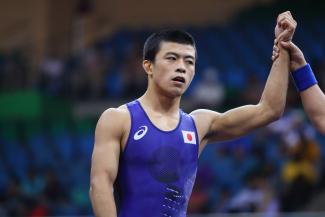
Fumita and Ota have been well aware of each other for years as former teammates at Nippon Sport Science University, where the 21-year-old Fumita is still a student. Ota and Fumita, currently ranked No.2 and No.3 by United World Wrestling, continue to train together at NSSU.
Fumita grabbed the spotlight when he knocked off the Rio 2016 silver medalist at the Emperor's Cup, then went on to win the gold medal at the Asian Championships. But Ota showed he was not ready to yield easily when he beat Fumita in the final of the Cerro Pelado International in Cuba.
"In February, I lost to him in the final in Cuba, that was really disappointing," Fumita said. "I took part in the Asian Championships and won, but was not satisfied with my performance. So I put everything into preparing for this tournament."
In the final, both wrestlers gained a point on the opponent's passivity when Ota was awarded a second to put him ahead with less than a minute left in the bout. But, at that precise moment, Fumita executed a back drop to regain the lead. He added a second a short time later to clinch the victory, which he celebrated with a back flip.
"I wasn't scared," Fumita said of falling behind late in the match. "I didn't feel the need to panic. If I don't make a mistake, one minute is enough time. Keeping calm led to my getting points."
Ironically, both wrestlers cut it close in the semifinals. Fumita was trailing, 2-2, on criteria to Hayanobu SHIMIZU when he scored with a throw with 40 seconds left to win, 4-2. Likewise, Ota fell behind, 2-0, to Masuto KAWANA before grabbing a decisive takedown in a wild flurry with 4:20 left.
"I thought I was prepared," Ota said. "But I couldn't attack like I needed to."

Like Fumita and Ota, Nakamura and Higuchi are quite familiar with each other, having faced each other going back to their days in youth wrestling and more recently as collegiate rivals. Nakamura goes to Senshu University, while Higuchi is among the strong group at NSSU.
"We've had over 10 matches, but this is the first time since junior high school that I won in an individual tournament," said Nakamura, who won the Meiji Cup at 57kg last year. "So it makes me feel like I've gotten over a wall."
In the final, Nakamura scored big with counters to Higuchi's single-leg takedown attempts, gaining four points with one crotch lift and two with another. He led 8-2 after the first period before finishing up the 14-5 win.
Higuchi was more cautious in the playoff, and built up a 5-1 lead early in the second period. But Nakamura cut the gap with another lift to counter a takedown, then went ahead with a single-leg takedown followed by an ankle roll with 50 seconds left.
"Today I was not good enough to win," said Higuchi, who suffered a surprise semifinal loss at New Delhi 2017 and had to settle for a bronze medal. "He (Nakamura) did his research on me very well. I wasn't strong enough."
Nakamura's victory capped his recovery from shoulder surgery which he underwent following last year's tournament. It was Higuchi's performance in Rio that motivated him.
"It was from the hospital bed that I saw Higuchi perform so well," Nakamura said. "I thought he looked so cool. The only things I could do while I was injured I went all out to do, and that paid off today."
No Stopping the Golden Girls
There were no surprises in the women's competition, in which Rio gold medalists Risako KAWAI (60kg) and Sara DOSHO (69kg) had little trouble winning titles after skipping last year’s tournament.
Teen titan Yui SUSAKI picked up her second straight title at 48kg with Rio 2016 champion Eri TOSAKA still on the sidelines, scoring all of her points in the first period and holding on for 3-0 victory in the final over junior world champ Miho IGARASHI.
All three, who won gold medals at the Asian Championships, are all but certain to be on the team for Paris, but will have to wait for confirmation until a later date. Unlike the men, the women's team will be chosen by the Japan Wrestling Federation based on the results of the two national tournaments and other factors.
Kawai, who was awarded the Meiji Cup as the tournament MVP, had an early scare in the final against defending champion Yui SAKANO, giving up a four-point throw.
But she soon took control and stormed back to win by technical fall, 14-4, at 5:02. It was her third career title after winning in 2012 at 51kg and in 2015 at 63kg.
"I knew she was an opponent that likes to use that throw," Kawai said. "I was doing only what I wanted to do and wasn’t paying attention to what my opponent was doing."
Assuming she is selected for Paris, Kawai will aim for her first world gold after taking a silver medal at 63kg in 2015.
"I don't think I can win if I keep going like this," Kawai said. "I have to rethink what I am doing from the beginning."
Dosho, a three-time world medalist also looking for her first gold, jumped out to a 6-0 lead in the final against high school student Miwa MORIKAWA before finishing up a 12-1 technical fall in 4:35.
Dosho had a tougher time in her only other match, a 4-2 win the semifinals over Chiaki IIJIMA, en route to her fifth career title and first since 2015.
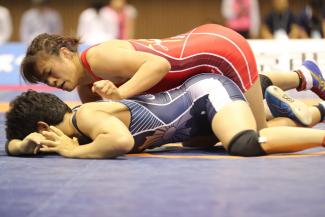
Results
Freestyle
61kg (12 entries)
Final - Rinya NAKAMURA df. Rei HIGUCHI, 14-5
3rd Place - Taishi NARIKUNI and Shoya SHIMAE
70kg (12 entries)
Final - Yuhi FUJINAMI df. Nobuyoshi TAKOJIMA, 10-2
3rd Place - Momojiro NAKAMURA and Shun ITO
Greco-Roman
59kg (13 entries)
Final - Kenichiro FUMITA df. Shinobu OTA, 6-2
3rd Place - Hayanobu SHIMIZU and Masuto KAWANA
85kg (8 entries)
Final - Kanta SHIOKAWA df. Masato SUMI, 4-1
3rd Place - Atsushi MATSUMOTO and Taichi OKA
Women's Wrestling
48kg (9 entries)
Final - Yui SUSAKI df. Miho IGARASHI, 3-0
3rd Place -Yuki IRIE and Miyu NAKAMURA
60kg (7 entries)
Final - Risako KAWAI df. Yui SAKANO by TF, 14-4, 5:02
3rd Place - Atena KODAMA and Miki KAWAUCHI
69kg (6 entries)
Final - Sara DOSHO df. Miwa MORIKAWA by TF, 12-1, 4:35
3rd Place - Chiaki IIJIMA and Yuka KAGAMI
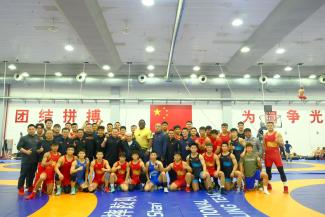
 Raul DIAZ (CUB) with the Chinese Greco-Roman national team. (Photo: Xinhua News)
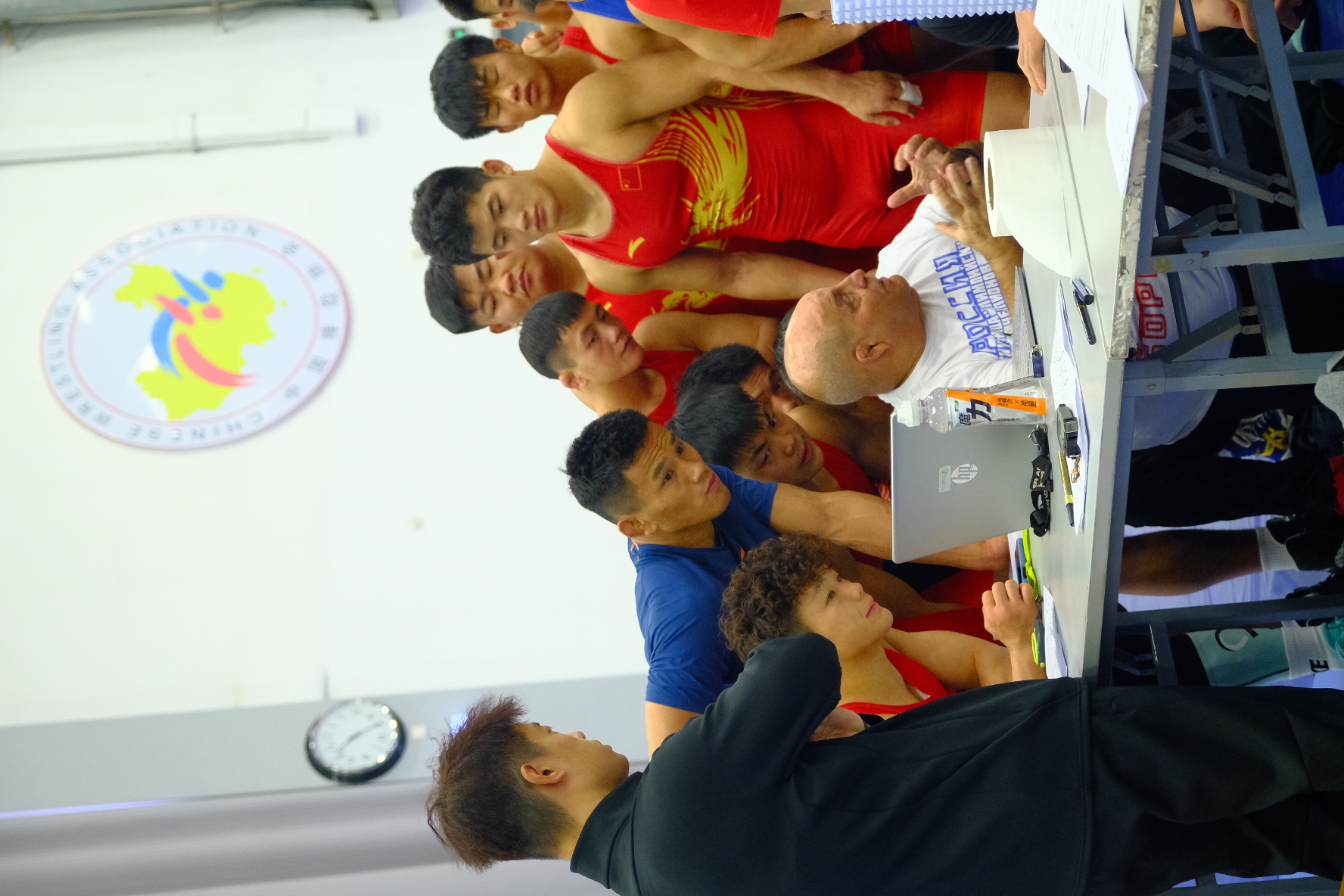
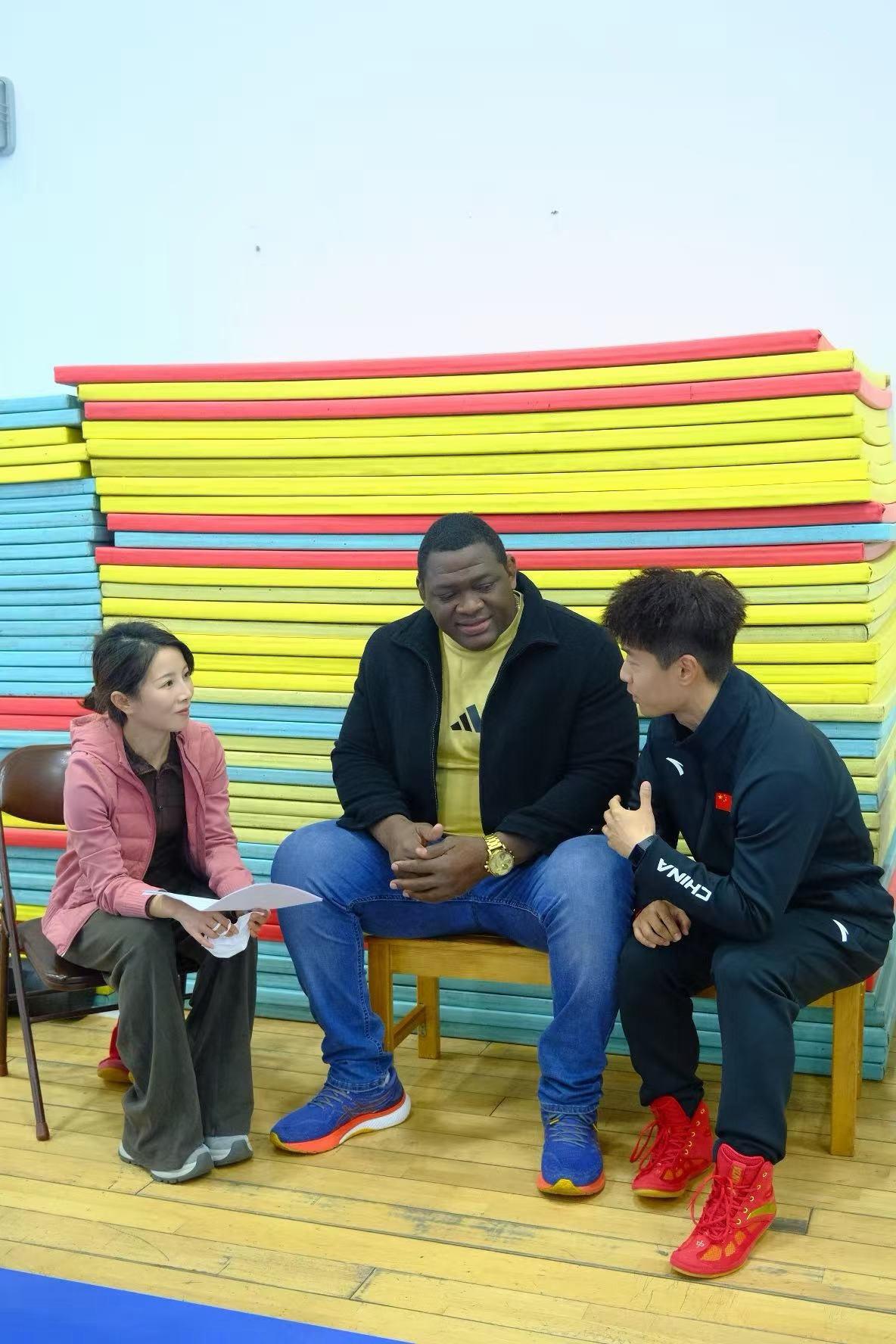 Reporter interviewing Mijain LOPEZ (center) and Shen SHIYAN (right), Spanish interpreter for the Chinese Greco-Roman team. (Photo: Xinhua News)
Share your thoughts.
Comments