

#JapanWrestling

Two-time Olympic champ formerly known as Kawai returns in triumph

By Ken Marantz

YAIZU, JAPAN (October 16) -- As Risako KINJO stood on the top of the medal podium, a warm smile came across her face. It was not for the victory in her return to the mat after 14 months, but for that other part of her life that had kept her to stay away so willingly.

She had caught sight of her mother in the stands across the gym, holding Kinjo's 5-month-old daughter in her arms and waving the infant's hand in her direction.

"There have been so many people supporting me, and that's what allowed me to take the mat today," she said.

To the rest of the wrestling world, she is still known by her maiden name KAWAI, under which she won a second straight Olympic title by capturing the women's 57kg gold at the Tokyo Games in August 2021.

Much had changed in her life since that triumph at Makuhari Messe arena, her name notwithstanding through the marriage to former wrestler Kiryu KINJO. But as the three-time world champion showed on Sunday, her desire and talent for the sport have not altered in the slightest.

Kinjo returned to competition by cruising to the 59kg senior title at the Japan Women's Open, winning three matches without surrendering a point in Yaizu, Shizuoka Prefecture, about 200 kilometers southwest of Tokyo.

"There's a feeling of relief, but also I wish I had a few more matches," said the 27-year-old Kinjo, who capped her golden run with a 9-0 victory in the final over national collegiate silver medalist Miyu NAKANISHI. "It felt like the three matches were over before I knew it."

Kinjo said she had butterflies in her stomach at the start, but actually welcomed that feeling as in reminded her of old times.

"I was really nervous before my first match," she said. "After that there wasn't much time between matches. But it's like there was something nostalgic about the nervousness. After it was over, looking back I thought, 'That was fun.'"

JPN
Risako KINJO gets 2 with a counter-lift in the 59kg final against Miyu NAKANISHI (photo by Japan Wrestling Federation)

Kinjo, who had a bye into the quarterfinals, opened with a victory by fall in 51 seconds over Mizuki NAKAHORI. Kinjo did not have to attack, as she spun behind off a Nakahori shot, executed a pair of gut wrenches, then used a leg lock and reverse half-nelson for the fall.

In her semifinal match against Himeka HASEGAWA, Kinjo maintained her defensive wall and scored two go-behind takedowns, then scored another with a snap down. From there, a pair of gut wrenches ended the match 10-0 at 1:23.

In the final against a defensive-minded Nakanishi, Kinjo took a 3-0 lead into the second period from an activity point and a back-door takedown off a single--off her first shot of the day. But in the second period, Kinjo effectively moved Nakanishi around to set up a low sweeping single, then a shrug-and-go-behind. She added a counter-lift for 2 to make it 9-0.

Kinjo's coach Ryo KANEHAMA was impressed with the performance, given the uncertainty going into the tournament.

"That she first of all could get so mentally prepared was really big," he said. "She also showed speed. What we were most fearful of was going the full six minutes, but she was able to keep moving like that. Looking at how she started in the morning, she looked in really good shape."

For Kinjo, the most unfamiliar moment came when her married name was used in the pre-match announcement for the first time.

"When I saw 'Kinjo' on the scoreboard, I was like, 'Oh, right,'" she said. "This is the first tournament that I entered as Kinjo, and I feel honored to have it on the certificate that I received."

The couple announced they had tied the knot on Aug. 27, 2021, and Kinjo gave birth to a baby girl in May this year. She said she started working out again at the end of June, and practiced on the mat the following month. As can be imagined, it was not easy.

"At first, I couldn't even do calistenics on the mat, or a high bridge," she said. "Parts of my body were really stiff. My legs couldn't react to where my eyes were looking. I thought, this is how much it changes after being away 10 months. It was like watching someone else."

Kinjo eventually got back to speed, realizing that the additional burden of raising a child meant changing her approach to training from quantity to quality.

"I have a child and she is the No. 1 priority," Kinjo said. "The amount of practice has been reduced. Before, my time was all mine; now more time is spent on the child. I don't know how much less I'm doing, but to me, it's of a better quality."

Living with her husband in Fukui Prefecture in western Japan, where he is coach at Tsuruga Kehi High School, presents a challenge for Kawai. She takes advantage of every opportunity for a practice spot--sometimes it's with the high schoolers, other times she might head to Tokyo or Aichi Prefecture to train with younger sister Yukako, the Tokyo Olympic gold medalist at 62kg.

Everywhere she goes, she is fortunate to have someone to help out with the baby. In Fukui, Tsuruga has a kids club and sometimes the mother of one of the team members will look after the child. In Tokyo, she knows she can always leave her with her mother, Hatsue, a national team member during her career who almost unfailingly attends all of her daughters' matches.

That support system has allowed Kinjo to join the ever-growing number of Japanese female athletes who are continuing careers after childbirth, which only a few decades ago would have been unheard of. Most noticeable was Ryoko TANI, who won a fourth Olympic medal in judo after giving birth.

JPN
Risako KINJO, center, smiles on the medal podium. (photo by Japan Wrestling Federation)

Kinjo became the latest high-profile wrestler to use the Japan Women's Open as the first stepping stone in a return to the sport. It is actually a second-tier tournament with age groups that for senior wrestlers, is a last-chance event to qualify for the All-Japan Championships in December. Kinjo's only previous appearance was in the junior high school division in 2008.

Previously, 2016 Olympic champion Eri TOSAKA appeared at the 2017 tournament as her first competition after undergoing foot surgery, and the legendary Kaori ICHO competed in 2018, having taken two years off after Rio 2016 in a bid for a fifth Olympic gold that would eventually be thwarted by Kinjo.

The question now is, what will Kinjo do from here? The All-Japan in December marks the start of the qualifying process for the 2024 Paris Olympics, which is squarely on Kinjo's radar. It is possible for her to enter at 59kg and later drop down to the Olympic weight of 57kg, or she can go down to the latter now. "It's a secret," she said mischievously.

Of course, whether she does it in December or later, Kinjo will almost surely eventually clash heads with rising star Tsugumi SAKURAI, who won the 57kg world title in Kinjo's absence.

Kinjo takes an esoteric stance when it comes to the emergence of the 21-year-old Sakurai, who also won the 55kg world title in 2021.

"I think it is a good thing for Japan that young wrestlers are being cultivated," Kinjo said. "I don't mean that it would be good for me to lose to them. But for the ones coming up after me, the future is bright. While I keep battling on, the young ones get stronger. They are all rivals, but I think that their getting stronger is a good situation."

JPN1
Yukako KAWAI talks to the media after withdrawing just before her opening match. (photo by Japan Wrestling Federation)

Younger sister defaults after injury during warm-up

Meanwhile, younger sister Yukako KAWAI was also entered in the tournament, but defaulted her opening match at 62kg after hurting her back while warming up.

"It's not such a serious injury, but we thought it was better to be cautious and not risk making it worse," Kawai said.

Unlike Risako, Kawai has already faced a domestic usurper to her throne, and lost it. In her first tournament after winning the Tokyo Olympic gold, she returned at the All-Japan Invitational Championships last June, but lost in the final to another rising star, Nonoka OZAKI.

Ozaki went on to win the senior world title in Belgrade last month, establishing herself as the one to beat in the race to Paris 2024.

"I've been working to fix the mistakes I make in the June match, and this Women's Open was supposed to be a test of how far I have come," Kawai said. "I think I'm rounding into shape."

Kawai said she finds motivation in Ozaki's world title run.

"I thought she would win the championship," she said. "By winning the title, I think it shows that our domestic matches are the highest level matches in the world. That's motivating me."

Another top wrestler who made the trip to Yaizu was world silver medalist Ami ISHII, who won the 68kg title by beating Kokona TAKADA by fall at the first-period buzzer.

"The reason I entered this tournament, to put it plainly, was to check my technique," she said. "Also, my pre-match preparation has not been good and I wanted to work on that."

In December, Ishii can expect to see a great deal of shifting into the Olympic weight class, with her most notable competition likely to be current 65kg world champion Miwa MORIKAWA.

"If I do what I need to do, the confidence will come," Ishii said. "We'll see how much I can progress in the next two months. If I do everything I need to, it will be like insurance, and winning won't be out of the question."

#JapanWrestling

Narikuni achieves first Greco-Freestyle double in 52 years

By Ken Marantz

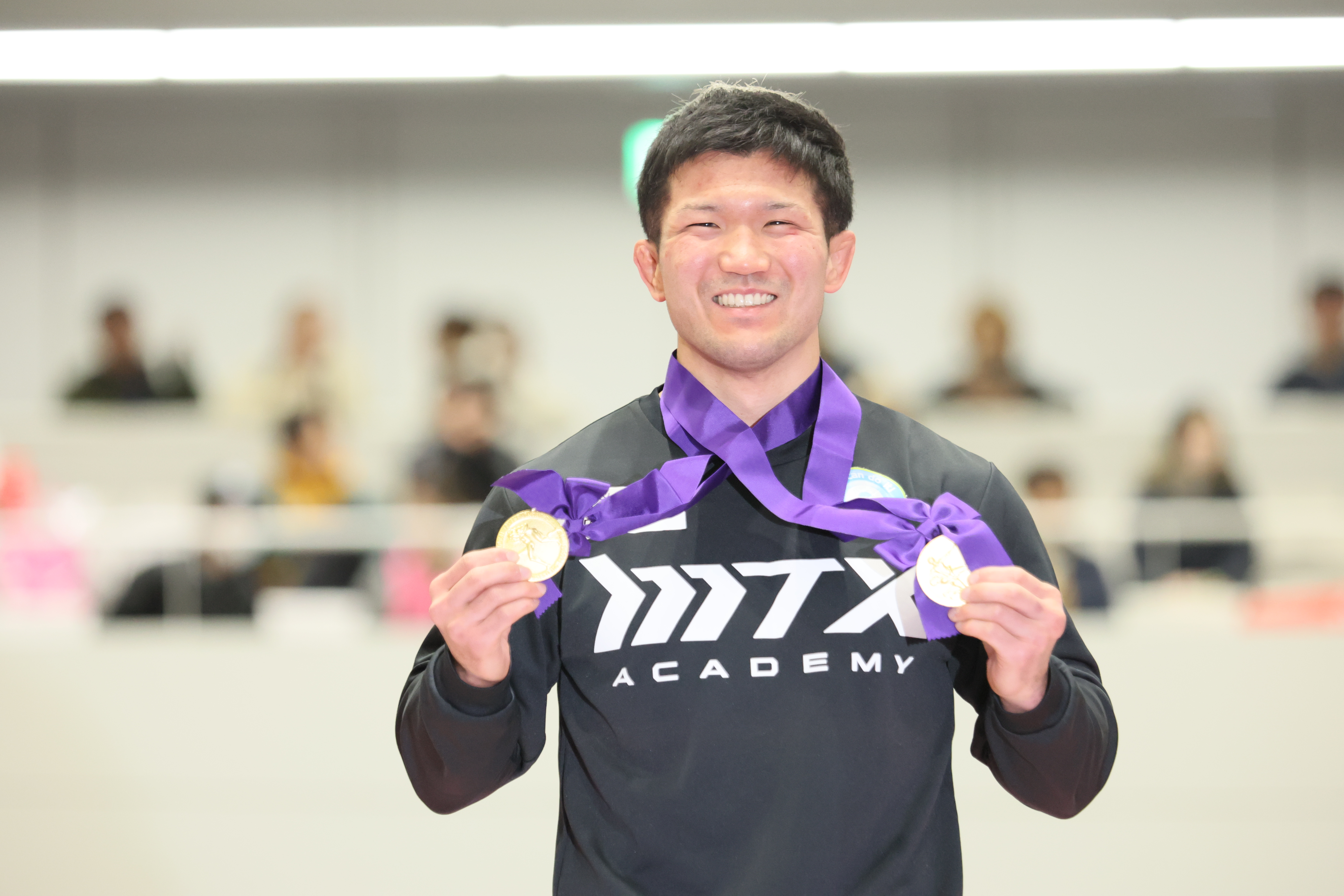
TOKYO (December 20) -- Before stepping down from the mat after his historic victory, Taishi NARIKUNI posed for the cameras with the fingers of one hand spread out in a "5", and the other in a vee for "2".

"I wasn't sure anyone would pick up on what that meant," he acknowledged.

For those who knew, it signified that Narikuni had achieved a seemingly impossible feat, becoming the first wrestler in 52 years to win titles in both freestyle and Greco-Roman at the same Emperor's Cup All-Japan Championships.

Narikuni captured the freestyle 70kg gold on Saturday with a 7-2 victory over world U23 silver medalist Yuma TOMIYAMA, a day after taking the Greco 72kg title.

Both weight classes had among the largest fields in the tournament at Tokyo's Komazawa Gym and, as non-Olympic weights, were competed in a single day. That meant Narikuni had to get through a gauntlet of four matches a day on consecutive days.

"I didn't have any concerns about making weight, but after the first day was over, I had to start again from the beginning the next day," the 28-year-old Narikuni said. "It was difficult to get back into the mode. It wasn't the physical aspect. Mentally, it was a tougher two days than I had thought it would be.

"I won collegiate titles in both styles, and I tried to approach this tournament from the same mentality, but it was completely different. I was a bit naive."

The four-day tournament is also serving as Japan's qualifier for the Asian Championships in April, and as one of two qualifiers for both the World Championships and Asian Games in the fall. The Olympic weights use the same format as the worlds and are contested over two days.

In other finals on Day 3, world bronze medalist Arash YOSHIDA stormed to his third straight title at freestyle 97kg, while veteran Sohsuke TAKATANI turned back the clock and triumphed at freestyle 86kg for his first title since 2022, when he won the last of 12 straight over four weight classes.

Taishi NARIKUNITaishi NARIKUNI shows off his two medals, one in freestyle and other in Greco. (Photo: Takeo Yabuki / wrestling-spirits.jp)
Narikuni's quest for double glory has its roots in his mother, a two-time world champion who runs the kids club in Tokyo where he got his start. To exceed mom, he set a target of also winning two world golds -- but adding a twist by making it one each in freestyle and Greco.

He accomplished half of his goal in 2022, when he captured the freestyle 70kg gold in Belgrade. But his chance to complete the crusade this year fell flat when he lost his first-round match at the worlds in Zagreb.

Narikuni said he will focus on Greco at the second world qualifier, the Meiji Cup All-Japan Invitational Championships in the spring, to assure his place on the team to the 2026 worlds. The world gold in Greco now tops his list of holy grails.

"Of course I am aiming for the Olympics," Narikuni said. "But at this time, my main target is to become a world champion in Greco. This is just a point to be passed along the way. I feel I got over one hurdle."

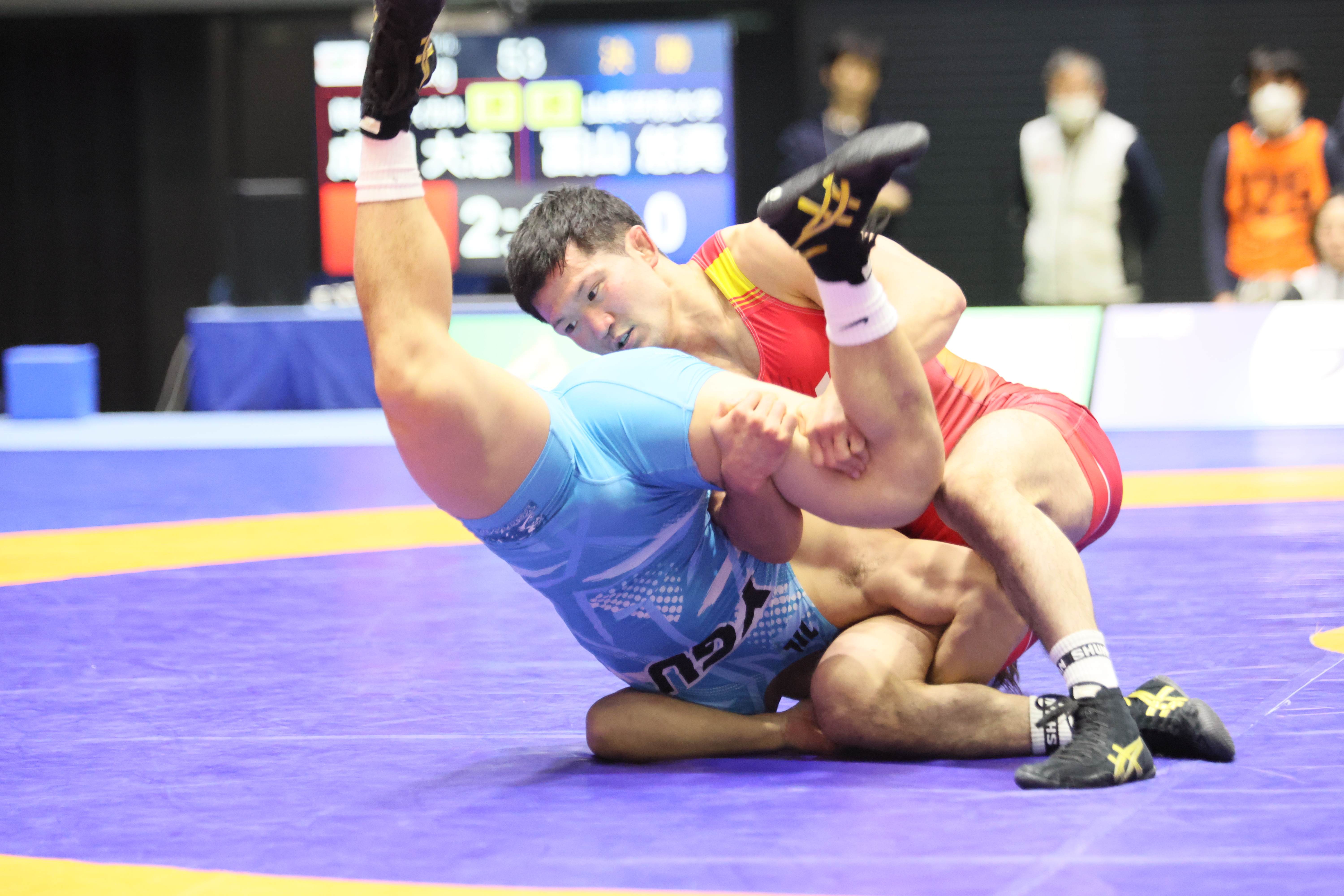
In the final, Narikuni earned an activity point and steoput to take a 2-0 lead into the break. In the second period, he countered a tackle attempt for a 2-point exposure.

When Tomiyama then got in deep on a double-leg, Narikuni went over the top to grab the legs from the back. Tomiyama rose up and dumped Narikuni to the mat and got behind for 2, but never had solid control and Narikuni quickly reversed, then transitioned immediately into a gut wrench to go up 7-2.

Taishi NARIKUNITaishi NARIKUNI counters a takedown attempt by Yuma TOMIYAMA for a 2-point exposure in the second period of the freestyle 70kg final. (Photo: Takeo Yabuki / wrestling-spirits.jp)
The thought that this might be his last opportunity served as strong motivation for Narikuni, overcoming any doubts and pain.

"I thought that this might be my only chance," he said. "If I had put it off, it might not come again. And that influenced my freestyle wrestling today. Instead of the full-out attack that I rely on, I went into a defensive shell. In the end, the result was good, but it wasn't done very well."

Narikuni became the first wrestler to complete the double since Mitsuo YOSHIDA won the 100kg titles in both styles in 1973. Ironically, Kaisei TANABE also had a chance to achieve the feat this week, but after winning the Greco 63kg title on Thursday, he lost in the semifinals at freestyle 65kg on Saturday.

Narikuni has long been a bit of a maverick in the wrestling world, often opting for weight training over live practice sessions. His desire to compete in both styles may have been an act of defiance against the common wisdom of specializing in one.

"People around me said that I had to specialize in one style, but that didn't sit well with me," Narikuni said. "Maybe I had a strong feeling of wanting to show them it could be done, and that's what makes this result so good."

As with Tanabe, there has been an increase in wrestlers doing both styles even up to the college level, a trend that Narikuni finds quite pleasing.

"That really makes me happy," he said. "When it is first tried, they will hear that it will degrade how people see them or that it won't be easy. Of course it isn't easy. Up to now, there was no format for doing both styles. To take up both with its own rules is something to be proud of, and I'm happy that there are wrestlers trying to emulate me."

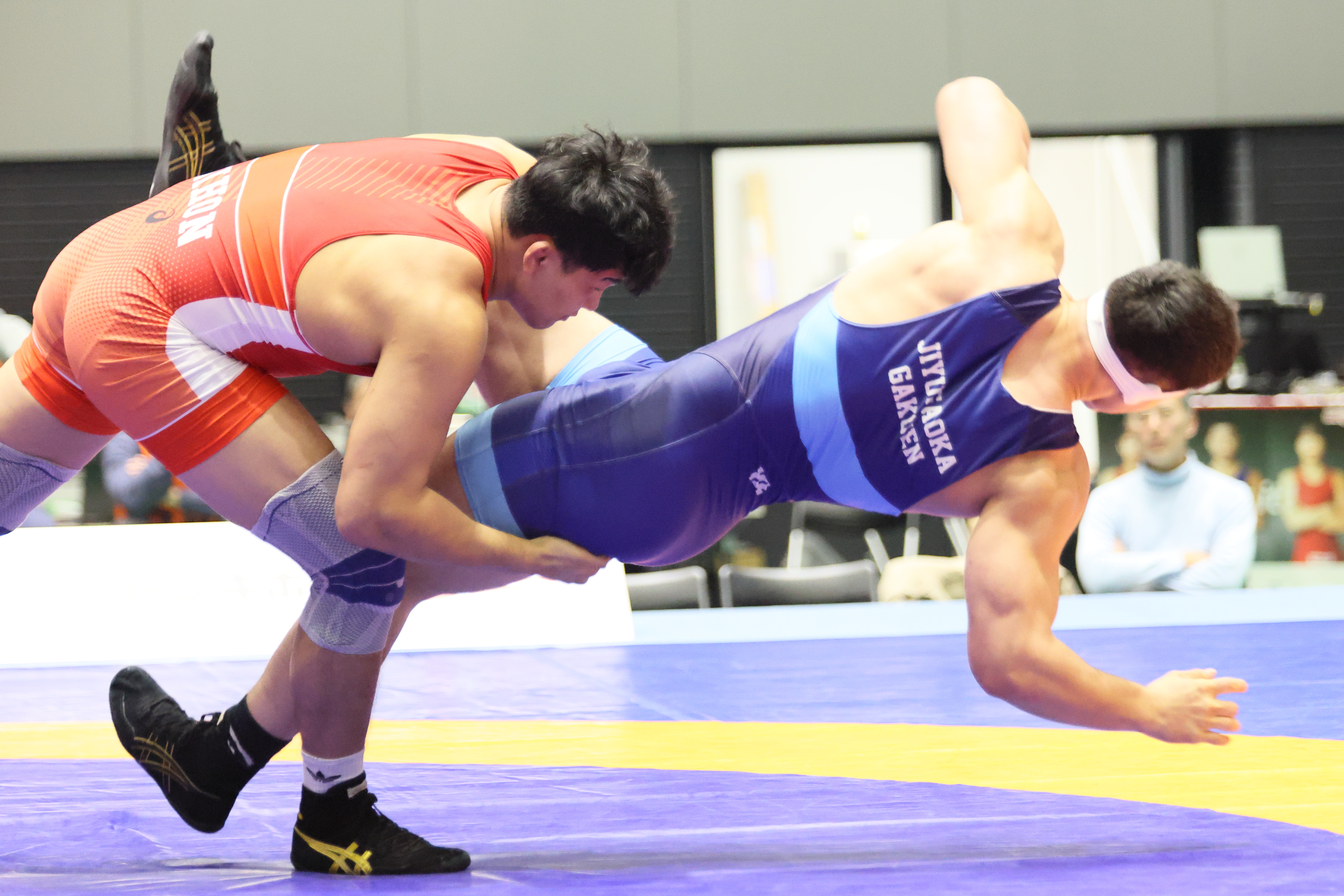
Arash YoshidaArash YOSHIDA dumps Noah LEIBOWITZ to his back for a 4-point takedown in the freestyle 97kg final. (Photo: Takeo Yabuki / wrestling-spirits.jp)
At 97kg, Yoshida continues to establish himself as the preeminent Japanese wrestler in the heavy weights, easily dismantling high schooler Noah LEIBOWITZ with an 11-0 technical fall in 1:13. That was a repeat of last spring's Meiji Cup final.

Yoshida showed the power that once gave him a victory over world champion Kyle SNYDER by starting off with four straight stepouts, with a fleeing point tacked onto the last. He then bulled Liebowitz over for a 4-point takedown, then used a lace lock to finish off the victory.

"It's a relief," Yoshida said. "A friend told me to go for crushing victories, and in the end, I won without giving up a point, so I think I cleared the level that my friend wanted. I was able to do what I do best from the start by pushing out, and that was a good way to pile up points."

Snyder avenged his earlier loss to Yoshida in the semifinals in Zagreb en route to the gold medal, but Yoshida views that as a positive. He feels that Snyder was not in prime condition when they met in February in Tirana.

"I lost to this year's world champion, but it was good that I faced him," he said. "I will prepare so that I can win at the Meiji Cup and get back to the World Championships."

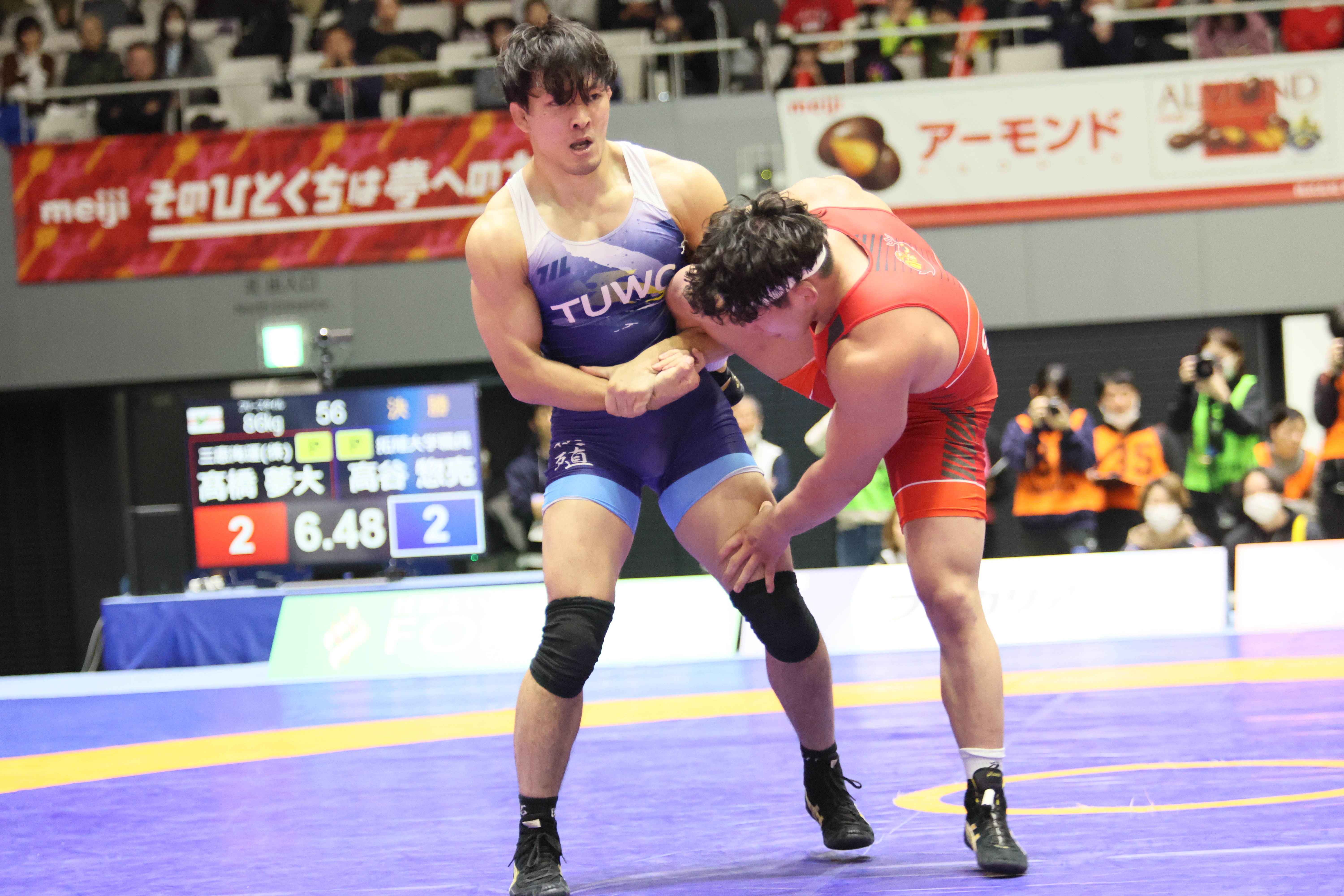
Sohsuke TAKATANISohsuke TAKATANI couldn't finish off this takedown against Yudai TAKAHASHI, but it was good enough to run out the clock for victory in the 86kg final. (Photo: Takeo Yabuki / wrestling-spirits.jp)
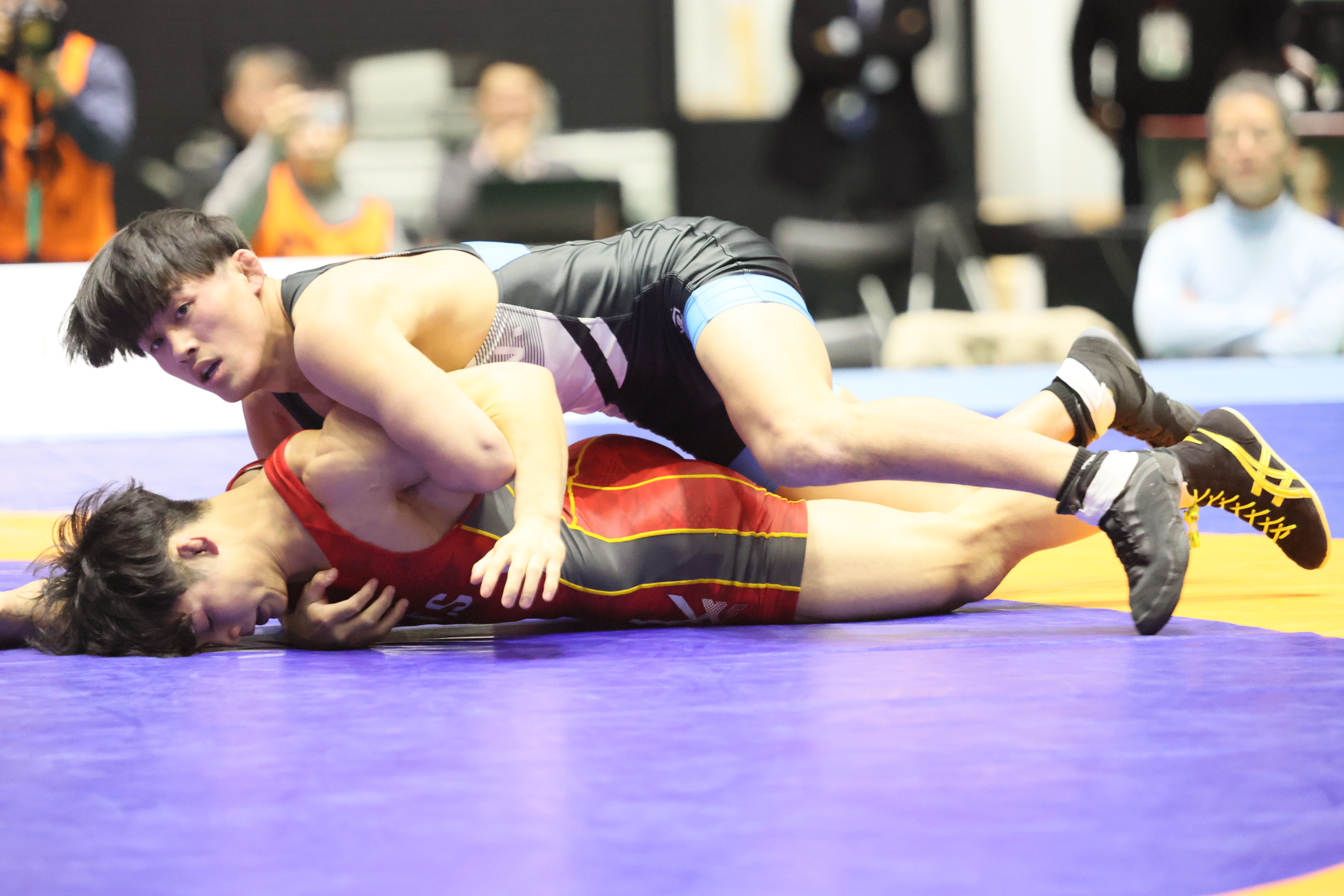
In the freestyle 86kg final, the 36-year-old Takatani added another gold to his bulging collection with a 2-2 victory over 2023 world U23 bronze medalist Yudai TAKAHASHI.

Takahashi scored a relatively easy takedown off a single-leg early in the first period, which was compounded when Takatani suffered a twisted ankle. But the veteran kept his nerves and when the opening came, he grabbed it. In the second period, he responded to a takedown attempt with well-timed counter roll to go up 2-2 on criteria.

In the final seconds, it was Takatani who went on the attack and got in on a single, even getting Takahashi's leg into the air. Although Takahashi squirmed out, it proved just as effective as a scoring move because time ran out.

"When he got the single leg at the beginning, I twisted my ankle and I couldn't put pressure on it," Takatani said. "After that, the opponent stopped pressing, so I thought as long it was only two points [difference], I could come back and I carried on with the match calmly. That's something that gets acquired with age."

Takatani is currently the head coach at his alma mater of Takushoku University, and is also a graduate student at Tsukuba University working on his doctorate.

He said that before his match, he received a message from the university for confirmation regarding the doctoral dissertation he had submitted.

He said he replied, "I have the final now, I'll check it when it's over." A message in response read: "Definitely win the title," so "I have good news for them."

Takatani, a three-time Olympian and a 2014 world silver medalist at 74kg, said his immediate goal is to get to the Asian Games, a competition that he has never experienced and which will be hosted by Japan.

He was unaware that the victory in the Emperor's Cup earned him a ticket to the Asian Championships, to be held in Kyrgyzstan. "But I have my work, and that's a time when there are a lot of tests. It might be hard to work it in. I will ask around."

Koto GOMIKoto GOMI works to turn Yu SHIOTANI in the Greco 60kg final. (Photo: Takeo Yabuki / wrestling-spirits.jp)

In other finals, world U23 and national collegiate champion Koto GOMI pulled off an impressive 8-0 victory over former world bronze medalist Yu SHIOTANI in the Greco 60kg final.

Gomi opened with a nifty 4-point arm throw, maintained control and added a 2-point exposure, then finished off the match with an arm lock roll in 1:46.

"Up to now, I had won on the collegiate level, but at the All-Japan I never even got close to the final," Gomi said. "I'm really happy to win the title."

Gomi and Shiotani had clashed twice previously this year, with Shiotani winning by technical fall at the Meiji Cup and Gomi turning the table with a victory by fall a month ago at the National Games.

At the All-Japan, the weight class was missing two-time defending champion Kaito INABA and Paris Olympic champion Kenichiro FUMITA, who was entered at 63kg but is expected to eventually return to the Olympic weight in the run-up to the 2028 Los Angeles Games. Both pulled out of the tournament due to injuries.

"Those are rivals I don't think I can beat yet," Gomi said. "It's more than just practicing harder, I have to think hard about how to train so that I can win again at the All-Japan."

For now, Gomi can look forward to making his international debut on the senior level at the Asian Championships.

"Going to that will not change what I have to do," he said. "I will be alright by sticking to my firm attacking style of wrestling."

In the women's 53kg final, Moe KIYOOKA won her fourth straight national championship and second in a row at that weight with a 4-0 victory over Umi IMAI.

Kiyooka, who won back-to-back titles at 55kg in 2022 and 2023 as well as the 2024 world gold, took a 3-0 lead in the first period with a takedown and activity point, then added a stepout in the second.

Day 3 Results

Freestyle

65kg (15 entries)
SF 1: Kotaro KIYOOKA df. Kaiji OGINO, 3-2
SF 2: Takara SUDA df. Kaisei TANABE, 5-4

70kg (21 entries)
GOLD: Taishi NARIKUNI df. Yuma TOMIYAMA, 7-2

BRONZE: Taishin HONNA df. Takeru KOZUKA, 7-6
BRONZE: Ariya YOSHIDA df. Kaito MORITA by Inj. Def.

SF 1: Taishi NARIKUNI df. Taishin HONNA, 10-2
SF 2: Yuma TOMIYAMA df. Kaito MORITA by TF, 10-0, :37

74kg (11 entries)
SF 1: Kota TAKAHASHI df. Toki OGAWA by TF, 11-0, 3:49
SF 2: Yoshinosuke AOYAGI df. Hikaru TAKATA, 7-1

86kg (10 entries)
GOLD: Sohsuke TAKATANI df. Kodai TAKAHASHI, 2-2

BRONZE: Natsura OKAZAWA df. Daichi AKIHO by TF, 11-1, 4:00
BRONZE: Tatsuya SHIRAI df. Ryonosuke KAMIYA, 5-1

97kg (8 entries)
GOLD: Arash YOSHIDA df. Noah LEIBOWITZ by TF, 11-0, 1:13

BRONZE: Toyoki HAMADA, no opponent
BRONZE: Ryusei TAKAHASHI df. Keita KOBAYASHI, 4-0

Greco-Roman

60kg (16 entries)
GOLD: Koto GOMI df. Yu SHIOTANI by TF, 8-0, 1:46

BRONZE: Keijiro SONE df. Takuma NAKASHIMA, 6-4
BRONZE: Ayata SUZUKI df. Maito KAWANA, 9-5

67kg (13 entries)
SF 1: Kyotaro SOGABE df. Kensuke SHIMIZU, 8-1
SF 2: Katsuaki ENDO df. Kojiro HASEGAWA, 4-0

77kg (13 entries)
SF 1: Nao KUSAKA df. Naoki KADODE by TF, 11-0, 1:41
SF 2: Isami HORIKITA df. Kodai SAKURABA, 6-1

82kg (16 entries)
GOLD: Tatsuya FUJII df. Reon KAKEGAWA, 6-6

BRONZE: Tesshin HIGUCHI df. Hisashi KONISHI, 8-6
BRONZE: Daizo TANIZAKI df. Yudai KOBORI by TF, 11-1, 4:51

SF 1: Reon KAKEGAWA df. Tesshin HIGUCHI by TF, 8-0, :28
SF 2: Tatsuya FUJII df. Daizo TANIZAKI by TF, 11-3, 4:43

130kg (9 entries)
GOLD: Yuta NARA df. Shion OBATA, 6-1

BRONZE: Kosei YAMADA df. Ayumu IWASAWA by TF, 9-0, 2:16
BRONZE: Sota OKUMURA df. Kosei MIYAKE by TF, 8-0, 1:47

Women's Wrestling

50kg (17 entries)
SF 1: Yui SUSAKI df. Mako ONO by TF, 10-0, 2:48
SF 2: Haruna MORIKAWA df. Rinka OGAWA by Fall, 4:47 (3-1)

53kg (10 entries)
GOLD: Moe KIYOOKA df. Umi IMAI, 4-0

BRONZE: Mayu SHIDOCHI df. Miwa MAGARA by TF, 10-0, 2:53
BRONZE: Saki YUMIYA df. Futaba UCHINO, 9-0

55kg (17 entries)
GOLD: Sowaka UCHIDA df. Nagisa HARADA, 2-0

BRONZE: Nana KOZUKA df. Natsumi MASUDA, 10-6
BRONZE: Karina HONDA df. Yuna SAWATANI, 6-5

SF 1: Sowaka UCHIDA df. Nana KOZUKA, 11-10
SF 2: Nagisa HARADA df. Yuna SAWATANI, 4-2

57kg (10 entries)
SF 1: Himeka TOKUHARA df. Rin KINOSHITA by TF, 10-0, 1:48
SF 2: Akari FUJINAMI df. Sara NATAMI, 7-4

62kg (9 entries)
SF 1: Sakura MOTOKI df. Yuzuka INAGAKI, 8-2
SF 2: Nonoka OZAKI df. Sakura ONISHI, 4-1