

#WrestlingHistory

Wrestling History: Who was Ivan Yarygin?

By United World Wrestling Press

For most, a trip to Krasnoyarsk, Siberia on the last weekend of January each year would sound chilling. Afterall, it is one of the coldest regions on the planet.

But for the past 35 years, wrestlers from around the world attend the Ivan Yarygin Grand Prix in January, the tournament which kicks off the season for most countries.

The prestigious tournament sees close to 1000 wrestlers vying for the gold medals in Freestyle and Women's Wrestling. But who was Ivan Yarygin after whom the tournament is named?

Born in Kemerovo, Soviet Union on November 7, 1948, Yarygin was a two-time Olympic gold medalist and a world champion who went on to became the coach of the Soviet Union team and later the Russian national team.

In 1966, aged 18, Yarygin was stationed in Krasnoyarsk with the army and began training with legendary coach Dmitry MINDIASHVILI to polish his technique.

Famous for winning his Olympic bouts via fall, Yarygin won seven bouts at the 1972 Games in just over seven minutes. Those were days when a bout could extend till nine minutes. He pinned all seven wrestlers before time and no one has come close to matching that record.

How did Yarygin begin training in wrestling?

Yarygin played football in his village. His big built made him a perfect goalkeeper, a position he continued to play during his driving school training in Abakan. Vladimir CHARKOV, a wrestling club trainer, saw Yarygin and asked him to try wrestling. And just by chance, Yarygin began his wrestling career.

The Freestyle wrestler primarily competed at 100kg and was known for his dynamic training and ditching traditional methods in wrestling. He quickly rose through the ranks in Soviet wrestling circles. He debuted internationally in 1970 at the European Championships and finished with a silver medal. Ahmet AYIK (TUR) defeated him in the 100kg final. But Yarygin won the European gold in 1972, the first of his three continental titles.

Later that year, Yarygin participated in the 1972 Munich Olympic Games and won gold medal in 100kg without giving up a single point in seven bouts. He defeated Khorloo BAYANMUNKH (MGL) and Jozsef CSATARI (HUN) in the finals round.

His results dipped after the Munich Olympics, with 1974 being a humbling year, Yarygin moved back to village. "I trained in the village every day like a peasant," Yarygin had famously said. "I chopped enough firewood for three winters ahead."

Yarygin returned and made sure he was still the winner. The gold medal in Montreal was not as simple as Munich but there was still no match for Yarygin. He went on to win the gold medal in 1976, his second in Olympic Games.

In the first bout of the 1976 Games, Yarygin faced Harald BUTTNER who had defeated him in the European Championships. However, Yarygin managed to keep Buttner at bay and won 13-5.

Yarygin's results soon declined and he failed to top the standings in USSR. He would finally make way for younger generation before the 1980 Moscow Olympics.

After his retirement, Yarygin tried his hand at coaching and administration. Yarygin was the coach of the Soviet Freestyle team from 1982 to 1992 and later became the president of the wrestling federation from 1993 to 1997. Russia hosted the 1997 World Championships in Krasnoyarsk which Yarygin led in organization.

Yarygin died on October 11, 1997 in a car accident. United World Wrestling inducted him into the UWW Hall of Fame in 2010.
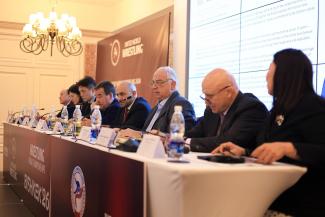
#WrestleLA

UWW announces new Olympic qualification process for LA 2028

By United World Wrestling Press

CORSIER-SUR-VEVEY, Switzerland (February 2) -- United World Wrestling has overhauled the qualification process for the Olympic Games.

Beginning with the 2028 Los Angeles Olympics, the 16 wrestlers who qualify per weight class will earn their spots through four routes: the World Championships, Continental Qualifiers, the World Olympic Qualifier, and the UWW Rankings.

The first phase of qualification will be the 2027 World Championships that will award 72 quotas for the Olympics. Each medalist [gold, silver, two bronzes] in the 18 Olympic weight classes will earn LA 2028 spots for their respective National Olympic Committees (NOC).

The second phase will be the UWW Rankings in which the first three wrestlers of the rankings, not qualified in the first phase, will obtain one quota place for their NOC for the LA28 Olympic Games. The UWW Rankings will include the seven main events organized before the LA28 Olympic Games:

- 2027 Senior Continental Championships*
- 2027 Ranking Series (3 events)
- 2027 Senior World Championships
- 2028 Ranking Series (1 event)
- 2028 Senior Continental Championships*

*UWW may include Continental Games for ranking but will only consider best two out of three continental results.

This means that 54 more wrestlers will earn Olympic quotas for their respective NOCs.

Phase three for qualifying will include the Continental Qualifiers -- Europe, Asia, Pan-America, and Africa & Oceania. These tournaments will award two quotas per weight class.

Top two wrestlers, the finalists, in each of the 18 Olympic weights will earn LA 2028 quotas for respective NOCs. A total of 144 wrestlers will be awarded at these continental events.

The fourth and final phase of qualification will be the World Olympic Qualifier which will offer 18 quotas. The gold medal winners in each of the 18 Olympic weight classes will earn the spot for their respective NOCs.

Only the countries that did not obtain a quota place during the previous three phases may participate in the World Olympic Qualifiers. The participating countries may only send two wrestlers across all styles at the World Qualifier.

For the LA 2028 qualifying cycle, UWW will award quotas at the following events:

4 quotas - 2027 World Championships
3 quotas - Ranking Series UWW Rankings
8 quotas - Continental Qualifiers (2 Europe, 2 Asia, 2 Pan-America, 2 Africa & Oceania)
1 quota - World Olympic Qualifier

Furthermore, the 2028 Continental Championships will be held before the Continental Qualifiers, ensuring that the three quotas via ranking are finalized before continental qualification events begin.

Ranking Series Participation Guidelines

Each country may enter a maximum of two wrestlers per weight class and a two-kilogram weight allowance will apply for Ranking Series events, but not for Continental or World Championships where standard weight rules apply.

The point allocation for these Ranking events will also be reviewed.

Seeding Changes

During the Olympic cycle, seeds will be assigned based on the following event tiers:

Four-seed events:
Continental Championships
Continental Qualifiers
World Qualifier

Eight-seed events:
Ranking Series
World Championships
Olympic Games

Seeding for the 2028 Olympic Games will be based on results from:

- Three 2027 Ranking Series events
- 2027 Continental Championships (or Continental Games, if applicable)
- 2027 World Championships
- One 2028 Ranking Series event
- 2028 Continental Championships

These same events will be used to seed wrestlers throughout the 2028 season, including the Ranking Series, Continental Championships and Qualifiers, the World Olympic Qualifier, and the Olympic Games.

For the 2027 Ranking Series events, 2027 Senior Continental Championships and the 2027 Senior World Championships, the results of 2026 Senior World Championships will also be considered to seed the athletes.

As is the rule, the ranking points obtained at the 2026 Senior World Championships will be removed after the 2027 Senior World Championships.

A key change is that at the Olympic Games, the seed belongs to the country, which keeps the seed even if it replaces the athlete who earned it. In all other events, the seed belongs to the wrestler, and a nation loses that seed if a different athlete competes.

For clarification regarding the new Olympic qualification process, all NFs and NOCs can contact sports@uww.org.