

#WrestlingHistory

Wrestling History: Who was Ivan Yarygin?

By United World Wrestling Press

For most, a trip to Krasnoyarsk, Siberia on the last weekend of January each year would sound chilling. Afterall, it is one of the coldest regions on the planet.

But for the past 35 years, wrestlers from around the world attend the Ivan Yarygin Grand Prix in January, the tournament which kicks off the season for most countries.

The prestigious tournament sees close to 1000 wrestlers vying for the gold medals in Freestyle and Women's Wrestling. But who was Ivan Yarygin after whom the tournament is named?

Born in Kemerovo, Soviet Union on November 7, 1948, Yarygin was a two-time Olympic gold medalist and a world champion who went on to became the coach of the Soviet Union team and later the Russian national team.

In 1966, aged 18, Yarygin was stationed in Krasnoyarsk with the army and began training with legendary coach Dmitry MINDIASHVILI to polish his technique.

Famous for winning his Olympic bouts via fall, Yarygin won seven bouts at the 1972 Games in just over seven minutes. Those were days when a bout could extend till nine minutes. He pinned all seven wrestlers before time and no one has come close to matching that record.

How did Yarygin begin training in wrestling?

Yarygin played football in his village. His big built made him a perfect goalkeeper, a position he continued to play during his driving school training in Abakan. Vladimir CHARKOV, a wrestling club trainer, saw Yarygin and asked him to try wrestling. And just by chance, Yarygin began his wrestling career.

The Freestyle wrestler primarily competed at 100kg and was known for his dynamic training and ditching traditional methods in wrestling. He quickly rose through the ranks in Soviet wrestling circles. He debuted internationally in 1970 at the European Championships and finished with a silver medal. Ahmet AYIK (TUR) defeated him in the 100kg final. But Yarygin won the European gold in 1972, the first of his three continental titles.

Later that year, Yarygin participated in the 1972 Munich Olympic Games and won gold medal in 100kg without giving up a single point in seven bouts. He defeated Khorloo BAYANMUNKH (MGL) and Jozsef CSATARI (HUN) in the finals round.

His results dipped after the Munich Olympics, with 1974 being a humbling year, Yarygin moved back to village. "I trained in the village every day like a peasant," Yarygin had famously said. "I chopped enough firewood for three winters ahead."

Yarygin returned and made sure he was still the winner. The gold medal in Montreal was not as simple as Munich but there was still no match for Yarygin. He went on to win the gold medal in 1976, his second in Olympic Games.

In the first bout of the 1976 Games, Yarygin faced Harald BUTTNER who had defeated him in the European Championships. However, Yarygin managed to keep Buttner at bay and won 13-5.

Yarygin's results soon declined and he failed to top the standings in USSR. He would finally make way for younger generation before the 1980 Moscow Olympics.

After his retirement, Yarygin tried his hand at coaching and administration. Yarygin was the coach of the Soviet Freestyle team from 1982 to 1992 and later became the president of the wrestling federation from 1993 to 1997. Russia hosted the 1997 World Championships in Krasnoyarsk which Yarygin led in organization.

Yarygin died on October 11, 1997 in a car accident. United World Wrestling inducted him into the UWW Hall of Fame in 2010.

#development

Italy Organizes UWW Level 3 Technical Course for Coaches

By United World Wrestling Press

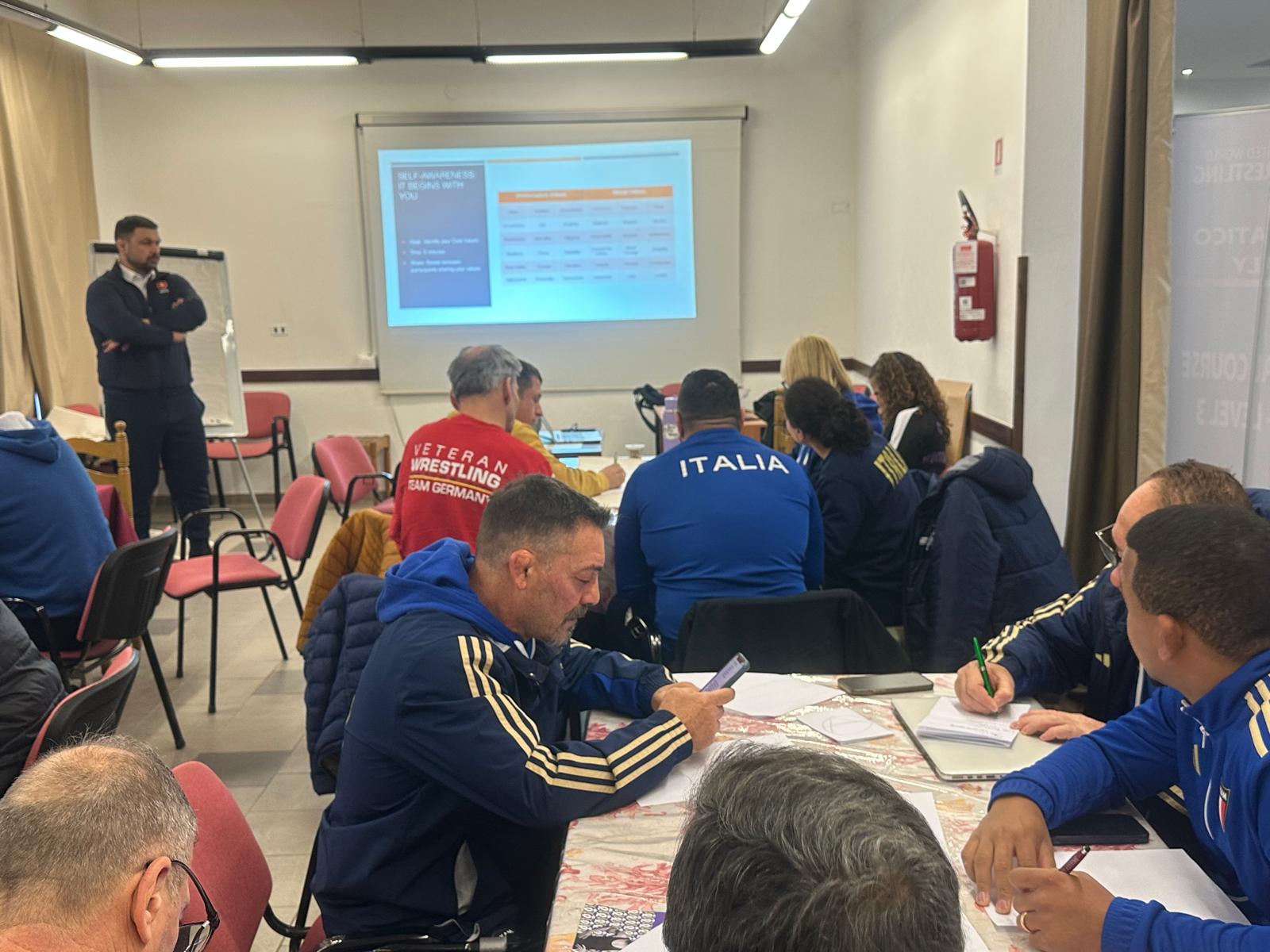
CESEBATICO, Italy (February 9) -- A United World Wrestling Level 3 Technical Course for coaches was successfully organized in Cesenatico, Italy from January 5 to 9, 2026. The course was organized in collaboration with UWW and the FIJLKAM.

Organised after a international tournament, the course brought together 33 coaches from Italy and other countries, including Germany, Poland, Croatia and Ivory Coast creating a rich environment for technical exchange, professional development and international cooperation.

This tournament provided an important practical framework for the educational programme, allowing coaches to observe real competition situations, analyze match management and technical-tactical aspects, and directly link theoretical learning to high-level competitive practice.

The programme was led by UWW Development Officer Vincent AKA, with practical sessions conducted by Olympic Champion and UWW expert Komeil GHASEMI. The course followed the new UWW education pathway, focusing on advanced coaching competencies for high-performance environments.

Italy

The key topics in the course included coaching philosophy and leadership, advanced planning and periodization, pedagogical situations and match analysis, technical and tactical development, safeguarding, anti-doping and athlete protection and introduction to Beach Wrestling.

Both theoretical and practical evaluations were conducted, allowing participants to apply their knowledge in real coaching situations. At the conclusion of the course, all successful participants were awarded the UWW Level 3 Coaching Certificate.

"I want to thank everyone for this course, for what you did, and for how we got along together," Carmelo RICCARDO, a coach and participant said. "It was a wonderful experience and very interesting course. Thanks to the UWW and FIJLKAM for these important opportunities for growth."

The Italian Wrestling Federation provided high-quality facilities, with classrooms and training venues meeting international standards. All activities were centralized at Villaggio Accademia Cesenatico, ensuring optimal logistical conditions for both learning and training.

The course benefited from the continuous presence of national federation representatives, including the Technical and Sports Directors, as well as the participation of FIJLKAM leadership during the closing ceremony—demonstrating strong institutional commitment to coach education.

After the course, it achieved its educational and development objectives. The combination of high-level technical content, structured evaluations, international expertise, and strong human values.

The course not only strengthened the competencies of participating coaches but also reinforced Italy’s role as a key hub for wrestling education and excellence in Europe, contributing sustainably to the long-term development of the sport.

Sustainability

From a sustainability perspective, the use of the covered stadium contributed to the efficient organization of Beach Wrestling activities by optimizing existing infrastructure. By adapting a multi-purpose covered venue for Beach Wrestling sessions, the organizers limited the need for additional temporary installations, reduced logistical and environmental impact, and ensured continuity of activities regardless of weather conditions.

This approach reflects UWW’s commitment to sustainable event organization through the рационal use of facilities and long-term infrastructure legacy.