

#development

Guenat presents UWW’s IT success at ASOIF workshop

By United World Wrestling Press

LAUSANNE, Switzerland (May 24) -- ASOIF’s Sport Development and Education Workshop brought together 50 experts from 29 Summer and Winter Olympic International Federations (IFs) earlier this week. Organized by the ASOIF Sport Development and Education Group (ASDEG), the workshop focused on the common challenges and opportunities related to digitalization, the centralization of information, the evaluation of return on investment of IF development programs, new revenue sources for such programs, and sport initiations at multi-sports events.

The event was held on May 16 and 17 in Lausanne, Switzerland, led by the Chair of ASDEG Deqa NIAMKEY, Development Director at United World Wrestling.

Several representatives from ASOIF member federations presented case studies and shared best practices, while a number of external experts provided additional insights into the topics addressed.

UWW IT Director Sébastien GUENAT presented the Athena and Arena system during the workshop explaining how technology can help ease the work of any IF.

“It has been a pleasure to show what we have been working on at UWW for the past 10 years and discover that other IFs are on a similar path with not only questions but also interesting ideas on how to make technological tools more engaging for everybody," Guenat said.

Cynthia Amami and Margaux Kaltenbacher from Olympic Solidarity shared their experience on successful methods and tools to centralize information, whereas Jonas Gredenhag from PGA Tour explained how new ways of data collection have helped to enhance professional golf tournaments.

Katie Brazier from Birmingham City Council and Lilia Barieva from the International University Sports Federation (FISU) then presented successful examples of innovative sports initiations at the Birmingham 2022 Commonwealth Games and the World University Games respectively.

During another session, Elena Portas and Patrick Massey from Portas Consulting discussed social return on investment with the Forum participants.

Development and education are crucial to solid foundations and the healthy future of every sport. It's great to see that each year, our workshop attracts more IF colleagues and the discussions and outcomes are really constructive.

The workshop facilitates a united approach of a large number of IFs in the implementation of their sport development and education projects. This allows efficiencies in terms of human and financial resources, ensures a certain consistency across the sports and thereby maximizes the impact of the related IF activities overall.
#development

South Africa Advances National Wrestling System with DNSS Phase 2

By United World Wrestling Press

PRETORIA, South Africa (April 8) -- South Africa has reached a decisive milestone in its long-term wrestling development strategy with the successful implementation of Phase 2 of the Development of National Sport System (DNSS) programme, delivered in collaboration with United World Wrestling (UWW) and supported by Olympic Solidarity.

Following the diagnostic and mapping phase conducted earlier, Phase 2 marks a clear transition from analysis to structured implementation, laying the foundation for a sustainable and internationally aligned wrestling system.

Led by UWW Development Officer Vincent AKA, in close cooperation with the South African Wrestling Federation (SAWF), the National Head Coach, Markus DEKKER and Provincial Coordinators, the programme was deployed across multiple provinces through a structured 10-day intervention from March 2 to 13. 

Activities were conducted in key locations including:

· LPWA (Ion Bachu)
· CGWA (Ruiter)
· NGWA (Menlo Park Hall)
· Frank Joubert Tournament (Menlo Park Hall)

This nationwide approach ensured direct engagement with provincial structures, strengthening alignment between national leadership and local associations while promoting inclusive development across the country.

From Talent Identification to System Building

Unlike traditional training camps, DNSS Phase 2 focused on identifying talent and building long-term development systems. Wrestlers and coaches from all age categories -- U13, U15, U17, U20, and Senior -- were actively involved, ensuring a complete pathway approach.

Provincial visits and stakeholder meetings played a key role in assessing facilities and operational structures, strengthening coordination between SAWF and provinces, and identifying emerging wrestlers.

Building Athlete Pipeline

A training camp for different provinces brought together wrestler to consolidate talent identified during Phase 1 and introduce standardized training methodologies.

The training camp included technical sessions, physical conditioning, match simulations and wrestling. The initiative contributed to the creation of an updated national prospect and the foundation of a structured athlete monitoring system.

South Africa

Beach Wrestling Gains Momentum

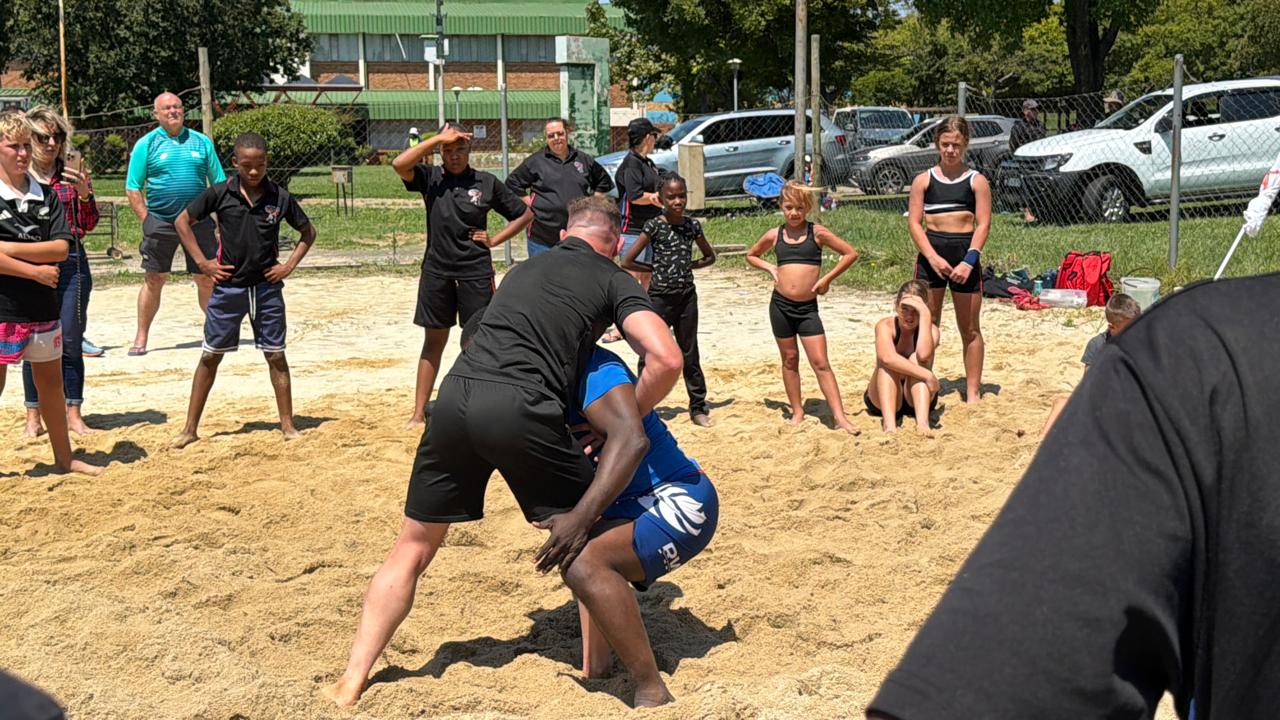
As part of the DNSS activities, a Beach Wrestling training session in Roodepoort highlighted the programme’s expanding impact.

During the visit, Aka led a specialized session, sharing advanced technical insights adapted to beach wrestling. It included stance and balance adjustments, grip and control techniques, and movement adaptation on sand.

The training programme comes at a crucial time, as South African athletes prepare for African Beach Wrestling Championships in Alexandria, Egypt and other international tournaments.