

Former Japan high school star aims to put Samoa on wrestling map
Monday, November 21, 2022 - 13:03 By Ikuo Higuchi

(Editor's Note: The following appeared on the Japan Wrestling Federation website on Nov. 2. It has been translated and published by permission.)
TOKYO -- On the Japan wrestling schedule, the National Non-Student Open falls far below the level of major tournaments like the Emperor's Cup and Meiji Cup, which serve as the qualifiers for the world and Olympic teams.
As such, it is rare to see a prospective Olympic team member entering the tournament. Yet at this year's event, which was held for the first time in three years due to the pandemic, there was one, although it is not Japan's team that Gaku AKAZAWA is hoping to make for the 2024 Paris Olympics.
A former high school star, Akazawa won the freestyle 70kg title as a member of a team from the Pacific Island nation of Samoa, which he hopes to represent in Paris.
The 32-year-old Akazawa, whose quest for Olympic glory included a four-year sabbatical in Russia, was wrestling in his native country for the first time in three years at the Non-Student Open, which was held Oct. 29-30 in Fujimi, Saitama Prefecture, north of Tokyo.
Akazawa, who was unable to obtain Samoan citizenship in time for the Tokyo Olympics, is hoping the paperwork comes through in time for Paris. "I have never stopped dreaming of appearing in the Olympics," he said. "I will make every effort as I try to become an Olympian from Samoa."
 Gaku Akazawa celebrates his victory at freestyle 70kg for Team Samoa. (Photo by Japan Wrestling Federation)
Akazawa last competed in Japan at the 2016 Emperor's Cup All-Japan Championships. The victory in Fujimi was his first anywhere since winning the National Inter-High School title at 66kg in 2008, which made him the first-ever national champion from Hanasaki Tokuharu High School in Saitama Prefecture.
His coach at Hanasaki Tokuharu, Takuya TAKASAKA, was on hand to watch the former prodigy show his fighting spirit with tough wins over several opponents with pedigrees. In the semifinals, Akazawa defeated 2018 national collegiate champion Hayato OGATA 8-2, then took the title with a 6-2 win over Kantaro YAMAZAKI, who won both the spring and fall titles of the East Japan collegiate league in 2018.
"It was a long time since I've wrestled in Japan, so I had no idea what level I am presently at," Akazawa said. "I was nervous. By winning the title, it gave me some idea of where I stand, and I'm honestly really happy."
Asked what was the source of his tenacity and stamina that allowed him to rally to victories, he replied, "Every morning and night, and sometimes three times a day, I train intensely. I think that came out today."
In Samoa, wrestling is still far from popular, and with the pandemic limiting activities, there are only about 10 wrestlers over the age of 14 in the entire country. The majority of competitors are still beginners, and he cannot train in a way that sharpens his skills. "Instead, I think I was able to win on physical strength," he said.
 Akazawa, right, poses with competitors at the Samoan national championships in the capital Apia in August 2021, where he served as a referee. (Photo courtesy of Gaku Akazawa)
From Russia, with determination
The Non-Student Open, as the name implies, is for anyone out of school, and draws a wide mix of wrestlers with various backgrounds, from former high school champions to more than a few who started the sport after leaving college to keep in shape and maybe practice on weekends at a local club.
But for Akazawa, it presented a challenge directly related to getting to Paris. "I hadn't wrestled in Japan for a long time, so I think there were people who thought I had retired," he said with a smile.
Akazawa, who had won national junior high school and JOC Junior Olympic titles, went to Nihon University following his Inter-High School success, but was unable to repeat it on the collegiate level. Plagued by injuries, Akazawa's file in the database of the Japan Wrestling Federation website, which lists all results, has no entries for his years at Nihon.
He would not make his first appearance at the Emperor's Cup (held in December) until 2013, the year he graduated from Nihon. He placed fifth at 60kg.
Never abandoning his Olympic dream, he chose a path that took him to one of the premier powerhouses in the sport, Russia. He headed to Krasnoyarsk, the Siberian city well known in Japan as the host of the prestigious Ivan Yarygin Grand Prix, to continue his career.
He had no sponsor. When his visa expired, he would return to Japan, work some odd jobs to save up money, then return to Krasnoyarsk. He endured this unstable life for four years from 2013 to 2017, all because of his love for the sport and his desire to become an Olympic champion.
But no matter how much he trained in a top wrestling country, such instability in his daily life certainly made it difficult to focus on the sport. He would return to Japan to compete in the Emperor's Cup and Meiji Cup (the All-Japan Invitational Championships, held in the spring), but was unable to finish on the podium.
The Olympics seemed farther away than ever. But his dream never faded. What caught his attention was that one of his Russian wrestling buddies, instead of competing for the stacked Russian team, had changed nationalities and made it to the 2016 Rio Olympics.
While such a move is exceedingly rare in Japan, it is not without precedent. A minor comedian named Neko HIROSHI (neko means cat; his real name is Kuniaki TAKIZAKI) became a Cambodian citizen so he could run the men's marathon at the 2016 Rio Olympics.
While his move gained attention as a celebrity, he also faced criticism as his best time would not have even made the Japanese women's team. He finished 138th in Rio, 37 minutes behind the winner with a time that would have placed 85th in the women's race.
Akazawa, whose case is different in that he is already on a global level, began to think about how he could go about changing nationality. Thinking of countries with the easiest route for qualifying he was attracted to Oceania. An English teacher from his junior high school days just happened to be dispatched to Samoa under a Japan International Cooperation Agency program as a judo instructor, and Akazawa got the wheels in motion by contacting him.
With that as the turning point, he relocated to Samoa in June 2017.
 Maulo Willie ALOFIPO, a former rugby player, accompanied Akazawa to Japan and finished second in both styles. (Photo by Japan Wrestling Federation)
Spreading the word in Samoa
Jerry WALLWORK, president of the Samoan Wrestling Federation, bought into Akazawa's enthusiasm and dedication and pledged his support. The following year, Akazawa married a local nurse named Sinevalley. He applied for a change of nationality with eyes on the Tokyo Olympics, but it did not come in time. "It's hard to get Samoan nationality," Akazawa said.
Akazawa currently earns a living as the owner of a massage parlor, and is able to continue his wrestling career through support from the federation. For the Non-Student Open, Samoa had come out of lockdown and Akazawa had needed to return to Japan for a family matter, so he decided to use the opportunity to enter the tournament and see where he stood.
He was to be accompanied by two Samoan wrestlers, who entered the individual tournaments in both styles. The trio would also enter the team event. However, the father of one wrestler took ill and was unable to make the trip, and Team Samoa had to withdraw.
The remaining wrestler, Maulo Willie ALOFIPO, made the most of his trip, winning silver medals in both styles at 97kg and gaining valuable international experience. The 25-year-old was originally a rugby player and has only been wrestling for two years.
"There are common points between rugby and wrestling," Akazawa told Alofipo in recruiting him to the latter. "You can do it just once a week if you want, but why don't you give it a try?"
Alofipo gradually started spending more time in wrestling. He practices in the morning before going to his day job on a cacao plantation, then returns to the mat for an evening session. He made his international debut in August this year, finishing fifth at freestyle 97kg at the Commonwealth Games in Birmingham, England.
As for his runner-up finishes in the Japan tournament, he commented, "I'm really happy. Japan is a very high level. It's a thrill to be able to fight here."
Asked about his goal from here, he replied, "The Olympics."
Both Akazawa and Alofipo remained in Japan after the tournament with plans to stay until late December. Akazawa said they will work out at his alma maters of Hanasaki Tokuharu High School and Nihon University.
Although his victory earned him a spot in the Emperor's Cup in December, Akazawa did not enter. His latest foray was to test his current level, and, regarding himself now as "Samoan," he said he draws the line at competing for the title of No. 1 in Japan.
 Akazawa records a fall in the second round at the National Non-Student Championships. (Photo by Japan Wrestling Federation)
Building a new powerhouse
When deciding what high school he would go to, Akazawa bypassed the powers of the day for Hanasaki Tokuharu, which was virtually unknown in wrestling circles. "Rather than get stronger on a strong team, I wanted to go to a no-name school and beat the powerhouses one after another," he said at the time.
And that was pretty much what he did. In his third year in 2008, he helped Hanasaki Tokuharu end the 14-year reign of Ibaraki Prefecture's Kasumigaura High School at the Kanto High School Championships (Kanto is the region of Japan that includes Tokyo and its environs).
Kasumigaura would get revenge later in the team final at the Inter-High School Championships, but in that match, Akazawa defeated the reigning national champion (shown in the top photo). He made a name for himself and helped launch a new powerhouse on the scene just four years after its founding.
The energy and enthusiasm that Akazawa feels in Samoa now are incredibly similar to "those days." Samoa enjoys warm weather year round, with average lows of 23 C and highs of 31 C. The wrestling room is an open-air facility with a roof, much like in the Japan of another era when each town had an outdoor sumo ring located next to the local shrine.
Whereas gyms in Japan are now air-conditioned, it is a world of difference in Samoa. "Every day, I practice drenched in sweat," Akazawa said.
Rugby is still king in Samoa, and trying to increase participation in other sports is no easy task. But there have been inroads made, as Samoa has been represented at the Olympics in judo. In wrestling, the lone Olympic entry in its history was at the 2000 Sydney Games, when Faafatai IUTANA qualified at Greco-Roman 76kg. Samoa had a fair number of gold medalists at the Oceania Championships, although none since 2011. So the potential is there.
Achieving his own Olympic dream will be a link to the spread of wrestling in Samoa. For now, as he awaits word of being granted citizenship, Akazawa will continue to focus all of his efforts on making it to Paris. Most of his high school teammates have long left the mat and have followed a path into coaching. But at least one of the "Class of 2008" still has a burning passion for the Olympics.
-- Translation by Ken Marantz
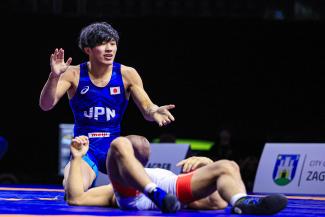
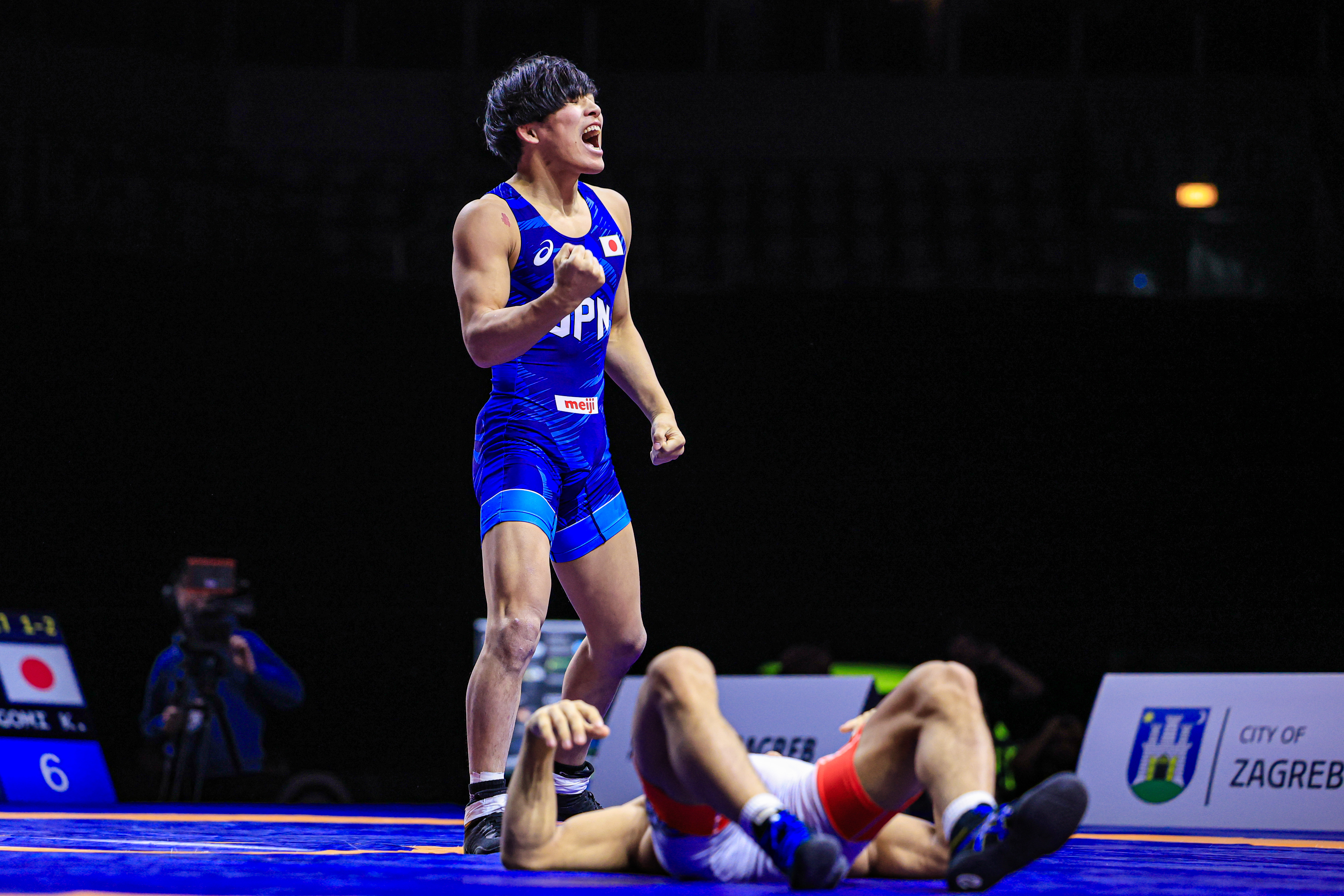 Koto GOMI (JPN) defeated Alisher GANIEV (UZB) in the Zagreb Open final. (Photo: United World Wrestling / Amirreza Aliasgari)
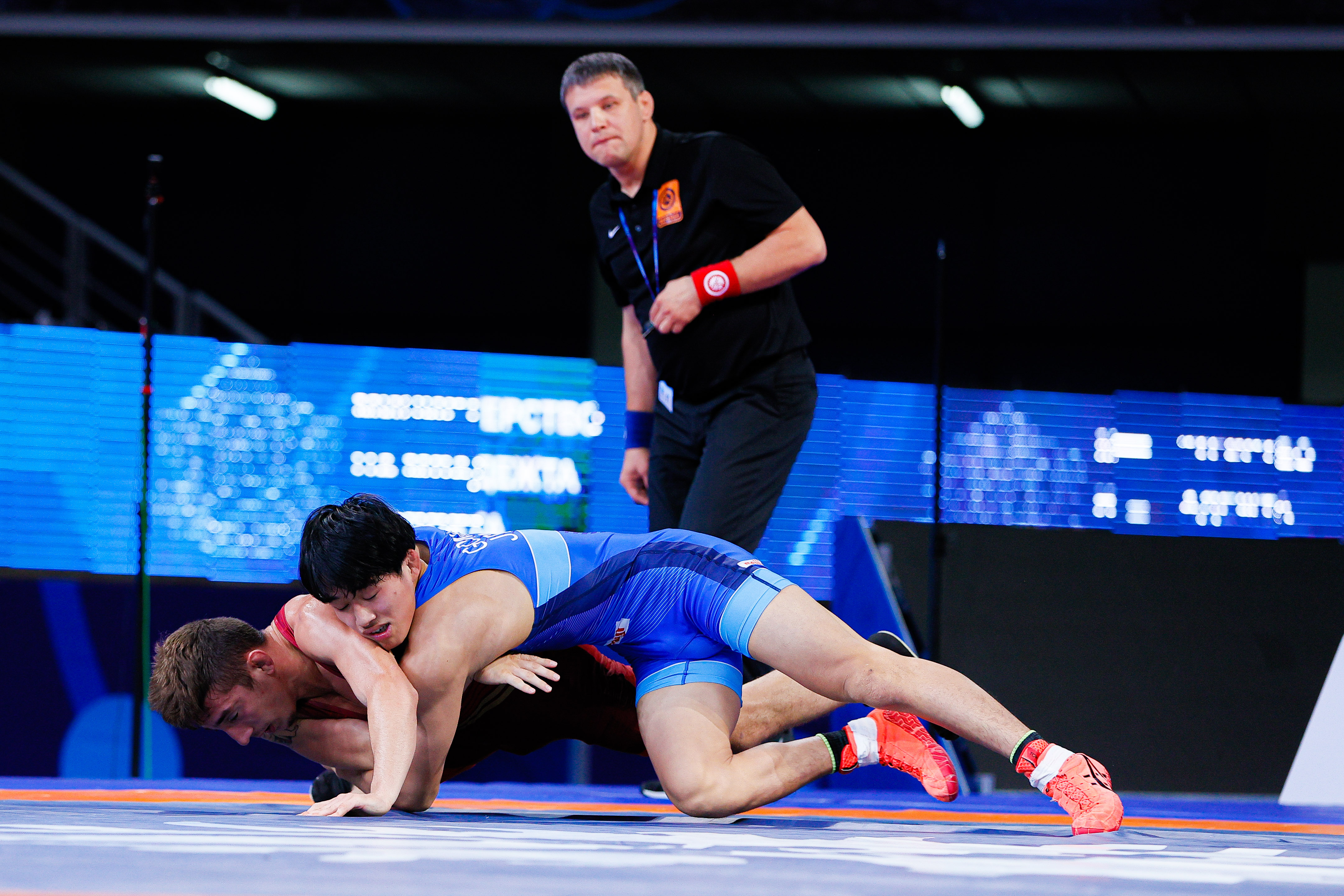 Koto GOMI (JPN), blue, at the 2022 U20 World Championships. (Photo: United World Wrestling / Kostadin Andonov)
Share your thoughts.
Comments