YoungestToOldest

The Youngest/Oldest GR Gold Medalists in Olympic History

By Ikuo Higuchi

(This is the last of a three-part series that appeared on the Japan Wrestling Federation website. It was translated for UWW by Ken Marantz.)

A Style Dominated by Europeans
Compared with the United States and Asia, where most wrestlers start the sport in freestyle, many in Europe start out in the sport as youth in Greco-Roman style. This can account for the fact that out of 196 gold medals awarded at the Olympics so far, 168 have gone to Europeans (170 if wrestlers from current Asian countries who competed for the Soviet Union are included). 

Even so, it took more than a century of Olympics before a teenager would bring home a gold. Islambek ALBIEV (RUS) broke through the barrier at the 2008 Beijing Olympics, where he won the 60kg gold at 19 years 7 months 15 days. A world junior champion in 2006, Albiev added to his stature when he triumphed at both the European and World Championships the year after Beijing.

Albiev remains the lone teenager to win a Greco gold heading into the Tokyo Olympics, although such a feat might have more to do with timing than skill, given that the Olympics come only once every four years. A wrestler who is 16 or 17 in an Olympic year will likely never get a legitimate shot at a gold as a teenager (not that it really matters in the end if one wins a gold at 19 or 20; it is just being mentioned here for historical purposes). 

Take the case of legendary Hamza YERLIKAYA (TUR), who was just 17 years 3 months 16 days when he won the 82kg title at the 1993 World Championships. But his triumph at the 1996 Atlanta Olympics came 1 month 18 days after he had celebrated his 20th birthday. Yerlikaya would add another Olympic title in 2000 and world title in 2005 before going on to become a member of Turkey's Parliament.

The 1987 World Championships in Clermand-Ferrand produced a teenaged Greco champ in Pedro Favier ROQUE (CUB), who won the 52kg gold at 18 years 8 months 26 days. He would have still been 19 at the Seoul Olympics the following year, but it was not to be. Cuba, following the lead of the Democratic People's Republic of Korea, did not participate in the Games in the south of the peninsula.

Comparatively, freestyle has eight Olympic champions who were in their teens or 20, while Greco has just half that number with four. Perhaps this shows how Greco relies more on experience to master. 

It looking at the oldest gold medalists, the world and Japanese media heralded the crowning of a 40-year-old champion at the 1972 Munich Olympics. Anatoli ROSCHTSCHIN (URS) was 40 years 6 months 0 days when he won the over-100kg crown. But there had been an older champion before that, back in the days before mass media. At the 1920 Antwerp Olympics, Adolf LINDFORS (FIN) was 41 years 6 months 12 days when he triumphed in the over-84kg class. And he certainly earned his medal--he won all five of his matches by fall, with his second-round victory take 23 minutes 43 seconds and his win in the final lasting a whopping 47 minutes 38 seconds. (In that era, the time limit for a match was reportedly 50 minutes.)

As in freestyle, the majority of champions on the oldest-ever list are in the upper weight classes. Of the top 15, the lone lightweight champions (68kg or lower) came in the pre-World War II era. Since the end of the war, there have been only six gold medalists aged 30 or over in the lightweight divisions, most recently Davor STEFANEK (SRB), who was 30 years 11 months 4 days when he won the 66kg gold at the 2016 Rio de Janeiro Olympics.

By the way, Japan has had four Greco champions in Olympic history. The youngest was Masamitsu ICHIGUCHI (JPN), who was 24 years 9 months 7 years when he took the 57kg gold at the 1964 Tokyo Olympics. The oldest, 1984 Los Angeles Olympic 52kg champion Atsuji MIYAHARA (JPN), was 25 years 7 months 13 days on the day of his triumph.

Why am I bringing this up? If the upcoming Tokyo Olympics had been held as scheduled this summer, current world 60kg champion Kenichiro FUMITA (JPN) could have broken Ichiguchi's record as youngest-ever by winning the gold on Aug. 3, when he will be 24 years 7 months 16 days. But with the Games postponed for year, Fumita instead has a chance to become the oldest-ever. The final is tentatively slated for Aug. 2, 2021, when Fumita will be 25 years 7 months 15 days--just two days older than Miyahara.

TOP 15 YOUNGEST OLYMPIC CHAMPIONS (GRECO-ROMAN)
Name                                                        Age                               Olympics                       Wt.    Date of birth
1. Islambek ALBIEV (RUS)                    19 years 7 months 15 days         2008 Beijing       60kg     1988/12/28

2. Hamza YERLIKAYA (TUR)             20 years 1 month 18 days         1996 Atlanta         82kg     1976/06/03

3. Suren NALBANDYAN (URS)           20 years 1 month 21 days         1976 Montreal       68kg     1956/06/03

4. Shazam SAFIN (URS)                       20 years 3 months 20 days      1952 Helsinki         67kg     1932/04/07

5. Alexandre KARELINE (URS)          21 years 0 months 2 days           1988 Seoul           130kg     1967/09/19

6. Varteres SAMURGASHEV (RUS)   21 years 0 months 13 days         2000 Sydney          63kg     1979/09/13

7. Boris GUREVICH (URS)                    21 years 4 months 4 days       1952 Helsinki          52kg     1931/03/23

8. Ji-Hyun JUNG (KOR)                        21 years 5 months 0 days       2004 Athens            60kg     1983/03/26

9. Alexander KOLTSCHINSKI (URS) 21 years 5 months 4 days           1976 Montreal    +100kg   1955/02/20

10. Khassan BAROEV (RUS)                 21 years 8 months 24 days      2004 Athens          120kg     1982/12/01

11. Roman VLASOV (RUS)                    21 years 9 months 30 days      2012 London           74kg     1990/10/06

12. Jouko SALOMAEKI (FIN)              21 years 11 months 7 days         1984 Los Angeles   74kg     1962/08/26

13. Schamil CHISAMUTDINOW (URS)  21 years 11 months 21 days   1972 Munich           68kg     1950/09/20

14. Henri DEGLANE (FRA)                    22 years 0 months 18 days      1924 Paris              +82kg     1902/06/22

15. Vincenzo MAENZA (ITA)                 22 years 2 months 30 days      1984 Los Angeles      48kg     1962/05/02

TOP 15 OLDEST OLYMPIC CHAMPIONS (GRECO-ROMAN)
Name                                                        Age                                       Olympics                        Wt.    Date of birth
1. Adolf LINDFORS (FIN)                   41 years 6 months 12 days          1920 Antwerp           +82kg     1879/02/08

2. Anatoli ROSCHTSCHIN (URS)      40 years 6 months 0 days            1972 Munich          +100kg     1932/03/10

3. Johannes KOTKAS (URS)               37 years  5 months 24 days          1952 Helsinki           +87kg     1915/02/03

4. Kaaro ANTTILA (FIN)                   36 years  10 months 10 days         1924 Paris                   62kg     1887/08/30

5. Carl WESTERGREN (SWE)           36 years  9 months 25 days          1932 Los Angeles      +87kg     1895/10/13

6. Claes JOHANSON (SWE)               35 years  9 months 16 days          1920 Antwerp           82.5kg     1884/11/04

7. Erik MALMBERG (SWE)                35 years  6 months 23 days          1932 Los Angeles        66kg     1897/01/15

8. Eemeli VAERE (FIN)                      34 years  10 months 23 days         1920 Antwerp          67.5kg     1885/09/28

9. Axel GROENBERG (SWE)             34 years  2 months 18 days           1952 Helsinki              79kg     1918/05/09

10. Mijain LOPEZ NUNEZ (CUB)     33 years  11 months 26 days          2016 Rio de Janeiro  130kg    1982/08/20

11. Ahmet KIRECCI (TUR)                33 years 9 months 10 days            1948 London              +87kg     1914/10/27

12. Ivar JOHANSSON (SWE)             33 years  6 months 9 days            1936 Berlin                    79kg     1903/01/31

13. Rudolf SVENSSON (SWE)            33 years  4 months 11 days           1932 Los Angeles          87kg     1899/03/27

14. Vaeinoe KOKKINEN (FIN)          32 years  8 months 13 days           1932 Los Angeles          79kg     1899/11/25

15. Valentin NIKOLAEV (URS)          32 years  8 months 0 days            1956 Melbourne            87kg     1924/04/06

#wrestlebishkek

Hong Ends Bronze Age, Helps China Usher in Possible Golden Era

By Ken Marantz

BISHKEK, Kyrgyzstan (April 10) -- By ending her own personal Bronze Age, Kexin HONG (CHN) helped China possibly usher in the beginning of a new Golden Era.

Hong was one of four Chinese to strike gold on the final day of the women’s competition at the Asian Championships, winning the 57kg title on Friday to end a rash of recent third-place finishes.

“Each bronze medal made me a little bit stronger by the competition,” Hong said. “So this time, I feel really happy, especially when yesterday I finished the semifinal and made it to the final. Finally, a final.” 

The other Chinese who made the top of the podium in Bishkek’s Zhastkyk Arena were Jin ZHANG (CHN) at 53kg, LILI (CHN) at 65kg and Jia LONG (CHN) at 72kg, capping a performance in which all 10 of the country’s wrestlers took home medals.

The lone other medal at stake on Friday went to two-time former world champion Nonoka OZAKI (JPN), who had ousted a Chinese opponent in the quarterfinals the previous day before snatching the 62kg gold by avenging one of her few international losses -- which led to a nice surprise for her on the medal podium.

China pipped rival Japan for the team title when Lili and Long defeated Japanese opponents in their gold-medal matches. China, with five golds overall, finished on top with 205 points, followed by Japan with 191 and Mongolia in third with 126.

“It shows that every single member of our team has been working hard behind the scenes,” Long said. “And because we have a good coach who draws up excellent plans for us, we execute them with dedication, all for the sake of our shared dream.”

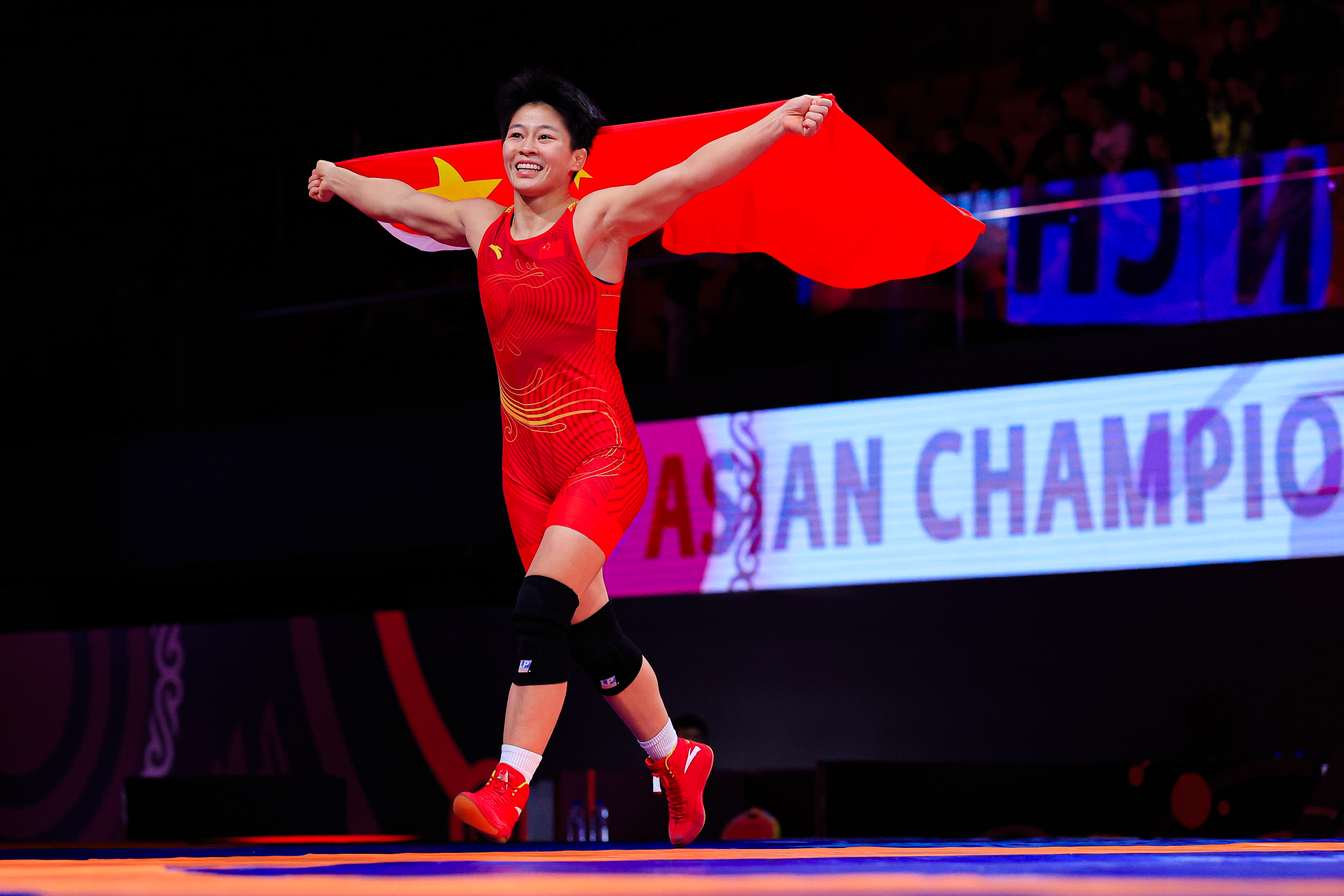
Kexin HONG (CHN)Kexin HONG (CHN) celebrates after winning the gold medal at 57kg. (Photo: United World Wrestling / Kostadin Andonov)
Hong completed a spotless run to the gold with a victory by fall over former world silver medalist Khulan BATKHUYAG (MGL) in the 57kg final.

Hong is no stranger to ending tournaments with victories, and her resume includes medals from every major global event. Unfortunately, none of those wins had come in finals over the past three years.

According to a Chinese team official, her teammates tease Hong about having an affinity for bronze, nicknaming her "Tong Pai Da Man Guan," which loosely translates to "Bronze Medalist Grand Slam." It’s not hard to see why. In the past three years, she has taken home medals of that color at four major competitions -- the 2023 Asian Games, the 2024 Paris Olympics, the 2025 Asian Championships and the 2025 World Championships.

The closest she came to breaking the hex came in Paris, where she was leading 7-0 in her semifinal against Anastacia NICHITA (MDA) when disaster struck and she got caught and pinned.

“Nobody wants to lose, but that's part of competition,” Hong said. “I really felt sad for that moment, but it also meant there was some weakness in my wrestling.

“So, I accepted and recovered, and told myself that I can become better and better. Now I’m happy to see myself improve.”

There were no slipups in her demolition of Batkhuyag in Friday’s final. Hong opened with a takedown and lace lock for a quick 4-0 lead. After a second takedown and exposure, she got her arm between Batkhuyag’s knees, lifted up and planted the Mongolian on her back, securing the fall in 1:31.

“Before, I never thought about that I can finish so fast,” said Hong, who won all three of her matches by technical superiority or fall, without conceding a point.

“Just before the competition, I just thought to be ready for the six minutes, ready to fight to the last second and just try my best to show all my advantages.”

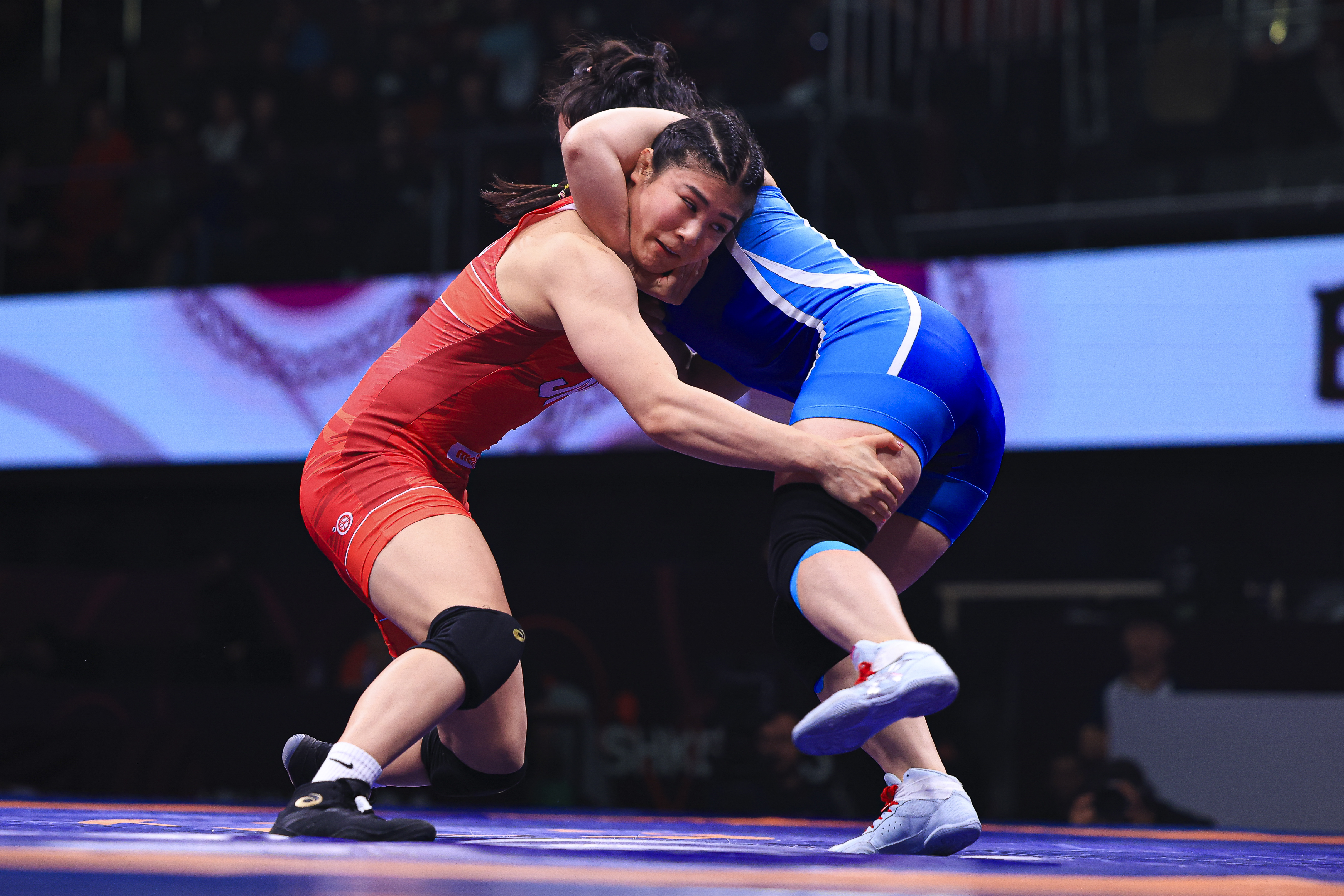
Nonoka OZAKI (JPN)Nonoka OZAKI (JPN) defeated Hyon Gyong MUN (PRK) to win her third Asian gold medal. (Photo: United World Wrestling / Kadir Caliskan)
At 62kg, Japan’s Ozaki completed an equally flawless run to her third Asian gold and fifth medal overall by scoring two 4-point takedowns in a 10-0 victory over Hyon Gyong MUN (PRK).

“I was able to win by technical superiority, but before the match, I never thought I could have such a large gap in points like this, so I'm really happy,” said Ozaki, a Paris Olympic bronze medalist at 68kg.

The victory in 2:15 avenged a particularly frustrating loss to Mun in the final of the 2023 Asian Games. Ozaki had been leading when Mun used an arm throw to toss her onto her back, then held her in the near fall position for the final minute to win 6-6 on criteria.

“One of my main objectives coming here was to beat that DPR Korean wrestler,” Ozaki said. “There were also big hurdles to get over. As such, I want to view this result in a positive light and regard it as doing a good job.”

Ozaki’s reward for a job well done came on the medal podium, where she was surprised to see that the presenter was none other than longtime rival and local superstar Aisuluu TYNYBEKOVA (KGZ), the three-time world champion and two-time Olympic medalist who is currently on a hiatus.

They shared a hug after the medal was placed around a beaming Ozaki’s neck.

“Aisuluu-san is a hero,” Ozaki said. “I have so much respect for her. Of course, I respected her while she was competing. She's really a special person. To be at a competition and receive the medal this way is really an honor and I am proud of it.”

To get to Bishkek, Ozaki had to defeat reigning world and Olympic champion Sakura MOTOKI (JPN) at the All-Japan Championships in December. Now, to achieve her goal of getting to this year’s World Championships and Asian Games, she will have to beat Motoki again, either at next month’s Meiji Cup or a subsequent playoff.

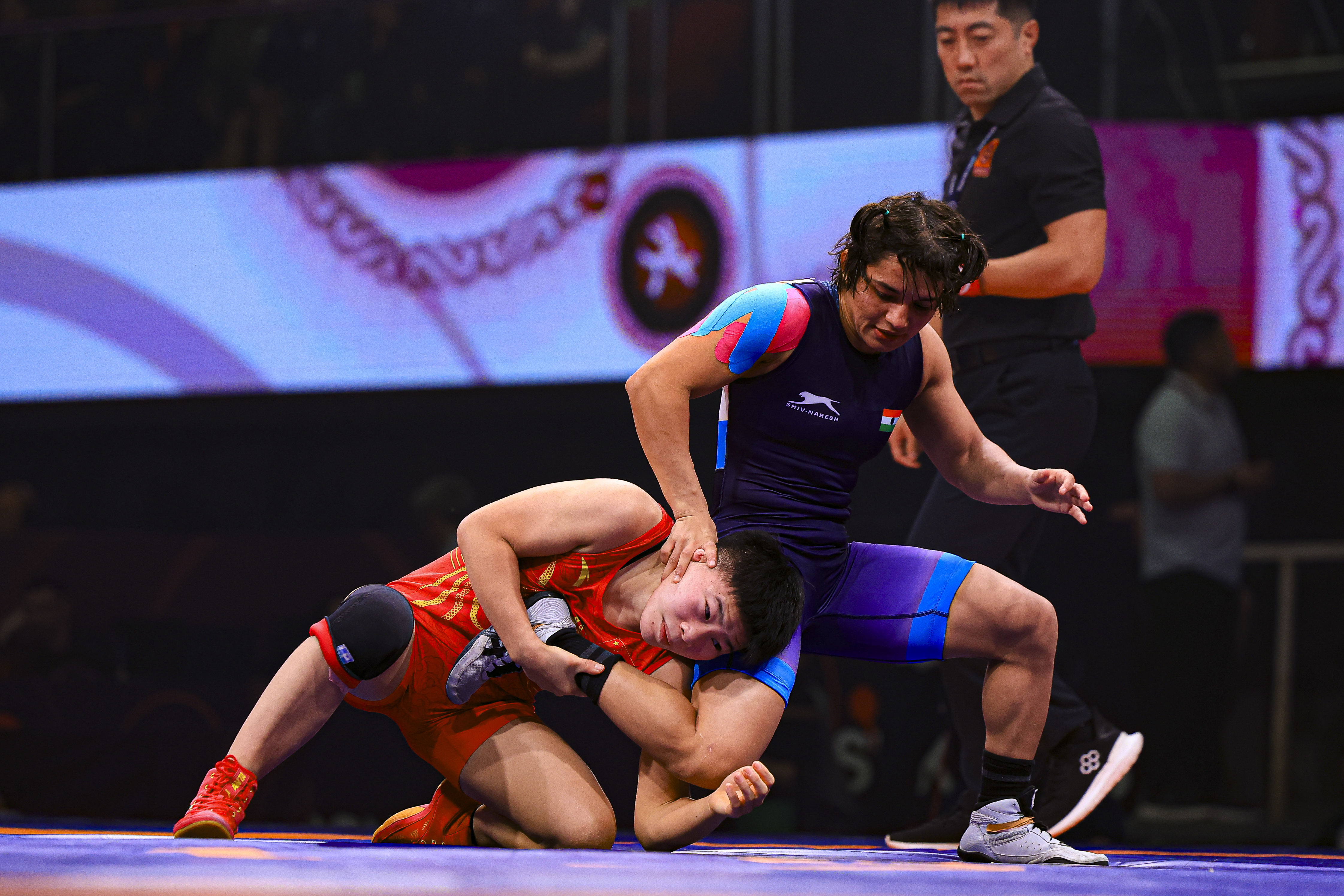
Jin ZHANG (CHN)Jin ZHANG (CHN) works on a takedown against MEENAKSHI (IND) during the 53kg final. (Photo: United World Wrestling / Kadir Caliskan)
At 53kg, Zhang picked up her first gold in her second trip to the Asian Championships with a lightning-quick 10-0 victory over MEENAKSHI (IND). A single-leg takedown, a lace lock and four quick spins gave Zhang the victory in 53 seconds.

Zhang, the 2024 world silver medalist at 55kg, got over her biggest hurdle in the semifinals, when she pancaked former world champion Moe KIYOOKA (JPN) for a stunning victory by fall.

“I never think about when what kind of action I can win from,” Zhang said. “I just follow the coach’s instructions, to be tough and do your attack.”

Zhang said she will not succumb to the pressure that comes with being a newly crowned Asian champion.

“After I stepped off this podium, everything will go to zero and it's a new start,” she said. “I will never think about I'm Asian champion now. I will surely fight for the higher step of the podium.”

Going into the last two finals, Japan could have won the team title with victories in both. Instead, the Chinese swept the two, with one match coming down to a challenge decision and the other a more forthright victory.

LILI (CHN)LILI (CHN) tries to score a takedown against Nana IKEHATA (JPN) during the 65kg final. (Photo: United World Wrestling / Kostadin Andonov)
At 65kg, China’s Lili had the winning takedown confirmed by challenge for a 3-2 victory after it appeared that Nana IKEHATA (JPN) had held on for the title.

Ikehata, the winner at the Zagreb Ranking Series this year and the 2024 world U20 champion, was leading 2-1 with all of the points coming on the activity clock when Lili made a low lunge for Ikehata’s leg with :30 to go.

Lili caught Ikehata’s heel and the Japanese tumbled onto her backside, but immediately got up and fought desperately to keep Lili from completing the takedown as time ran out.

But on challenge, it was decided that Ikehata’s initial drop to the mat constituted a takedown for Lili, who was awarded the 2 and the victory, giving her an Asian gold to go with her 2023 world bronze, and leaving Ikehata stunned.

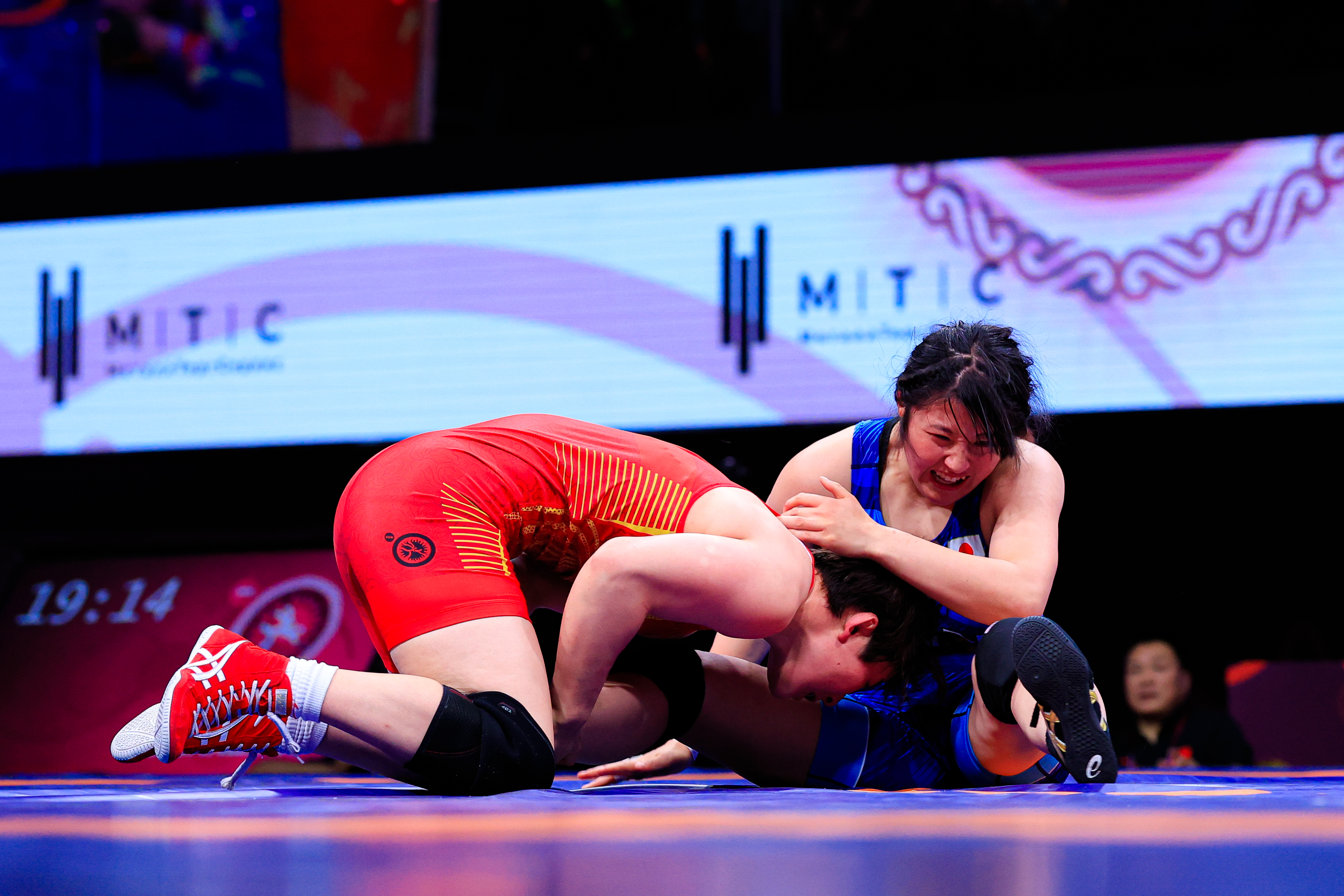
Jia LONG (CHN)Jia LONG (CHN) turns Mahiro YOSHITAKE (JPN) using a high gut wrench. (Photo: United World Wrestling / Kadir Caliskan)
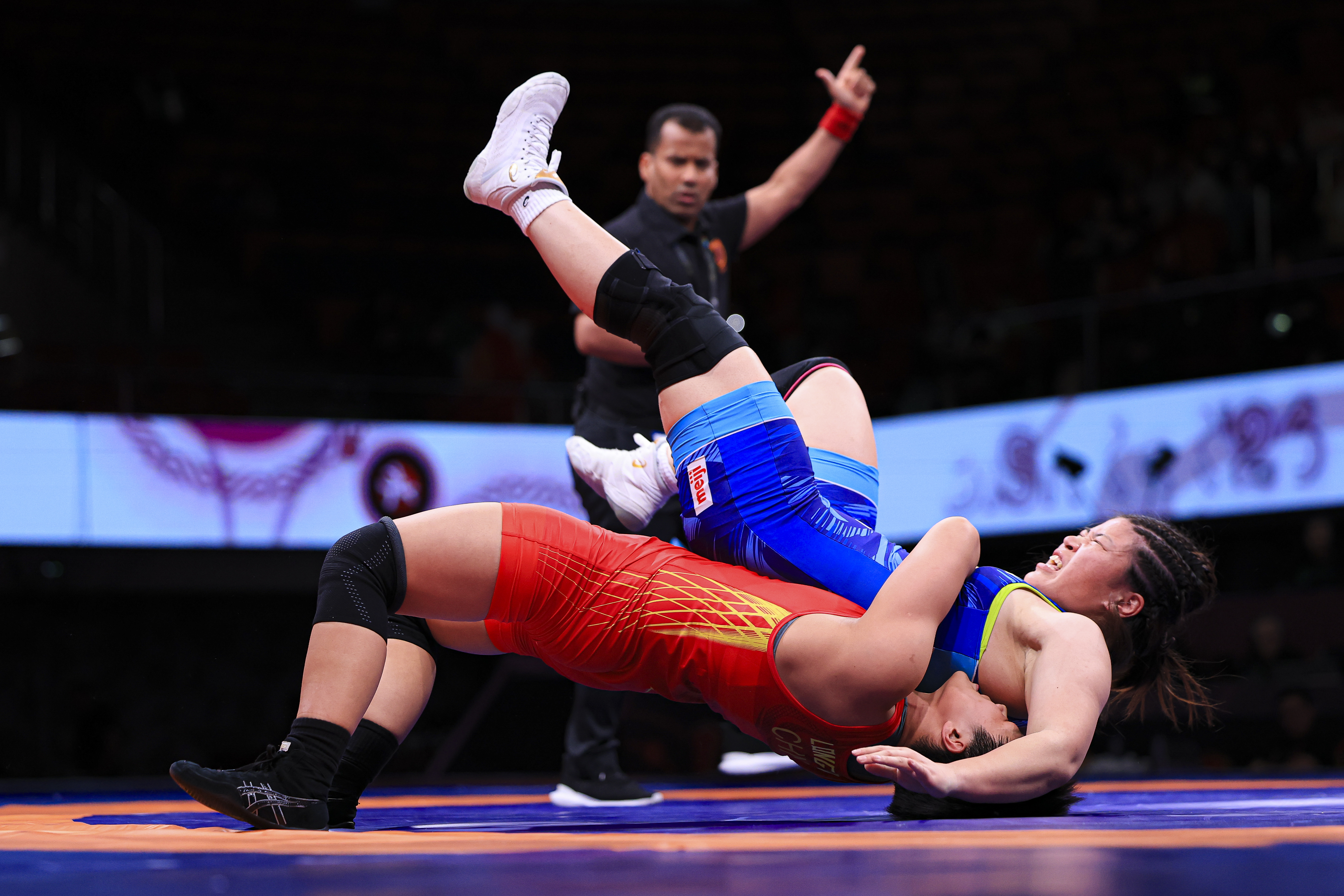
In the final bout of the night, Long completed the Chinese gold rush with a 10-2 victory in the 72kg final over Mahiro YOSHITAKE (JPN) -- a repeat of the 65kg final in 2023.

After a stepout and activity clock gave Long a 2-0 lead at the break, she finally got Yoshitake to the mat with a single-leg takedown. From there she used her deadly high gut wrench for three consecutive rolls.

That should have ended the proceedings right there, but on the final one, Yoshitake managed to fluidly step over for a 2-point exposure that kept the action going with 1:20 left. But Yoshitake never threatened and Long came away with her second Asian gold.

Long has been gradually moving up in weight, having won the 2022 world silver and 2024 world gold at 65kg and a bronze at last year’s World Championships at 68kg.

“Perhaps there were some challenges with strength,” Long said of competing at 72kg. “But in terms of speed, it might have been a bit better than at 68kg.”

Sara NATAMI (JPN)Sara NATAMI (JPN) defeated MANISHA (IND) to win the 57kg bronze medal. (Photo: United World Wrestling / Kadir Caliskan)

Kiyooka, Natami bounce back

Kiyooka and Sara NATAMI (JPN), who were both handed stunning losses by fall in the semifinals, bounced back to take home bronze medals with one-sided victories.

Kiyooka, the silver medalist a year ago, completed the collection of Asian medals with a 10-0 rout of Aziza KELDIBEKOVA (KGZ) in 1:24 at 53kg. Kiyooka also has 55kg gold from 2024, the year she also won a world title at that weight.

Sakibjamal ESBOSYNOVA (UZB) took home the other bronze at 53kg, using a fireman’s carry to take Seoyoung PARK (KOR) directly to her back and secure a fall in 2:00.

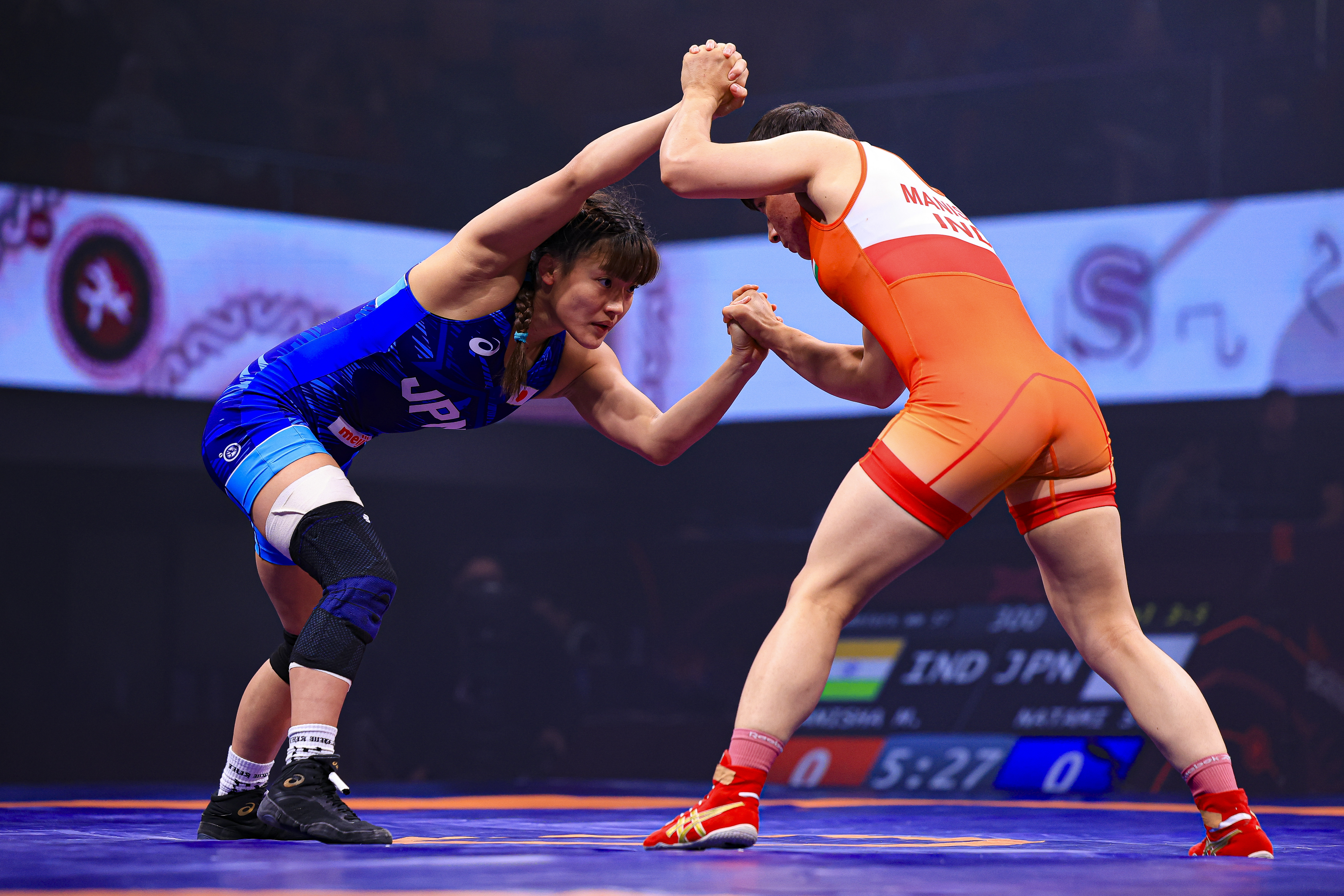
Natami, whose defense of the 57kg title was ended in the semifinals by Batkhuyag, needed slightly more time than Kiyooka to finish up her 10-0 win over MANISHA (IND). The winning points were decided on a Japanese challenge when the referee undercounted the number of spins Natami accomplished with her lace lock.

Natami, who came to Bishkek as a substitute for injured Olympic champion Akari FUJINAMI (JPN), now also has the full collection of Asian medals. In addition to last year’s gold, she won a silver in 2018 and another gold in 2022.

In the other match at 57kg, Youngjin KWON (KOR) gave Korea its lone medal in Women’s Wrestling by scoring three 2-point exposures off a takedown counter in the second period to top Thi My Trang NGUYEN (VIE) 7-2.

Qi ZHANG (CHN), the lone Chinese not wrestling in a final on the night, assured she would not leave Bishkek empty-handed when she converted her second takedown of Nigina SABIROVA (UZB) into a fall in 1:31 at 62kg.

The victory gave Zhang a second straight bronze and fourth of her career in a fourth different weight class. She also has a gold at 59kg from 2024, as well as the 2023 world gold at that weight.

A first-period fall also decided the other 62kg bronze, with Tserenchimed SUKHEE (MGL) building up a 7-0 lead over Tynys DUBEK (KAZ) before using an arm bar to end the match at 1:48.

Both the home team and India bagged bronzes in the two heavier weights.

At 65kg, Gulnura TASHTANBEKOVA (KGZ) gave up an early takedown to Firuza ESENBAEVA (UZB), but came back with a 4-point takedown to the back that she topped off with a fall in 2:02 to add to the Asian bronze she won at 68kg in 2024.

Two-time world U23 bronze medalist MONIKA (IND) also had a 4-point takedown in a 9-0 victory over Hanbit LEE (KOR) for the other 65kg bronze.

Nurzat NURTAEVA (KGZ), a world bronze medalist at 72kg, scored a first-period takedown while on the activity clock and that was enough to edge Odgerel ERDENE OCHIR (MGL) 2-0 for her first Asian bronze.

In the other 72kg bout, HARSHITA (IND) added to her 2024 silver medal with a victory by fall over Sevinchoy POLVONOVA (UZB) in 3:25 after building up a 5-0 lead.


Photo

Day 5 Results

Women’s Wrestling

53kg (11 entries)
GOLD: Jin ZHANG (CHN) df. MEENAKSHI (IND) by TS, 10-0, :53

BRONZE: Moe KIYOOKA (JPN) df. Aziza KELDIBEKOVA (KGZ) by TS, 11-0, 1:24
BRONZE: Sakibjamal ESBOSYNOVA (UZB) df. Seoyoung PARK (KOR) by Fall, 2:00 (2-0)

57kg (11 entries)
GOLD: Kexin HONG (CHN) df. Khulan BATKHUYAG (MGL) by Fall, 1:31 (10-0)

BRONZE: Youngjin KWON (KOR) df. Thi My Trang NGUYEN (VIE), 7-2
BRONZE: Sara NATAMI (JPN) df. MANISHA (IND) by TS, 10-0, 1:50

62kg (11 entries)
GOLD: Nonoka OZAKI (JPN) df. Hyon Gyong MUN (PRK) by TS, 10-0, 2:15

BRONZE: Qi ZHANG (CHN) df. Nigina SABIROVA (UZB) by Fall, 1:31 (4-0)
BRONZE: Tserenchimed SUKHEE (MGL) df. Tynys DUBEK (KAZ) by Fall, 1:48 (7-0)

65kg (9 entries)
GOLD: LILI (CHN) df. Nana IKEHATA (JPN), 3-2

BRONZE: Gulnura TASHTANBEKOVA (KGZ) df. Firuza ESENBAEVA (UZB) by Fall, 2:02 (4-2)
BRONZE: MONIKA (IND) df. Hanbit LEE (KOR), 9-0

72kg (8 entries)
GOLD: Jia LONG (CHN) df. Mahiro YOSHITAKE (JPN), 10-2

BRONZE: Nurzat NURTAEVA (KGZ) df. Odgerel ERDENE OCHIR (MGL), 2-0
BRONZE: HARSHITA (IND) df. Sevinchoy POLVONOVA (UZB) by Fall, 3:25 (5-0)

Freestyle

57kg (11 entries)
SF 1: Munkh Erdene BATKHUYAG (MGL) df. Abdymalik KARACHOV (KGZ), 4-1
SF 2: Milad VALIZADEH (IRI) df. Fuga SASAKI (JPN) by TS, 11-0, 3:23

65kg (12 entries)
SF 1: SUJEET (IND) df. Abdulmazhid KUDIEV (TJK), 7-2
SF 2: Umidjon JALOLOV (UZB) df. Alibeg ALIBEGOV (BRN), 5-3

70kg (10 entries)
SF 1: ABHIMANYOU (IND) df. Ernazar AKMATALIEV (KGZ), 6-3
SF 2: Tulga TUMUR OCHIR (MGL) df. Sina KHALILI (IRI), 5-1

79kg (12 entries)
SF 1: Keyvan GHAREHDAGHI (JPN) df. Razambek JAMALOV (UZB), 4-3
SF 2: Sandeep Singh MANN (IND) df. Somonjon IKROMOV (TJK) by TS, 10-0, 3:13

97kg (13 entries)
SF 1: Amirali AZARPIRA (IRI) df. VICKY (IND), 2-0
SF 2: Arash YOSHIDA (JPN) df. Akhmed TAZHUDINOV (BRN), 15-6