ATHENS, Greece (August 2) -- Artur KOSTIUK (UKR) ended a nine-year wait for a gold medal at World U17 Championships for Ukraine as he won the 80kg title in Athens, Greece on Saturday.
Ukraine has not had a world U17 champion since 2016 and a world champion in Freestyle since 2021. Kostiuk's gold was a double delight as he had won gold at European U17 Championships in June as well.
In the final facing Mohammadparsa KARAMI (IRI), Kostiuk was called passive and put on activity clock. He did not score in those 30 seconds but managed to get a takedown just before the break and led 2-1.
Karami was put on the activity clock in the second period and as he failed to score, Kostiuk's lead swelled to 3-1. Karami had 25 seconds to score two points but Kpstiuk kept his defense and captured the gold with a 3-1 score.
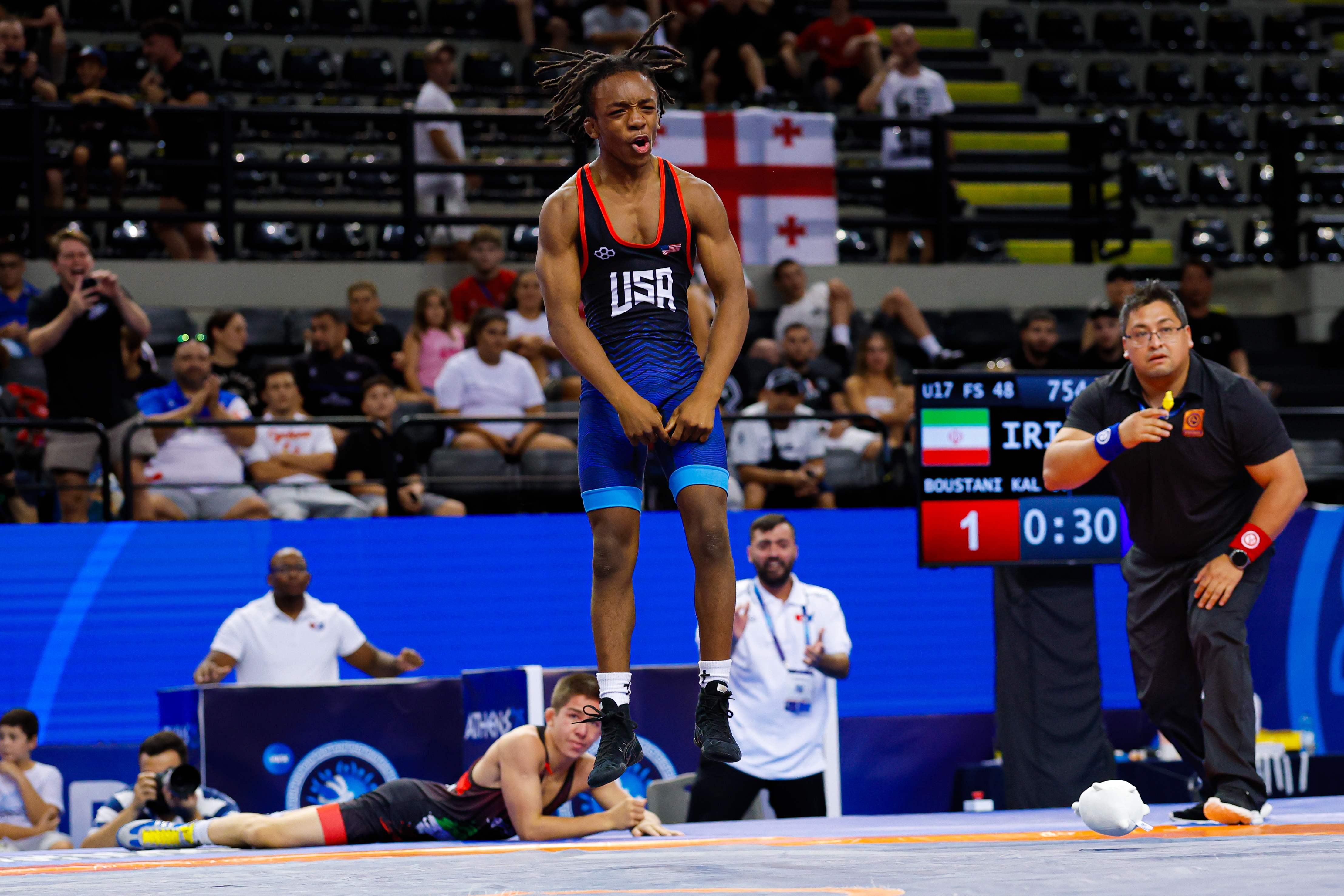 Ariah MILLS (USA) won the 48kg gold medal for the United States. (Photo: United World Wrestling / Kostadin Andonov)
That was the second loss in the final for Iran as it had suffered a loss at the 48kg weight class. That was the first final of the night on Saturday and Ariah MILLS (USA) gave no chance to Sina BOUSTANI (IRI) in the gold-medal bout.
While he was the one put on activity clock in the first period, Mills wasn't the one to defend. He had some fast re-attacks to stun Boustani. Mills gave up that activity clock point and as Boustani was setting up leg attack, Mills hit a counter and scored the takedown to lead 2-1 at the break.
Boustani had his chance to score reclaim the lead but Mills, who kept his distance, perhaps to have space to counter, got another takedown after a scramble. The U.S. wrestler managed to score a go-behind and two turns to win 12-1 and get the first gold medal in Freestyle for the U.S.
Jinnosuke OKONOGI (JPN), a returning bronze medalist, upgraded his medal to gold and in style. Down 4-0 against Abdumalik JALOLDINOV (UZB) in the final, he scored one of the perfect five-pointers using the headpinch and over the head throw to lead 5-4 in the final minute.
This was not the only time Okonogi had to make a big comeback in Athens. In his quarterfinals, he defeated Zhakshylyk BOROBAEV (KGZ), 9-8, after scoring a takedown and turn in last 10 seconds.
Okonogi had a 4-1 win over Mohammadreza BARARI (IRI) in his opening match and an 8-2 domination of Greyton BURNETT (USA) in the semifinals.
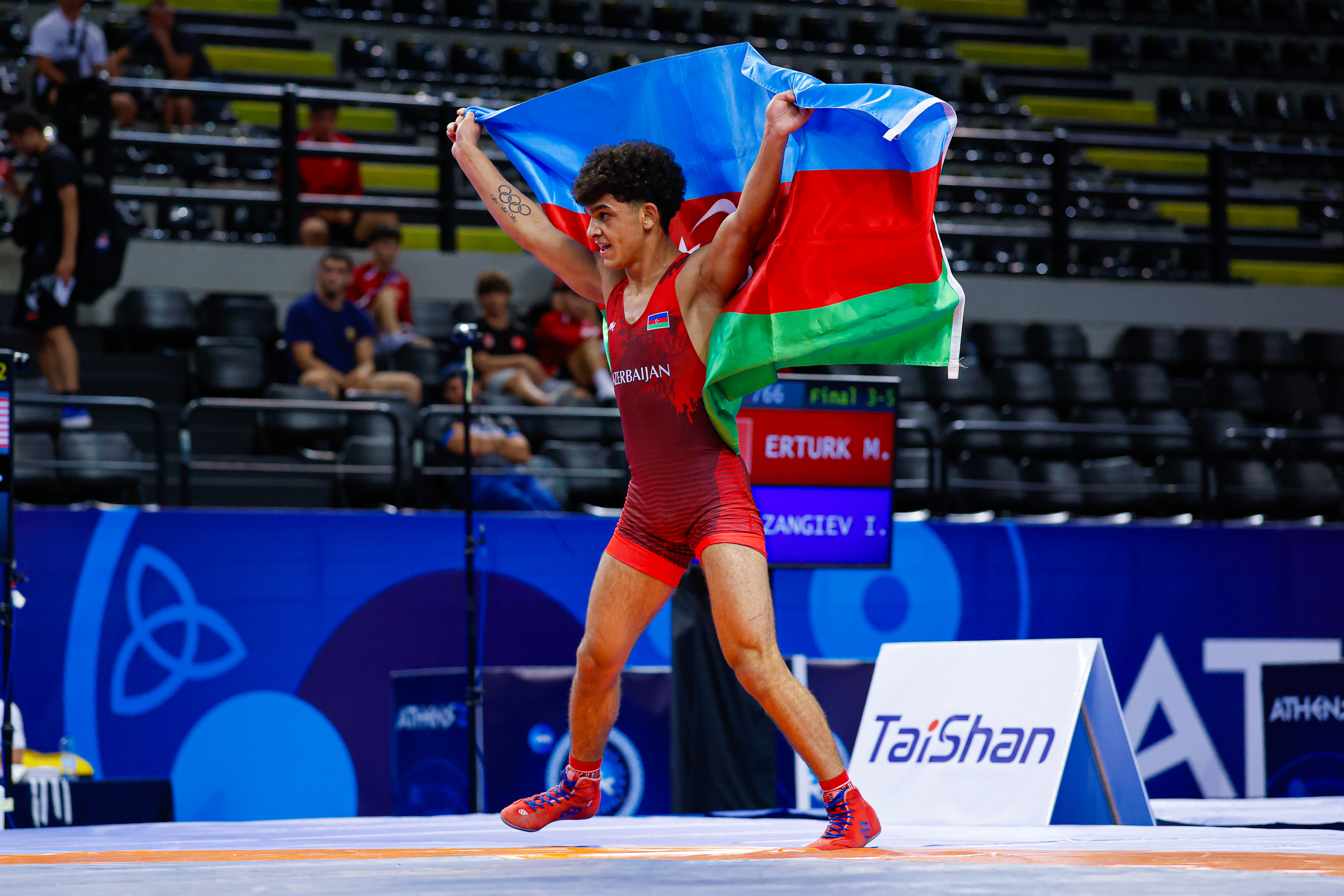 Huseyn ISMAYILOV (AZE) celebrates after winning the 65kg gold medal. (Photo: United World Wrestling / Kostadin Andonov)
Silver medalist from 2024 Huseyn ISMAYILOV (AZE) got a anti-climatic 1-1 victory over Arseni KIKINIOU (USA) in the 65kg final and won his first gold medal after finishing with three silvers in three different championships.
Kikiniou was the first to get a point on board as Ismayilov was called passive. He failed to score in the 30 seconds and the U.S. wrestler got a point.
In the second period, Kikiniou was called passive and Ismayilov got a point and the 1-1 criteria lead. He had a minute left in the bout to defend his lead and Kikiniou threw every thing at him. However, Ismayilov defended with determination and won the gold medal.
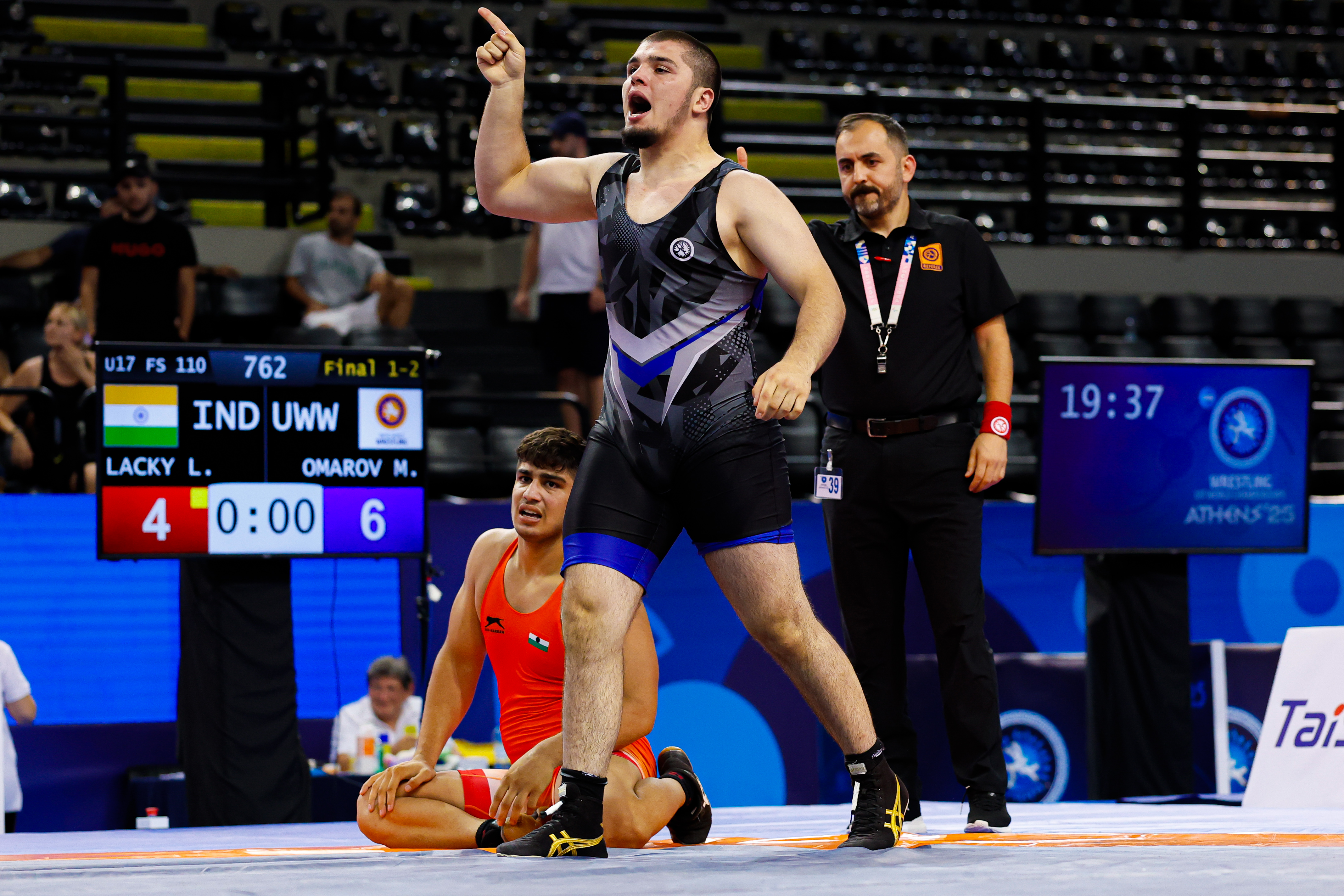 Magomedrasul OMAROV (UWW) held on to his 6-4 lead to win the 110kg final against LACKY (IND). (Photo: United World Wrestling / Kostadin Andonov)
The 110kg gold medal went to Magomedrasul OMAROV (UWW) who defeated LACKY (IND), 6-4, in the final. Omarov was down 2-2 on criteria at the break but he hit a stepout and Lacky was cautioned for fleeing, giving one more point to Omarov who now led 4-2.
Lacky tried to finish his leg-attacks but Omarov was quick to either defend or escape. During one of those attacks, Omarov managed to score a go-behind and got two points which made his lead 6-2. Lacky, with 17 seconds left in the bout, went for one final attack and scored a takedown. However, he was not able to turn Omarov which could have given him the criteria win.
Omarov defended the gut-wrench attempt and despite being in the air, did not turn more than 90 degrees. The win made Omarov an European and world champion in the same year.
RESULTS
48kg
GOLD: Ariah MILLS (USA) df. Sina BOUSTANI (IRI), 12-1
BRONZE: Islam RABADANOV (UWW) df. Ravan HASANZADE (AZE), 11-9
BRONZE: Dovudbek BAKHADIROV (KGZ) df. Masamune USHIMADO (JPN), 12-0
55kg
GOLD: Jinnosuke OKONOGI (JPN) df. Abdumalik JALOLDINOV (UZB), 5-4
BRONZE: Greyton BURNETT (USA) df. Mohammadreza BARARI (IRI), 4-0
BRONZE: Chingis SARYGLAR (UWW) df. Jovanni TOVAR (COL), 8-2
65kg
GOLD: Huseyn ISMAYILOV (AZE) df. Arseni KIKINIOU (USA), 1-1
BRONZE: Morteza HAJ (IRI) df. Gourav PUNIA (IND), 8-8
BRONZE: Adisbek ALTYNBEKOV (KGZ) df. Yeraly ASKERBEK (KAZ), 7-1
80kg
GOLD: Artur KOSTIUK (UKR) df. Mohammadparsa KARAMI (IRI), 3-1
BRONZE: Dinmukhammed KASSYMBEK (KAZ) df. Ivan PASLARI (MDA), 5-4
BRONZE: Issa ZANGIEV (UWW) df. Berat ERTURK (TUR), 5-2
110kg
GOLD: Magomedrasul OMAROV (UWW) df. LACKY (IND), 6-4
BRONZE: Hakim TAGHIYEV (AZE) df. Stefan STEFANOV (BUL), 1-1
BRONZE: Amirhossein NAGHDALIPOUR (IRI) df. Murtaz BAGDAVADZE (GEO), 11-0



Share your thoughts.
Comments