ATHENS, Greece (July 28) -- Athens and Olympics are incomplete without each other. The Olympic flame is lit in Athens, as a mark of ancient Olympics and modern Olympic restarting in Athens in 1896.
So as the World U17 Championships kicked off in Athens on Monday, the opening ceremony had to be about the fire of the flame. The wrestlers too were fired up in action on the mat.
Wrestlers from seven different countries made it to the Greco-Roman finals on day one of the tournament which began with 48kg, 55kg, 65kg, 80kg and 110kg. Kazakhstan, Uzbekistan and Georgia entered two wrestlers each in Tuesday's finals.
Kazakhstan's run began with 48kg as Asian U17 champion Nurdaulet KUMARULY (KAZ) earned himself a chance to win a world title after he defeated Kaisei YAMAMOTO (JPN), who was 12th last year at the World U17 Championships, in a back-and-forth semifinal at 48kg.
Yamamoto led 2-0 but Kumaruly hit a headlock throw for four points on the edge and got a 4-2 lead. But the Japanese was not one to give up. He scored a takedown and turn to reclaim the lead, 6-4. Kazakhstan challenged the scoring and won it as the first throw from Yamamoto was not considered as control.
Kumaruly led 4-4 on criteria and then executed a similar throw for four points and won the semifinal 8-4. He will face Asian U17 bronze medalist Bunyod HASANOV (UZB) in the final after the Uzbekistan wrestler defeated Baris SOYLU (TUR) in the semifinal.
Soylu began with a two-pointer counter to get on the scoreboard but failed to turn Hasanov from par terre. He led 3-0 going into the break and then defended his par terre position in the second period to give himself a good chance to reach the final.
However, Hasanov mounted a comeback with a front headlock throw four points to lead 5-3, and later added a takedown and a turn to win 11-3.
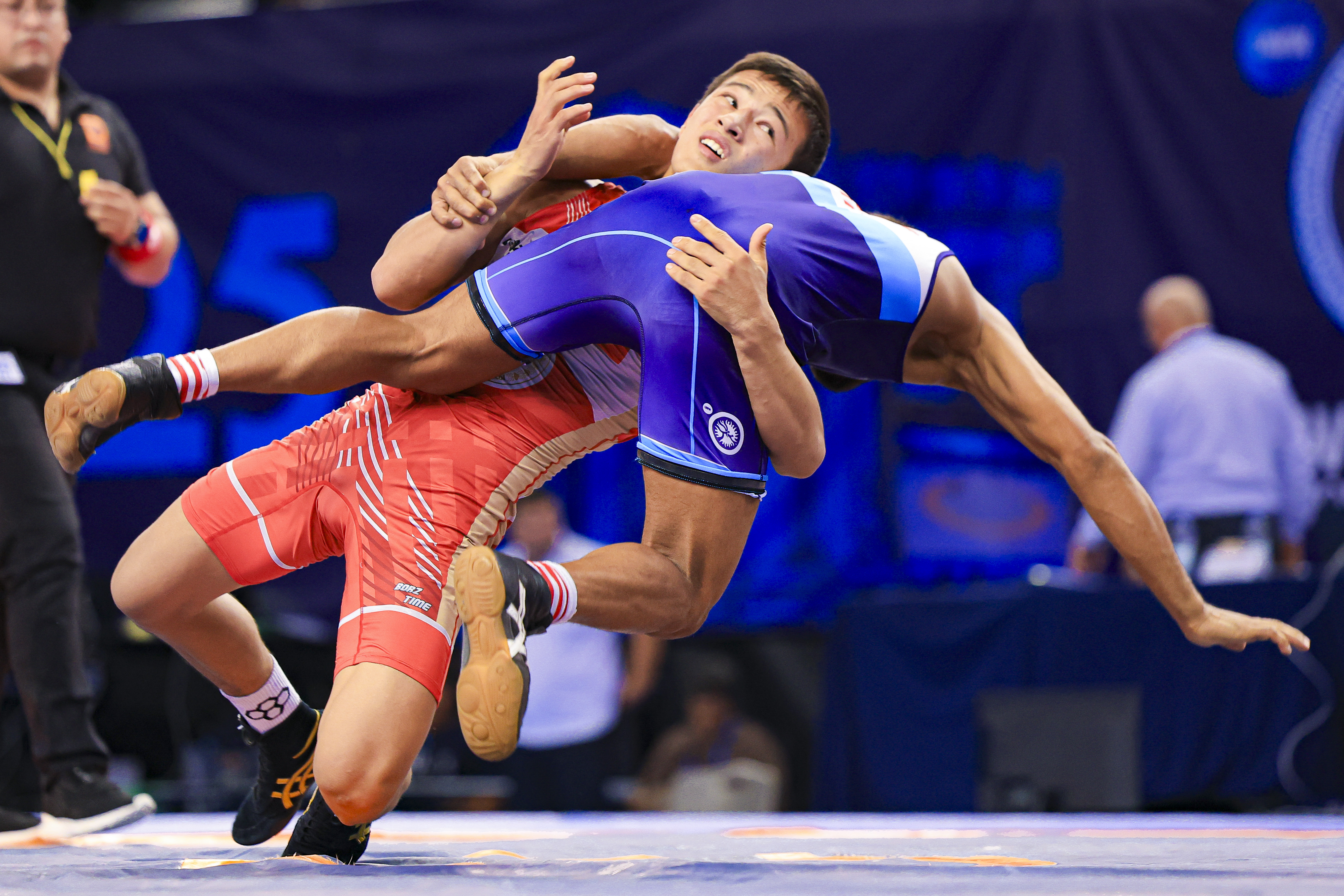 Asian U17 champion Alkham ABDIRASULOV (KGZ) reached the World U17 Championships final at 55kg. (Photo: United World Wrestling / Amirreza Aliasgari)
Another Asian U17 champion reached the final in Athens as Alkham ABDIRASULOV (KGZ) defended a pushing Aditya GUPTA (IND) in the 55kg semifinals. He booked a place in the final against Nurali ASKAR (KAZ), who finished fifth at the Asian U17 Championships, in what will be a rematch of the semifinal from Vietnam.
Abdirasulov had a big four-point throw and raced to a 6-0 lead in the semifinal against Gupta who managed to get one on board with a stepout. Gupta then got lucky as Abdirasulov tried an arm-spin but landed on his back and Gupta completed the control for four points. However, Abdirasulov kept his 6-5 lead for the remaining 90 seconds to win the semifinal.
Aksar turned Makhdi BAROTOV (TJK) from par terre to lead 3-0 in the other semifinal and gave up just a stepout when he was put in par terre to win 3-2. Barotov was hoping to becoming just the second wrestler from Tajikistan to reach a World Championships final in Greco-Roman.
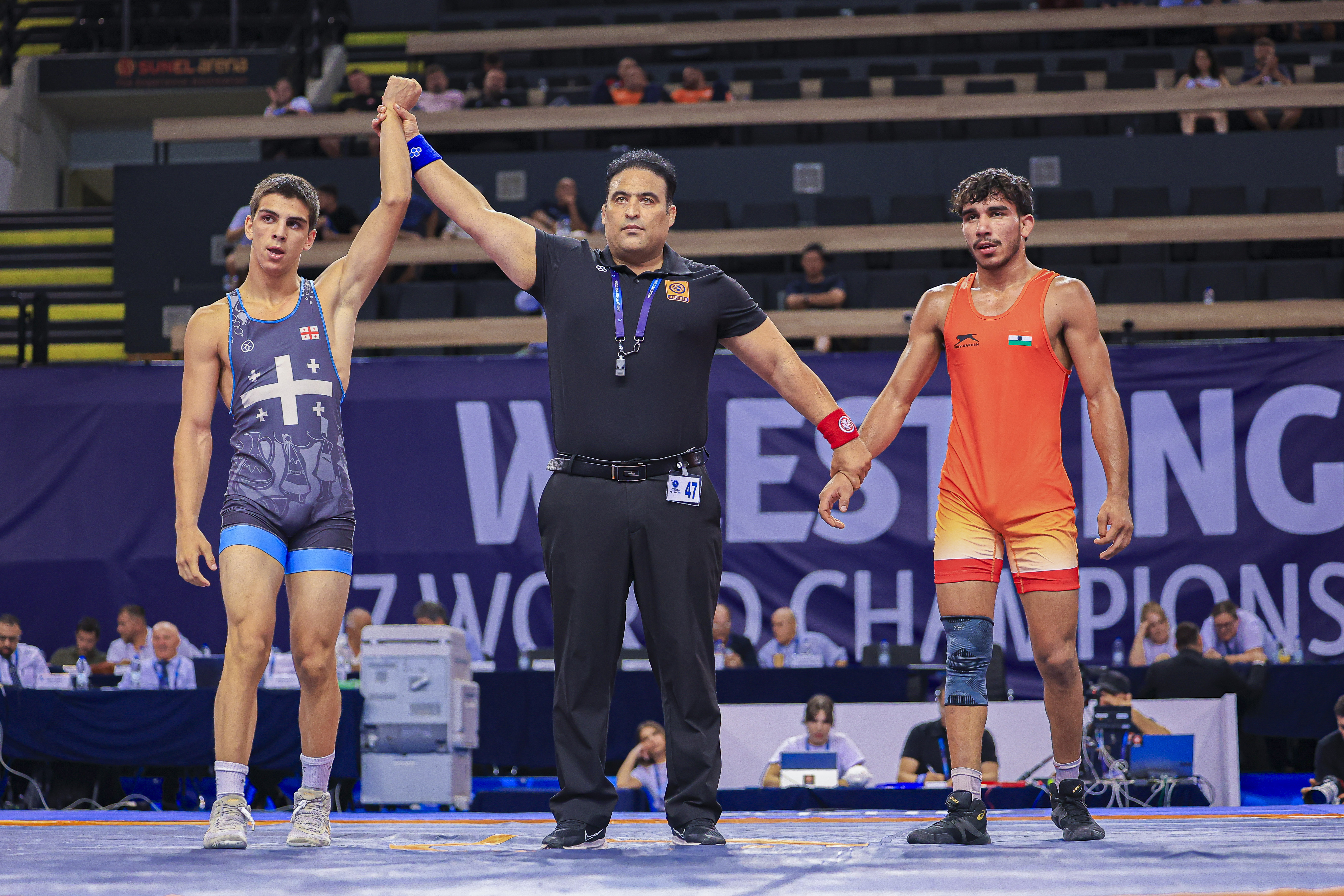 Erekle TAVBERIDZE (GEO), European U17 champion, reached the 65kg final in Athens and will taken on Janes NAZARYAN (ARM), an opponent he defeated in Euro final. (Photo: United World Wrestling / Amirreza Aliasgari)
A rematch of the European U17 Championships will be played at 65kg after Erekle TAVBERIDZE (GEO) and Janes NAZARYAN (ARM) made it to Tuesday's gold-medal bout. Tavberidze had humbled Nazaryan 9-0 in the final in Skopje in June.
Tavberidze outperformed ANUJ (IND) in the semifinal, scoring eight points from gut-wrench in the semifinal period to win 9-1 while Nazaryan had to work a little harder against Yehor TARASENKO (UKR) in the other semifinal.
He got the first par terre position and scored a drop on Tarasenko for four but Ukraine challenged and the call was overturned. With a 1-0 lead, Nazaryan defended the position from par terre in the second period. As Tarasenko let off of the hold, Nazaryan scored a takedown and won 3-1.
Tavberidze took out Dosbol SHAMIL (KAZ) in his opening bout 5-3 before beating Maxim DAMASCHIN (MDA) in the 1/8 final. He blanked Shohijahon BOBOEV (TJK) in the quarterfinals.
Nazaryan had an equally good run to the final as he defeated Pan-American U17 champion Arseni KIKINOU (USA), Huseyn ISGANDAROV (AZE) and Kyliane EDDOUH (FRA).
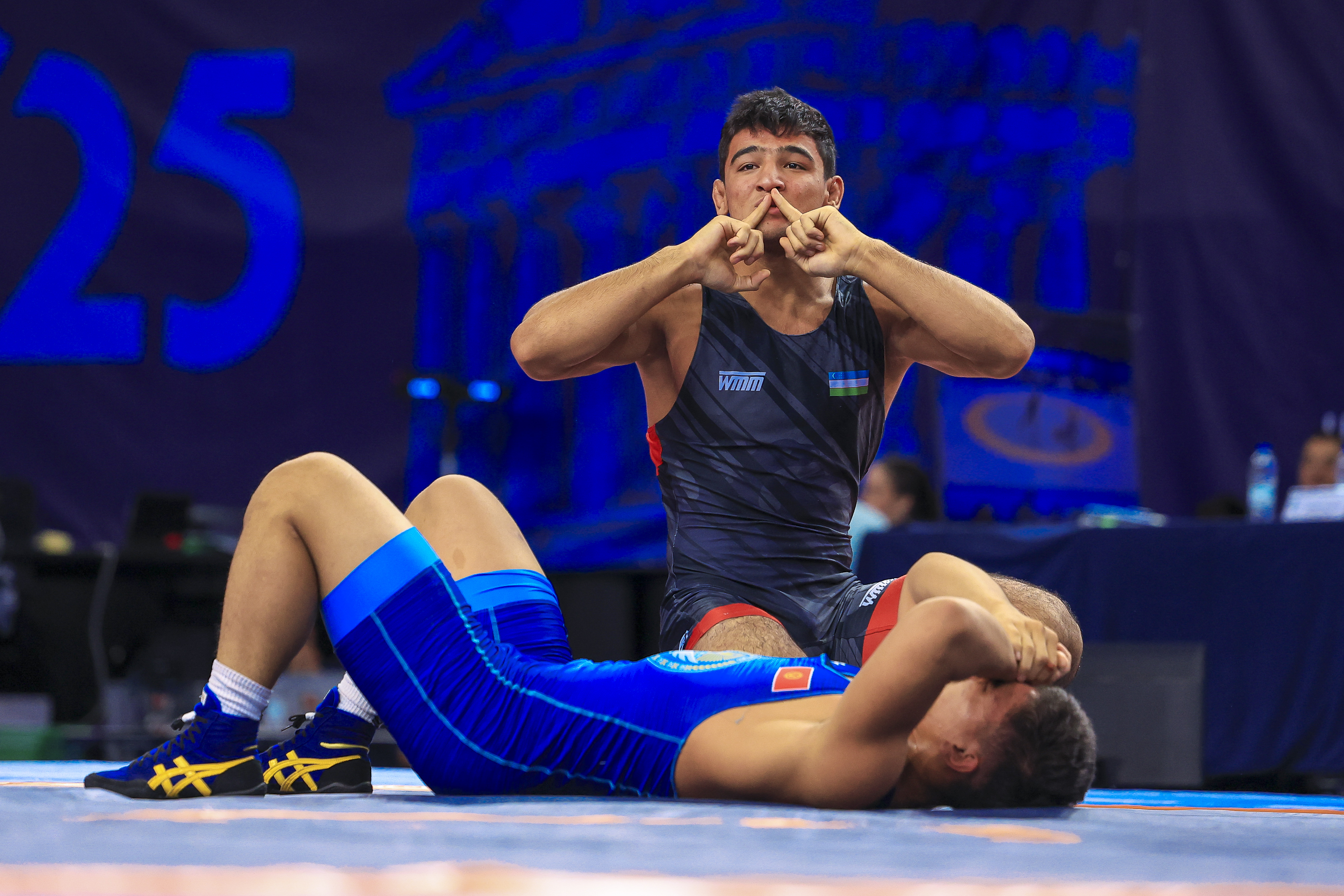 Abdulaziz KHOLMIRZAEV (UZB) pinned Nurislam OSKONBAEV (KGZ) in the 80kg semifinal. (Photo: United World Wrestling / Kadir Caliskan)
Abdulaziz KHOLMIRZAEV (UZB) showed why he is one of the top upcoming wrestlers as he slammed Nurislam OSKONBAEV (KGZ) with a bodylock four and then secured the fall in the 80kg semifinal. He is now one win away from winning the world title.
But standing between him and gold medal is Luka MARTIASHVILI (GEO) who needed a late stepout to beat Ismail BEREKET (TUR), 2-1 in the other semifinal. The Georgian finished fifth at the European U17 Championships but in 92kg.
In what turned out be a poor day for Iran, the defending team champions, Yazdan DELROUZ (IRI) gave it something to cheer about after making the 110kg final. That was the finalist for Iran on Monday.
Taking on Temuri SIMSIVE (GEO) in the semifinals, Delrouz had a takedown sandwiched between his two par terre points to win 4-0.
 Asian U17 champion HARDEEP (IND) defeated Emrullah CAPKAN (TUR) in the 110kg semifinals. (Photo: United World Wrestling / Kadir Caliskan)
He will take on Asian U17 champion HARDEEP (IND) who denied Emrullah CAPKAN (TUR) another chance to be in the final. The Turkiye wrestler had finished fifth last year.
Capkan got the 1-0 lead in the semifinal but Hardeep bounced back with a stepout. Capkan managed to get one back and take a 2-1 lead but that was the last point he scored.
Hardeep came back with a takedown and then got the par terre point in the second period and won the semifinal 4-2.
RESULTS
48kg
GOLD: Nurdaulet KUMARULY (KAZ) vs. Bunyod HASANOV (UZB)
SF 1: Bunyod HASANOV (UZB) df. Baris SOYLU (TUR), 12-3
SF 2: Nurdaulet KUMARULY (KAZ) df. Kaisei YAMAMOTO (JPN), 8-4
55kg
GOLD: Alkham ABDIRASULOV (KGZ) vs. Nurali ASKAR (KAZ)
SF 1: Nurali ASKAR (KAZ) df. Makhdi BAROTOV (TJK), 4-2
SF 2: Alkham ABDIRASULOV (KGZ) df. Aditya GUPTA (IND), 6-5
65kg
GOLD: Erekle TAVBERIDZE (GEO) vs. Janes NAZARYAN (ARM)
SF 1: Janes NAZARYAN (ARM) df. Yehor TARASENKO (UKR), 3-1
SF 2: Erekle TAVBERIDZE (GEO) df. ANUJ (IND), 9-1
80kg
GOLD: Luka MARTIASHVILI (GEO) vs. Abdulaziz KHOLMIRZAEV (UZB)
SF 1: Abdulaziz KHOLMIRZAEV (UZB) df. Nurislam OSKONBAEV (KGZ), via fall (4-2)
SF 2: Luka MARTIASHVILI (GEO) df. Ismail BEREKET (TUR), 2-1
110kg
GOLD: Yazdan DELROUZ (IRI) vs. HARDEEP (IND)
SF 1: HARDEEP (IND) df. Emrullah CAPKAN (TUR), 4-2
SF 2: Yazdan DELROUZ (IRI) df. Temuri SIMSIVE (GEO), 4-0



Share your thoughts.
Comments