

Top Stories of the Decade

Wrestling Introduces New Weight Categories, Gender Equity, and Ranking Series

By Eric Olanowski

CORSIER-SUR -VEVEY, Switzerland (December 29) -- The growth of international wrestling since 2010 has required a number of changes, but few have seemed to impact as many wrestlers and fans as the addition of weight categories, expansion of women's opportunities, and the introduction of a yearlong competition calendar, knowns as the Ranking Series.

 Heading into the 2017 World Championships in Paris, Wrestling enjoyed eight weight categories in each style, with six aimed at Olympic participation. During a bureau meeting at the event, it was decided to increase that total allotment to 10 weight categories and slightly shift a number of weight categories across the styles to better match anticipated participation. The additional weights also prompted a two-day format with same-day weigh-ins.

"These improvements made are incredible for the sport of wrestling," UWW President Nenad Lalović said at the time. "Our sport has never been stronger, and I believe that with the new categories and the improved competition format we will see continued growth in participation, support and viewership. I also believe these new rules will also encourage healthier wrestlers."

Another significant shift in the sport came with the launch of the Ranking Series in 2018, which uses four previously independent events, plus the world and continental championships to determine a points champion for the season. The rankings also determine the top seeds at the world championships and Olympic Games. 

“The Ranking Series makes it easier for fans, athletes, and coaches to understand the impact of each tournament and match," said Lalovic.

The Ranking Series was tweaked heading into the 2019 season with more weight placed on the number of participants to help determine the ultimate allocation of points per event. The shift proved prescient as participation in the events more than doubled in 2019.

As of 2019, the points earned from the World Championships, Continental Championships and Ranking Series events are as follows:

Wrestling’s growth hasn’t been contained to competition formats. In an effort to ensure better governance and compliance with IOC norms, wrestling has reached out to female leaders around the world to ensure their participation in the sport’s growth. Wrestling has utilized national federations, IOC-backed initiatives, and created an annual Women in Wrestling Global Forum to ensure increased outreach and education of women in the wrestling community.

“The past few years has seen wrestling provide more opportunities to female leaders and competitors than ever before,” said UWW Development Director Deqa Niamkey. “I’m pleased with our growth and looking forward to the next ten years!”

In addition to professional opportunities for women in wrestling, there has also been a much-increased focus on their mat achievements. From photos to stories to documentaries the women of wrestling are covered equally to men and have enjoyed several breakout moments, including many listed in the Top Ten Stories of the Decade.
#Grappling

U20 European Grappling: Poland Shines but Russia Remains Best

By United World Wrestling Press

YEREVAN, Armenia (May 26) — Poland flexed its strength in the heavier divisions while Russia piled up medals across categories at the U20 European Grappling Championships in Yerevan on Tuesday, with Germany also celebrating a standout gold through Damian David GRANCZYK at 66kg.

The Poles were particularly impressive in the upper weights. Kamil Konrad DZIKOWSKI claimed the 100kg title ahead of Yaroslav TOROPII (UKR). Armenia’s Samvel ATIKYAN taking bronze on home soil.

Mateusz KUCA (POL) resigned supreme at 84kg. Poland also produced medallists in 92kg, where Jakub JUCHNO finished on the top of the podium ahead of Ion SILI (MDA), underlining the country’s growing depth in the heavier classes of European grappling.

Russia, however, once again showed its overall dominance by placing wrestlers on nearly every podium. Russian athletes won titles at 62kg, 71kg, 77kg and 130kg, while also securing multiple silver and bronze medals.

At 130kg, Abubakr MAKASHARIPOV (RUS) took gold ahead of Ukraine’s Bohdan AKOPOV, with Gasan KHASAEV (RUS) settling for bronze in an all-Eastern European dominated podium.

Germany’s Granczyk was among the day’s standout performers. He captured the 66kg title, finishing ahead of Stanislav ROMANCHENKO (RUS), while Ukraine picked up both bronze medals through Vadym SIROSHTAN and Dmytro PRUT.

Russia swept the top two spots at 62kg through gold medallist Fedor RIABOV and silver winner Zaur ILIASOV, with Edgar SIMONYAN (ARM) finishing third. The hosts had more to celebrate in the 58kg category, where Aram SARGSYAN (ARM) beat Vanik SARGSYAN (ARM) to win the gold. Adam Magomedovich MAGOMEDOV (RUS) clinched the bronze.

At 71kg, Oliwier PRZERWA (POL) earned silver behind Sultanakhmed SULTANAKHMEDOV (RUS), while Malik MUKHTAROV completed a double podium finish for Russia with bronze.

Ukraine enjoyed a strong campaign too, especially in the middle and heavier weights. Suleiman MAMUTOV (UKR) won silver at 77kg and Lev TSEMKO (UKR) added bronze at 84kg.

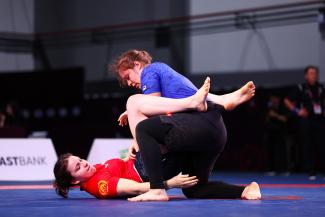
In the women's section, Russia and Poland continued their stranglehold, winning two gold medals each. But the loudest cheers inside the arena were reserved for Taguhi KHONDKARYAN, who finished ahead of fellow Armenian Mkrtaryan YELENA in a home-dominated 64kg category.

At 49kg, Hanna Gabriela SZPAKOWSKA (POL) broke the heart of home favourite Astghik HAYRAPETYAN (ARM) clinched the title with a 18-6 win in the final.

Russia then tightened its grip on the tournament. Elmira GALLIAMOVA won the 53kg gold medal in an all-Russian final against Valeriia SHCHIROVA, while Alva Linnea PANNWITZ (GER) claimed bronze to ensure another podium finish for the Germans after Damian Granczyk’s triumph in the men’s section.

The 58kg category also belonged entirely to Russia. Alisa GOLUB (RUS) defeated compatriot Ilda DAVLETSHINA (RUS) in the final, with Ukraine’s Kseniia POLIAK taking bronze.

Poland, which had already impressed in the heavier men’s divisions, carried that momentum into the women’s 90kg event. Maja Teresa SALAMON (POL) took gold, while compatriot Karolina KARALUS added bronze, sandwiching Russia’s Vlada BOIAKCHIEVA in second place.

The results underlined Russia’s continued dominance in European grappling, finishing on top of the team rankings in both, men and women's sections.