ULAANBAATAR, Mongolia (June 4) -- Payam AHMADI (IRI) emerged as the most dominant wrestler on day one of the Ulaanbaatar Open Ranking Series on Thursday.
At 55kg, Ahmadi outscored his opponents 33-0 in four bouts to claim the gold medal in the Nordic bracket, never looking in any kind of trouble.
The 2025 World Championships silver medalist was among the seven champions on day one of the tournament. Iran won two gold medals and so did India and Bulgaria. China won the remaining one to close out the day.
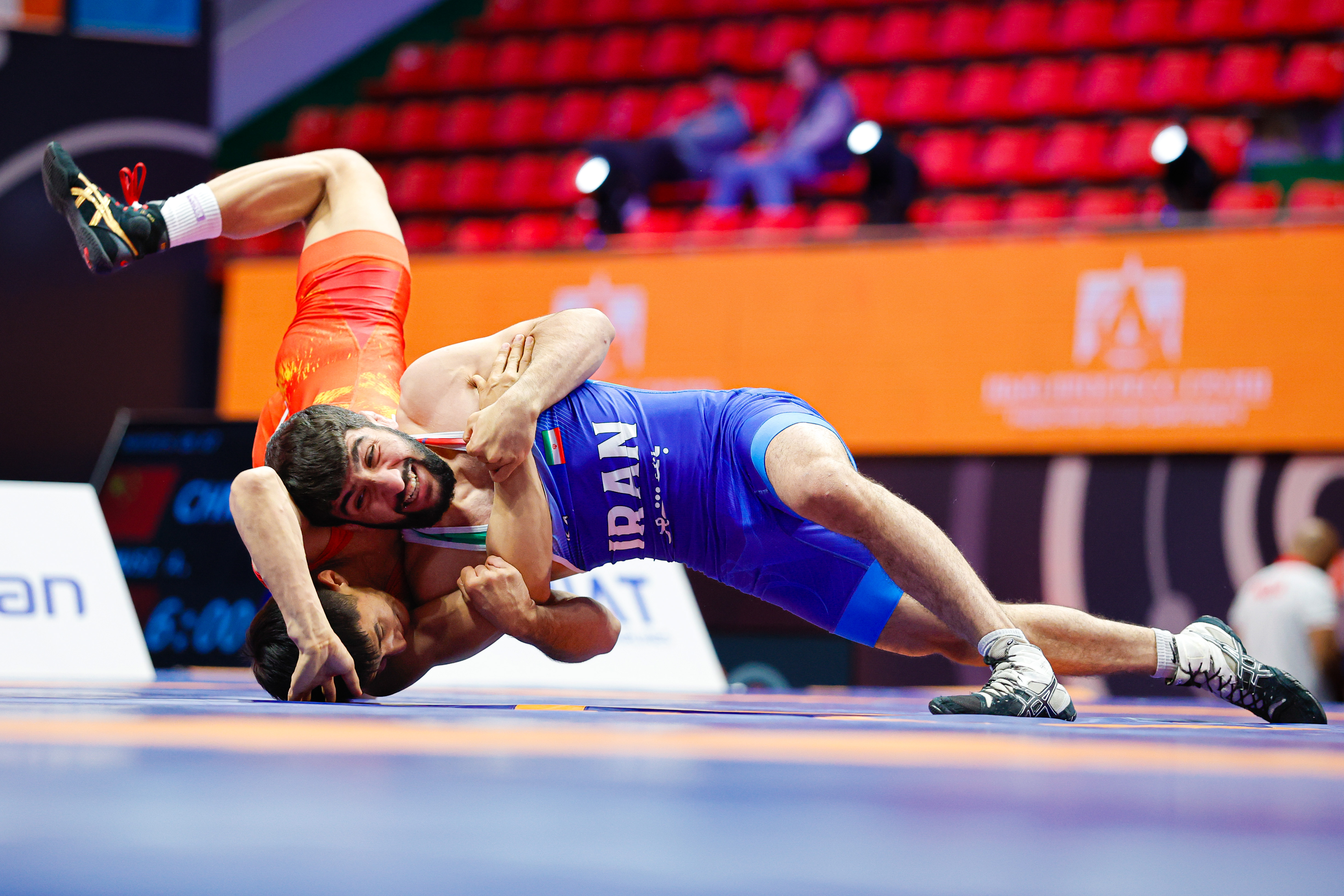 Payam AHMADI (IRI) blanked his opponents 33-0 in four bouts in Ulaanbaatar. (Photo: United World Wrestling / Kostadin Andonov)
Ahmadi opened the day against Asian Championships silver medalist LALIT (IND) and secured an easy 8-0 technical superiority win in one minute and 57 seconds.
In Round 2, Ahmadi took only 33 seconds to see off Davaabandi MUNKH ERDENE (MGL). He blocked Munkh Erdene's body lock attempt for four points and threw the Mongolian again for four more points. He took just 46 seconds to do the same to Sumiyabazar MUNKHZAYA (MGL) in Round 3.
His final bout was against Emin CAKIR (TUR) and Ahmadi two four-point throws from par terre to complete a 9-0 victory and claim the gold medal in the morning session itself.
By the end of the day, Iran had its second gold medalist in Danial SOHRABI (IRI), who defended his title in Ulaanbaatar Open from 2025 at 72kg. Just like last year, Sohrabi's gold medal carried extra significance.
With the 72kg victory over Javad REZAEI (IRI) in the final, Sohrabi assured his spot on the Iran team for the 2026 World Championships where he will try to upgrade his bronze medal that he won in 2025.
Both Sohrabi and Rezaei followed identical paths to the final, dominating every bout they wrestled. They were even finishing the matches in quick time and via technical superiorities.
In the final, Sohrabi was the first to go in par terre and Rezaei did his best to turn Sohrabi twice and lead 5-0. Sohrabi seemed unfazed despite falling behind in the bout.
When the second period began, he managed to earn the par terre position for himself. However, he turned Rezaei only once. When Sohrabi tried a throw, Rezaei managed to defend it but the former was awarded a stepout which made the score 5-4.
A little time had passed when Sohrabi brought down Rezaei for a takedown and took a 6-5 lead. He then turned Rezaei to extend his lead to 8-5 which he defended to win the gold medal, his second straight at the Ulaanbaatar Open at 72kg.
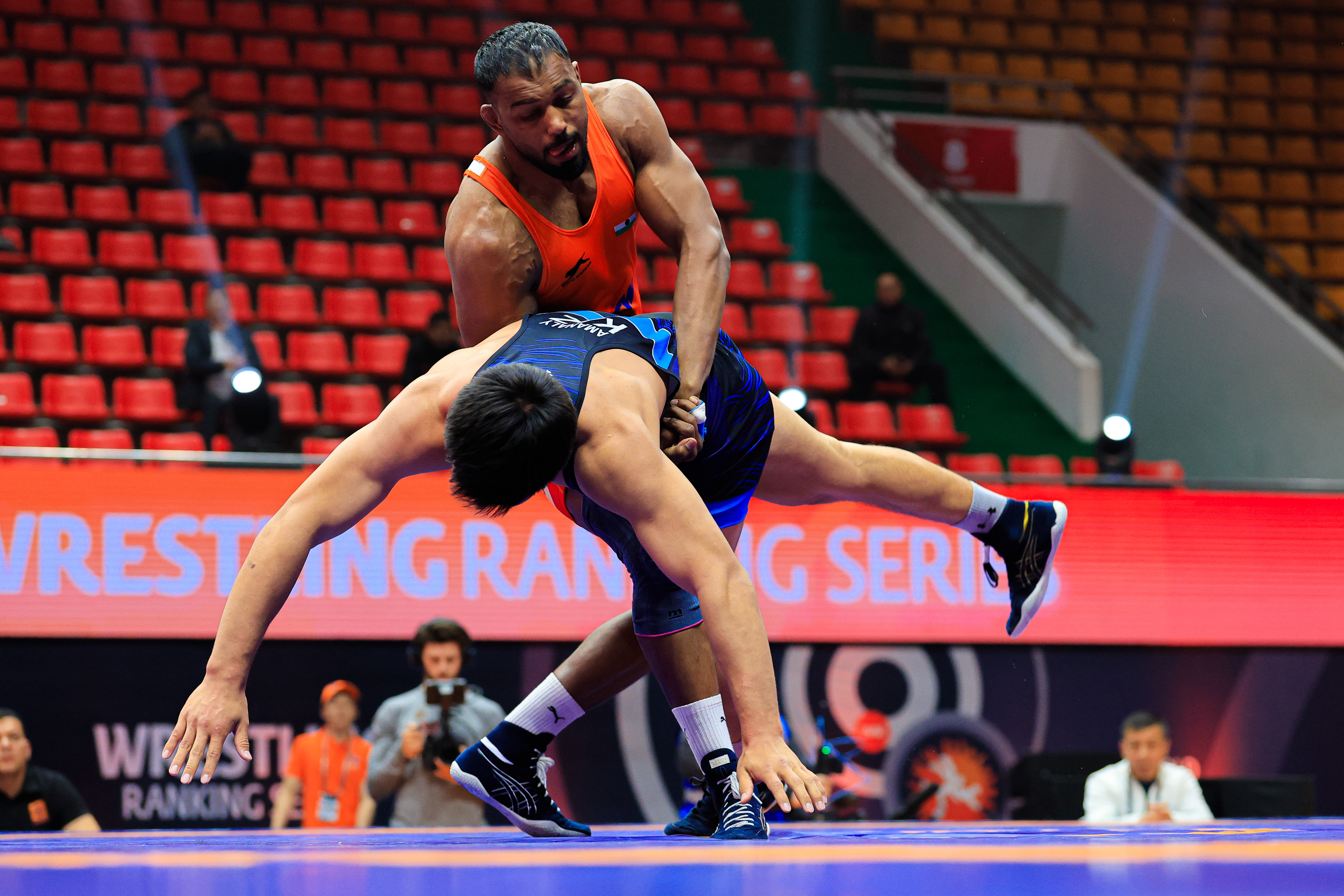 NITESH (IND) throws Nurassyl AMANALY (KAZ) during the 97kg final in Ulaanbaatar. (Photo: United World Wrestling / Kostadin Andonov)
India, Bulgaria Win 2 Golds
Apart from Iran, India and Bulgaria also won two gold medals each. Two 2026 Asian medalists for India, NITESH (IND) and Sunil KUMAR (IND), won at 97kg and 87kg respectively.
Bulgaria's two golds medals came through Deyvid DIMITROV (BUL) winning at 82kg and Stoyan KUBATOV (BUL) claiming gold at 77kg.
Nitesh, the Asian silver medalist at 125kg, overcame a deficit twice in the final against Nurassyl AMANALY (KAZ) and beat the Kazakhstan wrestler 13-9. At one point in the bout, Amanaly led 5-3 but Nitesh made it 5-5 with Amanaly leading on criteria.
As Nitesh tried a bearhug body lock, Amanaly tossed the Indian for four points for a 9-5 lead with around two minutes remaining in the final. Those two minutes must have felt like eternity for Amanaly who was struggling with his conditioning. He gave up a three step outs and a point for fleeing as Nitest made it 9-9, still behind on criteria.
He then brought down Amanaly for a takedown and then turned him for two more points to build a 13-9 lead. Amanaly did not have anything left in himself to fight for the remaining time and Nitesh comfortably defended the score.
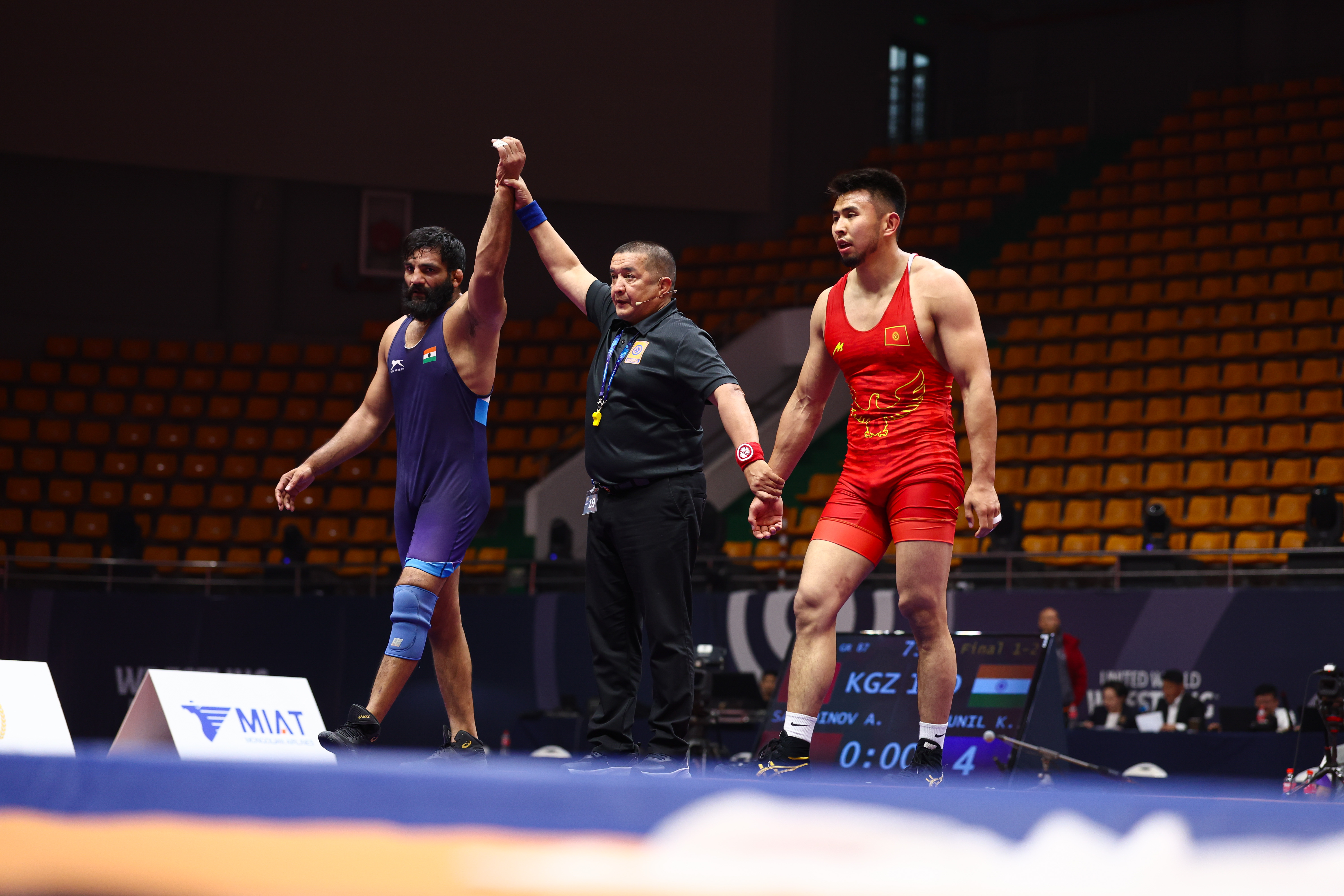 Sunil KUMAR (IND), blue, won the 87kg gold medal at the Ulaanbaatar Open. (Photo: United World Wrestling / Jake Kirkman)
Kumar followed a slightly different path as he managed to score a turn from par terre against Azat SALIDINOV (KGZ) and win 4-1. Salidinov got the par terre position in the first period to go 1-0 up. He tried a throw but no points were awarded for it. Kyrgyzstan challenged the call but lost, giving a point to Kumar.
In the second period, Kumar led 2-1 after given the par terre position and he used a gut wrench to turn Salidinov to score the winning points.
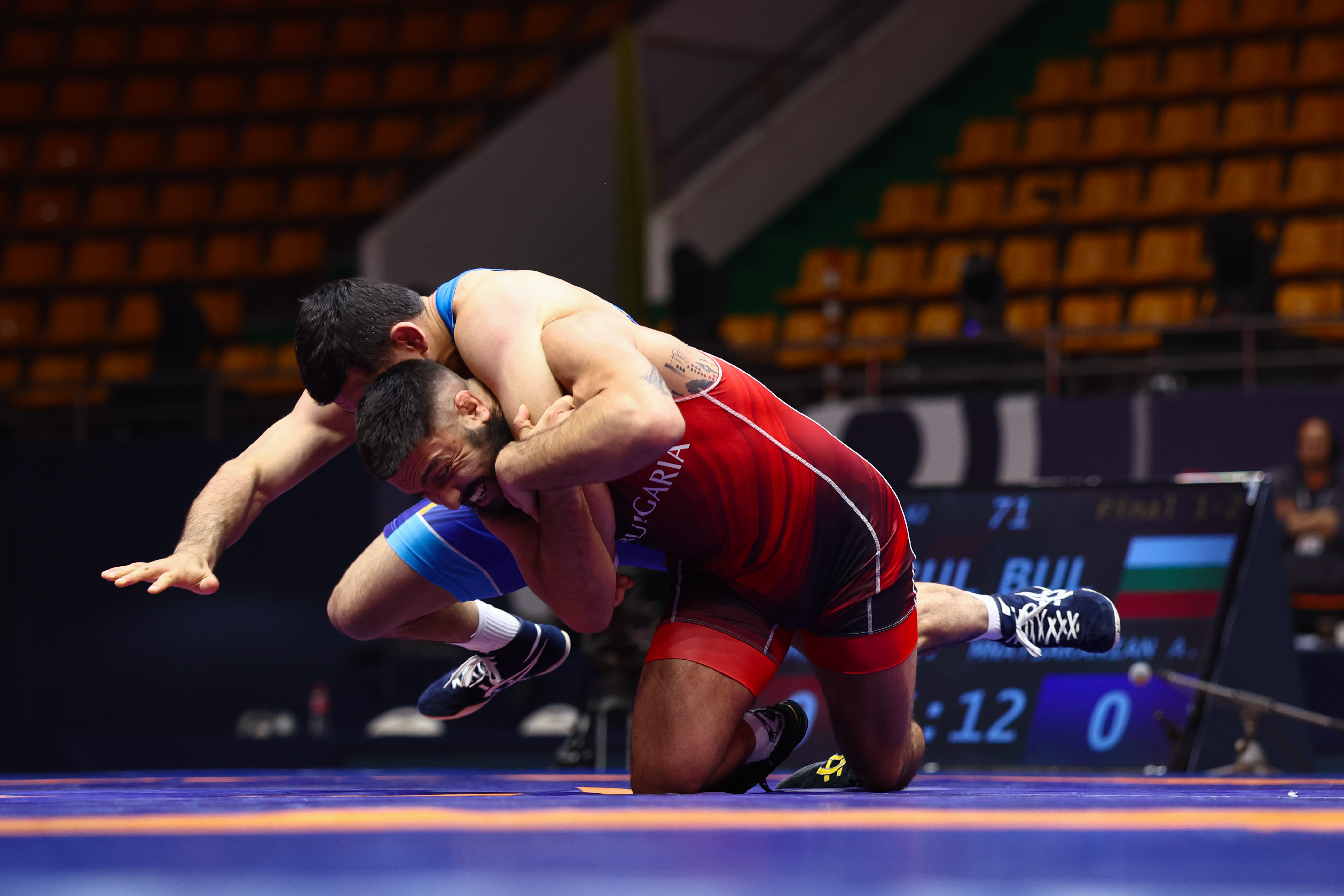 Deyvid DIMITROV (BUL) scores four points on Aik MNATSAKANIAN (BUL) using an arm throw during the 82kg final. (Photo: United World Wrestling / Jake Kirkman)
In an all-Bulgarian final at 82kg, Dimitrov faced Aik MNATSAKANIAN (BUL) and used an arm throw for four points to get on board and the big-scoring technique proved crucial in the end.
Mnatsakanian blocked Dimitrov when he was trying a turn for two points and then scored two points to make it 4-4 but Dimitrov led on criteria. In the second period, both wrestlers were given passivity warning which meant par terre positions and one point each. It made the score 5-5 but Dimitrov's four-point move took the precedent over Mnatsakanian who did not have any high-scoring technique.
Kubatov rolled to the gold medal at 77kg after he used a strong gut-wrench to beat Amuguleng BAI (CHN), 10-1, in the final.
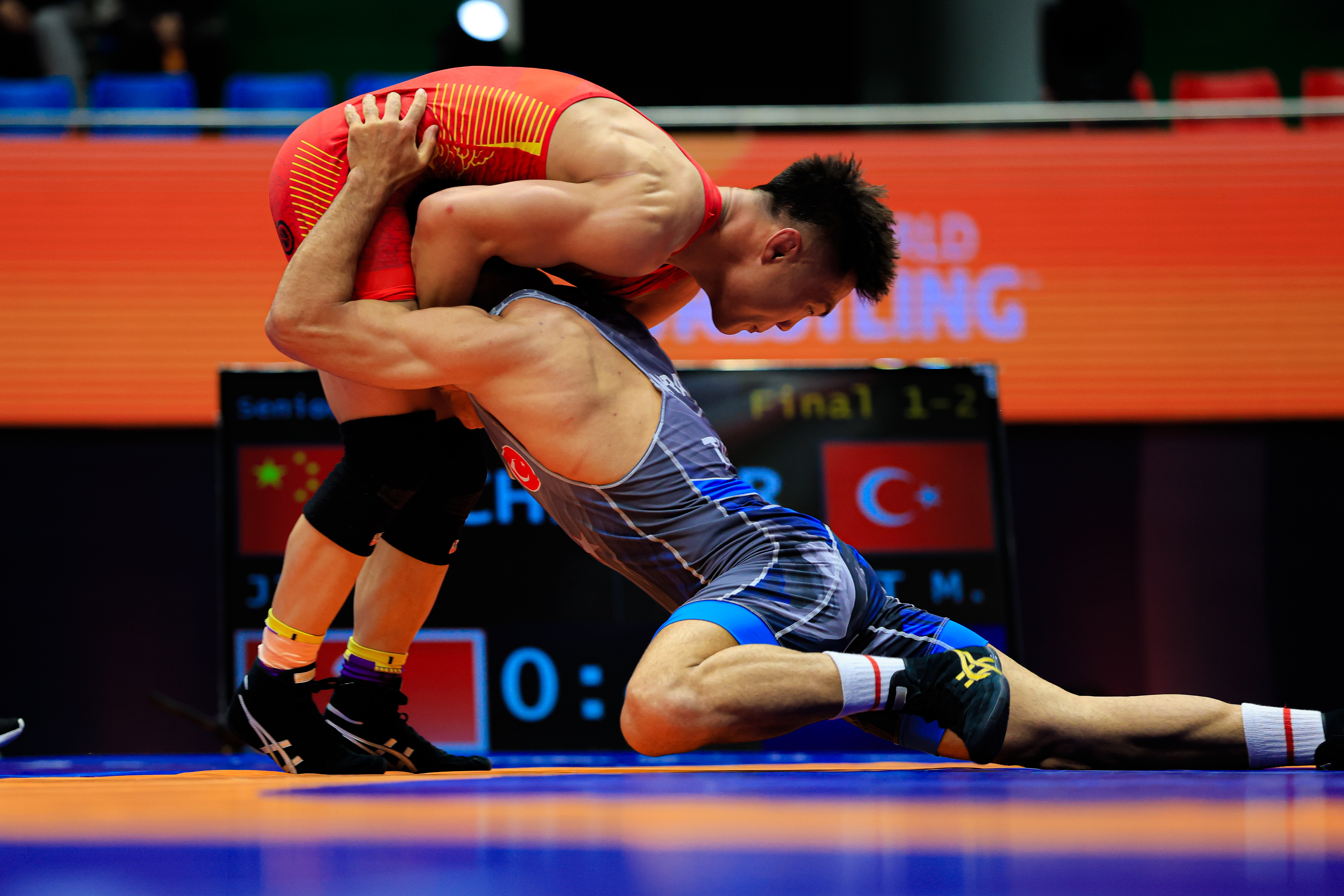 Xinxin JIN (CHN) sets up a counter throw from the edge against Murat FIRAT (TUR) during the 67kg final at the Ulaanbaatar Open. (Photo: United World Wrestling / Kostadin Andonov)
Jin Stuns Firat
The surprise champion of the day was Xinxin JIN (CHN) who upset European silver medalist Murat FIRAT (TUR) in the 67kg final. Firat got on the board first with par terre and he rolled Jin for two points to lead 3-0.
Next was Jin's turn for par terre in the second period and he managed a turn using a front headlock just before the referee's to get two points and take a 3-3 criteria lead. Firat tried to score a stepout in the final minute but Jin stamped himself right at the edge and tossed Firat for four points.
Turkiye challenged the call, asking that the stepout was scored first. But on review, the four-pointer was confirmed and Jin got another point of the lost challenge which made his lead 8-3, giving him his first-ever international medal.

RESULTS
55kg
GOLD: Payam AHMADI (IRI)
SILVER: Davaabandi MUNKH ERDENE (MGL)
BRONZE: Emin CAKIR (TUR)
67kg
GOLD: Xinxin JIN (CHN) df. Murat FIRAT (TUR), 8-3
BRONZE: Tsuchika SHIMOYAMADA (AUS) df. Ganbayar NAMSRAI (MGL), 9-0
BRONZE: ALAMUSI (CHN) df. Sachin SAHRAWAT (IND), 2-2
72kg
GOLD: Danial SOHRABI (IRI) df. Javad REZAEI (IRI), 8-5
BRONZE: Amanat SAMAT UULU (KGZ) df. Borgil TUVSHINBAATAR (MGL), 10-0
BRONZE: Zhantoro MIRZALIEV (KGZ) df. Sultan ASSETULY (KAZ), via fall (11-5)
77kg
GOLD: Stoyan KUBATOV (BUL) df. Amuguleng BAI (CHN), 10-1
BRONZE: Yeonghun NOH (KOR) df. Jason BAUCAS (PHI), via fall
BRONZE: Bekzat ORUNKUL UULU (KGZ) df. Ankit GULIA (IND), via fall
82kg
GOLD: Deyvid DIMITROV (BUL) df. Aik MNATSAKANIAN (BUL), 5-5
BRONZE: Imur TEMIRBEKOV (KGZ) df. Lkhagvasuren DASHJAMTS (MGL), 9-0
87kg
GOLD: Sunil KUMAR (IND) df. Azat SALIDINOV (KGZ), 4-1
BRONZE: Seunghwan LEE (KOR) df. Usukhbayar BAATARKHUU (MGL), 10-1
BRONZE: Luis AVENDANO (VEN) df. Turbold GANBOLD (MGL), via forfeit
97kg
GOLD: NITESH (IND) df Nurassyl AMANALY (KAZ), 13-9
BRONZE: Minho LEE (KOR) df. Tuvshinsanaa ERDENEJARGAL (MGL), 12-3
BRONZE: Gankhuyag GANBAATAR (MGL) df. Juan DIAZ (VEN), via fall




Share your thoughts.
Comments