

Top Stories of the Decade

Wrestling Fights its Way Back onto Olympic Programme

By Tim Foley

United World Wrestling President Nenad Lalovic speaks at the 125th IOC Session (AP Photo/Victor R. Caivano)

CORSIER-SUR-VEVEY, Switzerland (January 3) – The news spread quickly. On the morning of February 12, 2013, the International Olympic Committee Executive Board voted that wrestling be eliminated from the Olympic Programme. The 2016 Rio Olympic Games would be the sport’s last as a member of the Olympic family.

By early afternoon stories had run on every major international wire and sports website informing the worldwide wrestling community of the sport’s unlikely elimination from the Olympic Games. With the information came an immediate and worldwide mobilization effort aimed at earning back wrestling’s position on the Olympic programme.

Reacting to the news, the FILA bureau met in Thailand to decide next steps. It was apparent that there had been missed signs and opportunities for organizational improvement and the bureau moved quickly to elect a new president, ultimately choosing Serbian businessman Nenad Lalovic. Two months later Lalovic was elected interim president during an extraordinary Congress in Moscow and set the tone of hard work and cooperation that would ultimately prove successful in helping the sport recapture its spot in the Olympic Games.

“What goes on in this room today and the days that follow will determine if we are an Olympic sport after 2016. We have been given a strong message by the IOC.  How we answer that message will determine if our future includes the Olympic Games.  We need to convince the IOC that we will listen to them.  We are strong enough to change,” said Lalovic.

By June there were promotional events being held around the globe. In Japan a petition was signed with more than 1 million signatures. The United States and Russia raised millions of dollars to ensure additional promotion of values, consultation for a reshaping of the sport, and the creation of marketing and media departments.

In the midst of the upheaval the wrestling community had been given an opportunity. Shortly after the 125th IOC Session in September 2013 -- where members would vote to eliminate wrestling -- there would be a second vote allowing a new sport to earn its place on the programme. Wrestling was eligible for that slot, which allowed Lalovic and the wrestling community to focus its campaign on earning enough votes to win back the sport’s position in the Olympic Games.

The IOC has requests and Lalovic -- along with newly inspired cadre of wrestling leaders -- made the changes required to comply with good governance. One of the most pressing requests was that an effort be made for greater gender equity. Wrestling answered by expanding women’s wrestling to six weight categories to match with both Greco-Roman and men’s freestyle.

Competition rules were deemed too complicated for fans to follow so a new set was developed which simplified and focused action.

Women needed more representation in leadership positions. The referee body was to be separated from bureau control. Anti-doping education and enforcement were increased, and sport presentation was professionalized. As overhauls go, the renovation for wrestling would need to be complete.

On September 8, 2013 the 125th IOC Session took account of wrestling’s myriad initiatives and improvements and voted on whether or not to allow the sport back on to the programme for 2020 and beyond.

Wrestling – who faced competing bids from Squash and Baseball/Softball -- received 49 votes in the first ballot, which was enough to be awarded its position back in the Olympic Games.

"Today is the most important day in the 2,000-year history of our sport," Lalovic told the media in 2013. "We feel the weight of that history. Remaining on the Olympic programme is crucial to wrestling's survival."

From left to right: Jim Scherr, Daniel Igali, Lise Legrand, Carol Huynh and Nenad Lalovic were instrumental in getting wrestling back on the Olympic Programme (AP Photo/Victor R. Caivano)

With the vote wrestling returned to the Olympics, but the energy -- the drive the change --wasn’t to wane.

"With this vote, you have shown that the steps we have taken to improve our sport have made a difference,” Lalovic said in addressing media after the 2013 vote. "I assure each of you that our modernization will not stop now. We will continue to strive to be the best partner to the Olympic movement that we can be."

Since 2013 the sport has continued to improve, develop, and grow. From a modernized development department to the inclusion of more women in leadership positions, and the signing of partnership, sponsor, TV and streaming deals –progress and innovation are at the center of the sport’s future.

FILA is now ‘United World Wrestling’ an organization with fresh branding and worldwide marketing initiatives. Gone are the yellow mats, replaced with eye-friendly deep blue with orange accents. The new rules are still creating some of the most entertaining sporting moments in the world, and more women have become top-of-the-fold superstars both inside the wrestling community and in the wider sports media.

United World Wrestling President Nenad Lalovic was elected to the same IOC executive board that had voted to eliminate the sport only five years before

President Lalovic has increased participation United World Wrestling’s cooperation with the IOC and was added as a member in 2015. In 2018 he was elected to the same IOC executive board that had voted to eliminate the sport only five years before.

“We can never forget the mistakes of our past,” said Lalovic. “But at the end of the decade it’s impossible to not feel optimistic. Our sport is the strongest it’s ever been, and we are excited for the 20’s so we can showcase our wrestlers in Tokyo, Paris, and Los Angeles. Wrestling is now and will always be part of the Olympic programme.”

#WrestleAlexandria

Wrestling World's Attention on Dunia after Golden Show

By United World Wrestling Press

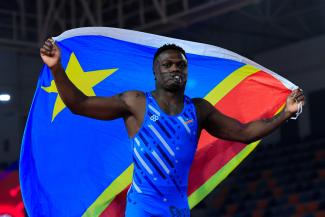
ALEXANDRIA, Egypt (May 2) -- Dunia SIBOMANA (COD) was six years old when, in an instant, his childhood was shattered.

While playing with his brother and cousin at the Virunga National Park in the Congo, the three boys were attacked by chimpanzees. His brother and cousin did not survive. Dunia did, but just barely. The attack left him with devastating injuries to his lips, face, and right ear. Much of the muscle in his face was destroyed, and he lost the middle finger of his left hand. Yet from that unimaginable tragedy, a story of resilience began to take shape - one that saw rise to claim two golds at the African Championships in Alexandria.

UWW Plus

At just eight years old, Dunia was brought to the United States for a chance at rebuilding what had been taken from him. What followed was a long and gruelling journey through 14 intensive surgeries, where doctors painstakingly grafted tissue and muscle in an effort to reconstruct his lips and restore basic function to his face. Each procedure was another battle, each recovery another test of endurance.

During his time in the United States, Dunia lived with two host families before finding a permanent home with Long Beach assistant wrestling coach Miguel Rodriguez and his wife, Marissa. What began as care turned into something deeper. They adopted him, giving him not just stability but a family. In 2019, Dunia officially became a permanent U.S. resident.

That possibility found its outlet on the wrestling mat. Dunia emerged as a force in middle school and continued to rise through the ranks at Long Beach High School. His determination, forged through years of hardship, translated into a relentless drive. At just 14 years old, he captured the New York State Division 1 wrestling championship title in 2022, a stunning achievement that marked him as one of the sport’s brightest young talents.

On Saturday, Dunia’s journey reached another defining moment. Competing at 57kg for his birth nation, Congo, he claimed the gold medal with commanding authority. He opened with a tense 3-2 victory over Alaa ELSAYED (EGY), then surged past Mouadh CHIBANI (ALG) with a dominant 12-2 semifinal win. In the final, he needed just 51 seconds to overwhelm Roland NFORSONG (CMR), sealing a 10–0 technical superiority victory.

Dunia’s march to the top of the podium was even more remarkable because he was one of the two wrestlers in Freestyle not from Egypt or Algeria to win the gold medal. The other wrestler who put the brakes on Egypt’s dominance was Harrison ONOVWIOMOGBOHWO (NGR), who defeated Mohamed SALAHELDIN (EGY) 10-4 to win the gold medal in the 97kg category.

These two results, however, did not stop Egypt from running away with the team title. The host-nation wrestlers reigned supreme in six out of the 10 categories, winning gold medals in the 61kg, 65kg, 70kg, 74kg, 92kg and 125kg weight classes. Algeria were second best, claiming top-of-the-podium finishes at 79kg and 86kg divisions.

Hassan ELSAYED (EGY) started the fireworks for the hosts by defending his title at 61kg. He started with a flawless 12-0 win over Saviour EGOLI (NGR), then beat Rabby KILANDI (COD) on superiority in the second round. He maintained his unbeaten record by defeating Tadeu DE DEUS (ANG) in the third round and entering the semifinals, where he defeated Mustapha BATNINI (TUN) 11-0. In the final, Elsayed beat Abdelghani AID (ALG) 9-1 to win the title.

Shehabeldin MOHAMED (EGY) took just two minutes to pin Stephen AKINTEWE (NGR) in the 65kg final to claim the title. He used a perfect over-under to throw Akintewe and secure the fall. Soon after, Mohamed AHMED (EGY) was even quicker to win the 70kg final against Wotna NDOC (GBS), 12-1, rolling him using the gut-wrench to win in just 1:02 minutes and upgrading his 2025 silver to gold.

Defending champion at 74kg Omar MOURAD (EGY) managed to retain his gold medal after winning the final against Ebierelayefa ANDREW (NGR) in just 1:13. Mourad used a counter front headlock to throw Andrew over and then pinned the Nigerian used a double-arm lock.

Ahmed MOHAMED (EGY) added the fifth gold medal, beating Walid CHEIKH LAHLOU (MAR), 12-0, in the 92kg final. He used an arm-throw to score four points, then a fireman carry to get two more and lead 6-0. He could not pin Lahlou but got two more points for exposure. A second arm-throw gave him four more points and win the final via technical superiority.

In the round-robin bracket at 125kg, Abdelrahman SHEYATAN (EGY) won all four of his bouts in dominant fashion to claim the gold medal. He won his first bout against Joel TOKAI (KEN), 10-0, pinned Issah FUSEINI (GHA), got a forfeit in Round 4 and then pinned Laid KHELIF (ALG), the eventual silver medalist, in Round 5.

At 79kg, Abdelkader IKKAL (ALG) managed to defended his gold medal at the expense of Mohamed ABDELHADY (EGY), winning the final 10-0. A stepout opened the scoring for Ikkal who then scored a takedown using a leg-attack before lacing Abdelhady for a turn to lead 5-0. He tripped the Egyptian for two more points before an easy takedown made it 9-0. He finished the final with a stepout to win just before the break.

Fateh BENFERDJALLAH (ALG) reclaimed the 86kg title after three years, beating Gabriel MC DUFFIE (SLE), 12-0 in the final. He used two beautiful arm throws to score eight points and two turns for two points each. Despite the loss to Benferdjallah, McDuffie can be proud that he is the first-ever Freestyle silver medalist for Sierra Leone at the African Championships.

Photo

RESULTS

57kg
GOLD: Dunia SIBOMANA (COD) df. Roland TAMBI NFORSONG (CMR), 10-0

BRONZE: John LEOPOLD (MRI) df. Makaya KATENDI (ANG), 9-1
BRONZE: Mouadh CHIBANI (ALG) df. Alaa ELSAYED (EGY), 11-7

61kg
GOLD: Hassan ELSAYED (EGY) df. Abdelghani AID (ALG), 9-1

BRONZE: Saviour EGOLI (NGR) df. Mustapha BATNINI (TUN), 5-5

65kg
GOLD: Shehabeldin MOHAMED (EGY) df. Stephen AKINTEWE (NGR), via fall

BRONZE: Raby BAPELEKIA (CGO) df. Gilbert MWAMBA (ZAM), 11-0
BRONZE: Oussama LARIBI (ALG) df. Gabriel YANGA (COD), 10-0

70kg
GOLD: Mohamed AHMED (EGY) df. Wotna NDOC (GBS), 12-1

BRONZE: Khaireddine BEN TLILI (TUN) df. Mourad SAAD (MAR), via forfeit
BRONZE: Dideikemei EREFAGHA (NGR) df. Elie DJEKOUNDAKOM DJERAYOM (CHA), 12-0

74kg
GOLD: Omar MOURAD (EGY) df. Ebierelayefa ANDREW (NGR), via fall

BRONZE: Abderrahmane BENAISSA (ALG) df. Jacques MONTY MBOUGOU (CMR), 5-2
BRONZE: Caetano ANTONIO SA (GBS) df. Omar LAMBARRAA (MAR), 7-5

79kg
GOLD: Abdelkader IKKAL (ALG) df. Mohamed ABDELHADY (EGY), 10-0

BRONZE: Solomon ULABO (NGR) df. Totiana RAZAFINJATO (MAD), via fall
BRONZE: Andy MUKENDI (COD) df. Mohammed BOUAZOUNI (MAR), 10-0

86kg
GOLD: Fateh BENFERDJALLAH (ALG) df. Gabriel MC DUFFIE (SLE), 12-0

BRONZE: Mohamed EL MEKKAOUI (MAR) df. Persy BAMONA (COD), via fall
BRONZE: Matteo MONTEIRO FURTADO TRESSE (CPV) df. Bouba SALEH (CHA), 10-3

92kg
GOLD: Ahmed MOHAMED (EGY) df. Walid CHEIKH LAHLOU (MAR), 12-0

BRONZE: Kevin MOSSE (BUR) df. Tiwisna BAMBA (CHA), via fall

97kg
GOLD: Harrison ONOVWIOMOGBOHWO (NGR) df. Mohamed SALAHELDIN (EGY), 10-4

BRONZE: Wali KEBIR (ALG) df. Cedric ABOSSOLO (CMR), via inj. def.

125kg
GOLD: Abdelrahman SHEYATAN (EGY)
SILVER: Laid KHELIF (ALG)
BRONZE: Issah FUSEINI (GHA)
